Ayurvedic Capsule Herb Sourcing and Traceability in Sri Lanka
Buyer’s snapshot
- In a 2004 study published in JAMA, 14 of 70 Ayurvedic herbal products tested, roughly one in five, contained lead, mercury, or arsenic (Saper et al., JAMA, 2004). The raw material, not the capsule shell, is where a herbal SKU is won or lost.
- Sri Lanka’s flora includes more than 1,400 plants used in indigenous medicine, with over 1,000 species endemic (Sri Lanka Export Development Board). The sourcing advantage is real, and so is the regulation that protects it.
- For a founder, specifying the herb means six things: species, plant part, origin, active-marker, contaminant limits, and lot traceability. Get those on paper before you book a run.
- Silk Foods Ceylon (SFC) runs a capsule line at 200,000 capsules per day, with a 180-bottle first-run MOQ, BRCGS- and FSSC 22000 V6-audited, plus Department of Ayurveda registration on relevant SKUs.
- See the sourcing-spec table and the claim-routing table below before you brief a capsule SKU.
Most local Sri Lankan wellness founders start an Ayurvedic capsule with a herb they trust and a name they like. Ashwagandha for stress. Gotukola for memory. Kothala himbutu for blood sugar. The recipe feels like the hard part. It rarely is. The hard part is proving that the powder inside the capsule is the right plant, the right part of that plant, grown and dried and tested in a way you can show a regulator and a retail buyer.
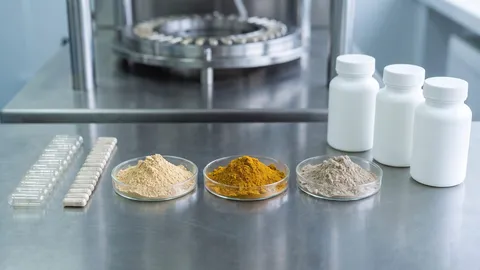
Silk Foods Ceylon (SFC), a BRCGS- and FSSC 22000 V6-audited manufacturer in Matale, runs an encapsulation line built for exactly that gap. This post is for the founder specifying a first Ayurvedic capsule SKU: what to write into a herb spec, how to build traceability that survives a lab test, and which regulatory lane a Department of Ayurveda claim puts you in versus a food-supplement claim. The geography helps here. Matale sits in the spice-and-herb belt, so a raw-material question and a sample can move in the same week.
Why the herb, not the capsule, decides an Ayurvedic SKU
An Ayurvedic capsule is a raw-material product wearing a small machine. The encapsulation step is consistent and fast once the powder is right; the variable that decides quality is the herb that goes in. In a 2004 JAMA study, about one in five Ayurvedic products tested off the shelf carried detectable lead, mercury, or arsenic (Saper et al., JAMA, 2004). None of that comes from the capsule. It comes from the soil, the collection, and the drying.
Sri Lanka starts from a strong position. The island’s flora includes more than 1,400 species used in indigenous medicine, many of them endemic (Sri Lanka Export Development Board). That depth is the founder’s advantage and the reason the Department of Forest and the Department of Ayurveda regulate against wild over-collection of medicinal plants (Sri Lanka EDB). Specifying the herb well is how you turn that natural advantage into a SKU a buyer will list, and the groundwork for a full herbal supplement capsule programme once the first run proves out.
What does specifying Ayurvedic herb sourcing actually mean?
Specifying Ayurvedic herb sourcing means writing down, before any production, the six things that define the raw material: the species, the plant part, the origin, the active marker, the contaminant limits, and the lot traceability. A herb name alone is not a spec. “Ashwagandha” is a name; “Withania somnifera root, cultivated, withanolides assayed, heavy metals within WHO limits, lot-coded to the drying batch” is a spec. The first books a guess. The second books a SKU.
The table below is the spec a founder can hand to any contract manufacturer, including SFC, as the starting brief for a capsule run.
| Spec dimension | What you write down | Why it matters for a capsule |
|---|---|---|
| Species (botanical) | The binomial, not just the common name (Withania somnifera, Centella asiatica) | Common names map to several plants; the binomial removes the ambiguity |
| Plant part | Root, leaf, bark, fruit, or whole plant | Actives sit in specific parts; the wrong part is the wrong product |
| Origin and method | Cultivated or wild-collected, and where | Wild collection is regulated; cultivated is traceable and repeatable |
| Active marker | The compound and a target range (withanolides, curcuminoids) | A marker turns “herbal” into a measurable, repeatable batch |
| Contaminant limits | Heavy metals, microbial load, pesticide residue caps | The JAMA finding is exactly this risk; limits make it testable |
| Lot traceability | A code linking the powder back to a collection or drying batch | A recall or a query is only answerable if the lot is traceable |
A founder who fills in all six rows has done most of the quality-assurance work before the first capsule is filled. The rest is testing against what the spec promises.
Botanical identity: the right species and the right plant part
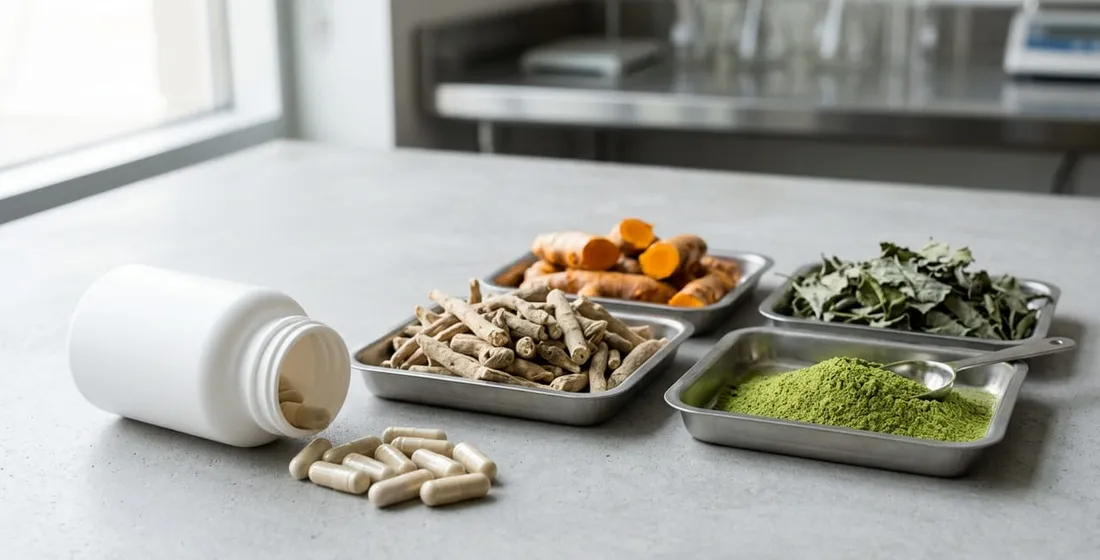
The single most common sourcing error is not contamination. It is identity: the wrong species, or the right species and the wrong part. Welpenela (Cardiospermum halicacabum) and Heenbovitiya (Osbeckia octandra) are Sinhala-named botanicals with specific plant parts that carry the activity; a supplier sending the convenient part rather than the specified one changes the product. Ashwagandha is the textbook case. The root carries the withanolides; the leaf is a different profile. The default delivery on “send me ashwagandha” is too often leaf material, because leaf is cheaper to collect.
The fix is to name the binomial and the part in the purchase spec, then verify the delivered material against it rather than against the invoice. The SFC R&D team sees the same gap on first briefs from founders sourcing herbs themselves: a confident common name, an unnamed plant part, and no botanical reference. Closing that one line, species plus part in writing, removes the most expensive category of rework before a single bottle is filled.
For Sinhala-named herbs, write the local name, the botanical name, and the part together on first use: Iramusu (Hemidesmus indicus, root), Gotukola (Centella asiatica, whole plant), Kothala himbutu (Salacia reticulata, stem and root). After that, the local name alone is fine on the spec sheet, because the binomial is already locked.
How do you build traceability into a herbal capsule?
Traceability in a herbal capsule means every batch of powder can be traced back to a known collection or drying lot, and tested against a certificate of analysis before it is encapsulated. WHO’s Good Agricultural and Collection Practices (GACP) for Medicinal Plants set the global baseline for this, including heavy-metal contamination control, and the framework remains current: the European Medicines Agency issued a revised GACP guideline for herbal starting materials in May 2025 (EMA, 2025). Traceability is what makes a contaminant limit enforceable rather than aspirational.
In practice, four things build it. First, origin: cultivated or controlled-collection material is traceable in a way that anonymous wild bulk is not. That is why wild over-collection is regulated (Sri Lanka EDB), and why the same discipline used when sourcing Ceylon spices and herbs for private-label retail applies to capsule botanicals. Second, the co-processing layer within contract manufacturing, washing, sorting, grading, drying, and grinding per the SFC brochure, done in-house so the raw material does not pass through an untracked third party. Third, a certificate of analysis per lot covering heavy metals, microbial load, and pesticide residue. Fourth, a lot code that links the finished bottle back to that COA.
Geography shortens the loop. The Matale facility sits in the herb-growing belt, and the adjoining plantation grows hydroponic herbs for R&D pilot batches, so a sourcing question can be answered with a fresh sample in the same week rather than a month later. For a founder, that is the difference between a traceability story you assert and one you can show.
Department of Ayurveda alignment: which lane your claim puts you in
The claim on the label decides the regulator, and a founder should pick the lane before printing anything. A product marketed with Ayurvedic claims registers with the Department of Ayurveda, Ministry of Health, which runs separate local and imported product-registration regulations; herbal finished products must be cleared by the Drug Formulator Committee appointed under the Department to be sold as healthcare products (Department of Ayurveda; Sri Lanka EDB). Running private-label Ayurvedic capsule registration with the Department of Ayurveda and SLSI in parallel is the usual way to keep both timelines moving. A product sold as a food or dietary supplement instead sits with the Food Control Administration of the Ministry of Health under the food labelling and advertising rules on health claims, while herbal extracts with medicinal claims can be classified as medicines by the National Medicine Regulatory Authority, a category that excludes Ayurvedic and homoeopathic medicine (NMRA, 2025).
| Your claim | Who registers it | What it unlocks, and the catch |
|---|---|---|
| Ayurvedic / traditional claim | Department of Ayurveda (Drug Formulator Committee) | Right to use Ayurvedic claim language; needs formulation, herb source, and claim wording on file |
| Food / dietary supplement | Food Control Administration, Ministry of Health | Faster retail route; claims limited to permitted health, structural, and content statements |
| Herbal extract, medicinal claim | National Medicine Regulatory Authority | Medicine pathway; excludes Ayurvedic and homoeopathic categories, higher evidence bar |
Underneath whichever lane you pick sits the local retail floor that never changes: SLSI clearance for shelf eligibility and Sri Lanka Food Act 1980 compliance for the label itself, both non-negotiable for the major supermarket chains and a Sri Lankan e-commerce marketplace. The full certification stack for a Sri Lankan FMCG launch reads BRCGS, then FSSC 22000 V6 on the manufacturer, then SLSI, then Sri Lanka Food Act compliance, then Department of Ayurveda registration where the claim requires it. Picking the lane early keeps the label, the claim, and the registration from contradicting each other six weeks before a target shelf date.
For a founder, the practical move is to lock the claim lane and the herb spec together, because the two decisions constrain each other. R&D and NPD (Co-Development on the SFC brochure) is where that pairing usually gets worked out, before the recipe locks for a production run.
Frequently asked questions
Do herbal capsules need Department of Ayurveda registration in Sri Lanka?
Only if the product carries Ayurvedic or traditional claims. Those register with the Department of Ayurveda through the Drug Formulator Committee (Department of Ayurveda; Sri Lanka EDB). A capsule sold as a food supplement instead sits with the Food Control Administration of the Ministry of Health, while a medicinal-claim herbal extract can fall under the NMRA. The claim decides the lane.
What is the MOQ for private-label Ayurvedic capsules at Silk Foods Ceylon?
The first-run MOQ is 180 bottles per SKU, set deliberately low for a founder’s first commercial run rather than export-scale volume. The Matale capsule line runs up to 200,000 capsules per day, so a 180-bottle pilot and a later scale-up share the same line, the same audit, and the same herb spec.
How do you test Ayurvedic herbs for heavy metals?
Each raw-material lot is tested against a certificate of analysis covering heavy metals (lead, arsenic, mercury, cadmium), microbial load, and pesticide residue, with limits referenced to WHO GACP for medicinal plants. This matters because a 2004 JAMA study found about one in five Ayurvedic products tested carried detectable heavy metals (Saper et al., JAMA, 2004).
What is the difference between a food supplement and an Ayurvedic medicine in Sri Lanka?
A food or dietary supplement is regulated by the Food Control Administration of the Ministry of Health, with claims limited to permitted health and content statements. An Ayurvedic medicine registers with the Department of Ayurveda and may use Ayurvedic claim language. Herbal extracts with medicinal claims can be classified as medicines by the NMRA (NMRA, 2025).
Can Silk Foods Ceylon source the herbs as well as make the capsules?
Yes. Beyond encapsulation, the co-processing layer within contract manufacturing (washing, sorting, grading, drying, grinding) is handled in-house, and the adjoining Matale plantation supplies hydroponic herbs for R&D pilots. That keeps the raw material on a traceable chain rather than passing through an untracked third party before it reaches the line.
How Silk Foods Ceylon can help
For founders launching a first Ayurvedic capsule SKU, Silk Foods Ceylon (SFC) operates a cellular-manufacturing facility in Matale that handles the steps between a herb spec and a retail-ready bottle. The capsule line runs up to 200,000 capsules per day, with a first-run MOQ of 180 bottles per SKU, and the co-processing layer (washing, sorting, grading, drying, grinding) keeps sourcing traceable in-house. The facility is BRCGS- and FSSC 22000 V6-audited, with SLSI submission support built into a standard engagement and Department of Ayurveda registration handled on relevant SKUs. The in-house R&D team works the herb spec and the claim lane together before a recipe locks.
To brief a capsule project, email b2b@esilkroute.com.lk or call +94 76 441 0389 / +94 76 918 5744.
Sources
- Saper RB, et al. (2004), “Heavy Metal Content of Ayurvedic Herbal Medicine Products”, JAMA, https://pubmed.ncbi.nlm.nih.gov/15598918/ (retrieved 2026-06-18).
- World Health Organization (2003), “WHO Guidelines on Good Agricultural and Collection Practices (GACP) for Medicinal Plants”, https://iris.who.int/ (retrieved 2026-06-18).
- European Medicines Agency (2025), “Guideline on Good Agricultural and Collection Practice (GACP) for starting materials of herbal origin, Revision 1”, https://www.ema.europa.eu/ (retrieved 2026-06-18).
- Department of Ayurveda, Ministry of Health, Sri Lanka, “Regulation of Local Ayurveda Drugs / Products Registration”, https://ayurveda.gov.lk/ (retrieved 2026-06-18).
- Sri Lanka Export Development Board, “Ayurvedic and Herbal Products in Sri Lanka”, https://www.srilankabusiness.com/ayurvedic-and-herbal/ (retrieved 2026-06-18).
- National Medicine Regulatory Authority, Sri Lanka, “Medicines”, https://www.nmra.gov.lk/pages/medicines (retrieved 2026-06-18).
Written by the Silk Foods Ceylon Team. Silk Foods Ceylon (Pvt) Ltd. is a BRCGS- and FSSC 22000 V6-audited contract manufacturer in Matale, Sri Lanka, offering contract manufacturing, private labelling, co-packing, and in-house R&D for local Sri Lankan brand owners, FMCG companies, hotel and restaurant groups, and distributors. To brief a project: b2b@esilkroute.com.lk, +94 76 441 0389, or +94 76 918 5744.