Capsule Contract Manufacturing in Sri Lanka: 180-Bottle MOQ
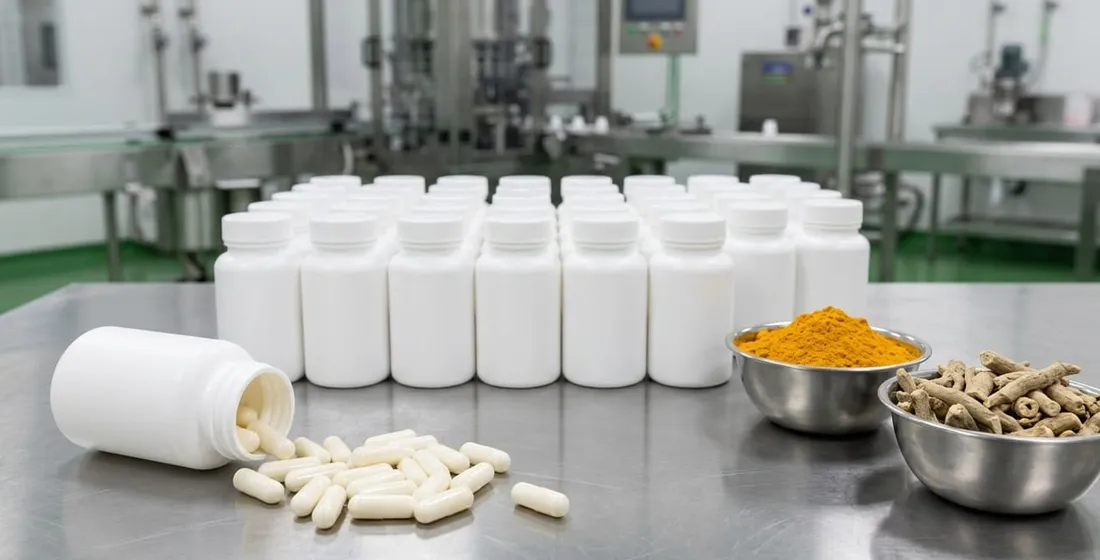
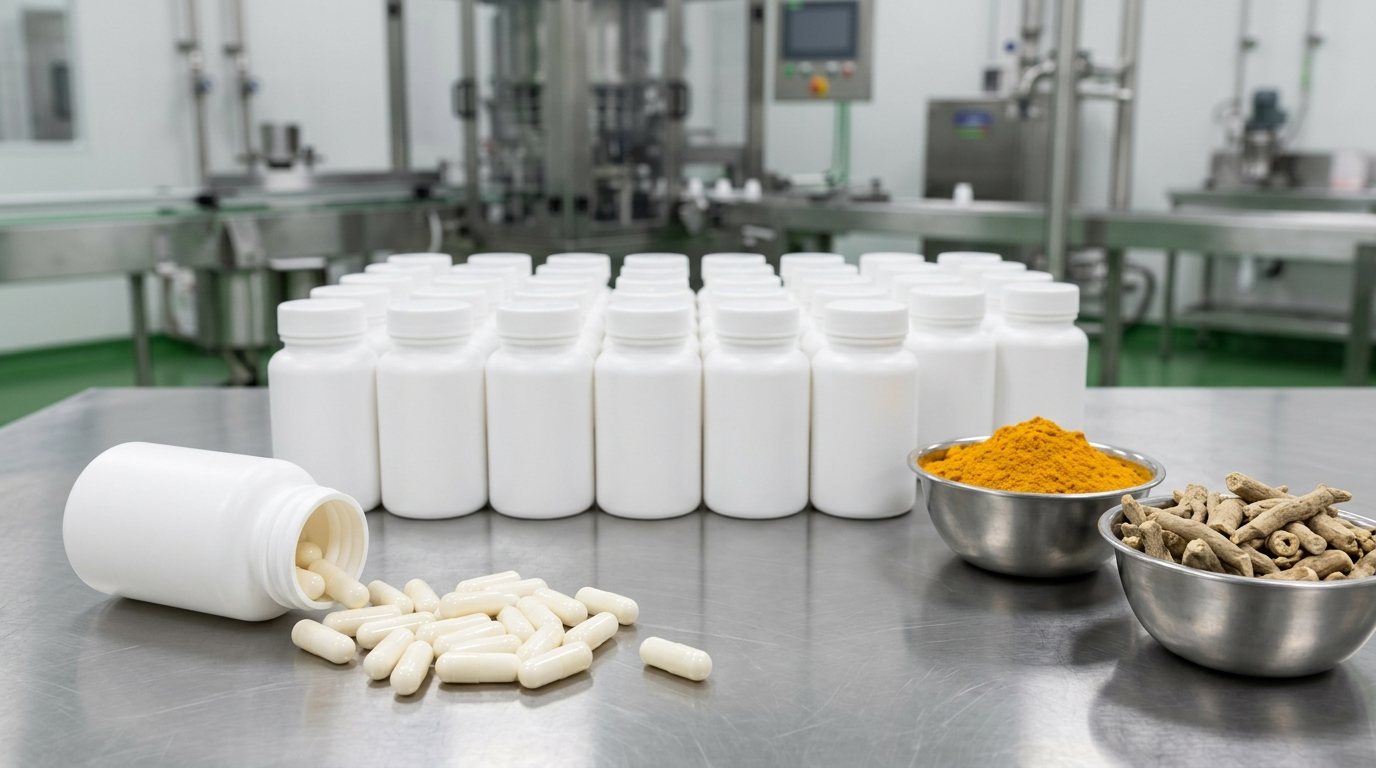
A first capsule run staged on the line: blank 60-count bottles, plain two-piece capsules, and botanical fill powders before encapsulation.
Buyer's snapshot The global dietary supplements market reached USD 209.52 billion in 2025 and is growing at 8.1% a year through 2033 (Grand View Research). Sri Lankan wellness brands are riding the same wave at local scale. Every herbal capsule SKU carrying an Ayurvedic claim needs Drug Formulary Committee approval under the Department of Ayurveda before it sells locally. Silk Foods Ceylon (SFC) runs capsule contract manufacturing at a 180-bottle first-run MOQ, on a line that fills 200,000 capsules per day at the Matale facility. The MOQ ladder below shows why capsules carry the lowest first-run commitment of any format on the SFC line. |
Most Sri Lankan wellness brands start the same way: a founder with a herbal formulation in mind, a supplier contact for the raw botanical, and a spreadsheet that says the margins work. Then the first manufacturing quote arrives, and the spreadsheet meets the MOQ. For most food formats, the first commercial run is the largest single line item a new brand ever faces. Capsules are the exception, and the reason comes down to how the format behaves on a production line. At 180 bottles, a capsule SKU is the lowest-commitment legitimate entry onto the Sri Lankan wellness shelf.
What does a 180-bottle MOQ actually mean in capsules?
The capsule contract manufacturing MOQ at Silk Foods Ceylon is 180 bottles per SKU. Each bottle is a 60-count format, so a first run totals 10,800 capsules. The Matale line fills 200,000 capsules per day, which means a complete first run occupies a fraction of a single shift. The numbers below break the run into its unit maths.
The SFC capsule line runs 100,000 capsules per single shift and 200,000 per day. A 180-bottle first run, at 10,800 capsules, takes up roughly 5% of one day’s capacity. That spare headroom is the entire economic story: the line does not need your SKU to fill a day, so the MOQ does not need to be large enough to justify one.
| First-run unit maths | Value |
| Bottles per first run | 180 (60-count, white or black bottles) |
| Capsules per bottle | 60 |
| Total capsules per run | 10,800 |
| Line capacity | 100,000 capsules per shift; 200,000 per day |
| Share of one day’s capacity | About 5% |
| Lead time, PO to dispatch (existing formulation) | 2 to 3 weeks |
| Lead time with R&D/NPD first | 6 to 10 weeks |
For a first-time wellness brand, that last pair of rows matters more than the capacity figures. If the formulation is locked, the production window is short. If the recipe still needs work, R&D and NPD (Co-Development on the SFC brochure) adds 4 to 6 weeks upfront, and the in-house team typically runs 2 to 4 sample iterations before the recipe locks.
Why capsules carry the lowest first-run commitment on the line
Capsule MOQs at Silk Foods Ceylon run at 180 bottles per SKU, against 1,500 jars for spreads, 1,250 bottles for beverages, and 5,000 to 10,000 units for frozen patties or nuggets. The gap is a function of changeover time, batch behaviour, and packaging tooling, not pricing strategy. The table below puts the formats side by side.
| Format | First-run MOQ | Why the floor sits there |
| Herbal capsules (60-count bottle) | 180 bottles | Dry format; changeover is a blend swap and a shell change; no retort, no liquid-line washdown |
| Spreads and semi-liquids (300 g glass jar) | 1,500 jars | Kettle batch sizes and jar-line changeover set a half-day production floor |
| Beverages (200 ml glass bottle) | 1,250 bottles | Retort cycles and CIP cleaning make small liquid batches uneconomic |
| Frozen patties or nuggets | 5,000 to 10,000 units | Forming, battering, and blast-freezing lines run continuously once started |
Encapsulation is a dry process. There is no retort cycle to amortise, no clean-in-place washdown between flavours, and no glass-tooling change. Swapping from a turmeric blend to a moringa blend is a matter of cleaning the dosing system and loading a new powder. That changeover discipline lets the line accept a 10,800-capsule job between larger runs without losing a day.
The same logic explains why the 180-bottle figure is unusual in the local market. A manufacturer running a single dedicated line has to fill it. Contract manufacturing at Silk Foods Ceylon runs on a cellular layout instead, which schedules small dry-format jobs around larger wet-format runs, so the small job costs the schedule almost nothing.
Where does the money actually go in a first capsule run?
A first capsule run at Silk Foods Ceylon prices across five components: the raw botanical, the capsule shells, the packaging set, the production and QA block, and registration support. Botanical raw-material prices move seasonally, so SFC quotes precise LKR figures on inquiry rather than publishing a rate card. The structure, though, is consistent run to run.
The five components behave differently as the run scales:
- Raw botanical. The largest swing factor. A run of ashwagandha capsules and a run of turmeric capsules can differ meaningfully in raw-material cost per bottle, and harvest timing moves the price again. Matale district sits in the spice and herb growing belt, which keeps the sourcing radius short for most of the 18 botanical SKUs already on the SFC capsule list.
- Capsule shells. Plain two-piece HPMC vegetable capsules. A fixed per-unit cost that barely moves with volume at first-run scale.
- Packaging. The 60-count bottle, cap, seal, and label. At 180 bottles, label printing is digital, so there is no plate cost to amortise.
- Production and QA. The encapsulation block, weight checks, and batch documentation. Compressed by the short production window.
- Registration support. The Department of Ayurveda pathway for claim-carrying SKUs and Sri Lanka Food Act labelling compliance. A time cost more than a cash cost, and the one first-time brands most often under-plan.
The maths is simpler than most first quotes make it look. The per-bottle price at 180 bottles will sit above the per-bottle price at 1,800; what the small run buys is proof, at a stake low enough to survive being wrong about flavour, positioning, or channel.
Registration and the cert chain before the first bottle sells
Herbal finished products in Sri Lanka must be approved by the Drug Formulary Committee, appointed under the Department of Ayurveda, before being marketed as healthcare products locally, per Sri Lanka Export Development Board guidance current as of 2026. For a first-time wellness brand, that approval runs in parallel with the manufacturer’s audit chain, and the calendar matters as much as the paperwork.
The split of responsibility is straightforward. The brand owns the registration of its SKU; the manufacturer owns the audit chain behind it. On the manufacturer side, the Matale facility is BRCGS- and FSSC 22000 V6-audited, with SLSI clearance and Sri Lanka Food Act labelling compliance handled inside a standard engagement, and Department of Ayurveda registration support where a SKU carries a traditional claim. Each layer unlocks something specific: the BRCGS and FSSC 22000 V6 pair is what modern-trade and hotel-group procurement teams ask about first, SLSI is the floor for any packaged retail SKU, and the Ayurveda Dept registration is what lets the label say what the capsule is for. The certification stack for a Sri Lankan FMCG launch covers each layer in detail.
One local wellness brand at Silk Foods Ceylon scaled from a 180-bottle pilot of an ashwagandha capsule SKU in 2024 to a multi-SKU monthly programme by the first quarter of 2026. The unlock was not the per-bottle price. It was that the same audited cert stack covered the second and third SKUs without re-auditing the manufacturer, so each new launch carried only its own registration timeline, not a fresh compliance build.
Plan the calendar backwards from the shelf date. SLSI clearance for a packaged SKU typically runs 4 to 8 weeks, and the practical buffer between manufacturer QA sign-off and a retail listing is 6 to 10 weeks. Brands that book the production slot and start the registration paperwork in the same week tend to hit their launch window. Brands that treat registration as a post-production step usually do not.
When does a 180-bottle first run make sense, and when doesn’t it?
A 180-bottle first run fits a wellness brand that has validated its concept and is ready to commit to a first commercial batch: a tested positioning, a named channel, and a formulation that is locked or close to it. It is deliberately sized for proof of commercial demand, not for hobby-scale experimentation or for established brands chasing volume pricing.
For brands still weighing the move from home-scale production, the kitchen-to-contract-manufacturing transition guide covers the breakpoints. The honest fit test runs in both directions.
Where SFC walks away A capsule brief gets declined when there is no Department of Ayurveda plan behind a claim-carrying SKU, when the buyer wants sub-MOQ runs that do not pencil even on the dry line, or when the brief is a lowest-quote shopping exercise with no intention of building an audit-backed brand. For founders still iterating on the concept itself, more validation first is the better path. |
For the brand that passes the test, the upside of starting at 180 bottles is the scale path behind it. The same line that fills the pilot run carries 200,000 capsules per day of headroom, and the cellular layout at the Matale facility holds 50+ ready-to-go SKUs on one audit. Reordering at 500 or 1,000 bottles is a scheduling conversation, not a new procurement cycle. Statista Market Insights notes that Sri Lanka’s Ayurveda tradition keeps local demand tilted toward natural and herbal formulations, with a growing middle class widening the buyer pool year on year. The brands that win that demand will be the ones that proved their SKU early and kept the compliance chain intact while scaling.
Frequently asked questions
What is the capsule contract manufacturing MOQ at Silk Foods Ceylon?
The first-run MOQ is 180 bottles per SKU, each a 60-count bottle, for a total of 10,800 capsules. The figure is deliberately set for a wellness brand’s first commercial run. SFC also carries 18 ready-to-go botanical capsule SKUs that can launch under a buyer’s brand through private labelling; the herbal supplement capsules buyer’s guide covers the portfolio.
How long does a first capsule run take from PO to dispatch?
With a locked formulation, 2 to 3 weeks from purchase order to dispatch. If R&D and NPD work is needed first, plan 6 to 10 weeks, since formulation typically runs 2 to 4 sample iterations. Registration timelines run in parallel and should start the same week the production slot is booked.
Do herbal capsules need Department of Ayurveda registration in Sri Lanka?
Any capsule SKU marketed with an Ayurvedic or traditional claim needs approval from the Drug Formulary Committee under the Department of Ayurveda, per Sri Lanka Export Development Board guidance (2026). SFC supports the registration pathway inside a standard engagement; the brand holds the registration, the manufacturer holds the audit chain.
Can a brand scale beyond 180 bottles without re-auditing the manufacturer?
Yes. The Matale facility runs a cellular layout holding 50+ ready-to-go SKUs on one BRCGS- and FSSC 22000 V6-audited cert stack, with 200,000 capsules per day of capacity. A reorder at 500 or 1,000 bottles is a scheduling decision; the audit chain behind the SKU does not need rebuilding.
What drives the cost of a first capsule run?
Five components: the raw botanical (the largest swing factor, moving with harvest timing), HPMC capsule shells, the bottle, cap, and label set, the production and QA block, and registration support. Because botanical prices move seasonally, SFC quotes precise LKR figures on inquiry rather than publishing a rate card.
How Silk Foods Ceylon can help
For wellness brands planning a first capsule SKU, Silk Foods Ceylon (SFC) runs capsule contract manufacturing at the Matale facility with a 180-bottle first-run MOQ and 200,000 capsules per day of capacity behind it. The line sits inside a 10,000 sq ft cellular-manufacturing layout holding 50+ ready-to-go SKUs on a single BRCGS- and FSSC 22000 V6-audited cert stack, with SLSI submission support and Department of Ayurveda registration guidance inside a standard engagement. The in-house R&D team handles formulation work when the recipe is not yet locked, typically across 2 to 4 sample iterations.
To brief a project, email b2b@esilkroute.com.lk or call +94 76 441 0389 / +94 76 918 5744.
Sources
- Grand View Research, “Dietary Supplements Market Size, Share & Trends Analysis Report” (2025): the global dietary supplements market was estimated at USD 209.52 billion in 2025, projected to reach USD 393.56 billion by 2033 at a CAGR of 8.1%. https://www.grandviewresearch.com/industry-analysis/dietary-supplements-market-report (retrieved 2026-06-05)
- Sri Lanka Export Development Board, “Ayurvedic and Herbal Products in Sri Lanka”: herbal finished products must be approved by the Drug Formulary Committee, appointed under the Department of Ayurveda, to be marketed as healthcare products locally and for export; plant-based traditional medicine accounts for the primary healthcare needs of over 50 percent of the world population. https://www.srilankabusiness.com/ayurvedic-and-herbal/overview.html (retrieved 2026-06-05)
- Department of Ayurveda, Ministry of Health, “Regulation of Local Ayurveda Drugs/Products Registration.” https://ayurveda.gov.lk/docs/regulation-of-local-ayurveda-drugs-products-registration/ (retrieved 2026-06-05)
- Statista Market Insights, “Vitamins & Minerals: Sri Lanka”: Sri Lanka’s Ayurveda tradition shapes consumer preference toward natural and herbal supplements, with a growing middle class driving market growth. https://www.statista.com/outlook/hmo/otc-pharmaceuticals/vitamins-minerals/sri-lanka (retrieved 2026-06-05)
Further reading: Sri Lanka Standards Institution, https://www.slsi.lk/ ; Sri Lanka Export Development Board, “Certificates for Ayurvedic and Herbal Product Exports,” https://www.srilankabusiness.com/ayurvedic-and-herbal/certificates-for-ayurvedic-and-herbal-product-exports.html
Written by the Silk Foods Ceylon Team. Silk Foods Ceylon (Pvt) Ltd. is a BRCGS- and FSSC 22000 V6-audited contract manufacturer in Matale, Sri Lanka, offering contract manufacturing, private labelling, co-packing, and in-house R&D for local Sri Lankan brand owners, FMCG companies, hotel and restaurant groups, and distributors. To brief a project: b2b@esilkroute.com.lk, +94 76 441 0389, or +94 76 918 5744.