Co-packing 250 g kraft pouches for the ethnic-grocery export bridge
Buyer's snapshot
|
Walk down the dry-goods aisle of a Sri Lankan grocery store in London, Toronto, or Melbourne and the pack size is almost always the same: a small stand-up pouch, roughly 250 grams, of roasted curry powder, chilli powder, coconut milk powder, or a rice-based flour. The diaspora buys these the way a Colombo household buys them, in quantities that restock a pantry rather than fill a warehouse. UN migration data puts the Sri Lankan-born emigrant population at around 1.49 million as of 2024 (UN DESA, 2024), and the descent-based community running and shopping those overseas stores is larger still.
For a Sri Lankan distributor or importer sitting on a cleared bulk container, that shelf is the goal. The gap in between is not the product. It is turning a 25 kg sack into a few thousand retail-ready pouches, choosing a barrier film that survives the transit, and clearing the export paperwork so the goods can actually leave. This is co-packing, and at Silk Foods Ceylon (SFC), a BRCGS- and FSSC 22000 V6-audited contract manufacturer in Matale, it is a defined service: the buyer supplies the finished or bulk goods, and the team packs, seals, and labels them into a format a diaspora shelf will accept.
Why 250 g is the ethnic-grocery pouch size
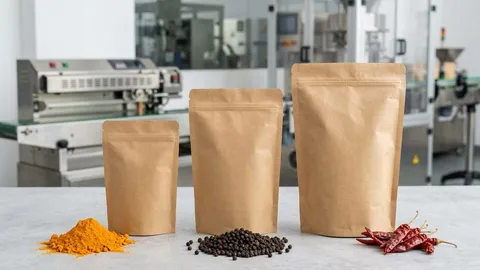
The 250 g pouch is the default retail unit for Sri Lankan dry goods on an overseas ethnic-grocery shelf because it matches how the household actually buys. A pantry staple like roasted curry powder or coconut milk powder is restocked, not stockpiled, so a quarter-kilo pack turns over fast enough to stay fresh and sits at a price point a shopper decides on without thinking. It is also freight-efficient: a 250 g pouch is light, stacks flat before filling, and lets a distributor spread a single bulk lot across more individual sales than a 500 g or 1 kg pack would.
The format has a shelf-life logic too. A smaller pouch is opened and finished sooner, which limits the window in which a high-aroma spice loses its volatile oils once the seal is broken. For the distributor, the 250 g pouch is the unit that keeps the maths simple: more facings on the shelf, a lower per-unit price, and a pack the diaspora shopper already recognises. The same logic drives the co-packing formats behind imported bulk repacked for local retail.
What co-packing actually covers for an export-bound pouch
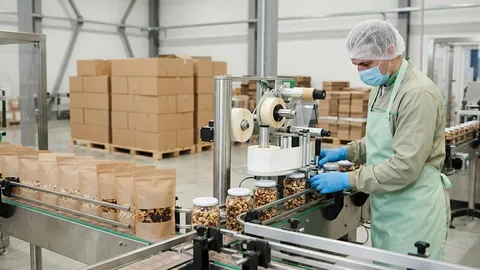
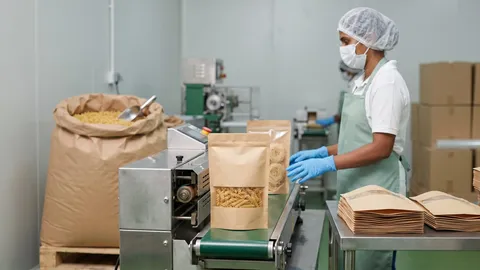
Co-packing sits at the back end of the production chain. The buyer supplies finished or bulk goods, spice powder, coconut or rice-based dry mixes, tea, and the co-packer weighs, fills, seals, and labels into the retail format. At SFC the buyer does not have to hand over a recipe or commission any formulation work; the value is the packing line, the barrier materials, and the audit trail, not the product itself. This is the same service behind co-packing imported almonds into retail pouches and preparing SKUs for online-grocery fulfilment.
For goods heading to an overseas ethnic-grocery buyer, the audit chain is the part that does quiet work. An importer abroad, and the retail chain behind them, increasingly ask what facility packed the goods and against what standard. A pouch sealed on a BRCGS- and FSSC 22000 V6-audited line answers that question before it is asked, which is the difference between a one-off informal shipment and a repeatable supply relationship. An informal co-packer without a current food-safety audit cannot make that claim, and the gap tends to surface at the importer’s door rather than at the factory gate.
Does exported packaged food need a health certificate?
Yes. Any food consignment leaving Sri Lanka needs an export health certificate, and it is issued per consignment by the Food Control Administration Unit of the Ministry of Health, certifying the goods are fit for human consumption. The certificate is not a rubber stamp on the way out. A factory inspection is a prerequisite for issuing it, and the exporting company must already be registered with the unit as a prequalification before any certificate is granted (Food Control Administration Unit, Ministry of Health).
A distributor who has cleared a bulk container through Sri Lanka Customs sometimes treats the health certificate as a formality that trails the goods. It does not. The certificate follows a registered, inspected facility, not the sack. For a distributor packing through an unregistered informal operator, the gap surfaces at the worst moment: the buyer abroad is waiting, the pouches are filled, and the certificate cannot be issued because the packing site was never on the register. Booking the pack at a facility that is already registered and audited closes that gap before it opens.
The two-label problem: Sri Lanka and the destination country
An export-bound pouch usually has to satisfy two labelling regimes at once, and they are not the same. On the Sri Lankan side, the Food Act 1980 and the Food (Labelling and Advertising) Regulations 2022, in force from 1 January 2026, govern what a packaged food must declare, including the common name, ingredients, allergens, net weight, and dates (US Department of Agriculture, Foreign Agricultural Service, 2022). Critically for a co-packer, when food is imported in bulk and repackaged, the label must carry the country of origin and both the date of manufacture and the date of repackaging.
On the destination side, the importing country’s food authority sets its own rules: local-language declarations, its own allergen format, and a nutrition panel in its prescribed layout. For high-value markets, a distributor should read the destination requirements early; the EU’s importer requirements for spices and herbs, for example, are detailed and enforced (CBI, 2025). A co-packer that plans the label as two overlapping specs rather than one avoids the reprint that a mismatch forces. The table below sets out who requires what.
| Requirement | Who sets it | What the co-packed pouch must carry |
| Export health certificate | Food Control Administration Unit, Ministry of Health | Issued per consignment; the facility must be registered and pass inspection first |
| Sri Lanka Food Act label | Food Act 1980 / Labelling Regulations 2022 | Common name, ingredients, allergens, net weight, and dates |
| Origin and repacker declaration | Labelling Regulations 2022 | Country of origin, plus date of manufacture and date of repackaging for bulk-repacked goods |
| Destination-country label | The importing country’s food authority | Local-language declarations, its allergen format, and its nutrition panel layout |
Kraft pouch construction: local turnover versus export shelf life
Not every kraft pouch is built for a long journey. The kraft look is the same across the range, but the barrier is set by the inner film, and that choice decides whether a spice arrives with its aroma intact or clumped and faded. A basic kraft-and-polyethylene pouch is cheap and fine for fast local turnover, but it offers a weak oxygen barrier and lets a high-aroma powder dull over the weeks a sea shipment takes. For an export leg, a kraft laminate with an aluminium-foil layer gives a high barrier to oxygen, moisture, and light, which is why it is the standard for high-aroma spice blends heading abroad (MTPak, 2024).
The trade-off is cost and weight: a foil laminate costs more per pouch and adds a little mass to the freight. The seal matters as much as the film, because a barrier pouch is only as good as its weakest heat seal, and a poorly sealed seam undoes the whole laminate. A co-packing line that controls the seal and matches the film to the transit is what keeps a 250 g pouch shelf-stable from Matale to a diaspora aisle. The table below maps construction to use.
| Pouch construction | Barrier profile | Best for | Watch-out |
| Kraft with polyethylene liner | Basic moisture resistance, weak oxygen barrier | Fast-turnover local retail, short supply chain | Aroma and colour fade over months; weak on a long sea leg |
| Kraft with metallised film | Good moisture and light barrier, moderate oxygen | Mid-shelf-life dry goods on air freight | Seam is the weak point; needs a clean, controlled heat seal |
| Kraft with aluminium-foil laminate | High barrier to oxygen, moisture, and light | High-aroma spice blends and curry powders on long export legs | Higher unit cost; adds a little freight weight |
| Paper-only or compostable kraft | Low barrier | Sustainability-led local SKUs with quick sell-through | Short shelf life; unsuitable for humid transit |
From a cleared bulk lot to a first co-packing run
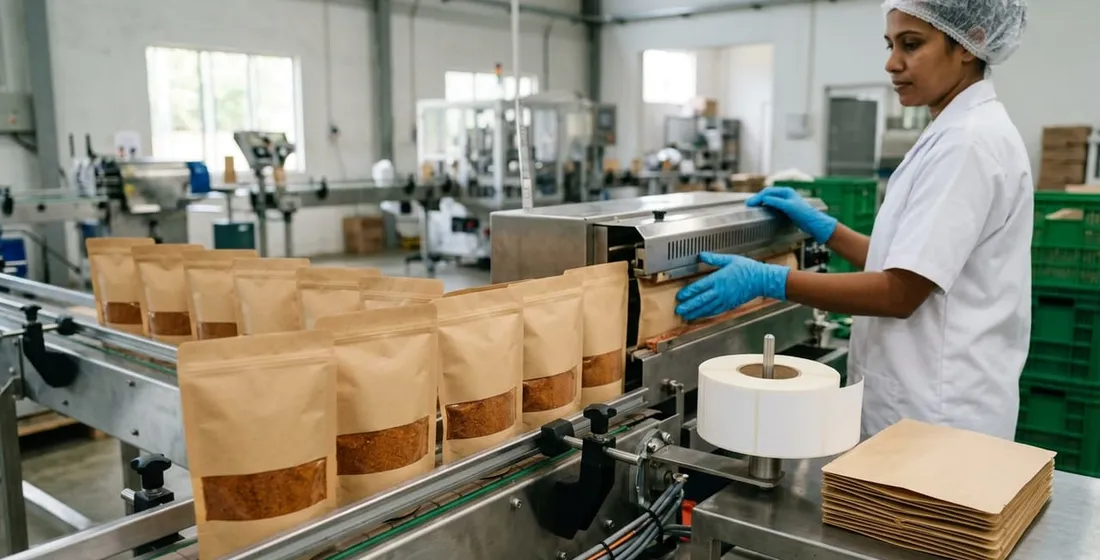
Once the goods are at the facility and the format is chosen, a co-packing run is fast relative to a full manufacturing engagement, because there is no formulation step. At SFC the packing line handles pouch sizes from 50 g to 1 kg, glass jars, and capsule bottles, and a co-packing run typically turns around in one to two weeks once the finished goods arrive. Multiple imported SKUs can run through one packing block, which is where a distributor consolidating several lines finds the pricing break. This consolidation logic sits alongside co-packing for supermarket and gift-shop channels.
The cert stack is what makes the run bankable on the buyer’s side. A BRCGS- and FSSC 22000 V6-audited packer, with the export health certificate and the Sri Lanka Food Act label handled inside the run, is the audit trail an overseas importer needs to place a repeat order rather than a trial one. For a distributor whose product also carries a provenance story, that same audited line handles diaspora gifting formats such as kithul and coconut treacle, and any SKU that will also sell locally clears SLSI through the standard submission route. The full certification stack is what a serious export buyer checks first.
Frequently asked questions
Does Silk Foods Ceylon co-pack products into 250 g pouches for export?
Yes. Silk Foods Ceylon offers co-packing at its Matale facility, where a buyer supplies finished or bulk goods and the team fills, seals, and labels into retail formats from 50 g to 1 kg, including the 250 g kraft pouch. The line is BRCGS- and FSSC 22000 V6-audited, and the export health certificate and Sri Lanka Food Act label are handled inside the run.
What pouch size works best for ethnic-grocery retail abroad?
For Sri Lankan dry goods on an overseas ethnic-grocery shelf, the 250 g stand-up pouch is the default. It matches how the diaspora household restocks a pantry, turns over fast enough to stay fresh, sits at an easy price point, and spreads a single bulk lot across more sales than a 500 g or 1 kg pack.
Do I need a health certificate to export packaged food from Sri Lanka?
Yes. The Food Control Administration Unit of the Ministry of Health issues an export health certificate per consignment, certifying the food is fit for human consumption. A factory inspection is a prerequisite, and the exporting company must be registered with the unit beforehand, so the certificate follows a registered, audited facility rather than the goods.
Can a co-packer handle the destination-country label as well as the Sri Lankan one?
An export pouch usually satisfies two regimes: the Sri Lanka Food Act label, including country of origin and a repackaging date for bulk-repacked goods, and the importing country’s own rules on language, allergens, and nutrition. Planning the label as two overlapping specs at the co-packing stage avoids a reprint later, which is why the destination requirements should be read before the run.
How Silk Foods Ceylon can help
For distributors converting a cleared bulk lot (spice powders, coconut and rice-based dry mixes, tea) into diaspora-ready retail pouches, Silk Foods Ceylon (SFC) runs a dedicated co-packing capability at its Matale facility. The buyer supplies the finished goods; the team handles filling, sealing, and labelling into formats from 50 g to 1 kg, including the 250 g kraft pouch, plus SLSI and Sri Lanka Food Act label support and the export health-certificate chain. A co-packing run typically turns around in one to two weeks once the goods arrive, and multiple SKUs can consolidate through one packing block. The BRCGS and FSSC 22000 V6 cert stack on the packer side is the audit trail an overseas importer checks before placing a repeat order.
To brief a co-packing or export-bridge plan, email brands@esilkroute.com.lk or call +94 77 157 7294.
Sources
- Sri Lanka Export Development Board (2025), “Sri Lanka Export Performance Exceeded US$ 17.2 Billion in 2025,” https://www.srilankabusiness.com/news/sri-lankas-export-performance-exceeded-us-17.2-billion-in-2025.html (retrieved 2026-07-08).
- Food Control Administration Unit, Ministry of Health, Sri Lanka, “Export Certification Procedure,” https://eohfs.health.gov.lk/food/index.php?option=com_content&view=article&id=6&Itemid=140&lang=en (retrieved 2026-07-08).
- US Department of Agriculture, Foreign Agricultural Service (2022), “Sri Lanka Enacts New Legislation for Food Labeling and Advertising,” https://apps.fas.usda.gov/newgainapi/api/Report/DownloadReportByFileName?fileName=Sri+Lanka+Enacts+New+Legislation+for+Food+Labeling+and+Advertising_Colombo_Sri+Lanka_CE2023-0011.pdf (retrieved 2026-07-08).
- CBI, Centre for the Promotion of Imports (2025), “What requirements must herbs and spices meet to be allowed on the European market?” https://www.cbi.eu/market-information/spices-herbs/buyer-requirements (retrieved 2026-07-08).
- United Nations Department of Economic and Social Affairs (2024), “International Migrant Stock 2024,” https://www.un.org/development/desa/pd/content/international-migrant-stock (retrieved 2026-07-08).
- MTPak (2024), “How Barrier Layers in Stand-Up Pouches Extend Food Shelf Life: A Manufacturers Guide,” https://mtpak.com/how-barrier-layers-in-stand-up-pouches-extend-food-shelf-life-a-manufacturers-guide/ (retrieved 2026-07-08).
Further reading:
- Sri Lanka Export Development Board (2025), “Export Development Performance Analysis Report,” https://www.industry.gov.lk/web/wp-content/uploads/2025/12/EDB-English.pdf (retrieved 2026-07-08).
Written by the Silk Foods Ceylon Team. Silk Foods Ceylon (Pvt) Ltd. is a BRCGS- and FSSC 22000 V6-audited contract manufacturer in Matale, Sri Lanka, offering contract manufacturing, private labelling, co-packing, and in-house R&D for local Sri Lankan brand owners, FMCG companies, hotel and restaurant groups, and distributors. To brief a project: brands@esilkroute.com.lk or +94 77 157 7294.