
Co-Packing 50g and 100g Spice Pouches for the E-Commerce Tier
Buyer’s snapshot
- Sri Lanka’s FMCG sector accelerated from roughly 5% growth in 2024 to about 7% in 2025, with SKUs suited to a lower cash outlay among the segments gaining ground (Daily Mirror Business, 2025).
- Sri Lanka’s Food (Labelling and Advertising) Regulations, effective from 1 January 2024, require a repackaged bulk product to carry both the original manufacture date and the date of repackaging on the label (Sri Lanka Ministry of Health regulation, via USDA FAS GAIN report, 2023).
- Silk Foods Ceylon (SFC) co-packs spice pouches at 50g and 100g as two of its standard kraft-pouch formats, with a typical production block of one to two weeks once finished goods arrive at the Matale facility.
- The table below sets out where a straight co-packing run and a private-label spice run diverge for a mini-format e-commerce SKU.
A 50g pouch of cinnamon or a 100g pouch of curry powder is not a smaller version of a 1kg retail bag. It is a different economic object, built for a different basket. Local online marketplaces and grocery delivery services increasingly favour mini formats because the price point clears a lower cash-outlay threshold, and Sri Lanka’s FMCG sector accelerated from roughly 5% growth in 2024 to about 7% in 2025, partly on that shift toward smaller, cheaper-to-buy SKUs (Daily Mirror Business, 2025). For a distributor sitting on bulk spice, the live question is not whether to go small-format. It is who cuts, weighs, seals, and labels the pouch, and what the label has to say once the product moves online.
What does co-packing mean for a 50g or 100g spice pouch run?
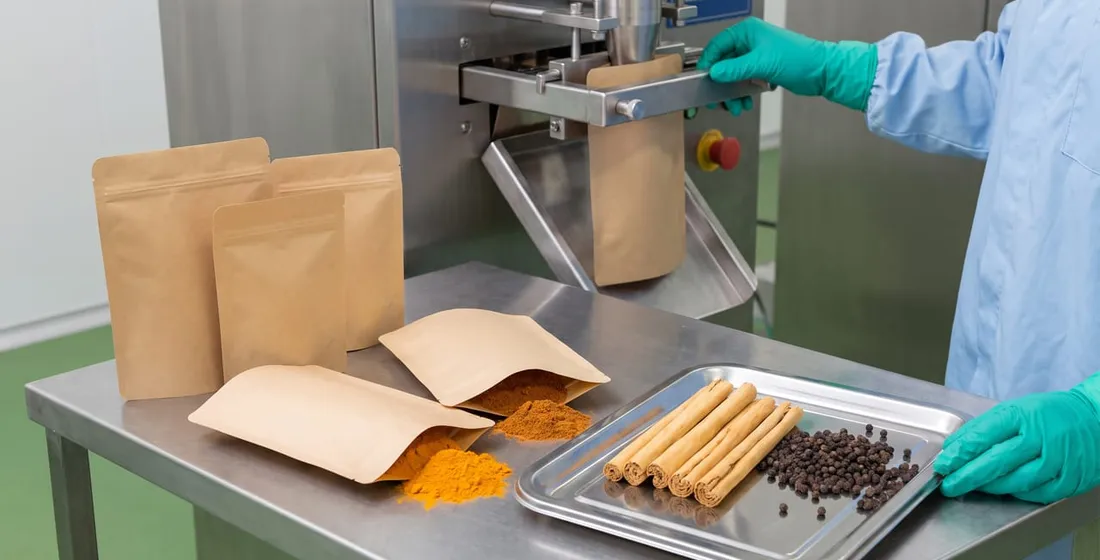
Co-packing at Silk Foods Ceylon (SFC) means the buyer supplies spice that is already cleaned, dried, and in most cases ground to spec, and the SFC team packs, seals, and labels it into retail-ready pouches. The recipe and the raw material stay the buyer’s; the Matale facility handles the conversion from bulk sack to shelf-ready format. For a distributor converting imported or locally sourced bulk spice into a Sri Lankan e-commerce SKU, that division of labour usually means a faster route to market than developing an in-house packing line for a handful of SKUs.
Where a distributor holds whole spice rather than a ground product, the size-reduction step (grinding, sieving to a mesh spec) sits inside contract manufacturing rather than co-packing proper. SFC’s spice line runs at 100 to 200 kg an hour, and that grinding pass typically happens before the pouch fills start, on the same production day where volumes allow it. Once the spice is at the correct particle size, kraft pouch co-packing for distribution covers the fill, seal, and label steps through the same form-fill packing and band-sealing equipment used for larger pouch formats.
Kraft pouches at SFC run from 50g and 100g, the two sizes suited to an e-commerce single-serve or trial-size price point, up through 250g and 1kg for wholesale and pantry-size formats. All sizes use the same heat-seal edge and brown or white kraft stock, so a distributor running a 50g e-commerce SKU alongside a 1kg wholesale SKU from the same bulk lot is a packaging-line decision, not a separate manufacturing relationship.
Co-packing, private labelling, or contract manufacturing: which fits a mini-format spice pouch?
The right service depends on what the distributor already has: finished spice, an existing formulation to license, or a recipe that still needs scaling.
| Attribute | Co-Packing | Private Labelling | Contract Manufacturing |
|---|---|---|---|
| Who supplies the spice or blend | Buyer, already processed | SFC, from its existing formulation catalogue | Buyer’s recipe, processed at scale by SFC |
| Best fit for a 50g/100g e-commerce pouch | A distributor with bulk stock on hand | A brand wanting a ready SKU without sourcing spice | A brand with its own blend recipe needing a production line |
| First-run scale | Typically a single production block per SKU mix | 50 kg of raw material per SKU (volume tiers at 500 kg, 1,000 kg, 2,500 kg) | Spice line runs 100 to 200 kg an hour |
| Lead time | One to two weeks once finished goods arrive | Two to four weeks on an existing recipe | Two to three weeks on an existing recipe; six to ten weeks with new formulation work |
| Labelling and compliance | SLSI and Sri Lanka Food Act compliance built into the engagement | Same, plus the buyer’s own label design | Same, plus the recipe stays the buyer’s intellectual property |
For a distributor already holding bulk cinnamon, pepper, or a curry powder blend, co-packing is usually the fastest route to a 50g or 100g e-commerce SKU, since the raw material and the formulation are already settled. A brand without an existing spice source or blend recipe is better served starting from private labelling or, where the blend itself needs development, food product development before the first commercial batch.
What SLSI and Food Act rules apply to a repackaged spice pouch sold online?
Any packaged spice sold through a Sri Lankan e-commerce marketplace needs SLSI clearance and Sri Lanka Food Act 1980 compliance, the same floor that applies to a supermarket-shelf SKU. The SLSI packaged-food submission process typically runs four to eight weeks for a stable formulation, and the working assumption most distributors plan against is a six-to-ten-week buffer between manufacturer QA sign-off and a live listing date.
A repackaging run carries one obligation that a first-time manufacturing run does not. Sri Lanka’s Food (Labelling and Advertising) Regulations, effective from 1 January 2024, add a specific rule for bulk-repackaged product: the label must carry both the original manufacture date and the date of repackaging, not one or the other (Sri Lanka Ministry of Health regulation, via a 2023 USDA Foreign Agricultural Service GAIN report on the regulation). For a co-packing run converting bulk spice into 50g or 100g pouches, that means the batch record has to travel with the raw material from the moment it arrives at the Matale facility, rather than getting reconstructed at the labelling stage. Product name, ingredient list, allergen disclosure, and country-of-origin still apply in the standard tri-lingual format under the same regulation.
One Sri Lankan distributor at Silk Foods Ceylon brought in a pallet of bulk curry powder blend with a single pack size in mind: a 500g pouch built for a wholesale account. Once the distributor’s own online marketplace listing showed most orders arriving as single-item, trial-size baskets, a 50g add-on run went through the same production block and the same SLSI submission window, since the manufacture date on the bulk stock had not changed. Only the pack size and the repackaging date on the label were new. The second SKU took a production day, not a second manufacturer relationship.
The economics of a mini-pouch e-commerce SKU
A 50g or 100g pouch costs more per gram to produce than a 1kg bag, since the packaging-to-product ratio rises as the pack size falls. Distributors who run the maths on invoice cost alone sometimes conclude the mini format is not worth it. The comparison that actually matters is landed cost per pouch against the online price point the format unlocks, since a 50g spice pouch typically sells for a fraction of a 1kg bag’s LKR price, which is precisely the lower cash-outlay threshold driving e-commerce demand for the format in the first place (Daily Mirror Business, 2025).
Co-packing for online grocery marketplace fulfilment adds a second consideration beyond the pack size itself: order-level packing, since a marketplace fulfilment run often bundles several SKUs per customer order rather than shipping single-SKU cartons to a retail warehouse. Distributors running both a wholesale 500g-to-1kg line and a mini e-commerce line through the same co-packing engagement typically consolidate both into one production block, since the bulk raw material and the SLSI submission cover both pack sizes.
How Silk Foods Ceylon can help
For distributors converting bulk spice into Sri Lankan e-commerce-ready SKUs, Silk Foods Ceylon (SFC) operates a dedicated co-packing capability at the Matale facility. The distributor supplies the finished or processed spice; the SFC team handles the fill, seal, and label steps, including the dual-date labelling that a repackaged product requires under the Food (Labelling and Advertising) Regulations. Packaging options for a mini-format run span 50g and 100g kraft pouches up to 250g, 1kg, and bulk sack formats, all covered under the same BRCGS- and FSSC 22000 V6-audited cert stack that reassures marketplace and retail procurement on the audit chain. SLSI submission support is built into the standard co-packing engagement.
To brief a co-packing or consolidation plan, email b2b@esilkroute.com.lk or call +94 76 441 0389 / +94 76 918 5744.
Frequently asked questions
Does Silk Foods Ceylon co-pack spice pouches in 50g and 100g sizes?
Yes. 50g and 100g kraft pouches are two of SFC’s standard co-packing formats, alongside 250g and 1kg. The distributor supplies the processed spice; SFC handles filling, sealing, and labelling, with a typical production block of one to two weeks once finished goods arrive at the Matale facility.
What SLSI and Food Act rules apply to a repackaged spice pouch sold online?
Every packaged spice sold on a Sri Lankan e-commerce marketplace needs SLSI clearance and Sri Lanka Food Act 1980 compliance. Since 1 January 2024, repackaged bulk product must also carry both the original manufacture date and the repackaging date on the label, a rule specific to bulk-to-retail conversion.
How long does a co-packing run take once bulk spice arrives at the facility?
Typically one to two weeks for the packing run itself. Where whole spice needs grinding or sieving to a mesh spec first, that processing step usually adds to the same production window rather than a separate manufacturing cycle, since the spice line runs at 100 to 200 kg an hour.
What is the difference between co-packing and private labelling for a mini-format spice SKU?
Co-packing uses the distributor’s own spice and formulation; SFC only packs, seals, and labels it. Private labelling uses an existing SFC formulation under the buyer’s brand. A distributor with bulk stock on hand is usually better served by co-packing; a brand without a spice source starts with private labelling instead.
Can Silk Foods Ceylon grind or sieve whole spice before co-packing it into pouches?
Yes. Whole spice that needs size reduction goes through the spice line’s grinding and sieving equipment to the buyer’s mesh spec before the co-packing run begins. That processing step sits inside contract manufacturing rather than co-packing proper, though both typically run within the same production block.
Sources
- Daily Mirror Business, “Consumer goods in modern trade record strong growth momentum over 3 years”, 2025. https://www.dailymirror.lk/business/Consumer-goods-in-modern-trade-record-strong-growth-momentum-over-3-years/215-335839 (retrieved 2026-07-28)
- USDA Foreign Agricultural Service, GAIN Report, “Sri Lanka Enacts New Legislation for Food Labeling and Advertising”, 2023. https://www.fas.usda.gov/data/sri-lanka-sri-lanka-enacts-new-legislation-food-labeling-and-advertising (retrieved 2026-07-28)
- Sri Lanka Export Development Board, Spices, Essential Oils and Oleoresins sector export performance, 2024 figures. https://www.srilankabusiness.com/spices/about/export-performance.html (retrieved 2026-07-28)
- Sri Lanka Standards Institution, national standards and certification framework. https://www.slsi.lk/ (retrieved 2026-07-28)
- Daily FT, “Trends and growth of Sri Lanka’s e-commerce industry”, 2025. https://www.ft.lk/Business/Trends-and-growth-of-Sri-Lanka-s-e-commerce-industry-An-overview-of-Daraz-e-commerce-Index/34-703498 (retrieved 2026-07-28)
Written by the Silk Foods Ceylon Team. Silk Foods Ceylon (Pvt) Ltd. is a BRCGS- and FSSC 22000 V6-audited contract manufacturer in Matale, Sri Lanka, offering contract manufacturing, private labelling, co-packing, and in-house R&D for local Sri Lankan brand owners, FMCG companies, hotel and restaurant groups, and distributors. To brief a project: b2b@esilkroute.com.lk, +94 76 441 0389, or +94 76 918 5744.