Co-packing imported almonds: 250g and 500g pouches for Sri Lanka
Buyer's snapshot
|
Almonds do not grow in Sri Lanka. Every kernel on a local shelf was imported, most of it grown in California, which produces the large majority of the world crop, and in Australia, the second source, often routed through Indian and Gulf re-export hubs before it clears Colombo (USDA FAS, 2025; UN Comtrade, 2022). For a distributor who has just landed a container of bulk almonds, the asset is real and so is the problem. The goods sit in 10 or 25 kg cartons, while the retail shelf wants a 250 g snack pack and a 500 g value pack, each carrying a compliant tri-lingual label and a scannable barcode. Co-packing is how a distributor crosses that gap without buying a packing line.
What co-packing covers for a container of imported almonds
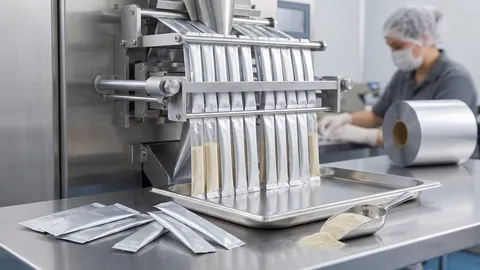
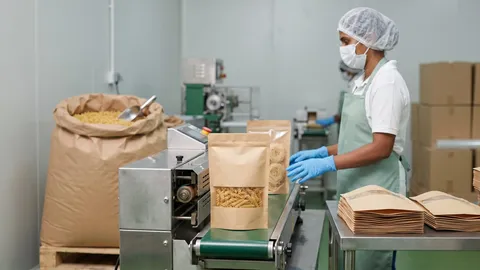
Co-packing at Silk Foods Ceylon (SFC) sits at the back end of the production chain. The distributor supplies the cleared bulk almonds, whole or roasted, and the SFC team handles the packing, the heat-seal, the retail label, and the Sri Lanka Standards Institution (SLSI) paperwork the channel asks for. The sourcing and the import stay with the distributor; the conversion to a retail-ready 250 g or 500 g pouch moves to the manufacturer.
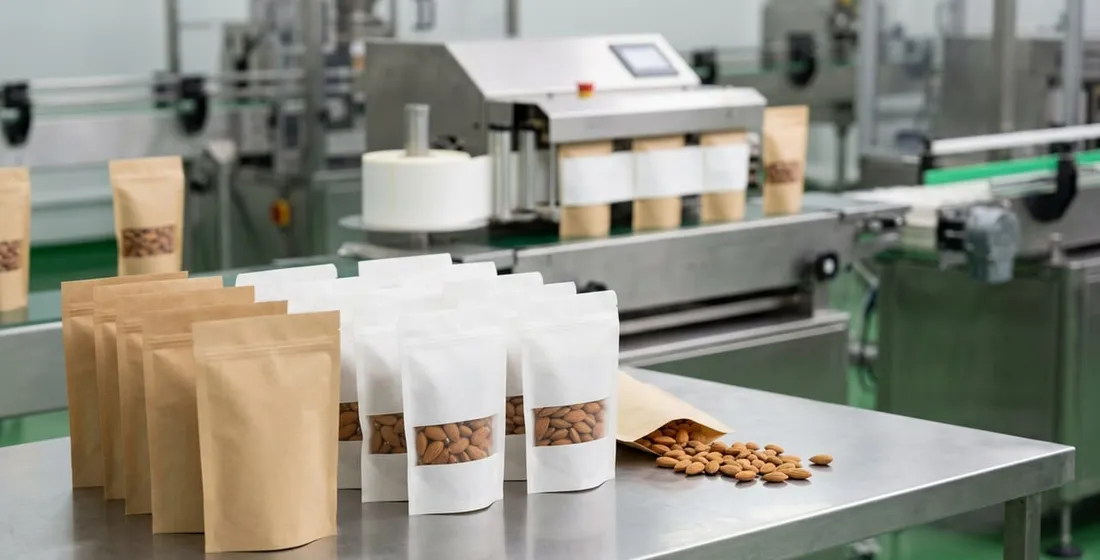
Format range is the first decision. Silk Foods Ceylon packs into brown and white kraft stand-up pouches, window pouches that show the product, and glass jars where a premium gifting line wants one. For an almond rollout, the working pair is a 250 g pouch and a 500 g pouch, the two weights that carry most of a nut retail line in the local market. A distributor running whole natural almonds at a snack weight and a larger value weight can do both in a single consolidated block rather than two separate runs. Australia anchors the second supply line behind California (INC, 2024/25), which is why most local almond programmes blend origins rather than depend on one.
The same back-end logic underpins SFC’s co-packing imported cashews and dates and its kraft-pouch co-packing for distribution: the buyer owns the goods, and the manufacturer owns the conversion to a shelf-ready SKU.
Why almonds need a barrier pouch, not just any kraft
An almond is roughly half oil, and most of that oil is unsaturated. The Almond Board of California reports that whole natural almonds hold quality for more than two years stored below 10 degrees Celsius at under 65 percent relative humidity, and up to three years in vacuum-sealed tri-laminate foil pouches. Roasted almonds oxidise faster and usually need nitrogen flushing or vacuum packing (Almond Board of California).
That chemistry is why almonds taste good and why they go rancid. Exposed to oxygen, warmth, light, and humidity, the unsaturated fats oxidise and the kernel turns stale and cardboard-flavoured long before any visible spoilage. In a warm, humid retail environment, an almond pouch is fighting that clock from the day it is sealed.
A plain brown kraft pouch with no barrier liner is the wrong call for almonds. The pouch needs a metallised or foil-laminate inner layer to block oxygen and moisture, and for roasted or salted almonds it usually needs a nitrogen flush or an oxygen-scavenger sachet inside the seal. A window pouch trades some of that barrier for shelf appeal, so the window film and the fill weight have to be matched to how fast the SKU is expected to turn. This is the decision a co-packer is paid to get right.
The most expensive almond SKU is the one that comes back. A distributor who packs a humid-season batch into an unlined pouch can face returns weeks later when the product turns on the shelf, and the cost of the recall and the re-listing dwarfs the few rupees per pouch saved on the cheaper film.
250 g or 500 g? Sizing the retail ladder
The 250 g pouch and the 500 g pouch do different jobs on the shelf. A 250 g pack is the everyday snack and impulse weight, priced to move and earning more facings; a 500 g pack is the value and gifting weight, with better per-gram economics and a slower turn. Most almond rollouts run both, with the 250 g carrying volume and the 500 g anchoring value.
| Pouch | Primary shopper | Shelf role | Relative turn | Packing note |
| 250 g whole natural | Individual snacker, impulse buy | Volume driver, more facings | Faster | Foil-laminate barrier; a resealable zip helps repeat use |
| 500 g whole natural | Family, value buyer, gifting | Margin and basket-size driver | Slower | Foil-laminate barrier; a nitrogen flush is worthwhile at the larger fill |
On a landed-cost basis, the 500 g pouch usually gives the shopper a better price per 100 g, which is why a distributor often prices it as the value anchor and lets the 250 g pouch carry the impulse volume. Running both weights off one block keeps the per-pouch packing cost down, because the changeover between a 250 g and a 500 g fill on the same film is minutes, not hours. The category tailwind is real: the global almond market was worth about USD 8.1 billion in 2025 and is growing near 7 percent a year (Mordor Intelligence, 2026), and the local pull mirrors that as modern-trade retail widens its healthy-snacking range.
What the label law now requires for repackaged almonds
Since 1 January 2026, the Food (Labelling and Advertising) Regulations 2022 have been in force in Sri Lanka, replacing the 2005 rules (USDA FAS, 2025). For a repackaged imported food, the retail label must carry the common name in Sinhala, Tamil, and English, a declared allergen line, the country of origin, the importer name and address, and both the date of manufacture and the date of repackaging.
Almonds are a tree nut, and tree nuts are a declarable allergen, so the pack has to state it plainly. The country-of-origin line matters for almonds specifically, because the kernels are imported and the regulations require the origin to be shown. The repackaging date is the SFC step, while the manufacture date stays with the upstream supplier, so a repacked almond pouch carries both.
Getting that label right is part of why the channel asks for an audited repacker. The detail sits inside the SLSI packaged-food submission, step by step and the wider certification stack for a Sri Lankan FMCG launch, both of which a co-packing engagement at SFC supports.
Sequencing a retail rollout from one co-packing block
A first almond rollout works best as a tight SKU set run in one consolidated block: a 250 g and a 500 g whole natural pouch, with a 250 g roasted-salted line if the channel wants it. Lead time at Silk Foods Ceylon is typically 1 to 2 weeks once the finished goods reach the Matale facility.
Starting narrow keeps the first listing manageable. Two or three almond SKUs prove the label, the barrier, and the price ladder before the range widens. Because the SFC line runs cellular, several pack weights and one or two roast variants can move through a single production block, and the SLSI submission support sits inside the same engagement rather than being a separate project.
Spec snapshot: co-packing imported almonds at Silk Foods Ceylon
|
The reflex comparison is against an informal repacker quoting a lower rate per pouch. The number to compare is total cost, not invoice price. An informal operator working without a current FSSC 22000 V6 audit or SLSI clearance for the new SKU carries a re-listing risk the channel will price in, and an almond batch that oxidises in an unlined pouch erases the saving in a single return cycle. The BRCGS and FSSC 22000 V6 audit on the repacker side is what lets the major supermarket and modern-trade buyers clear the SKU without a separate manufacturer audit.
For a distributor weighing channel mix, the same packing block can serve both co-packing for supermarket and gift-shop SKUs and the health-food shelf that already buys co-packing imported oats and dates.
Frequently asked questions
Does Silk Foods Ceylon co-pack imported almonds into retail pouches?
Yes. Silk Foods Ceylon runs a co-packing service where the distributor supplies cleared bulk almonds and the SFC team packs, seals, and labels them into retail-ready 250 g and 500 g pouches. The Matale facility is BRCGS- and FSSC 22000 V6-audited, and SLSI submission support is part of the engagement.
Is 250 g or 500 g the better pouch size for retail almonds in Sri Lanka?
Most rollouts run both. A 250 g pouch is the impulse and everyday snack weight that drives volume and earns shelf facings, while a 500 g pouch gives a better price per 100 g and works as the value and gifting weight. Running both off one block keeps the per-pouch packing cost low.
How should almonds be packed so they do not go rancid?
Almonds are high in unsaturated fat and oxidise with exposure to oxygen, warmth, and moisture. The Almond Board of California reports whole natural almonds keep for over two years below 10 degrees Celsius, and up to three years in vacuum-sealed foil pouches. A foil-laminate barrier pouch, with a nitrogen flush for roasted almonds, is the practical answer.
Do repackaged imported almonds need a tri-lingual label in Sri Lanka?
Yes. Under the Food (Labelling and Advertising) Regulations 2022, in force since 1 January 2026, a repackaged imported food must show the common name in Sinhala, Tamil, and English, a tree-nut allergen declaration, the country of origin, the importer details, and both manufacture and repackaging dates (USDA FAS, 2025).
How long does an almond co-packing run take at Silk Foods Ceylon?
Once the finished bulk almonds reach the Matale facility, a co-packing run typically takes 1 to 2 weeks, covering packing, sealing, labelling, and SLSI submission support. Running several pack weights and roast variants in one consolidated block keeps the timeline and the per-pouch cost down for a first retail rollout.
How Silk Foods Ceylon can help
For distributors converting imported bulk almonds into Sri Lankan retail-ready SKUs, Silk Foods Ceylon (SFC) operates a dedicated co-packing capability at its Matale facility. The distributor supplies the cleared finished goods; the SFC team handles packing, sealing, foil-barrier pouching, labelling, and SLSI submission support under the Food (Labelling and Advertising) Regulations 2022. Retail formats span 250 g and 500 g kraft pouches, with window and stand-up options, and lead times typically run 1 to 2 weeks once goods reach the facility. The BRCGS and FSSC 22000 V6 cert stack on the repacker side clears the SKU for the major supermarket and modern-trade buyers without a separate manufacturer audit.
To brief a co-packing or consolidation plan, email brands@esilkroute.com.lk or call +94 76 441 0389 or +94 76 918 5744.
Sources
- USDA Foreign Agricultural Service (2025), “Tree Nuts: World Markets and Trade”, https://www.fas.usda.gov/sites/default/files/2025-11/treenuts.pdf (retrieved 2026-06-28).
- UN Comtrade / World Bank WITS (2022), “Sri Lanka almond imports, HS 080212”, https://wits.worldbank.org/trade/comtrade/en/country/LKA/year/2022/tradeflow/Imports/partner/ALL/product/080212 (retrieved 2026-06-28).
- International Nut and Dried Fruit Council (2024/25), “Almonds: Global Statistical Review”, https://inc.nutfruit.org/almonds-global-statistical-review-5/ (retrieved 2026-06-28).
- Almond Board of California, “Shelf Stability and Shelf Life”, https://www.almonds.org/tools-and-resources/food-safety-and-quality/shelf-stability-and-shelf-life (retrieved 2026-06-28).
- USDA Foreign Agricultural Service (2025), “Sri Lanka Extends Implementation of the Food Labeling and Advertising Regulations-2022 by Additional Six Months”, https://apps.fas.usda.gov/newgainapi/api/Report/DownloadReportByFileName?fileName=Sri+Lanka+Extends+Implementation+of+the+Food+Labeling+and+Advertising+Regulations-2022+by+Additional+Six+Months_Colombo_Sri+Lanka_CE2025-0009.pdf (retrieved 2026-06-28).
- Mordor Intelligence (2026), “Almond Market Size and Share Analysis”, https://www.mordorintelligence.com/industry-reports/almond-market (retrieved 2026-06-28).
Written by the Silk Foods Ceylon Team. Silk Foods Ceylon (Pvt) Ltd. is a BRCGS- and FSSC 22000 V6-audited contract manufacturer in Matale, Sri Lanka, offering contract manufacturing, private labelling, co-packing, and in-house R&D for local Sri Lankan brand owners, FMCG companies, hotel and restaurant groups, and distributors. To brief a project: brands@esilkroute.com.lk, +94 76 441 0389, or +94 76 918 5744.