
Co-packing imported olive oil into retail glass in Sri Lanka
By the Silk Foods Ceylon Editorial Team
Buyer’s snapshot
- An imported food repacked in Sri Lanka must carry the date of manufacture and the date of repacking, under Regulation 5(2)(a)(v) of the Food (Labelling and Advertising) Regulations 2026.
- For edible oils, Regulation 5(5) treats the date of packing as the date of manufacture. The bottling date in Matale becomes the date the shelf reads, not the pressing date at origin.
- Codex caps extra virgin olive oil at 0.8 g oleic acid per 100 g free acidity and a peroxide value of 20 meq oxygen per kg. A drum arriving outside those limits cannot be bottled as extra virgin.
- Silk Foods Ceylon (SFC) fills glass at its Matale facility on a BRCGS- and FSSC 22000 V6-audited site, with a liquid filling and glass bottle capping line built for oils, syrups and beverages.
An olive oil brief from a distributor usually arrives as two numbers. Landed cost per litre of bulk, and a bottle size for the shelf. Both are ordinary on their own. What sits between them is a grade declaration, a date rule and a bottle specification. Each of the three can invalidate a label after the oil is already in glass, and one of them changed in July 2026.
This post runs one composite scenario. Imported bulk olive oil, rebottled locally into retail glass for the wholesale channel. What the grade on the drum lets you print. What the 2026 labelling regulations require on a repacked pack, and what the packaging rules require of the bottle. Then where the dates go on a 500 ml SKU.
Why the grade on the drum decides the SKU you can sell
Olive oil is one of the few edible oils where the retail name is a chemical claim, not a marketing choice. The Codex Alimentarius standard for olive oils and olive pomace oils, CXS 33-1981, sets each grade against two measurable numbers. Free acidity, expressed as grams of oleic acid per 100 grams. And peroxide value, in milliequivalents of active oxygen per kilogram.
Extra virgin sits at 0.8 free acidity or lower. Virgin at 2.0. Ordinary virgin at 3.3. Above 3.3 the oil is lampante, which the International Olive Council trade standard, revision 22 of June 2026, classifies as unfit for consumption in that state. Refined olive oil comes back down to 0.3, because refining strips the free fatty acids out.
| Grade | Free acidity, max (g oleic acid/100 g) | Peroxide value, max (meq O2/kg) |
|---|---|---|
| Extra virgin olive oil | 0.8 | 20 |
| Virgin olive oil | 2.0 | 20 |
| Ordinary virgin olive oil | 3.3 | 20 |
| Lampante virgin olive oil | above 3.3, not for consumption as is | not specified |
| Refined olive oil | 0.3 | 5 |
| Olive oil (refined and virgin blend) | 1.0 | 15 |
| Refined olive pomace oil | 0.3 | 5 |
| Olive pomace oil | 1.0 | 15 |
The peroxide column is the one that catches importers. Free acidity is largely fixed at the mill and moves slowly. Peroxide value measures oxidation, and it climbs with heat, light, oxygen and time. A consignment can leave origin as compliant extra virgin and arrive at a Colombo warehouse above 20, having spent six weeks in a hot container.
That is why a certificate of analysis dated at origin is not the same evidence as a certificate of analysis dated on arrival. The grade you can lawfully print is the grade the oil holds when it is bottled, not the grade it held when it shipped. Testing the drum before the bottling block is booked is cheaper than relabelling after.
The International Olive Council standard adds a further marker for extra virgin, a limit of 35 mg/kg on fatty acid ethyl esters. It is a check on whether a declared extra virgin has been softened with deodorised oil. Buyers importing on a broker’s word rather than a full analysis have no way to see that.
What does the 2026 labelling rule change for a rebottled oil?
The Food (Labelling and Advertising) Regulations 2026 were published in Gazette Extraordinary No. 2494/47 of 26 June 2026 and came into operation on 1 July 2026. Regulation 16 rescinds the 2005 regulations and the 2022 regulations published in Gazette Extraordinary No. 2319/40. Anyone still working from the 2022 text is working from a rescinded instrument.
Two clauses land directly on a rebottling operation. Regulation 5(2)(a)(v) requires that where foods are imported in bulk and repacked, the pack carries the date of manufacture and the date of repacking. Both dates, not one. Regulation 4(3) separately bars defacing, distorting, erasing or obliterating the original date of manufacture. The same applies to the date of expiry, and to the date of packing where a package is repacked.
Then comes the clause that changes the arithmetic. Regulation 5(5) states that the date of packing shall be considered as the date of manufacture in respect of tea, spices, edible oils, edible salt, cereals, whole and split legumes, and edible oilseeds. Olive oil is an edible oil, so the bottling date in Matale becomes the date of manufacture on the label.
For a distributor that reads as a commercial advantage, and it partly is. A drum pressed eleven months ago yields a bottle dated the week it was filled. But the shelf life clock is a different question from the date rule. The oil’s peroxide value does not reset because the label date does. A buyer who treats the two as one will have stock going rancid inside a date code that still reads as current.
Regulation 7(1) adds one requirement specific to oils. Any edible oil, including any refined oil, must bear its common name clearly and conspicuously. In close proximity it must bear the source of origin, in the same font, size and colour. A small-print origin line under a large product name does not satisfy that. The two have to match visually.
A related point on nutrition labelling. Schedule II of the 2026 regulations makes the nutrition panel mandatory one year after publication, so from 26 June 2027. Edible oils are not in the exemption list. An olive oil SKU bottled for a long shelf run should carry the panel now rather than be relabelled next year.
What the rules say about the bottle itself
The bottle is governed by a separate instrument, the Food (Packaging Materials and Articles) Regulations 2010, published in Gazette Extraordinary No. 1660/30 of 29 June 2010. It is older than the labelling regulations and easy to miss, and it carries one clause that rules out a common cost-saving idea.
Regulation 5(1)(c) bars putting any edible fat or edible oil into a bottle or metal container previously used for any other purpose. Storage silos and tankers are carved out. Retail glass is not. A reclaimed bottle, however well washed, is not available to an edible oil SKU.
Regulation 2(2)(a) requires food-contact packaging to be printed with the words FOR FOOD USE together with the symbol set out in Schedule I. That is a specification to put in the purchase order to the glass supplier, not something to discover at goods-inward. Schedule II sets leachate limits for antimony, arsenic, cadmium and lead at 0.2 parts per million for storage articles.
Glass colour is a commercial decision rather than a legal one, but it interacts with the peroxide ceiling above. Light drives oxidation. Clear flint glass shows the oil, which sells, and lets light through, which does not help the oil. Green or amber glass protects the contents and hides them. A distributor selling through the major supermarket chains is usually pushed toward clear by the buyer and toward tinted by the chemistry.
Where do the dates physically go on a 500 ml bottle?
This is where a rebottling brief usually runs out of surface area. A 500 ml oil bottle has a curved body, a narrow neck and one usable label panel. That panel has to carry a brand, a grade and an origin line at matching size. It also has to carry an ingredient declaration, an importer address, a packer address, a batch code and two dates.
Regulation 6 and Schedule III set the sizes. The common name must be at least one third the height of the brand name, with a floor of 3 mm. Other declarations, the date of manufacture and the date of expiry sit at 1.5 mm or larger. Where the main panel is 120 square centimetres or smaller, the 1.5 mm floor applies; above that, 3 mm. The main panel itself is defined as no less than 20 per cent of total surface area, excluding the bottom.
| Where it goes | What has to appear | Minimum size |
|---|---|---|
| Main panel | Common name in bold, trade or brand name, net contents in ml or l | Common name at least one third of brand name height, minimum 3 mm |
| Any panel | Ingredient list, manufacturer, distributor, importer name and address, packer name and address, batch or code number, date of manufacture, date of repacking, country of origin | 1.5 mm, nutrition panel 1 mm |
| Bottle neck | Date of expiry, batch number and date of manufacture, stamped indelibly and legibly | 1.5 mm |
That bottle neck row is the concession worth knowing. Regulation 5(2)(c) permits bottled food products to carry the date of expiry, the batch number and the date of manufacture on the bottle neck. They must be stamped indelibly and legibly, at a letter size of not less than 1.5 mm. That moves three declarations off a crowded label and onto glass, which is what most imported oil brands already do.
Language is the other space constraint. Regulation 15 defines three languages as Sinhala, Tamil and English. The common name goes in all three, or in any two on the main panel with the third on any panel. Where an imported pack already bears one of the three, Regulation 4(4) allows a supplementary label carrying the other two in bold.
What the inbound bulk leg has to carry
The drum or flexitank arriving at the warehouse is itself a regulated pack, and the 2026 regulations treat it differently from the retail bottle. The proviso to Regulation 3 exempts business-to-business food products from most labelling. It applies where the product is not for direct consumer sale, and is intended for further processing or resale.
The exemption is not a blank. Ten particulars still have to appear. Common name, trade name, net contents, date of manufacture, date of expiry, batch number, manufacturer, distributor, country of origin and the full ingredient list. The pack must also print the words Not for retail sale in bold at 3 mm or larger. An inbound drum that misses that line is a compliance problem before the oil is ever bottled.
Regulation 4(4) carries a further obligation that catches importers buying on Julian or QR coded dates. Where the imported pack shows the date in code, the importer must affix a supplementary label decoding it. The importer must also hold documentary evidence of the conversion method, issued or confirmed by the manufacturer, packer or brand owner. That evidence has to be producible to the Chief Food Authority on request.
In practice that means asking the origin supplier for a written date-code key at the purchase order stage. Chasing it after a consignment has landed, from a mill that has already been paid, is a slower conversation.
On the duty side, olive oil falls under heading 15.09 of the Sri Lanka Customs tariff. Virgin and other olive oil are separately classified, and olive pomace oil sits under 15.10. The Customs national imports tariff guide prints a general duty of 15 per cent or Rs. 40 per kg, and a cess of 15 per cent or Rs. 55 per kg. Rates and edition dates move, so confirm against the current guide before pricing a container.
How a consolidated bottling block runs
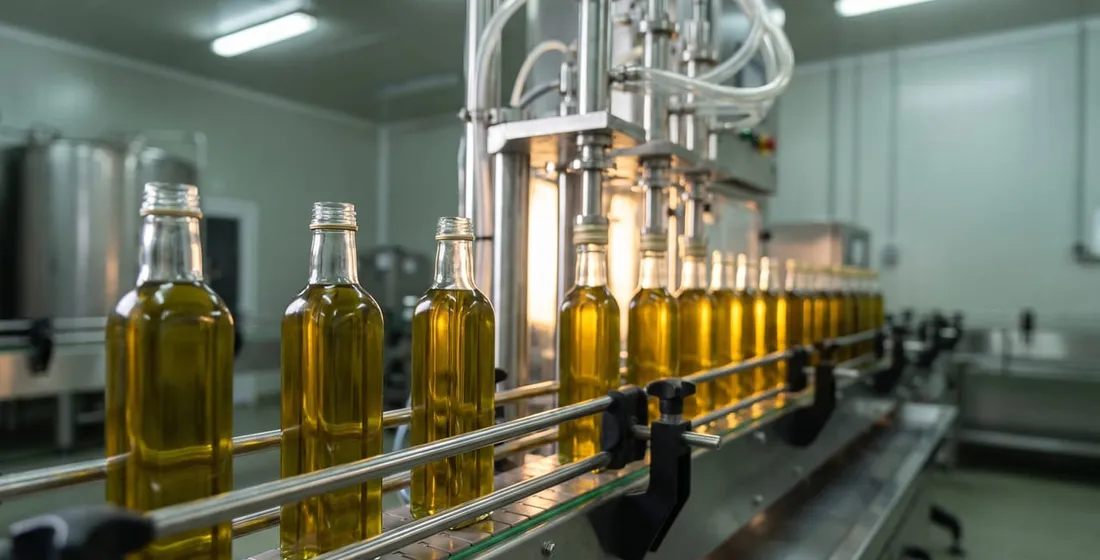
Once the grade is confirmed, the glass is specified and the artwork clears, the bottling itself is the short part. The oil is buyer-supplied finished product. The co-packer’s job is to filter, fill, cap, label, code and case it without changing what is in the drum.
At the Matale facility the line runs a pipe-type duplex filter, a homogenizer, a liquid filling machine and a glass bottle capping machine. It is configured for glass-bottled oils, syrups and beverages, in formats from 50 ml jars up to 1 litre. The site is BRCGS- and FSSC 22000 V6-audited. That is the audit chain a supermarket procurement team asks about before it asks about price.
Sequencing matters more than speed. Oil filling is changeover-sensitive. Residue from a previous product carries into the next run more readily in a liquid line than in a dry one. A single-SKU block on a cleaned line costs less in lost time than three SKUs interleaved across a shift.
Two dates have to be agreed before the block is booked rather than after. The arrival certificate of analysis date, which fixes the grade that can be printed. And the bottling date, which under Regulation 5(5) becomes the date of manufacture on every bottle in the run. Artwork cannot be finalised until the second one is scheduled. The date format and its position have to be proofed with the rest of the panel.
Stock ownership is worth settling in the same conversation. The oil belongs to the distributor throughout, the glass may be bought by either party, and the finished cases sit somewhere between filling and despatch. Writing down who owns what at each step avoids an argument about a short-filled pallet three months later.
Frequently asked questions
Can I label imported bulk oil as extra virgin once it is bottled in Sri Lanka?
Only if the oil still meets the grade at bottling. Codex CXS 33-1981 caps extra virgin at 0.8 g oleic acid per 100 g free acidity and a peroxide value of 20 meq oxygen per kg. Peroxide value rises in transit, so test on arrival rather than relying on the origin certificate.
What date goes on an imported olive oil rebottled in Sri Lanka?
Both the date of manufacture and the date of repacking, under Regulation 5(2)(a)(v) of the Food (Labelling and Advertising) Regulations 2026. For edible oils, Regulation 5(5) treats the date of packing as the date of manufacture, so the local bottling date carries that label.
Can I reuse glass bottles for an edible oil SKU?
No, not if they held anything else. Regulation 5(1)(c) of the Food (Packaging Materials and Articles) Regulations 2010 prohibits putting any edible fat or edible oil into a bottle or metal container previously used for another purpose. Storage silos and tankers are the only carve-out.
Does the inbound bulk drum need a Sri Lankan label?
A reduced one. The proviso to Regulation 3 of the 2026 regulations exempts business-to-business packs from most labelling, but ten particulars remain, including country of origin and the full ingredient list, and the pack must print Not for retail sale in bold at 3 mm or larger.
Does Silk Foods Ceylon co-pack imported oils into retail glass?
Yes. The Matale facility runs a liquid filling and glass bottle capping line built for oils, syrups and beverages, with glass formats from 50 ml to 1 litre. The site is BRCGS- and FSSC 22000 V6-audited, and labelling and submission support sit inside a standard co-packing engagement.
How Silk Foods Ceylon can help
For distributors converting imported bulk into Sri Lankan retail-ready SKUs, Silk Foods Ceylon (SFC) operates a dedicated co-packing capability at the Matale facility. The buyer supplies the finished product; the SFC team handles filling, capping, labelling, coding and submission support under the Sri Lanka Food Act labelling framework. For liquids the line runs a pipe-type duplex filter, a homogenizer, a liquid filling machine and a glass bottle capping machine, with glass formats from 50 ml to 1 litre. Dry formats span 50 g to 1 kg kraft pouches and 60-count capsule bottles.
The BRCGS- and FSSC 22000 V6-audited cert stack on the repacker side answers the audit-chain question major supermarket chain procurement teams ask first.
To brief a co-packing or consolidation plan, email b2b@esilkroute.com.lk or call +94 76 441 0389 / +94 76 918 5744.
Sources
Ministry of Health and Mass Media, Sri Lanka, Food (Labelling and Advertising) Regulations 2026, Gazette Extraordinary No. 2494/47 of 26 June 2026, in operation from 1 July 2026. Regulations 3 proviso, 4(3), 4(4), 5(1), 5(2)(a)(v), 5(2)(c), 5(5), 6, 7(1), 15, 16 and Schedules II and III. Ministry of Health (retrieved 15 September 2026).
Ministry of Health, Food Control Administration Unit, current food regulations register, listing the Food (Labelling and Advertising) Regulations 2026 as the operative labelling instrument. Food Control Administration Unit (retrieved 15 September 2026).
Ministry of Health, Sri Lanka, Food (Packaging Materials and Articles) Regulations 2010, Gazette Extraordinary No. 1660/30 of 29 June 2010. Regulation 2(2)(a) on the FOR FOOD USE marking, Regulation 5(1)(c) on previously used bottles and containers, and Schedules I and II. Ministry of Health (retrieved 15 September 2026).
FAO and WHO Codex Alimentarius, Standard for Olive Oils and Olive Pomace Oils, CXS 33-1981, revised 2015. Free acidity and peroxide value limits by grade. Codex Alimentarius (retrieved 15 September 2026).
International Olive Council, Trade Standard Applying to Olive Oils and Olive Pomace Oils, COI/T.15/NC No. 3/Rev. 22, June 2026. Lampante classification and the 35 mg/kg fatty acid ethyl ester limit for extra virgin. International Olive Council (retrieved 15 September 2026).
Sri Lanka Customs, National Imports Tariff Guide, Chapter 15, February 2024 edition. Heading 15.09 olive oil and 15.10 olive pomace oil, general duty and cess rates. Sri Lanka Customs (retrieved 15 September 2026).
Central Bank of Sri Lanka, Sri Lanka Purchasing Managers’ Index, July 2026. Services PMI 61.4 in July 2026 against 58.5 in June 2026. Central Bank of Sri Lanka (retrieved 15 September 2026).