Co-packing imported organic teas into Sri Lankan retail tea bag SKUs
Buyer’s snapshot
- Sri Lanka exported about USD 1.51 billion of tea in 2025, and the part that grew was value added: packeted tea, tea bags, and green tea, while bulk tea contracted over the year (Daily FT, 2026).
- Importing tea (Camellia sinensis) is licensed by the Sri Lanka Tea Board: bulk only, registered importer, permitted varieties. Herbal infusions such as chamomile, peppermint, and hibiscus are not tea under the Tea Control Act, so they run under SLSI and the Sri Lanka Food Act instead.
- Which one a distributor imports sets the entire compliance path before a single tea bag is filled.
- Silk Foods Ceylon (SFC) co-packs into retail tea bag formats at the Matale facility, under a BRCGS- and FSSC 22000 V6-audited cert stack with SLSI clearance on every retail SKU.
Sri Lanka is a tea country. The island shipped about USD 1.51 billion of tea in 2025, and the segment that grew was value added: packeted tea, tea bags, instant, and green tea, while bulk tea fell over the year (Daily FT, 2026). So importing tea into Sri Lanka reads like a contradiction. It isn’t. The local retail shelf increasingly asks for organic green tea, matcha, and herbal infusions the island does not grow at scale, and the distributor who puts those on a shelf under a local brand is filling a gap rather than competing with Ceylon tea. The catch is that bringing tea into a tea-exporting country is one of the more regulated moves a distributor can make.
Why would a Sri Lankan distributor import tea at all?
The global organic tea market sat near USD 1.5 billion in 2025 and is forecast to reach about USD 2.9 billion by 2034 (IMARC Group, 2025), while the herbal tea market was around USD 4.1 billion in 2025, with Asia Pacific holding the largest regional share at 36% (Towards FnB, 2025). The local-retail pull is real, and a lot of it sits in teas Sri Lanka does not produce.
The demand concentrates in the categories the island can’t grow. Organic green tea and matcha come from elsewhere. So do rooibos, and the dried botanicals behind chamomile, peppermint, and hibiscus infusions. A wellness-positioned tea range on a local shelf usually needs at least some of these, and that is where importing earns its place: not to replace Ceylon tea, but to round out a range with what local gardens were never built to supply. A distributor importing bulk and converting it into retail tea bags under its own brand captures that gap across the major supermarket chains, a Sri Lankan e-commerce marketplace, and the diaspora gifting channel, all of which read more on the local retail and HORECA landscape.
Can you import tea into Sri Lanka? The Tea Board rule
Importing tea into Sri Lanka is licensed by the Sri Lanka Tea Board. Only registered importers may bring tea in, only in bulk, and only in permitted varieties (Sri Lanka Tea Board, 2025). The framework grew up around value addition for re-export, where repacked blends must carry set origin narration, so a distributor aiming at the local shelf has to plan the import route deliberately rather than assume it.
This is the step distributors most often misjudge. The instinct is to treat imported tea like imported almonds or oats: bring in the bulk, repack, label, done. Tea is not that. A distributor who books a co-packing slot before the import licence and the registered-importer status are in place loses the weeks it takes to put that paperwork right, with the bulk sitting in a warehouse earning nothing. The fix is unglamorous: confirm which track the product sits on before any bulk lands, the same discipline that makes co-packing imported bulk for retail work for almonds, oats, and dates in the first place.
Tea or tisane: the distinction that sets your path
Under the Tea Control Act, tea means the leaf of Camellia sinensis, and made tea must be produced in a registered factory (Tea Control Act, Sri Lanka). A herbal infusion built from chamomile, peppermint, hibiscus, lemongrass, or rooibos is not tea in that legal sense. It falls outside Tea Board jurisdiction and runs under SLSI and the Sri Lanka Food Act like any other packaged food.
That single distinction changes the route to shelf:
| Question | Camellia sinensis tea (green, black, matcha) | Herbal infusion or tisane (chamomile, hibiscus, rooibos) |
|---|---|---|
| Primary regulator | Sri Lanka Tea Board, plus SLSI and the Food Act | SLSI and the Sri Lanka Food Act |
| Import rule | Tea Board import licence; registered importer; bulk only; permitted varieties | Standard food import under SLSI and the Food Act; no Tea Board licence |
| Packing and blending | Tea Board packer and warehouse registration applies | Food-grade packing under the manufacturer’s FSSC audit; no Tea Board registration |
| Retail label note | Country of origin, plus any required blend or origin narration | Country of origin under the Food Labelling Regulations |
| Fastest local-retail route | Slower: licensing is the gate | Faster: fewer gates before co-packing |
For a first local-retail SKU, many distributors start with a herbal or wellness infusion because the path is shorter, prove the brand on shelf, then add Camellia sinensis lines once the Tea Board import registration is in hand. Both end up in the same retail tea bag, which is why a single co-packer can carry the range once each product is legally in country, the way functional tea bag programmes handle mixed format runs.
What co-packing imported tea into retail tea bags involves
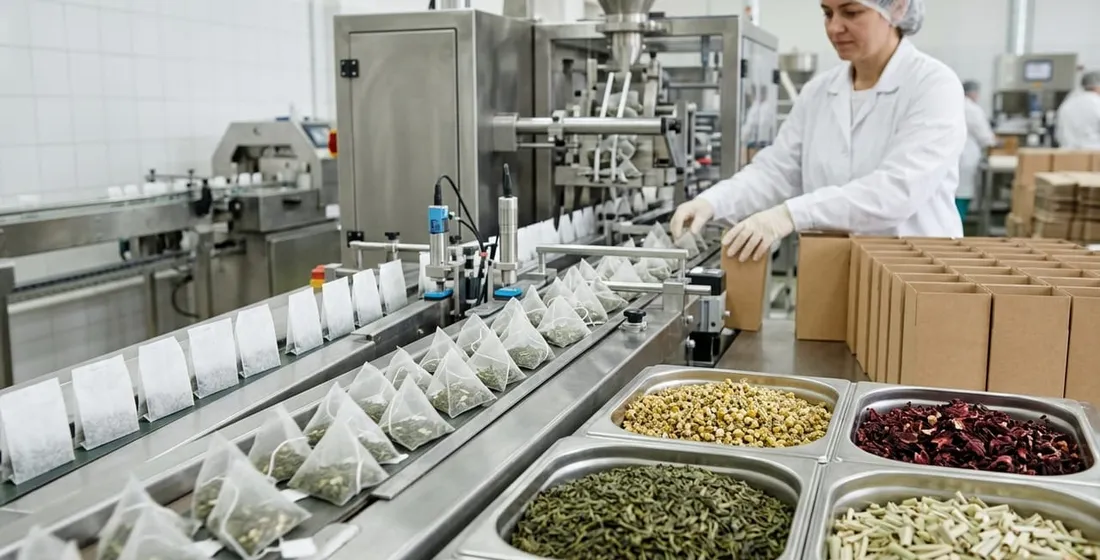
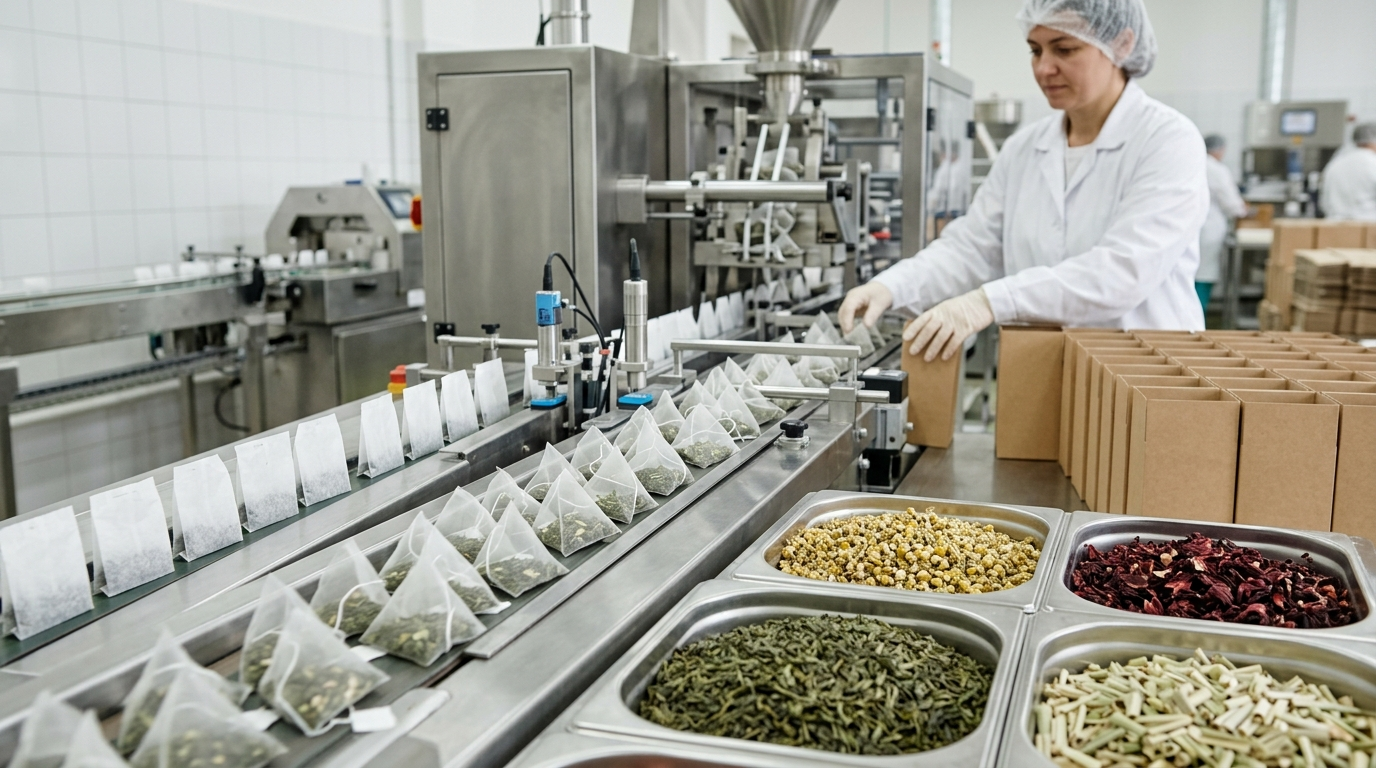
Co-packing is the bulk-to-retail conversion step. The distributor supplies the bulk tea or herbal blend, already legally imported, and the SFC team fills it into tea bags, cartons it, and labels it to a retail spec. For an organic claim to survive onto the shelf, the organic certification has to carry through the handler, not just the raw material, so the chain-of-custody documents matter as much as the leaf.
The run itself is a short sequence:
- Incoming QA: moisture, foreign matter, and a check of the organic chain-of-custody and import documents against the bulk that arrived.
- Tea-bagging in the chosen format: pyramid, round paper, string and tag, or filter paper.
- Enveloping and cartoning to the retail count.
- Labelling to the Sri Lanka Food Act spec, including country of origin and repackaging dates.
- SLSI submission support for shelf eligibility.
The format choice is a cost and positioning decision, not a detail. Pyramid bags signal a higher-end product and suit whole-leaf green tea and botanical blends; round paper and string-and-tag formats are the everyday retail and gifting workhorses. Settling the format early keeps the co-packing run on a single production block instead of a stop-start changeover.
What must the label carry for a repacked imported tea?
Sri Lanka’s Food (Labelling and Advertising) Regulations 2022 require imported food to show the country of origin and the importer’s name and address, and where food is imported in bulk and then repackaged, both the date of manufacture and the date of repackaging must appear; the rules phase to full effect by 1 January 2026 (USDA Foreign Agricultural Service, 2024).
For an imported tea co-packed locally, that means the carton names where the tea was grown and packed, not just a local brand. An organic claim is only printable when the certification is current and held through the repacker, so USDA Organic or EU Organic status follows the SKU rather than the brand name. Getting the label right the first time avoids a re-print and a re-listing, which is the same logic that runs through the certification stack for a Sri Lankan FMCG launch.
What does a first tea co-packing run cost in formats and lead time?
Service snapshot
Service: Co-packing (buyer-supplied finished goods, packed and labelled) for imported tea and herbal infusions
Formats: pyramid, round paper, string and tag, and filter-paper tea bags; enveloping, cartoning, and retail labelling
Lead time: typically 1 to 2 weeks once the bulk goods arrive at the Matale facility and the import and organic documents clear
Cert coverage: BRCGS- and FSSC 22000 V6-audited, with SLSI clearance and Sri Lanka Food Act compliance on every retail SKU; USDA Organic and EU Organic carried per SKU where the tea is certified organic
Consolidation: multiple imported tea and infusion SKUs can run through one packing block
The economics favour consolidation. A distributor bringing in three or four organic and herbal lines does not need a separate run for each; a single packing block can move from one format to the next, which spreads the setup over more SKUs and keeps the per-unit cost honest. One distributor running a small wellness-tea range found the saving was not in the bag price at all. It was in clearing several SKUs through one SLSI submission and one labelling pass rather than treating each as its own project. That same consolidation logic is what makes co-packing for supermarket and hotel gift-shop SKUs pencil for a mixed range.
Frequently asked questions
Can Silk Foods Ceylon co-pack imported tea into retail tea bags?
Yes. Silk Foods Ceylon co-packs imported tea and herbal infusions into retail tea bag SKUs at the Matale facility, across pyramid, round paper, string and tag, and filter-paper formats, with cartoning and labelling. Lead time is typically 1 to 2 weeks once the bulk goods and documents clear, under a BRCGS- and FSSC 22000 V6-audited cert stack with SLSI clearance.
Do you need a licence to import tea into Sri Lanka?
For tea, yes. The Sri Lanka Tea Board licenses tea imports, which are bulk only, restricted to registered importers and permitted varieties (Sri Lanka Tea Board, 2025). Herbal infusions such as chamomile or rooibos are not tea under the Tea Control Act, so they import under SLSI and the Sri Lanka Food Act without a Tea Board licence.
Are herbal teas regulated like tea in Sri Lanka?
No. Under the Tea Control Act, tea means Camellia sinensis. A chamomile, peppermint, hibiscus, or rooibos infusion is a tisane, outside Tea Board jurisdiction, and runs under SLSI and the Sri Lanka Food Act like any packaged food. That usually makes a herbal blend the faster first SKU for a distributor entering the local shelf.
What must the label on a repacked imported tea show?
Country of origin and the importer’s name and address, and for bulk imported then repackaged, both the date of manufacture and the date of repackaging (Food (Labelling and Advertising) Regulations 2022, per USDA Foreign Agricultural Service, 2024). An organic claim is printable only where the organic certification is held through the repacker.
How long does a tea co-packing run take at Silk Foods Ceylon?
For an imported bulk tea or herbal blend with documents in order, a co-packing run is typically 1 to 2 weeks once the goods arrive at the Matale facility. Settling the tea bag format and the label spec before the bulk lands is what keeps the run on a single block.
How Silk Foods Ceylon can help
For distributors converting imported bulk into Sri Lankan retail-ready SKUs, Silk Foods Ceylon (SFC) operates a dedicated co-packing capability at the Matale facility. The buyer supplies the imported tea or herbal blend; the SFC team handles tea-bagging across pyramid, paper, and string-and-tag formats, cartoning, labelling, and SLSI submission support under the Sri Lanka Food Act framework, including country-of-origin and repackaging-date compliance. Co-packing lead time is typically 1 to 2 weeks once goods arrive, and a multi-SKU range runs through one block. The BRCGS and FSSC 22000 V6 cert stack on the repacker side reassures retail procurement on the audit chain, with USDA Organic and EU Organic carried per SKU where the tea is certified organic.
To brief a co-packing or consolidation plan, email b2b@esilkroute.com.lk or call +94 76 441 0389 / +94 76 918 5744.
Sources
- Daily FT (2026), “Tea exports top $1.5b in 2025 despite price pressures” (Forbes & Walker Research data). https://www.ft.lk/front-page/Tea-exports-top-1-5-b-in-2025-despite-price-pressures/44-787299 (retrieved 2026-06-24)
- Sri Lanka Tea Board (2025), “Legal and Statutory Information” (tea import licensing and registration framework). https://srilankateaboard.lk/sri-lanka-tea-board/legal-and-statutory-information/ (retrieved 2026-06-24)
- Tea Control Act, Laws of Sri Lanka (registration of tea manufacturers and factories; made tea must be produced in a registered factory). https://www.srilankalaw.lk/t/1273-tea-control-act.html (retrieved 2026-06-24)
- USDA Foreign Agricultural Service (2024), “Sri Lanka Enacts New Legislation for Food Labeling and Advertising,” documenting the Food (Labelling and Advertising) Regulations 2022. https://www.fas.usda.gov/data/sri-lanka-sri-lanka-enacts-new-legislation-food-labeling-and-advertising (retrieved 2026-06-24)
- IMARC Group (2025), “Organic Tea Market Size, Industry Growth, Report 2034.” https://www.imarcgroup.com/organic-tea-market (retrieved 2026-06-24)
- Towards FnB (2025), “Herbal Tea Market Size, Growth, and Trends 2025 to 2035.” https://www.towardsfnb.com/insights/herbal-tea-market (retrieved 2026-06-24)
Written by the Silk Foods Ceylon Team. Silk Foods Ceylon (Pvt) Ltd. is a BRCGS- and FSSC 22000 V6-audited contract manufacturer in Matale, Sri Lanka, offering contract manufacturing, private labelling, co-packing, and in-house R&D for local Sri Lankan brand owners, FMCG companies, hotel and restaurant groups, and distributors. To brief a project: b2b@esilkroute.com.lk, +94 76 441 0389, or +94 76 918 5744.