Co-Packing Oats and Dates for Sri Lankan Health-Food Retail
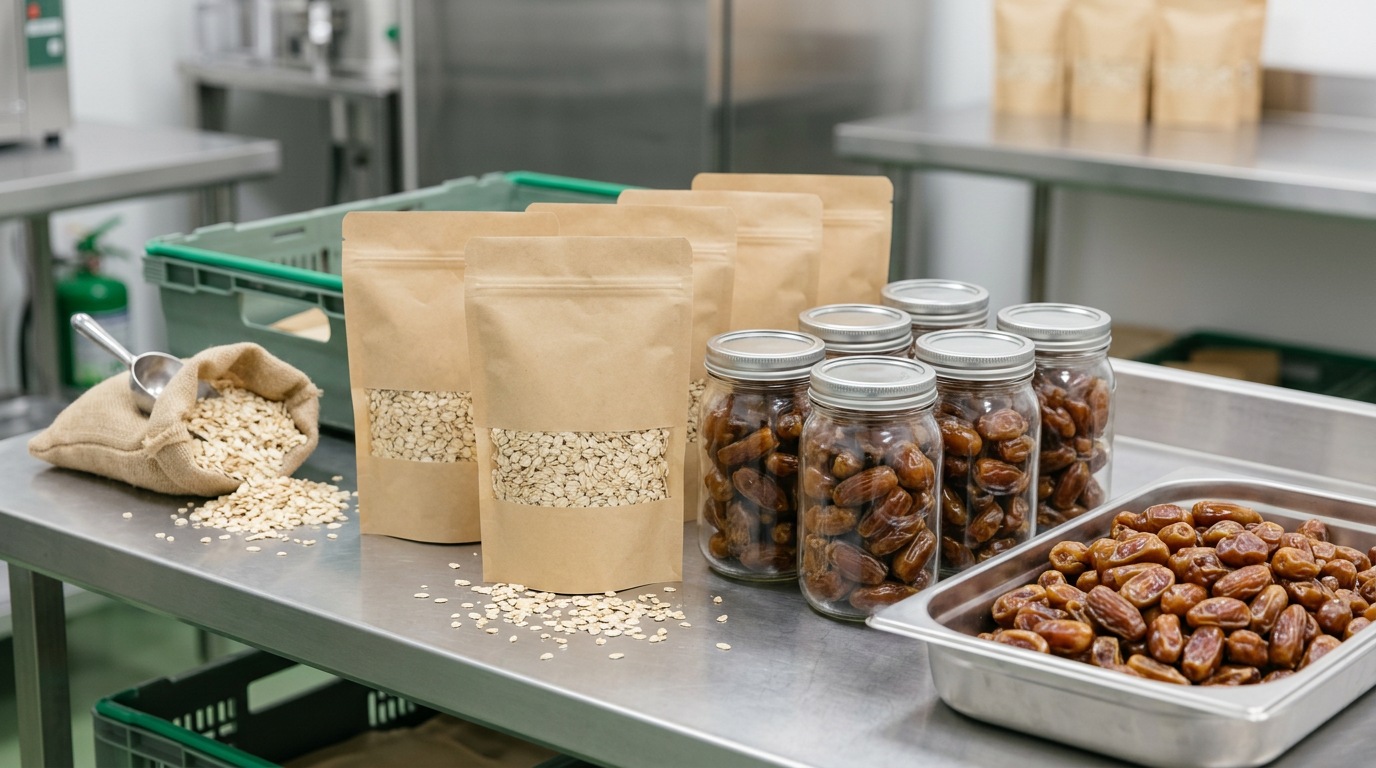
Buyer’s snapshot
- Sri Lanka imported roughly 20 million kg of oats in 2023, up about 37% on the prior year (IndexBox, 2025). Almost all of it lands as bulk and needs converting into retail-ready packs.
- Dates run on a sharp seasonal curve. Sri Lanka now buys close to 39% of Pakistan’s dry-fruit exports (The Express Tribune, 2025), and Ramadan gifting demand concentrates much of the year’s volume into a few weeks.
- For a distributor, the gap between a bulk import and a shelf SKU is not the product. It is packing, labelling, and a clean audit trail.
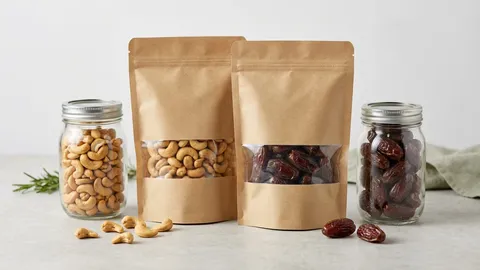
- Silk Foods Ceylon (SFC) co-packs buyer-supplied oats and dates into kraft pouches from 50 g to 1 kg or glass jars from 50 ml to 1 L, BRCGS- and FSSC 22000 V6-audited, with SLSI submission inside a co-packing engagement.
- See the pouch-versus-jar matrix below before you brief a run.
Most oats and dates on a Sri Lankan shelf started life in a 25 kg sack or a 5 kg carton. Oats arrive bulk from Canada, Australia, or India. Dates arrive bulk from Pakistan or the Gulf re-export trade. Somewhere between the container and the supermarket aisle, that bulk has to become a 500 g pouch or a 400 g jar with a compliant tri-lingual label and a date code that holds up to inspection. That conversion step is co-packing, and for a distributor it is usually the part that decides whether a margin survives.
This post is for the local distributor or importer holding bulk stock and deciding how to get it onto the health-food shelf. It walks through what co-packing covers for oats and dates, how to match format to channel, what the new labelling rules require for repacked imports, and how a consolidated run is scheduled.
Why oats and dates are a co-packing opportunity right now
Sri Lanka’s bread and cereal category is growing on the back of rising health consciousness and stronger demand for whole-grain options (Statista, 2025). Oats sit at the centre of that shift, and import volume reflects it: roughly 20 million kg landed in 2023, a jump of about 37% year on year (IndexBox, 2025). The product is already in the country. The value sits in the conversion.
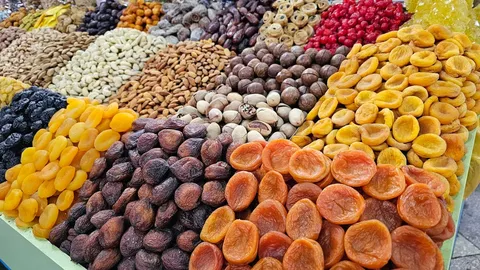
Dates tell a different story with the same conclusion. Demand is seasonal and intense, concentrated around Ramadan, when gifting and iftar consumption pull volume forward. Sri Lanka has become a significant buyer in the regional dry-fruit trade, taking close to 39% of Pakistan’s dry-fruit exports (The Express Tribune, 2025). A distributor who imports a season’s worth of dates in bulk needs a packing partner who can turn that stock around fast, often inside a tight window, into gift-ready jars and pouches. This is where co-packing at Silk Foods Ceylon fits the distributor model.
What does co-packing actually cover for imported oats and dates?
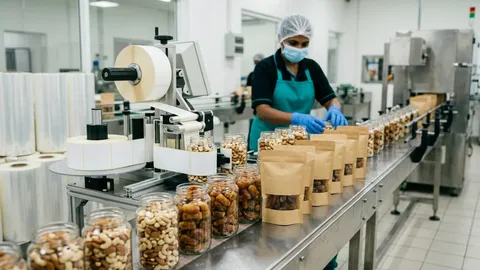
Co-packing is the back end of the production chain. The buyer supplies finished goods, in this case bulk oats or dates that need no further processing, and the manufacturer packs, seals, and labels them into retail formats. Silk Foods Ceylon handles the conversion at its Matale facility under the same cert stack that covers its contract-manufacturing work, which is what keeps the repacked SKU credible at a procurement desk.
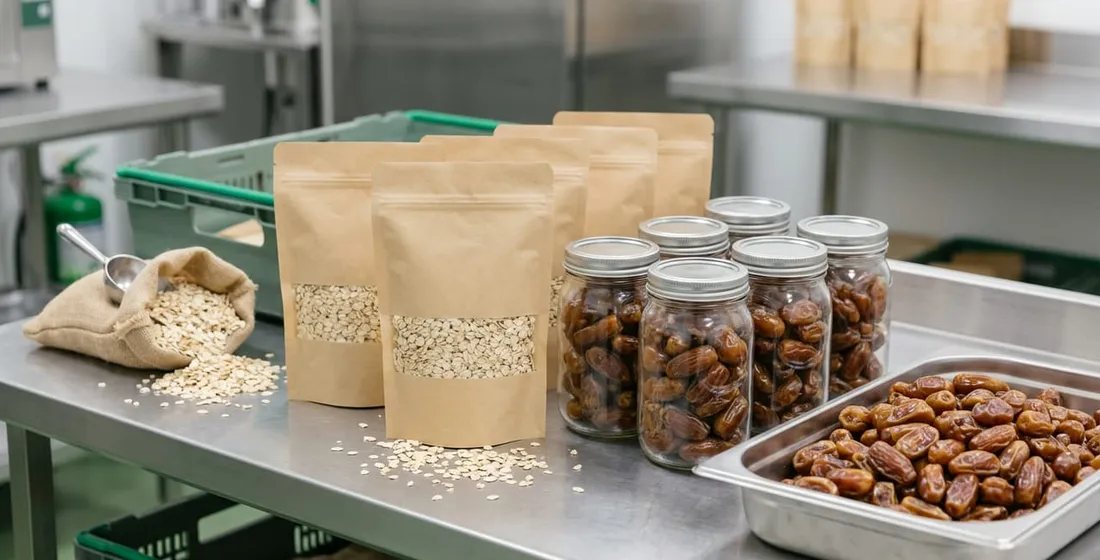
For oats, a typical co-packing run covers de-sacking, weighing to a target fill (250 g, 500 g, 1 kg are the common health-food retail weights), pouch or jar filling, heat sealing or capping, and label application. For dates, the run adds sorting and a hygiene-controlled fill, since dates are higher-moisture and stickier than a dry grain. Both formats finish with a date code and the compliant label panel. Nothing about the product changes. What changes is that it becomes a unit a shelf can stock and a buyer’s brand can own.
The lean-route argument matters here. Many Sri Lankan distributors run their repacking through one or two layers of informal co-packers, often operators without a current food-safety audit. The invoice looks cheaper. The risk sits downstream, in a delayed SLSI clearance or a re-listing problem when a retail buyer asks for the manufacturer’s audit history.
Pouch or jar? Matching format to the health-food shelf
The format decision is a margin and merchandising decision, not a packaging preference. Kraft pouches are lighter, cheaper per unit, and read as natural and health-positioned, which suits oats and everyday date packs. Glass jars cost more and weigh more, but they signal premium and reseal well, which suits gifting-grade dates and the higher price points in the health-food and diaspora gifting channels.
| Factor | Kraft pouch | Glass jar |
|---|---|---|
| Best fit | Oats, everyday date packs, value and mid tier | Gifting-grade dates, premium oats, diaspora and gift channels |
| Typical fill | 250 g, 500 g, 1 kg | 250 g, 400 g, 500 g |
| Unit cost | Lower | Higher |
| Shelf signal | Natural, health-positioned | Premium, reseal, gift-ready |
| Weight and freight | Light | Heavy |
| Co-packing line | Pouch fill and heat seal | Jar fill and cap |
SFC co-packs across the full range a distributor is likely to need: kraft pouches at 50 g, 100 g, 250 g, 500 g, and 1 kg, and glass jars from 50 ml through 220, 330, and 500 ml to 1 L. A consolidated brief often uses both, a pouch line for the value oats SKU and a jar line for the gifting date SKU, run in the same production block. The packaging options for a co-packed SKU guide covers the full format list.
What the 2025 to 2026 labelling rules mean for repacked imports
The labelling rules around packaged food in Sri Lanka are tightening. The Food (Labelling and Advertising) Regulations 2022 replace the 2005 framework, and after several extensions the core provisions now take effect from 1 January 2026 (USDA Foreign Agricultural Service, 2025). Restrictions on marketing food to children already applied from 1 January 2025 (Daily Mirror, 2024). For a distributor repacking imported bulk, the practical points are specific and worth planning around.
A repacked imported SKU carries a heavier label burden than a domestically made one. Common names must appear in bold across the tri-lingual convention, the country of origin and the importer’s name and address must be declared, and for food imported in bulk and repackaged, both the date of manufacture and the date of repackaging must be labelled. That double-date requirement catches distributors out more than any other line in the regulation, because it means the repacking date itself becomes a compliance field, not just an internal record. Building the label artwork and the SLSI submission around the rule before the run, rather than after, is the difference between a clean listing and a reprint.
How is a consolidated co-packing run scheduled?
Once finished goods arrive at the Matale facility, a co-packing run for an existing format typically moves from intake to dispatch in one to two weeks, depending on volume and how many SKUs share the block. The schedule covers goods-in and weight verification, line setup for the chosen format, the fill and seal run, label application, QA hold, and SLSI documentation support. A single 1,000 kg sack of oats yields roughly 2,000 retail pouches at a 500 g fill, so even a modest bulk position converts into a meaningful SKU count in one block.
Consolidation is where the economics improve. Running several imported SKUs, oats in pouches, dates in jars, a nut line alongside, through one packing block on one audit spreads the setup and compliance cost across more units. The R&D and operations team at the facility sees the same pattern often: a distributor arrives with three separate bulk imports and three separate informal packers, and the consolidation onto one audited line removes both the coordination overhead and the audit-chain gaps that show up later at a procurement review. The consolidated co-packing for distributors approach is the standard route for a multi-SKU distributor.
Service snapshot: Co-Packing at Silk Foods Ceylon
- Service: buyer supplies finished goods (bulk oats, dates, nuts, spices); SFC packs, seals, labels.
- Formats: kraft pouches 50 g to 1 kg; glass jars 50 ml to 1 L; capsule bottles; tin cans.
- Lead time: typically 1 to 2 weeks from goods-in to dispatch for an existing format.
- Cert coverage: BRCGS- and FSSC 22000 V6-audited, with SLSI clearance and Sri Lanka Food Act compliance on every retail SKU.
- Compliance: SLSI submission support, including the bulk-repack double-date requirement, built into the engagement.
Co-packing or private labelling: which fits oats and dates?
The two services answer different questions. Co-packing fits a distributor who already holds the product and needs it packed and labelled. Private labelling fits a buyer who wants an SFC-formulated product under their own brand without holding any stock. For imported oats and dates, co-packing is almost always the right route, since the distributor’s value is the import relationship and the bulk position, not a recipe. Where a buyer wants a blended product, a date-and-oat breakfast mix, or a flavoured oat SKU, the conversation shifts toward R&D and contract manufacturing instead. The co-packing or private labelling comparison sets out each route in detail.
FAQ
What does the co-packing service at Silk Foods Ceylon include for imported oats and dates?
SFC co-packs buyer-supplied bulk into retail formats: de-sacking, weighing, pouch or jar filling, sealing, labelling, and date coding. Formats run from 50 g kraft pouches to 1 L glass jars. The facility is BRCGS- and FSSC 22000 V6-audited, with SLSI submission support included in a standard co-packing engagement.
How long does a co-packing run take once bulk stock arrives?
For an existing format, a co-packing run at the Matale facility typically moves from goods-in to dispatch in one to two weeks, depending on volume and the number of SKUs sharing the production block. Consolidating several imported SKUs into one block shortens the overall timeline and spreads compliance cost.
What do the new labelling rules require for repacked imported food in Sri Lanka?
Under the Food (Labelling and Advertising) Regulations 2022, core provisions effective 1 January 2026 (USDA FAS, 2025), repacked imports must declare country of origin, importer name and address, tri-lingual common names in bold, and both the date of manufacture and the date of repackaging.
Is the co-packing line SLSI cleared and food-safety audited?
Yes. The Matale facility holds BRCGS and FSSC 22000 V6 audits, with SLSI clearance and Sri Lanka Food Act compliance applied to every retail SKU. That audit chain is what retail procurement asks for on the repacker side, and it is the value a current audit adds over an informal co-packer.
Can a distributor consolidate several imported SKUs into one co-packing run?
Yes. Running oats, dates, and adjacent lines through one packing block on one audit is the standard consolidation pattern at SFC. It spreads setup and compliance cost across more units and removes the audit-chain gaps that come from splitting work across several informal packers.
How Silk Foods Ceylon can help
For distributors converting imported bulk such as oats, dates, almonds, and cashews into Sri Lankan retail-ready SKUs, Silk Foods Ceylon (SFC) operates a dedicated co-packing capability at the Matale facility. The buyer supplies finished goods; the SFC team handles packing, labelling, and SLSI submission support under the Sri Lanka Food Act labelling framework, including the bulk-repack double-date requirement. Packaging options span 50 g to 1 kg kraft pouches and glass jars from 50 ml to 1 L. The BRCGS and FSSC 22000 V6 cert stack on the repacker side reassures retail procurement on the audit chain, alongside the certification stack for a Sri Lankan FMCG launch. Lead times run one to two weeks once finished goods reach the facility.
To brief a co-packing or consolidation plan, email b2b@esilkroute.com.lk or call +94 76 441 0389 or +94 76 918 5744.
Sources
IndexBox. “Sri Lanka’s Oat Market Report 2025: Prices, Size, Forecast.” 2025. https://www.indexbox.io/store/sri-lanka-oats-market-analysis-forecast-size-trends-and-insights/ (retrieved 2026-06-15)
The Express Tribune. “Pakistan turns to Sri Lanka for dry date exports.” 2025. https://tribune.com.pk/story/2028954/pakistan-turns-sri-lanka-dry-date-exports (retrieved 2026-06-15)
USDA Foreign Agricultural Service. “Sri Lanka Extends Implementation of the Food Labeling and Advertising Regulations-2022.” 2025. https://www.fas.usda.gov/data/sri-lanka-sri-lanka-extends-implementation-food-labeling-and-advertising-regulations-2022-0 (retrieved 2026-06-15)
Daily Mirror. “New labelling, advertising rules leave confectionery industry in sticky situation.” 2024. https://www.dailymirror.lk/breaking-news/New-labelling-advertising-rules-leave-confectionery-industry-in-sticky-situation/108-298518 (retrieved 2026-06-15)
Statista. “Breakfast Cereals: Sri Lanka.” 2025. https://www.statista.com/outlook/cmo/food/bread-cereal-products/breakfast-cereals/sri-lanka (retrieved 2026-06-15)
Written by the Silk Foods Ceylon Team. Silk Foods Ceylon (Pvt) Ltd. is a BRCGS- and FSSC 22000 V6-audited contract manufacturer in Matale, Sri Lanka, offering contract manufacturing, private labelling, co-packing, and in-house R&D for local Sri Lankan brand owners, FMCG companies, hotel and restaurant groups, and distributors. To brief a project: b2b@esilkroute.com.lk, +94 76 441 0389, or +94 76 918 5744.