Co-packing for supermarket and hotel gift-shop SKUs in Sri Lanka
Channel snapshot
- Sri Lanka’s modern grocery trade is growing about 6.2% a year through 2031, and the leading chains now run own-label ranges in the hundreds of SKUs (6Wresearch, 2025).
- A record 2.36 million tourists arrived in 2025, up 15.1% year on year (SLTDA, 2025), which keeps hotel-property gift shops stocked with branded local-food SKUs.
- The gap between imported bulk and a shelf-ready own-label pack is usually packing and labelling, not the product.
- Silk Foods Ceylon (SFC) co-packs buyer-supplied goods in Matale under a BRCGS- and FSSC 22000 V6-audited cert stack, with SLSI clearance on every retail SKU.
Sri Lanka’s modern grocery trade now sits at roughly a fifth to a quarter of total grocery sales, and it is growing at about 6.2% a year through 2031 (6Wresearch, 2025). The chains that run that trade increasingly sell own-label ranges, several hundred SKUs deep on the larger fascias. For a distributor importing almonds, dates, oats, or spices in bulk, the demand signal is clear: the channel wants retail-ready packs, under its own label or the importer’s. The bottleneck between a 25 kg sack and that shelf pack is rarely the product. It is the packing, the label, and the certification chain behind both.
What co-packing actually does for a supermarket or gift-shop SKU
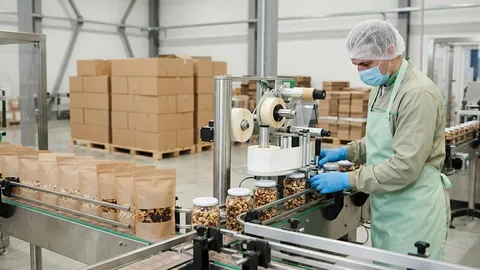
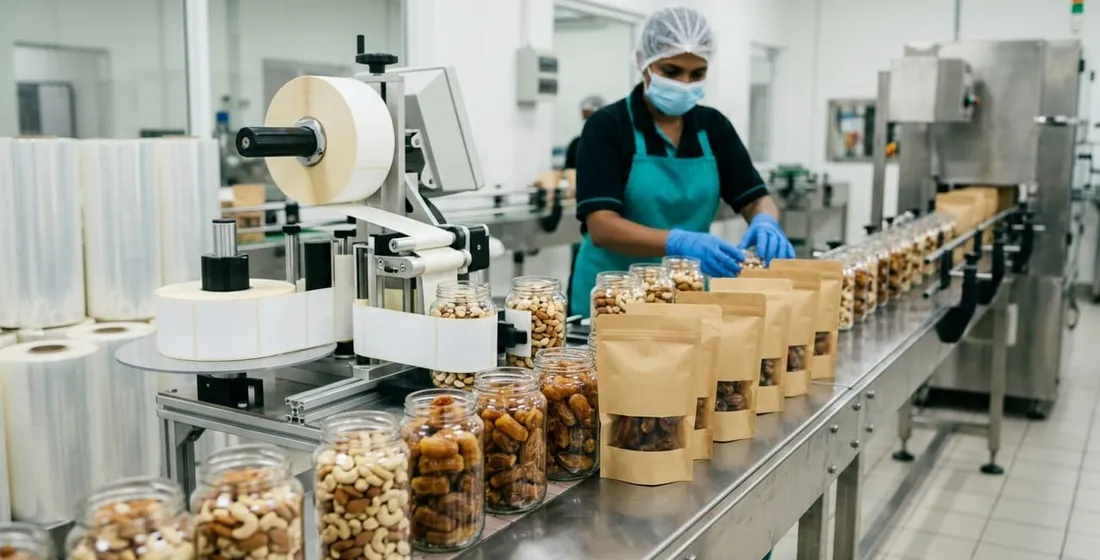
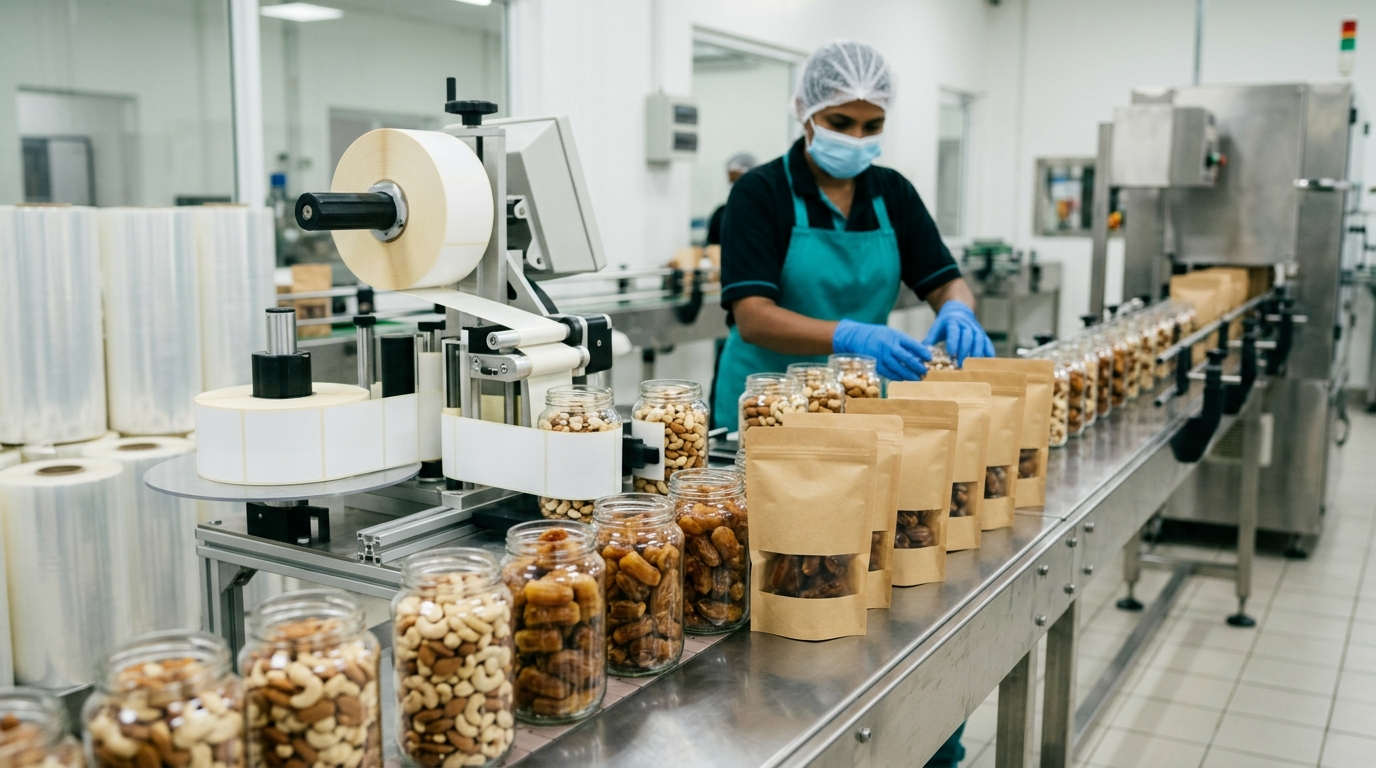
Co-packing is the back-end service where the buyer supplies finished goods and the manufacturer packs, seals, and labels them into retail-ready formats. The buyer owns the product; the packer owns the format, the line, and the compliance step. It is not contract manufacturing, where the recipe is made from scratch, and it is not private labelling, where the formulation is the manufacturer’s own.
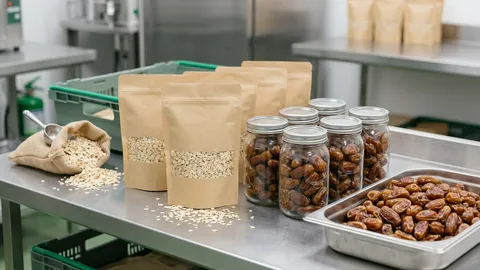
For a supermarket or a hotel-property gift shop, that distinction matters on cost and on time. A distributor who already imports a stable bulk product does not need a recipe developed. What they need is a clean conversion: 25 kg of imported dates into hundreds of 250 g pouches that scan at the till, carry a compliant label, and come off a line a retail buyer can audit. That bulk-to-retail conversion is where co-packing at Silk Foods Ceylon sits in the chain.
Why are supermarket and gift-shop buyers asking for own-label packs?
Own-label is no longer a discount play. Globally, private brands now account for more than 45% of grocery volume and over 20% of consumer-packaged-goods value, and half of shoppers say they buy more own-label than ever before (NIQ, 2024). Sri Lanka’s modern trade is following the same curve, which is why the larger chains keep widening their house ranges.
The hotel channel adds a second pull. With a record 2.36 million arrivals in 2025 and a government target of three million for 2026 (SLTDA, 2025), hotel-property gift shops have more footfall for branded local-food SKUs: spice blends, treacle, cashews, tea. Most of those gift SKUs are imported or locally sourced in bulk, then packed and labelled under the property’s own brand. That conversion is co-packing work. The demand is real, and it lands on whoever can pack to a retail-grade standard.
The labelling rule that catches most repacked imported SKUs
This is the step distributors miss most. Under Sri Lanka’s Food (Labelling and Advertising) Regulations 2022, phased to full effect by 1 January 2026, imported food must carry the country of origin plus the importer’s name and address. For food imported in bulk and repackaged locally, the label must show both the date of manufacture and the date of repackaging (USDA Foreign Agricultural Service, 2024, documenting the Ministry of Health regulations).
That second clause trips up first-time repackers. A bulk sack carries one manufacture date; the retail pack created from it carries a second, the repackaging date, and both have to appear. Add the three-language convention and allergen disclosure, and the label becomes the part of the project most likely to delay a shelf date. Getting it right at artwork stage is cheaper than a reprint after a retail buyer or an SLSI desk officer sends it back. The maths there is not subtle.
Supermarket shelf vs hotel gift-shop: how the co-pack spec differs
The two channels look similar from the outside and diverge fast once you spec a pack. A supermarket SKU is built for scanning, price-tier fit, and distribution turnover across many outlets. A gift-shop SKU is built for presentation, provenance, and a slower sell-through in a single property or group.
| Spec point | Supermarket shelf SKU | Hotel-property gift-shop SKU |
|---|---|---|
| Typical pack format | 250 g to 1 kg kraft pouch, or 220 to 500 ml glass jar | 50 to 220 g jar, or 100 to 250 g pouch, gift weight |
| First-run volume | Higher; full shelf facing across outlets | Lower; single-property or group programme |
| Label priority | Barcode, net weight, country of origin, price-tier fit | Brand story, provenance, country of origin, gift presentation |
| Barcode (GTIN) | Required for till scanning | Often required; sometimes a property-internal SKU |
| Audit ask on the packer | Current FSSC 22000 audit increasingly expected | Food-safety audit (FSSC or HACCP) plus allergen disclosure |
| Shelf-life expectation | Set for distribution cycle | Set for slower gift-shop turnover |
The same imported bulk product can serve both channels. What changes is the pack weight, the artwork, and the run size, which is exactly what a co-packing line is set up to vary.
How does consolidation cut the cost per SKU?
The cost lever in co-packing is consolidation. Running several imported SKUs through one packing line in a single production block spreads the fixed costs, the line setup, the changeover, and the audit overhead across more units, so the cost per pack falls. For a distributor with four or five imported lines, that is the difference between a viable own-label programme and a margin that disappears into setup fees.
Service snapshot
Co-Packing at the Matale facility
Service: SFC packs, seals, and labels buyer-supplied finished goods into retail-ready formats
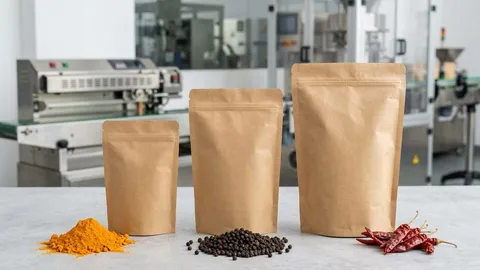
Packaging options: 50 g to 1 kg kraft pouches; glass jars from 50 ml to 1 L; round tin cans at 400 ml; 60-count capsule bottles
Lead time: typically 1 to 2 weeks once finished goods arrive at the facility
Consolidation: multiple imported SKUs run on one line in a single production block
Cert coverage: BRCGS- and FSSC 22000 V6-audited, with SLSI clearance and Sri Lanka Food Act compliance on every retail SKU
One Colombo distributor importing bulk dates and almonds came to the Matale facility with four formats in mind: a 1 kg supermarket pouch, a 500 g pouch, a 250 g pouch, and a 100 g gift jar for a hotel-property programme. Run as four separate jobs, each would have carried its own setup. Consolidated into one production block on a shared label-and-seal setup, the per-pack cost dropped enough to keep all four price tiers on the table. The unlock was scheduling, not a discount.
What to have ready before you brief a co-packer
A co-packing brief moves faster when the documentation is ready. Before booking a line, have these in hand.
- Import documentation for the bulk product: permit, country of origin, and the supplier’s certificate of analysis.
- The retail format and pack weight you want for each channel.
- A view on whether the SKU falls in an SLS-mark category and needs an SLSI submission.
- Label artwork in the three-language framework, with country of origin and importer details.
- A barcode (GTIN) allocation for any SKU that will scan at a till.
- The target shelf-life and storage condition for the chosen format.
- Volumes per SKU, so consolidation can be scheduled across a single block.
- Allergen information for the label.
The first three are where most delays start. A clear answer on SLSI and on the repackaging-date label removes the two most common reasons a co-packed SKU gets held before a shelf date.
Frequently asked questions
Does Silk Foods Ceylon offer co-packing for supermarket and hotel gift-shop SKUs?
Yes. Silk Foods Ceylon co-packs buyer-supplied finished goods into retail-ready formats for both channels at its Matale facility. Packaging runs from 50 g kraft pouches to 1 L glass jars, lead time is typically 1 to 2 weeks once goods arrive, and the line is BRCGS- and FSSC 22000 V6-audited with SLSI clearance on every retail SKU.
Do repacked imported foods need a country-of-origin label in Sri Lanka?
Yes. Under the Food (Labelling and Advertising) Regulations 2022, phased to full effect by 1 January 2026, imported food must show the country of origin and the importer’s name and address. Bulk food repackaged locally must also carry both the date of manufacture and the date of repackaging (USDA Foreign Agricultural Service, 2024).
What packaging formats can SFC co-pack into?
The co-packing line handles 50 g to 1 kg kraft pouches, glass jars from 50 ml to 1 L, round tin cans at 400 ml, and 60-count capsule bottles. The same imported bulk product can be split across several formats and pack weights in one production block, which is how a distributor serves a supermarket shelf and a hotel gift shop from one run.
How long does a co-packing run take at SFC?
A co-packing run is typically 1 to 2 weeks from the point finished goods arrive at the Matale facility, depending on format count and label readiness. Consolidating several SKUs into a single block shortens the total timeline against running each as a separate job, since the line setup and audit overhead are shared.
How Silk Foods Ceylon can help
For distributors converting imported bulk (almonds, cashews, dates, oats, spices) into Sri Lankan retail-ready SKUs, Silk Foods Ceylon (SFC) operates a dedicated co-packing capability at the Matale facility. The buyer supplies finished goods; the SFC team handles packing, labelling, and SLSI submission support under the Sri Lanka Food Act labelling framework. Packaging options span 50 g to 1 kg kraft pouches, glass jars from 50 ml to 1 L, and 60-count capsule bottles, with a typical 1 to 2 week lead time once goods arrive. The BRCGS and FSSC 22000 V6 cert stack on the repacker side reassures supermarket and hotel-group procurement on the audit chain.
To brief a co-packing or consolidation plan, email b2b@esilkroute.com.lk or call +94 76 441 0389 / +94 76 918 5744.
Sources
- USDA Foreign Agricultural Service (2024), “Sri Lanka Enacts New Legislation for Food Labeling and Advertising,” documenting the Ministry of Health Food (Labelling and Advertising) Regulations 2022. https://www.fas.usda.gov/data/sri-lanka-sri-lanka-enacts-new-legislation-food-labeling-and-advertising (retrieved 2026-06-21)
- 6Wresearch (2025), “Sri Lanka Food & Grocery Retail Market (2025-2031) Outlook.” https://www.6wresearch.com/industry-report/sri-lanka-food-grocery-retail-market-outlook (retrieved 2026-06-21)
- Sri Lanka Tourism Development Authority (2025), “Year in Review 2025.” https://www.sltda.gov.lk/ (retrieved 2026-06-21)
- Daily FT (2026), “Tourism arrivals grow by 15% to 2.36 m record high in 2025.” https://www.ft.lk/top-story/Tourism-arrivals-grow-by-15-to-2-36-m-record-high-in-2025/26-786582 (retrieved 2026-06-21)
- NielsenIQ (2024), “The rise of private labels: a global perspective on growth and consumer trends.” https://nielseniq.com/global/en/insights/analysis/2024/the-rise-of-private-labels-a-global-perspective-on-growth-and-consumer-trends/ (retrieved 2026-06-21)
Written by the Silk Foods Ceylon Team. Silk Foods Ceylon (Pvt) Ltd. is a BRCGS- and FSSC 22000 V6-audited contract manufacturer in Matale, Sri Lanka, offering contract manufacturing, private labelling, co-packing, and in-house R&D for local Sri Lankan brand owners, FMCG companies, hotel and restaurant groups, and distributors. To brief a project: b2b@esilkroute.com.lk, +94 76 441 0389, or +94 76 918 5744.