Contract Manufacturing Dehydrated Fruit Snack SKUs in Sri Lanka
Buyer's snapshot
|
Sri Lanka’s snack food market is projected to grow by close to 10% a year, reaching roughly US$1.37 billion by 2029, and the fastest-moving part of that shelf is natural, fruit-based snacking rather than fried or confectionery formats (Statista Market Forecast, 2025; Euromonitor, 2025). For a local FMCG brand owner, dried pineapple, mango, and banana sit in a useful spot. The raw fruit is grown here, the format reads as healthy, and a 40 g pouch carries a margin that fresh fruit never will. The gap between that opportunity and a shelf-ready SKU is rarely the fruit. It is the drying spec, the moisture control, and the audit chain a packaged food has to carry. Silk Foods Ceylon (SFC), a BRCGS- and FSSC 22000 V6-audited contract manufacturer in Matale, produces dehydrated-fruit SKUs to a buyer’s cut and moisture spec.
Why dried fruit is a live snack category for Sri Lankan brands now
Dehydrated fruit has become one of the more active local snack categories because demand and raw material line up. Sri Lanka’s snack food market is projected to grow about 9.76% a year to roughly US$1.37 billion by 2029, led by natural and fruit-based formats (Statista Market Forecast, 2025). Pineapple, mango, and banana are all grown locally, which shortens the supply line to the drying floor.
The processing know-how is already in the country. Sri Lanka exports dehydrated pineapple, mango, and papaya to the UK, the USA, Australia, Spain, and the Maldives, in rings, strips, tidbits, and dices (Sri Lanka Export Development Board). What is newer is local brand owners building their own retail snack SKUs instead of only shipping dried fruit in bulk for a foreign packer to brand. The local opportunity is the inversion of the export story: keep the cut, the pack, and the brand at home, and the value-add stays with the Sri Lankan brand rather than the overseas re-packer.
When the same fruit is destined for a beverage, bakery, or dairy application rather than a snack, the format usually shifts from pieces to powder. That is a different line and a different spec, covered in spray-dried fruit powder contract manufacturing.
What does contract manufacturing dehydrated fruit actually involve?
Contract manufacturing dehydrated fruit means the buyer brings the product brief, the cut, and the pack spec, and the manufacturer runs the washing, sorting, slicing, drying, and packing at scale. At Silk Foods Ceylon, that sequence is the co-processing layer within contract manufacturing (Washing, Sorting, Grading, Drying, Grinding, per the SFC brochure). The recipe and the brand stay the buyer’s; the line, the moisture control, and the SLSI submission move to the factory.
The run starts at fruit intake from local growers, then peeling and coring for pineapple, and slicing to the chosen cut. A pre-treatment decision comes next: whether the fruit is dried with no added sugar, infused with a sugar syrup for a softer chew, or treated with a sulphite to hold colour. The fruit then dries to a target moisture, conditions to even out, passes a metal detector, and packs into the buyer’s pouch or jar. Because the Matale facility runs a cellular-manufacturing layout, a dried-fruit run books drying and packing capacity in a block rather than tying up a single-purpose line.
The most common question on a first brief is whether to add sugar. A no-added-sugar pineapple ring is the cleaner label and the easier health claim, but it dries harder and reads tart; a lightly infused mango strip sells on chew. That trade-off is a recipe decision the buyer owns, and it is the kind of adjustment the in-house team works through when a home sample needs scaling, as in reformulating a kitchen recipe for batch consistency.
Which cuts and formats fit which snack SKU?
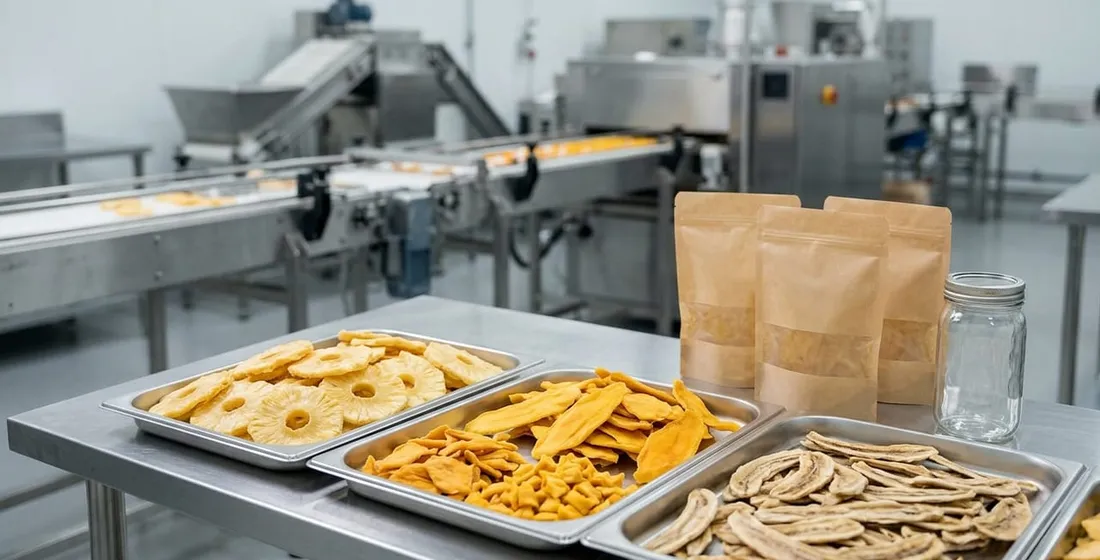
The cut decides the snack. Dried pineapple rings read as a premium single-serve or gifting piece, mango tidbits and strips work as an everyday resealable pouch, and banana strips sit at the value end and pair well with trail-style mixes. Sri Lankan processors already cut dried mango in strips, halves, tidbits, and dices, and pineapple in rings, chunks, and tea-bag cut (Sri Lanka Export Development Board), so the format range is proven.
| Format | Cut | Snack positioning | Typical pack | Note |
|---|---|---|---|---|
| Pineapple rings | Cored ring | Premium single-serve, gifting | 40 to 100 g window pouch or clear jar | Translucent gold; the visual hero of the range |
| Mango tidbits | Small cube | Everyday resealable snack | 50 to 150 g stand-up pouch | Usually the highest repeat-purchase format |
| Mango strips | Long strip | Grab-and-go, lunchbox | 30 to 50 g flow-wrap or pouch | Chewy, leathery; sells on texture |
| Banana strips | Strip or coin | Value, trail-mix base | 100 to 250 g pouch | Matte pale brown; blends well with nuts and seeds |
| Tea-bag cut | Fine dice | Infusion or blending input | 1 to 25 kg bulk | An ingredient sale, not a retail snack on its own |
A brand rarely launches all five at once. The common first move is one anchor format that carries the brand, often a mango tidbit pouch for repeat purchase or a pineapple ring pack for gifting, then a second format once the first SKU has a shelf history. Banana strips and the value pouch sizes also work as a blend base alongside co-packed imported nuts when a brand wants a trail-mix line without running two separate manufacturers.
How dry is dry enough? The spec that sets shelf life
A dried-fruit snack is shelf-stable only when it is dry enough to stop mould. Below a water activity of about 0.60 no microorganism can grow, and shelf-stable dried products are normally held at or below 0.65 (Codex Alimentarius General Standard for Dried Fruits, CXS 360-2020). Sit above that band and the pouch can grow mould before its date. Dry too hard and the fruit turns brittle and loses the chew that sells it.
Water activity, not the moisture percentage a home dehydrator reports, is the number that governs spoilage, and the two do not move in lockstep once sugar is infused. A sugar-infused mango strip can feel soft yet sit at a safe water activity because the sugar binds the water; a no-added-sugar ring can feel dry yet hold pockets of free moisture if the drying curve was rushed. Each fruit and each cut at the Matale facility carries its own target water-activity window, set on the first sample runs and held on every batch after that.
Two further decisions ride on the same spec. Sulphite (sulphur dioxide) holds the bright colour of dried pineapple and mango, but it is a declarable additive and some export markets and clean-label channels cap or exclude it, so the colour-versus-label trade-off is set at brief stage. And in a warm, humid climate the pouch itself has to hold the spec: a barrier or metallised laminate, not a plain unlined kraft, keeps the fruit at its target water activity across the shelf life. The detail is the same audited-line logic set out in the certification stack for a Sri Lankan FMCG launch.
What does a first dehydrated-fruit run cost and how long does it take?
A first commercial dehydrated-fruit run is gated by drying capacity and fruit seasonality, not by a high minimum order. At Silk Foods Ceylon a first contract-manufacturing run is structured for a local brand’s first commercial volume, with sample turnaround measured in weeks rather than months, and pricing quoted in LKR per pack against the cut, the moisture target, and the pouch spec.
Service snapshot: contract manufacturing dehydrated fruit
|
Seasonality is the real scheduling variable. Pineapple and mango run to harvest windows, so the lowest cost per pack comes from booking the run when the fresh fruit is in season and the drying floor can take volume. The R&D team at the Matale facility sees the same gap on most dried-fruit briefs: a founder has dried a tray of mango in a home dehydrator and it tastes right, but the home sample sits at a moisture they guessed by feel. Scaled to a commercial drier and a sealed pouch, that same fruit either case-hardens or grows mould within a month. The first two sample iterations are usually about pinning the water-activity target, not the flavour.
Talking to the factory directly is the point. Most local dried-fruit lines reach a brand through a layer of brokers and informal packers, which adds cost and removes the one conversation that matters, the one about the drying spec. The case for going direct is the same one set out in the broker layer in Sri Lankan FMCG and what it really costs.
What certifications does a dried-fruit snack need for a Sri Lankan shelf?
Every packaged dried-fruit snack going onto a Sri Lankan supermarket or e-commerce shelf needs Sri Lanka Standards Institution (SLSI) clearance and a label compliant with the Sri Lanka Food Act 1980 and its labelling regulations. Retail buyers increasingly also ask for a current FSSC 22000 audit on the manufacturer. Silk Foods Ceylon carries BRCGS and FSSC 22000 V6 on the line, with SLSI clearance on every retail SKU.
For a dried-fruit SKU the label detail is specific. The pack needs a tri-lingual statement, a declared sulphite line where sulphur dioxide is used, an accurate net weight, and substantiation for any no-added-sugar or no-preservative claim on front of pack. SLSI clearance is the gating step before listing, and SLSI publishes no processing time, so the practical advice is to confirm the current window with SLSI at submission and build a buffer between manufacturer QA sign-off and a target shelf date. The full sequence is laid out in the SLSI packaged-food submission, step by step.
The order the certifications matter in is worth keeping straight. BRCGS leads and FSSC 22000 V6 follows as the international food-safety anchors that a premium private-label tier and any later export step will ask for; USDA Organic and EU Organic sit on relevant SKUs; SLSI and Sri Lanka Food Act compliance are the local floor every retail SKU must clear. For a dried-fruit brand that may want to export the same line later, the audit cost on the manufacturer is already sunk, which is part of the case for a fully audited line over an informal packer.
Frequently asked questions
Does Silk Foods Ceylon offer contract manufacturing for dried fruit snacks?
Yes. Silk Foods Ceylon contract-manufactures dried pineapple rings, mango tidbits and strips, and banana strips to a buyer’s cut and moisture spec at its Matale facility. The line is BRCGS- and FSSC 22000 V6-audited, with SLSI clearance and Sri Lanka Food Act labelling support on every retail SKU.
What water activity should a dried-fruit snack target?
Shelf-stable dried fruit is normally held at a water activity at or below 0.65, and below 0.60 no microorganism can grow at all (Codex Alimentarius CXS 360-2020). Water activity, not the moisture percentage alone, is the number that governs whether a sealed pouch keeps over its shelf life.
Can a dried-fruit snack be made without added sugar?
Yes. A no-added-sugar dried fruit is the cleaner label and the simpler health claim, though it dries firmer and tastes more tart than a sugar-infused version. The choice is set at brief stage, and any no-added-sugar claim must be substantiated on the label under Sri Lanka Food Act 1980 labelling rules.
How long does a first dried-fruit run take from brief to dispatch?
On a settled spec, plan 2 to 3 weeks from purchase order to dispatch, with sample dispatch in 1 to 2 weeks before that. If the recipe still needs R&D, add 3 to 4 weeks at most (signed brief to approved formulation). Pineapple and mango run to harvest windows, so booking to the fresh-fruit season lowers the cost per pack.
How Silk Foods Ceylon can help
For local FMCG brands moving a dried-fruit idea from a home dehydrator to a retail shelf, Silk Foods Ceylon (SFC) runs a 10,000 sq ft cellular-manufacturing facility in Matale that dries, conditions, metal-detects, and packs pineapple, mango, and banana to a buyer’s cut and water-activity spec. A first commercial run is structured for a local brand’s first volume, with sample dispatch in 1 to 2 weeks and 2 to 3 weeks from purchase order to dispatch on a settled recipe; R&D, if needed first, takes 3 to 4 weeks maximum from signed brief to approved formulation. The line is BRCGS- and FSSC 22000 V6-audited, with SLSI submission support inside the standard engagement, and the in-house R&D team pins the moisture target before the first commercial batch.
To brief a project, email brands@esilkroute.com.lk or call +94 77 157 7294.
Sources
- Statista (2025), “Snack Food - Sri Lanka, Market Forecast”, https://www.statista.com/outlook/cmo/food/confectionery-snacks/snack-food/sri-lanka (retrieved 2026-06-29).
- Euromonitor International (2025), “Snacks in Sri Lanka”, https://www.euromonitor.com/snacks-in-sri-lanka/report (retrieved 2026-06-29).
- Sri Lanka Export Development Board, “Processed Fruit, Vegetable and Juice from Sri Lanka”, https://www.srilankabusiness.com/food-and-beverages/processed-food-vegetables-juices.html (retrieved 2026-06-29).
- Codex Alimentarius (FAO/WHO) (2020), “General Standard for Dried Fruits, CXS 360-2020”, https://www.fao.org/fao-who-codexalimentarius/ (retrieved 2026-06-29).
- 6Wresearch (2025), “Sri Lanka Fruit and Vegetable Processing Market (2025-2031)”, https://www.6wresearch.com/industry-report/sri-lanka-fruit-and-vegetable-processing-market (retrieved 2026-06-29).
Written by the Silk Foods Ceylon Team. Silk Foods Ceylon (Pvt) Ltd. is a BRCGS- and FSSC 22000 V6-audited contract manufacturer in Matale, Sri Lanka, offering contract manufacturing, private labelling, co-packing, and in-house R&D for local Sri Lankan brand owners, FMCG companies, hotel and restaurant groups, and distributors. To brief a project: brands@esilkroute.com.lk or +94 77 157 7294.