
Food Product Development in Sri Lanka: Budgeting for R&D Iterations
Key takeaways
- Most new SKUs at the Matale facility take 2 to 4 R&D sample iterations before a recipe locks. A budget built for one iteration is the most common reason a local brand owner runs out of runway mid-project.
- Nielsen data cited by FoodNavigator in 2014 puts the two-year failure rate for new US consumer packaged goods at 85 percent industry-wide, with skipped iteration among the documented causes.
- Budget each iteration separately, in LKR and in weeks, rather than as one lump “R&D fee.” The comparison table below breaks out what each round actually tests and costs.
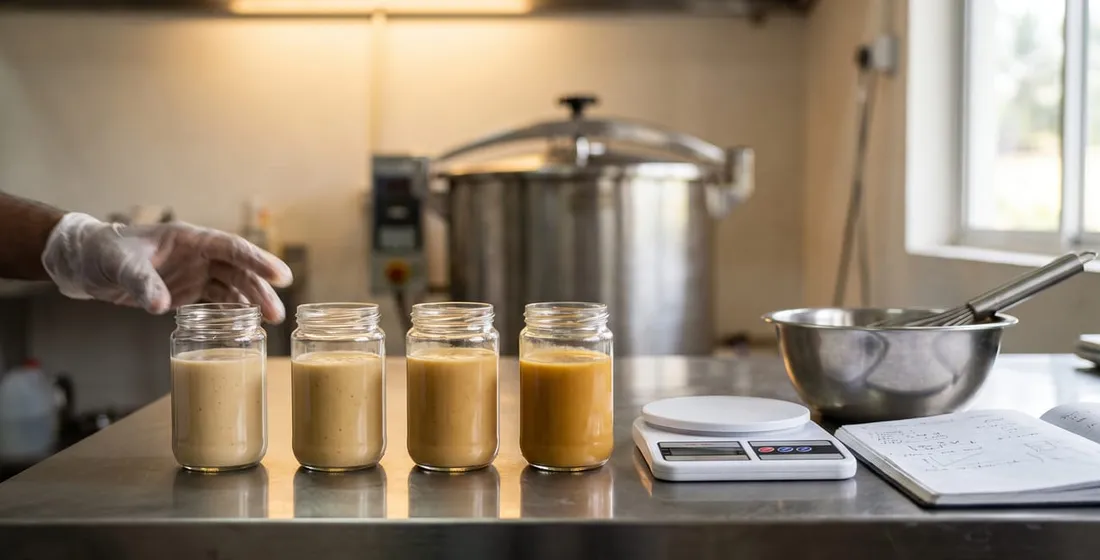
In 2019, I quoted a client one bench trial for a coconut-based spread and told myself it would be enough. It took four. The jar looked right on day one, tasted right on day one, and separated in the fridge by day ten. That gap between a kitchen-table success and a shelf-stable product is why Silk Foods Ceylon (SFC) now builds a realistic iteration count into every R&D and NPD (Co-Development on the SFC brochure) quote before a single sample reaches the bench. Most local Sri Lankan brand owners still budget for one.
Why one R&D trial almost never locks a recipe
A recipe that works in a home kitchen rarely survives contact with a commercial line unchanged. Nielsen data reported by FoodNavigator in 2014 found that 85 percent of new consumer packaged goods in the US fail within two years of launch, with skipped or rushed iteration among the documented causes. For a Sri Lankan founder, the lesson is less about failure rates and more about scheduling.
I used to think the gap was a formulation problem. It isn’t, usually. It’s a scale problem. A recipe that tastes right in a 2-litre pot behaves differently in a 200-litre jacketed kettle: heat transfer changes, mixing shear changes, and the time between cooking and packing stretches from minutes to hours. None of that shows up until you actually run the batch at the size the client wants to sell.
What actually breaks between a kitchen batch and a 1,500-jar run?
A first commercial run at Silk Foods Ceylon typically means 1,500 jars of a spread or 1,250 bottles of a beverage. Getting a recipe from a stovetop version to that scale usually surfaces three problems the founder never saw at home: retort temperature changes how starches and proteins set, larger-batch homogenising changes viscosity, and glass-jar headspace changes how fast a product oxidises on the shelf.
Each of those is fixable. None of them is fixable in the same trial that fixed the flavour. That’s the part of the R&D and NPD (Co-Development) process that a one-trial budget doesn’t leave room for: the second problem only appears once the first one is solved and the batch moves to the next scale up.
The iteration ladder Silk Foods Ceylon plans against
Rather than quote R&D as a single lump fee, Silk Foods Ceylon’s in-house R&D team plans against a typical ladder of iterations, each testing a different failure point and each carrying its own cost and calendar time. The table below is a planning assumption built from the team’s own project history, not an audited or fixed price list; individual SKUs vary by format and complexity.
| Iteration | What it tests | Typical outcome | Cost and time band |
|---|---|---|---|
| 1. Bench formulation | The base recipe at 1 to 5 kg scale against the brief or the home-kitchen original | Usually holds on flavour; often needs adjustment for raw-material or supplier variance | LKR 40,000 to 70,000 / 2 to 3 weeks |
| 2. Process-adjusted batch | The same recipe under real retort, homogenising, or fill-line conditions | Viscosity, preservation, or headspace usually needs a second pass | LKR 60,000 to 100,000 / 3 to 4 weeks |
| 3. Shelf-life and micro-panel validation | Real-time or accelerated shelf-life and batch-to-batch consistency near commercial scale | Recipe usually locks here, or flags one more preservation tweak | LKR 80,000 to 150,000 / 4 to 6 weeks |
| 4. Label-driven reformulation (when triggered) | Whether the locked recipe survives SLSI, Sri Lanka Food Act, or Department of Ayurveda claim review | A minor ingredient or claim-language swap, then final lock | LKR 40,000 to 90,000 / 2 to 4 weeks |
Read across the table and the pattern is straightforward: the first two rounds test whether the product survives becoming a factory product at all, and the third tests whether it survives sitting on a shelf. Most projects land the recipe by round three. A full run through all four, at the upper end of every band, sits somewhere near LKR 340,000 (roughly USD 1,100) before a single commercial batch is produced. Budgeted as one trial, that same project looks like it overran by three times.
Does Sri Lanka’s food labelling law add another iteration?
Per a 2025 US Foreign Agricultural Service report, Sri Lanka extended enforcement of the Food (Labelling and Advertising) Regulations 2022 to July 2025, following a gazette notice issued in December 2024. For a brand owner mid-project, a regulatory timeline shift like that can force label wording, allergen disclosure, or tri-lingual layout changes after the recipe otherwise looked finished.
Ruwanthi, the R&D lead at the Matale facility, has a phrase for this: the fourth iteration nobody schedules. A capsule SKU carrying an Ayurvedic claim can pass every bench and shelf-life test and still need a formulation tweak once the Department of Ayurveda reviews the claim language against the active herb content. It isn’t a formulation failure. It’s a compliance round that happens to land after the kitchen work is done, and shelf-life validation practices at this stage generally follow the general hygiene and process-control principles set out in the FAO/WHO Codex Alimentarius framework.
The founders who plan for this round in advance treat it as a scheduled step, not a surprise. The ones who don’t tend to call it a delay, when it was really always going to be part of the process.
Why working with the manufacturer directly shortens the loop
Every iteration round has a queue built into it: sample production, a waiting period for shelf-life or micro results, then a decision on whether to run again. Where that queue gets long is usually the handoff, not the lab work itself. A broker layer between a founder and the factory adds a relay: the founder waits on the broker, the broker waits on the plant, and a two-week test window becomes a month once messages sit in someone’s inbox.
Silk Foods Ceylon’s in-house R&D team works from the same site as the production line, which means a bench result on a Tuesday can inform a process trial the following week rather than the following month. The adjoining plantation at Hapugasyaya also means fresh herb or produce inputs for a trial are a same-day request, not a supplier lead time. Neither of those advantages changes the iteration count. They change how long each round actually takes on the calendar.
How much should a Sri Lankan brand owner actually budget?
Take the ladder above, multiply the middle of each band by the number of rounds a format typically needs, and add a buffer for the SLSI submission running in parallel to round three or four. For most spreads, sauces, and beverages, that lands somewhere in the LKR 250,000 to 400,000 range across the whole R&D phase, before the first commercial production run is even quoted separately.
That number isn’t the part founders usually get wrong. It’s whether the first budget draft has three more rows under it at all.
Frequently asked questions
Can Silk Foods Ceylon develop a new recipe for a local Sri Lankan brand that doesn’t have one yet?
Yes. R&D and NPD (Co-Development on the SFC brochure) is the entry point for buyers without a locked formulation. The in-house team at the Matale facility typically plans for 2 to 4 sample iterations per new SKU before recommending a first commercial batch, per Silk Foods Ceylon’s own project-planning data.
How many R&D iterations does a new food product usually need before it’s ready for a commercial line?
Planning assumptions at Silk Foods Ceylon put most new SKUs at 2 to 4 sample iterations: one bench formulation, one process-adjusted batch under real retort or fill conditions, and one shelf-life and micro-panel validation run, with a fourth sometimes needed for label-driven changes.
Why do so many new food products fail even after tasting fine in an early sample?
Nielsen data reported by FoodNavigator in 2014 found that 85 percent of new US consumer packaged goods fail within two years of launch, with skipped iteration among the documented causes. A recipe that tastes right at bench scale can still fail on shelf-life, viscosity, or batch consistency once produced at commercial volume.
Does Sri Lanka’s food labelling law affect how many R&D rounds a formulation needs?
Sometimes. Per a 2025 USDA Foreign Agricultural Service report, Sri Lanka extended enforcement of the Food (Labelling and Advertising) Regulations 2022 to July 2025. Label-driven changes, such as allergen wording or claim language, can force a reformulation round after the recipe otherwise looked finished.
What’s a realistic budget range for R&D iterations at Silk Foods Ceylon?
As a planning assumption rather than an audited figure, each iteration (bench, process, or shelf-life trial) typically runs LKR 40,000 to 150,000 and 2 to 6 weeks, depending on format. A capsule or Ayurvedic-claim SKU usually sits at the higher end of both ranges.
How Silk Foods Ceylon can help
For brand owners who haven’t locked a recipe yet, R&D and NPD (Co-Development on the SFC brochure) is where the relationship with Silk Foods Ceylon (SFC) usually starts. The in-house team at the Matale facility plans against a typical 2 to 4 sample iteration count before recommending a first commercial run, and works alongside production planning so a locked recipe can move straight into Contract Manufacturing on the same cellular-manufacturing line. The Matale facility is BRCGS- and FSSC 22000 V6-audited, with SLSI clearance and Sri Lanka Food Act compliance built into every retail SKU, and Department of Ayurveda registration support for Ayurvedic-claim capsule lines.
To brief a project, email b2b@esilkroute.com.lk or call +94 76 441 0389 / +94 76 918 5744.
Written by Sahan Bakmiwewa, Founder, Silk Foods Ceylon. Silk Foods Ceylon (Pvt) Ltd. is a BRCGS- and FSSC 22000 V6-audited contract manufacturer in Matale, Sri Lanka, offering contract manufacturing, private labelling, co-packing, and in-house R&D for local Sri Lankan brand owners, FMCG companies, hotel and restaurant groups, and distributors. To brief a project: b2b@esilkroute.com.lk, +94 76 441 0389, or +94 76 918 5744.