Frozen Vegan Nugget Contract Manufacturing in Sri Lanka
Buyer’s snapshot
- Global plant-based meat was worth about USD 10.8 billion in 2025, and frozen formats hold roughly 64% of it, led by nuggets, burgers, and sausages (Polaris Market Research, 2025). Frozen is where the category actually sells.
- Sri Lanka’s food and beverage exports rose about 17% in 2025 (EconomyNext, 2025), and local ready-to-eat demand is tracking a 6.3% annual growth rate (6Wresearch, 2025). The home market for a frozen vegan nugget is real, not just an export bet.
- A frozen nugget is won or lost on two things a recipe cannot fix on its own: a coating-and-fry line that holds spec at volume, and a freezer-pack chain that never breaks.
- Silk Foods Ceylon (SFC) runs a vegan nugget line at 30,000 units per day, BRCGS- and FSSC 22000 V6-audited, with a 5,000 to 10,000-unit first-run MOQ per SKU.
- See the line-stage table and the chilled-versus-frozen table below before briefing a run.
Most local Sri Lankan plant-based brands start in a small kitchen or a rented commercial space, hand-forming and crumbing nuggets in trays of a few dozen. That works until a frozen-food buyer at one of the major supermarket chains asks for consistent units, a manufacturer audit, and a cold chain the brand can actually prove. Somewhere between a few hundred and a few thousand packs a month, the kitchen stops scaling, and the question stops being the recipe. It becomes who runs the line.
Silk Foods Ceylon (SFC), a BRCGS- and FSSC 22000 V6-audited manufacturer in Matale, runs a vegan nugget line built for that transition. This post is for the local FMCG brand owner deciding what frozen vegan nugget contract manufacturing actually involves: the coating-and-fry sequence, the 30,000-unit-a-day capacity, the freezer-pack logistics, and the two regulations a fried, frozen SKU has to clear before it reaches a Sri Lankan shelf.
Why frozen vegan nuggets are a category worth making in 2026
Global plant-based meat was worth roughly USD 10.8 billion in 2025 and has been growing close to 20% a year, with frozen formats holding about 64% of sales because frozen shelf life runs 6 to 24 months against 1 to 3 months for chilled (Polaris Market Research, 2025). Nuggets sit among the fastest-growing formats in that frozen tier.
The local picture supports the bet. Sri Lanka’s food and beverage exports rose about 17% in 2025, one of the standout export sectors for the year (EconomyNext, 2025), and domestic ready-to-eat demand is tracking a 6.3% annual growth rate to 2031 (6Wresearch, 2025). Vegetarian and plant-forward eating is already common across the country for cultural and religious reasons, which gives a vegan nugget a built-in domestic audience rather than a niche one.
Frozen is the format that makes the category work. A chilled plant-based product has a week or two of usable life and needs a cold chain it rarely survives; a frozen nugget holds for months, ships nationally, and sits in a retail freezer until a shopper reaches for it. For a brand owner, that shelf life is what turns a good recipe into a distributable SKU. The manufacturing question is whether the line and the freezer chain can deliver it at volume, which is where plant-based and vegan contract manufacturing in Sri Lanka becomes the practical route in.
What does contract manufacturing a frozen vegan nugget involve?
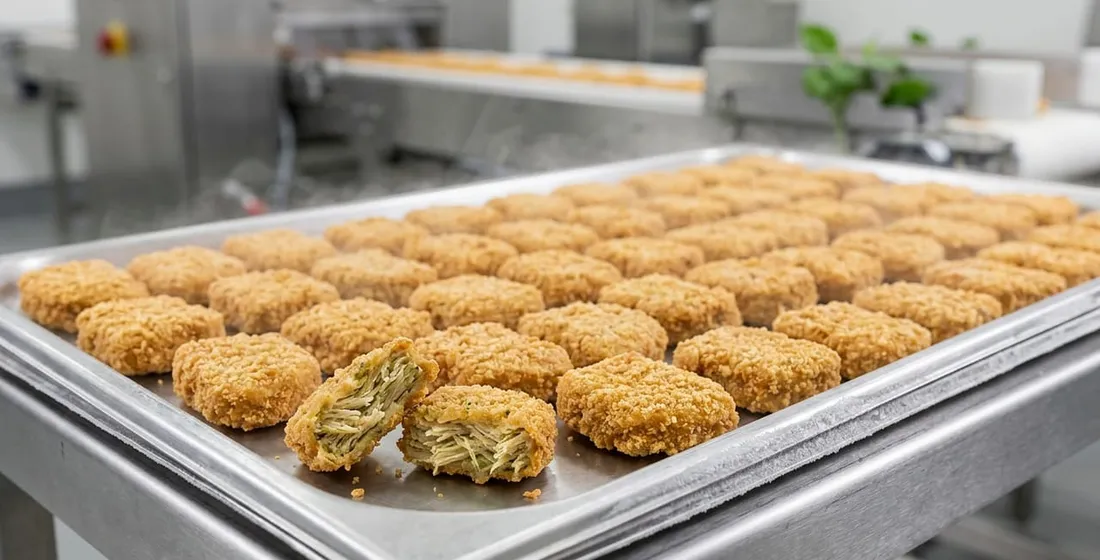
Contract manufacturing means the brand owns the recipe and the brand, and the manufacturer runs the production. For a frozen vegan nugget, that production is a sequence: form the plant-protein core, coat it, set the coating, freeze it hard, and pack it, all under one food-safety audit. Silk Foods Ceylon runs that sequence on a line rated at 30,000 nuggets per day, with a first-run MOQ of 5,000 to 10,000 units per SKU.
The recipe stays the buyer’s. The line, the audit, the SLSI submission, and the cold chain move under the manufacturer. That division is the whole point of contract manufacturing, and it is the model set out in the pillar guide to contract manufacturing at Silk Foods Ceylon. The brand keeps what makes it different, and hands off the capital-heavy machinery and compliance load.
Not every brief arrives with a locked recipe, and that is normal. R&D and NPD (Co-Development on the SFC brochure) is where many plant-based inquiries actually begin. A home-kitchen nugget that tastes right in a tray of twelve often needs reformulation before it survives a 30,000-unit run: the binder has to hold under a continuous fryer, the coating has to adhere through freezing, and the texture has to stay fibrous rather than turn rubbery. SFC’s in-house R&D team typically works through 2 to 4 sample iterations before a recipe locks for contract manufacturing.
Inside the 30,000-unit-per-day line: forming, coating, frying, freezing
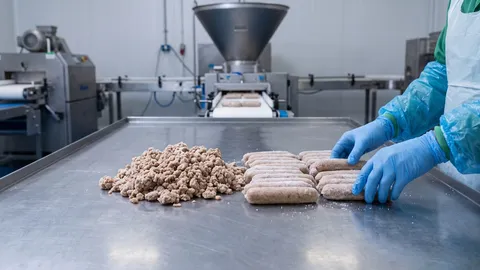
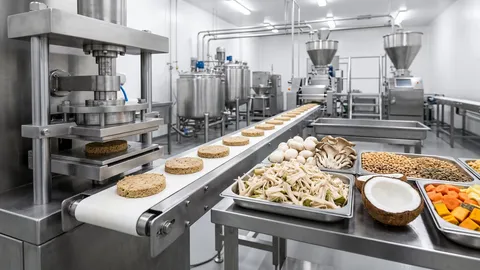
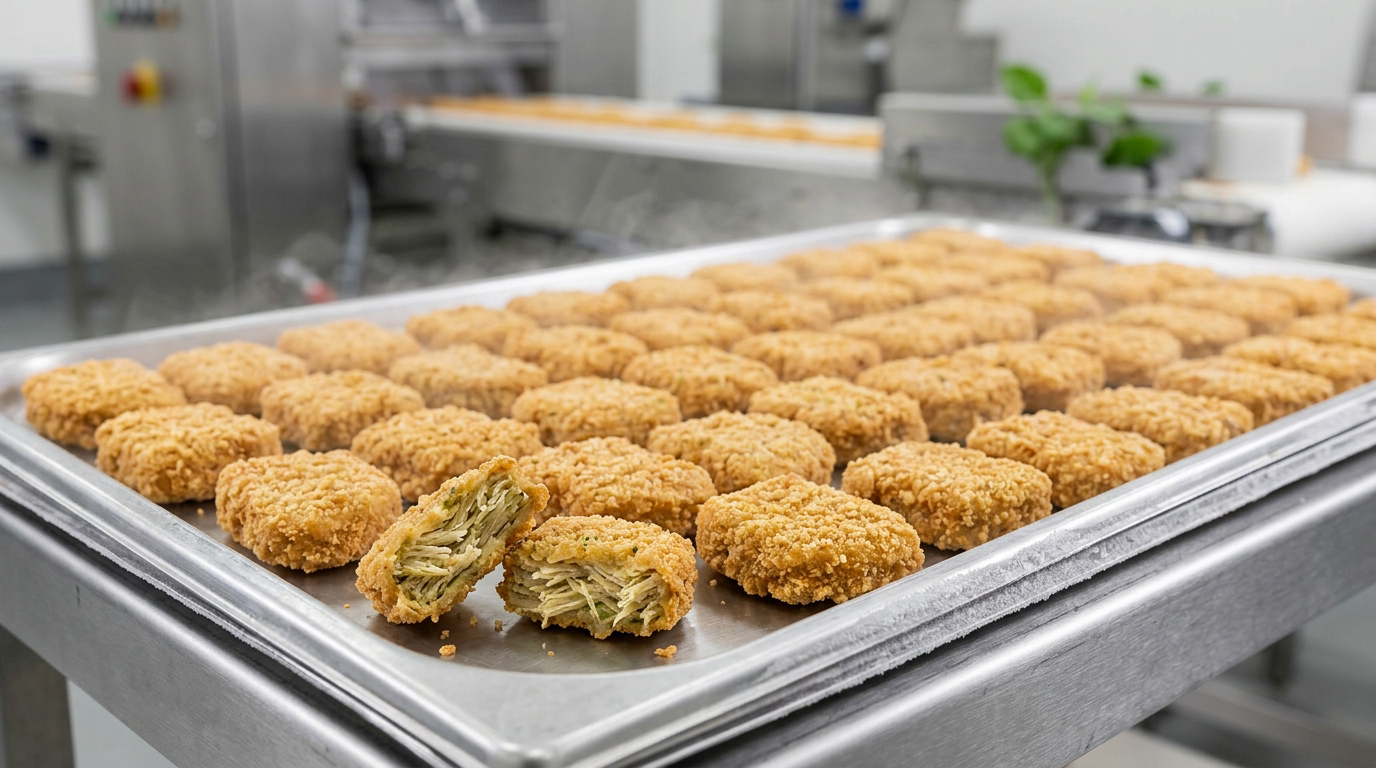
The line is a set of stations, each with a job that the home kitchen does by hand and the factory does to spec. The plant-protein mix is portioned and formed, battered, crumbed, par-fried to set the coating, then frozen and packed. Each station is where consistency is either held or lost at volume.
| Line stage | What happens | Why it matters at volume |
|---|---|---|
| Forming | Plant-protein mix portioned to a uniform weight and shape | Even cook, even fry, even pack count per bag |
| Battering | Wet batter applied as the adhesion layer | Without it, the crumb sheds in the fryer and the freezer |
| Breading (crumbing) | Dry crumb coating applied and pressed | The crunch and the visual; uneven crumb reads as a defect |
| Frying | Par-fry sets the coating and colour, not a full cook | Locks the crumb on; oil spec is a compliance decision (see trans-fat below) |
| Freezing | Rapid freeze straight off the fryer line | Smaller ice crystals, better texture, the start of the cold chain |
| Packing | Retail bag or bulk catering pack, sealed | Pack format and labelling decide which channel the SKU fits |
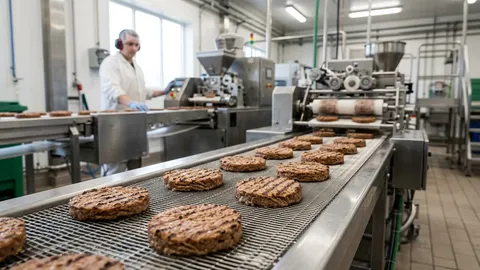
The forming, frying, and freezing machines sit in the same cellular-manufacturing hall as the burger-patty line, which runs at 15,000 units per day. One audit covers both, so a brand launching a nugget and a patty does not pay to audit the manufacturer twice. That is the practical economics behind multi-SKU contract manufacturing on a single audit, and it is most of the reason a second plant-based SKU reaches the shelf faster and cheaper than the first.
The most common gap the R&D team sees is not flavour. It is a coating that adhered fine when a founder pressed crumb onto a dozen nuggets by hand, then sheds across a continuous battering and frying line because the batter viscosity and the crumb particle size were never set for machine application. Fixing it is a formulation step, not a production fault, and it is far cheaper to find in a sample iteration than in a 10,000-unit run. The same forming and coating logic carries across to contract manufacturing for plant-based patty launches, where the first commercial run raises the same questions.
Freezer-pack logistics: where a frozen SKU is won or lost
A frozen nugget that thaws once, even partially, in the gap between the factory and the retail freezer is a quality failure the shopper sees as freezer burn or a soggy crumb. The cold chain is therefore not a delivery detail. It is part of the product spec, and in Sri Lanka it is the part most likely to break, because cold-chain infrastructure outside the organised players still struggles with temperature reliability, storage capacity, and power continuity (Trace Data Research, 2025).
Manufacturing for frozen means freezing straight off the fryer line and never letting the temperature rise after that. The Matale facility holds finished nuggets in reefer (frozen and chilled) storage on site, so the SKU stays frozen from the line to dispatch. From there the brand owner’s distribution has to maintain the chain, which is why the pack format matters: a sealed retail bag for a supermarket freezer and a bulk catering pack for a frozen-food distributor or a quick-service kitchen are different decisions with different cold-chain demands.
The chilled-versus-frozen choice is the one most first-time brand owners underestimate. The table below is the short version of why most serious plant-based nugget programmes go frozen.
| Factor | Chilled | Frozen |
|---|---|---|
| Typical shelf life | 1 to 3 months | 6 to 24 months (Polaris Market Research, 2025) |
| Cold chain required | Continuous, tight tolerance | Continuous, but more forgiving at deep-freeze |
| National distribution reach | Limited by short life | Practical across the island |
| Best-fit channels | Local, fast-turn | Supermarket freezer, catering, e-commerce |
| Production handoff | Pack and rush | Freeze hard, then pack |
There is a total-cost point here that an in-house plan often misses. Running frozen production in-house means owning a blast freezer, reefer storage, and an energy bill that runs whether the line is busy or idle. Under contract manufacturing, that standing cost sits with the manufacturer and is quoted into a per-unit price in LKR, with tier breaks as volume rises above the first run, rather than landing on the brand as fixed overhead.
The trans-fat rule a fried nugget has to clear
A battered, fried nugget is a fried food, and Sri Lanka now regulates frying fat directly. The Food (Trans Fat) Regulations cap industrially produced trans-fat at 2% of the total fat in a food and ban partially hydrogenated oils, the main industrial source of trans-fat, with products manufactured only for export exempted (USDA Foreign Agricultural Service, 2024; WHO, 2023). For a nugget sold on a Sri Lankan shelf, the fry oil is a compliance decision, not just a cost line.
This is where a manufacturer running a current FSSC 22000 V6 system earns its place. Oil selection, oil rotation, and the records that prove both sit inside the food-safety system, so the trans-fat cap is met and documented rather than assumed. A brand frying in a home kitchen with whatever oil is cheapest that week has no such record, and no answer when a retail buyer or a regulator asks for one. The wider cert logic, and how each layer compounds, is set out in the certification stack for a Sri Lankan FMCG launch.
What SLSI and the 2026 labelling rules require for a frozen nugget SKU
Every packaged food on a Sri Lankan retail shelf needs SLSI clearance, and from 1 January 2026 it also has to meet the Food (Labelling and Advertising) Regulations 2022 in full, which require the common name in bold in Sinhala, Tamil, and English, allergen disclosure, and clear date marking (USDA Foreign Agricultural Service, 2025). A frozen vegan nugget hits several of these at once.
The allergens are the part brand owners forget. A typical vegan nugget carries soy and wheat or gluten in the protein base and the crumb, both of which must be declared. The label also needs a keep-frozen storage instruction, since the safety case for the product depends on it staying frozen. Silk Foods Ceylon handles the SLSI submission and the label-compliance check inside a standard contract manufacturing engagement, against a cert stack that runs BRCGS, FSSC 22000 V6, then SLSI clearance and Sri Lanka Food Act 1980 compliance on every retail SKU.
Plan the calendar around the clearance, not the other way around. SLSI clearance for a stable formulation typically runs four to eight weeks, so a brand should hold a six-to-ten-week buffer between manufacturer-side QA sign-off and a target shelf date. For a brand that still needs recipe work first, the R&D step sits ahead of that, which is why R&D and NPD at Silk Foods Ceylon is usually the first conversation, not the last.
Frequently asked questions
Does Silk Foods Ceylon offer contract manufacturing for frozen vegan nuggets?
Yes. Silk Foods Ceylon runs a vegan nugget line at the Matale facility rated at 30,000 units per day, with a first-run MOQ of 5,000 to 10,000 units per SKU. The brand keeps its recipe; the manufacturer runs forming, coating, frying, freezing, packing, and SLSI submission under a BRCGS- and FSSC 22000 V6-audited system.
What is the minimum order quantity for frozen vegan nuggets at a Sri Lankan contract manufacturer?
At Silk Foods Ceylon the first-run MOQ for frozen nuggets is 5,000 to 10,000 units per SKU, set deliberately for a local brand’s first commercial run rather than export-scale volume. Because the line is cellular, a nugget and a patty SKU can share one audit and one production block.
How is the cold chain handled for frozen vegan nuggets?
Nuggets are frozen straight off the fry line and held in on-site reefer (frozen and chilled) storage at the Matale facility, so the product never warms before dispatch. Sri Lanka’s cold-chain infrastructure is uneven outside the organised players (Trace Data Research, 2025), so the pack format and onward distribution are planned with the buyer.
Do frozen vegan nuggets sold in Sri Lanka have to meet trans-fat rules?
Yes, for the local market. The Food (Trans Fat) Regulations cap industrially produced trans-fat at 2% of total fat and ban partially hydrogenated oils, with export-only products exempt (USDA Foreign Agricultural Service, 2024). A manufacturer on a current FSSC 22000 V6 system documents the fry oil spec that keeps a nugget compliant.
What labelling does a frozen vegan nugget need in Sri Lanka in 2026?
From 1 January 2026 the Food (Labelling and Advertising) Regulations 2022 apply in full, requiring tri-lingual bold common names, allergen disclosure, and date marking (USDA Foreign Agricultural Service, 2025). A vegan nugget must declare soy and wheat or gluten, carry a keep-frozen instruction, and clear SLSI before it reaches a shelf.
How Silk Foods Ceylon can help
For local FMCG brands moving a plant-based product from kitchen scale to a frozen retail SKU, Silk Foods Ceylon (SFC) operates a 10,000 sq ft cellular-manufacturing facility in Matale with a vegan nugget line rated at 30,000 units per day and a companion patty line at 15,000 per day, both on a single BRCGS- and FSSC 22000 V6-audited cert stack. First-run MOQs sit at 5,000 to 10,000 units per SKU, with on-site reefer storage so the cold chain starts at the line. The in-house R&D team handles coating and texture reformulation before a recipe locks, and SLSI submission sits inside the standard engagement.
To brief a frozen vegan nugget run, email b2b@esilkroute.com.lk or call +94 76 441 0389 or +94 76 918 5744.
Sources
- Polaris Market Research (2025), “Plant-based Meat Market Size, Share, Analysis Report 2025-2034”, https://www.polarismarketresearch.com/industry-analysis/plant-based-meat-market (retrieved 2026-06-17).
- EconomyNext (2025), “Sri Lanka exports top US$17.2bn in 2025”, reported via Daily Mirror Business, https://www.dailymirror.lk/breaking-news/Sri-Lanka-exports-top-US-17-2bn-in-2025/108-331344 (retrieved 2026-06-17).
- 6Wresearch (2025), “Sri Lanka Ready to Eat Food Market (2025-2031)”, https://www.6wresearch.com/industry-report/sri-lanka-ready-to-eat-food-market-2020-2026 (retrieved 2026-06-17).
- Trace Data Research (2025), “Sri Lanka Cold Chain Market Report”, https://www.tracedataresearch.com/industry-report/sri-lanka-cold-chain-market (retrieved 2026-06-17).
- USDA Foreign Agricultural Service (2024), “Sri Lanka Enacts Regulations to Ban and Limit Trans-fats in Food Products”, https://www.fas.usda.gov/data/sri-lanka-sri-lanka-enacts-regulations-ban-and-limit-trans-fats-food-products (retrieved 2026-06-17).
- USDA Foreign Agricultural Service (2025), “Sri Lanka Extends Implementation of the Food Labeling and Advertising Regulations-2022”, https://www.fas.usda.gov/data/sri-lanka-sri-lanka-extends-implementation-food-labeling-and-advertising-regulations-2022-0 (retrieved 2026-06-17).
- World Health Organization (2023), “WHO lauds Sri Lanka’s move on trans fat”, https://www.who.int/srilanka/news/detail/25-05-2023-who-lauds-sri-lanka-s-move-on-trans-fat (retrieved 2026-06-17).
Written by the Silk Foods Ceylon Team. Silk Foods Ceylon (Pvt) Ltd. is a BRCGS- and FSSC 22000 V6-audited contract manufacturer in Matale, Sri Lanka, offering contract manufacturing, private labelling, co-packing, and in-house R&D for local Sri Lankan brand owners, FMCG companies, hotel and restaurant groups, and distributors. To brief a project: b2b@esilkroute.com.lk, +94 76 441 0389, or +94 76 918 5744.