Bulk banqueting and bakery supply in 5kg and 10kg: the LKR case
By the Silk Foods Ceylon Editorial Team
Buyer’s snapshot
- The rupee depreciated 5.6 per cent against the US dollar over 2025, then a further 5.4 per cent in the first five months of 2026, so a dollar-priced import gets more expensive in rupee terms before duty, VAT, the Ports and Airports Levy, CESS and the Social Security Contribution Levy are even added.
- Sri Lanka recorded 2.36 million tourist arrivals in 2025, its highest ever annual total, with 4,600 new hotel rooms added the same year, so banqueting and bakery volume is scaling faster than most hotel groups have re-tendered their bulk supply list.
- A bulk business-to-business pack in Sri Lanka carries its own labelling rule: Not for retail sale, in bold, at a minimum 3 millimetre character height, on artwork built for the pail rather than scaled down from a retail jar.
- The number that actually breaks a banqueting calendar is rarely the price per kilogram. It is a stockout mid-event because a container sat in customs during a wedding weekend, or a reorder that cannot move faster than a shipping schedule.
A hotel group’s procurement office rarely reviews its banqueting and bakery supply list until something on it goes wrong. The list itself is usually a mix of imported case goods bought on a container schedule and a handful of local lines bought on a purchase order, and the two run on completely different clocks. The imported fruit filling for the pastry section arrives four times a year in a shipping container. The local bread flour arrives every Tuesday. Nobody has actually compared what a pail of banqueting filling costs against the local alternative on the same terms, because the two have never been quoted the same way.
That comparison is the useful one, and it runs on three numbers that have nothing to do with brand loyalty: the minimum order a supplier will actually accept in 5kg or 10kg format, the delivery cadence a property can rely on, and what the rupee is doing to the imported side of the ledger while the comparison is being made.
Why a banqueting kitchen buys in 5kg and 10kg pails, not retail jars
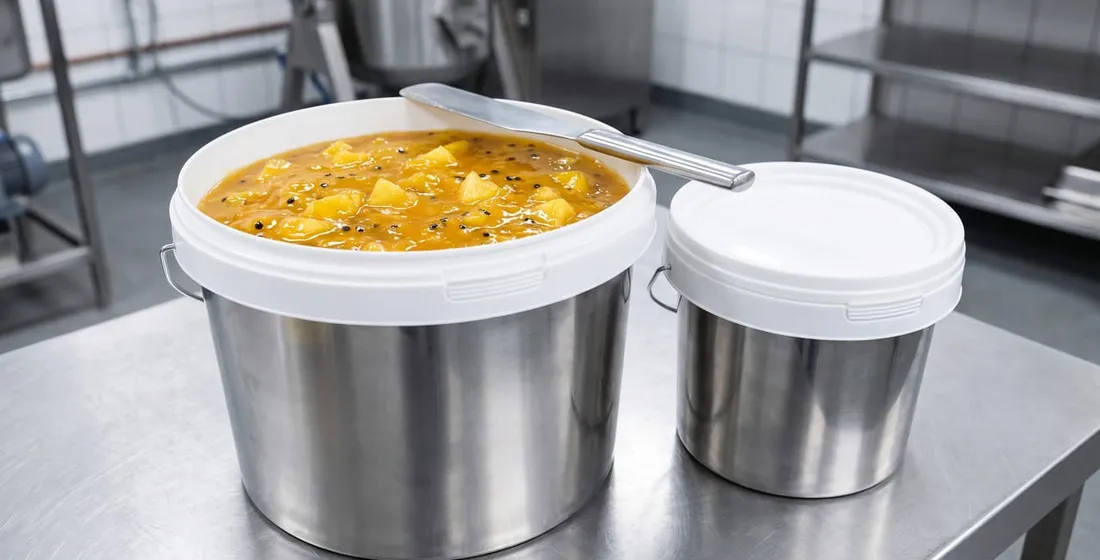
A banqueting and bakery kitchen at hotel scale does not decant from a 400 gram retail jar. It runs from a bulk institutional pail, sized so that a single container feeds a service period without an open, half used jar sitting in a walk-in between events. A 5kg pail suits a single busy weekend’s banqueting fruit filling or chutney draw at a mid-size property. A 10kg pail suits a central bakery producing for several outlets, or a property carrying a heavier events calendar across a month.
The pail size is also a labelling decision, not just a volume one. A pack built for foodservice reuse and repeated scooping needs a wide mouth, a resealable lid rated for repeated opening, and a label that survives a chilled walk-in without delaminating. None of that is how a retail jar is built, and scaling a retail label up to a 10kg pail rather than designing for the format is one of the more common reasons a first bulk order arrives with the wrong artwork.
The MOQ conversation: what a container commits a property to, against what a pail commits it to
An imported case-pack equivalent and a domestically co-packed 5kg or 10kg pail are not competing on unit price alone. They are competing on what each format actually commits a hotel group to before the first delivery lands.
| Dimension | Imported case-pack equivalent | Domestic co-pack, 5kg or 10kg |
| Typical minimum order | A container load, or a part-container consolidated with other lines, set by the exporter’s own minimum run | A per-SKU run sized to the co-packer’s production batch, agreed at contract stage against a quarterly or annual volume |
| Lead time, order to first delivery | Weeks, driven by production, shipping schedule and customs clearance, plus a buffer for a missed sailing | Days to a few weeks for the first batch, then a standing delivery cadence once the supply agreement is live |
| Currency exposure | Dollar-linked invoice against a depreciating rupee, exposure runs from quotation to the date the shipment clears | Rupee-quoted contract; currency risk sits with the supplier’s own input costs, not with each individual order |
| Reorder flexibility mid quarter | Limited. A surge week cannot be met by an extra container sailing on short notice | A standing agreement can usually absorb a surge order against agreed notice, since production is local |
| Batch traceability | Tied to a shipment and a customs entry; a quality query has to trace back through the import chain | Tied to a single production date and lot code, traceable directly to the manufacturing run |
The lead time row is where most banqueting calendars actually get into trouble. A property that plans its imported fruit filling stock four months ahead has no room to react to an unusually strong booking month, because the next container is already committed to what was ordered a season earlier. A domestic supply agreement with a standing cadence absorbs that variability far better, at the cost of the hotel group carrying a locked volume commitment with a named co-packer instead of shopping the spot market each quarter.
Delivery cadence per property: the scheduling problem an import cannot solve
A hotel group with more than one property rarely runs the same banqueting calendar at each one. A Colombo flagship carries a heavier conference and corporate events load through the week. A hill country property peaks around weekend leisure bookings and a longer high season. A coastal resort’s banqueting and bakery draw swings hardest around wedding season and school holiday periods. One national delivery cadence, set to suit whichever property orders loudest, under-serves the other two.
| Property profile | Primary banqueting driver | Suggested delivery cadence | On-site buffer to hold |
| City conference property | Weekday corporate events, steady bakery draw across the week | Weekly, fixed day, to match a predictable events board | 3 to 5 days of cover against a missed slot |
| Hill country leisure property | Weekend and high season surges, longer average stay | Fortnightly standing order, with a surge top-up window ahead of a known high season | 1 to 2 weeks of cover, heavier ahead of the season |
| Coastal resort property | Wedding season and school holiday banqueting spikes | Weekly during peak months, monthly in the shoulder season, both agreed in advance | A dedicated wedding season buffer, sized to the largest single booking on the calendar |
This is also where a supply agreement earns its keep on paper, not just in the kitchen. A cadence written into the contract, with a stated surge clause for a named peak period, is the difference between a property calling a supplier in a panic during a wedding weekend and a delivery that was already scheduled for that week months earlier.
The LKR case against the imported equivalent
A coastal property’s bakery ran an imported fruit filling for three years, ordered on the standard four-container annual schedule. In year three, a shipment due for delivery ahead of the peak wedding weekends sat at customs for eleven days during a routine clearance backlog. The property’s banqueting team improvised with a substitute filling for two weekend events rather than run short, and the substitution showed up in guest feedback on both. The shipment itself cleared fine. The cost was never in the invoice. It was in the two weekends the kitchen had to run around a supply chain it could not see or influence once the container left the exporter’s dock.
Underneath that kind of event sits a currency trend that makes the imported side of the comparison worse every year it continues. The Sri Lankan rupee depreciated 5.6 per cent against the US dollar across 2025, moving from an indicative rate of roughly Rs. 288 to the dollar at the start of the year to roughly Rs. 306 by year end. That slide continued into 2026: by the end of May the rupee had weakened a further 5.4 per cent year to date, pushing the indicative rate past Rs. 324. A dollar-priced contract signed at the start of a financial year and invoiced through the rest of it gets more expensive in rupee terms with every shipment, independent of anything the exporter changes.
That currency slide sits underneath a tax structure that applies regardless of the exchange rate on the day. Sri Lanka Customs’ National Imports Tariff Guide applies customs import duty, an 18 per cent VAT charge, the Ports and Airports Levy, CESS and the Social Security Contribution Levy on top of the landed dollar cost, layered before preferential trade agreement rates are even considered. None of that structure is unique to banqueting inputs, but it means the rupee comparison against a domestic co-pack is never a straight unit-price line. It is landed cost after five separate charges, converted at whatever the rate happens to be on the day the shipment clears.
A domestically co-packed pail is quoted in rupees against a supply agreement, which removes the currency variable from the comparison entirely and replaces the shipping and customs lead time with a standing delivery cadence a property can actually plan against.
What changes on the label when the buyer is a kitchen, not a retail shelf
A bulk business-to-business pack is not exempt from labelling. It carries a different, specific rule instead. Under the Food (Labelling and Advertising) Regulations 2026, gazetted under the Food Act, No. 26 of 1980, a bulk pack intended for foodservice rather than retail sale must declare Not for retail sale in bold, at a minimum 3 millimetre character height, on artwork built for the bulk format rather than a scaled down version of any retail label the same recipe might also carry.
Batch number, date of manufacture and date of expiry still apply at the same character-height standard as a retail pack, since traceability does not relax just because the buyer is a kitchen rather than a consumer. What does change is the panel space freed up by not needing a full nutrition declaration formatted for point of sale, which is usually reallocated to handling instructions: chilled storage temperature, use once opened window, and a resealing instruction suited to repeated scooping over the life of the pail.
The SLSI clearance path a bulk foodservice line still has to pass, even without a retail listing, is covered step by step in the SLSI submission walk-through.
Where a supply agreement like this actually sits inside co-packing
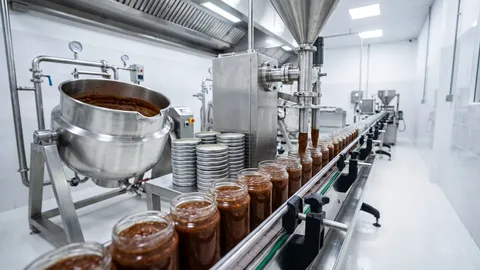
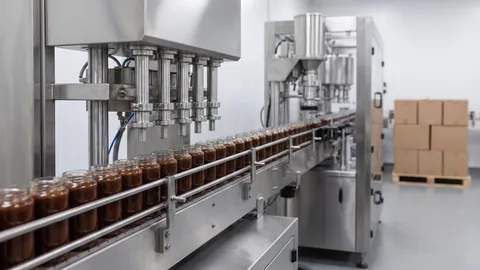
A standing bulk supply agreement for a hotel group’s banqueting and bakery kitchen is a co-packing arrangement, not a one-off order. The distinction matters because it changes what gets agreed before the first pail ships. A one-off order is a quotation and a delivery date. A co-packing agreement is a production slot reserved on a recurring cadence, a formulation locked against the property’s recipe or the closest match to it, and a pack format, 5kg or 10kg, sized to how each property actually draws stock rather than to whatever the exporter’s container happened to hold.
The broader choice between contract manufacturing, private labelling and co-packing, and which one actually fits a given supply problem, is set out in this comparison. For a hotel group already buying spice or seasoning lines in portioned formats, the same co-packing logic extends to seasoning sachets and portion packs, and the on-site stock question that a multi-property cadence raises is covered in warehousing, despatch and stock ownership.
The comparison also has to be honest about where an import stays the right call. A specialty ingredient with no domestic equivalent, at a volume too small to justify a dedicated production slot, is still better bought as an import. The banqueting and bakery lines worth moving to a bulk domestic agreement are the ones ordered every month at a volume large enough to fill a standing production run, which is most of a hotel group’s fruit filling, chutney, sauce and preserve draw and rarely its specialty imported garnish.
A wider look at what an import layer actually costs once freight, duty and a broker’s margin are counted is in the true cost of the broker layer, and the buyer-facing MOQ and lead time numbers for HORECA private label specifically are set out in the HORECA private label buyer guide. A property already sourcing dried fruit or nut lines through an importer can compare the same maths against co-packing an imported dried fruit range domestically.
Buyer's checklist: what to fix in the supply agreement before the first pail ships
|
Frequently asked questions
What is the minimum order for 5kg or 10kg bulk banqueting supply?
The minimum depends on the SKU and the co-packer’s production batch size rather than a fixed pail count. A standing supply agreement is usually anchored to a quarterly or annual volume across the banqueting and bakery range, with individual delivery quantities set against that total rather than each drop being separately negotiated.
How is delivery cadence set across more than one hotel property?
Cadence is set per property against that property’s own banqueting and bakery draw, not as one national schedule. A city conference property with a steady weekday events board usually runs a weekly fixed-day delivery. A resort property with a wedding season peak needs a heavier cadence for a defined stretch of months and a lighter one in the shoulder season, agreed in the supply contract rather than renegotiated each time bookings rise.
Does a bulk business-to-business pack need a different label from a retail jar of the same product?
Yes. Under the Food (Labelling and Advertising) Regulations 2026, a bulk pack intended for foodservice must declare Not for retail sale in bold at a minimum 3 millimetre character height, on artwork designed for the bulk format. Batch number, manufacture date and expiry date still apply at full retail standard, since traceability requirements do not relax for a foodservice buyer.
Can Silk Foods Ceylon co-pack a hotel group’s own recipe in 5kg and 10kg institutional formats?
Yes. Co-packing at Silk Foods Ceylon (SFC) covers filling, sealing and labelling a hotel group’s own formulation, or the closest achievable match to it, into bulk foodservice pack sizes on a standing delivery cadence rather than a single order. The Matale facility is BRCGS- and FSSC 22000 V6-audited, with SLSI clearance and Sri Lanka Food Act labelling support, including the bulk business-to-business declaration, built into a standard engagement.
How Silk Foods Ceylon can help
For a hotel group comparing an imported banqueting or bakery input against a domestic bulk supply agreement, Silk Foods Ceylon (SFC) runs co-packing from a cellular-manufacturing facility in Matale, filling, sealing and labelling in 5kg and 10kg institutional formats against a delivery cadence agreed per property rather than a single container schedule. Rupee-quoted supply agreements remove the currency exposure that sits on a dollar-linked import invoice, and lot-level batch traceability ties every pail back to a single production date rather than a shipment and a customs entry. The facility is BRCGS- and FSSC 22000 V6-audited, with SLSI clearance and Sri Lanka Food Act labelling support, including the bulk business-to-business pack declaration, built into a standard engagement.
To brief a banqueting or bakery bulk supply requirement, email brands@esilkroute.com.lk or call +94 77 157 7294.
Sources
Daily FT, Tourism arrivals grow by 15% to 2.36m record high in 2025, reporting 2.36 million tourist arrivals for 2025, 15.1 per cent up year on year, and 4,600 new hotel rooms added over the same year, published 6 January 2026. ft.lk (retrieved 30 August 2026).
Ada Derana, citing Central Bank of Sri Lanka indicative exchange rate data, reporting the rupee depreciated 5.6 per cent against the US dollar over 2025, moving from Rs. 288.32 / Rs. 297.01 at end 2024 to Rs. 306.29 / Rs. 313.83 at end 2025, published 1 January 2026. adaderana.lk (retrieved 30 August 2026).
LankaTalks, citing Central Bank of Sri Lanka data, reporting a further 5.4 per cent rupee depreciation year to date by 29 May 2026, with the indicative US dollar buying and selling rate at Rs. 324.45 and Rs. 334.24, published 30 May 2026. lankatalks.com (retrieved 30 August 2026).
Sri Lanka Customs, National Imports Tariff Guide, on the stacked import charge structure of customs import duty, 18 per cent VAT, the Ports and Airports Levy, CESS and the Social Security Contribution Levy applied to imported goods including processed food. customs.gov.lk (retrieved 30 August 2026).
Food (Labelling and Advertising) Regulations 2026, Gazette Extraordinary No. 2494/47 of 26 June 2026, made under the Food Act, No. 26 of 1980, Ministry of Health, on the bulk business-to-business pack declaration requiring Not for retail sale in bold at a minimum 3 millimetre character height, and on batch number, date of manufacture and date of expiry requirements. eohfs.health.gov.lk (retrieved 30 August 2026).
Sri Lanka Export Development Board, via srilankabusiness.com, Sri Lanka’s Export Performance Exceeded US$17.2 Billion in 2025, reporting food and beverage export earnings of USD 583.89 million for 2025, up 24.23 per cent year on year, driven largely by a 40.4 per cent increase in processed food exports, published 26 January 2026. srilankabusiness.com (retrieved 30 August 2026).