
Specifying nutmeg, mace, and vanilla for a premium private-label spice line
Buyer’s snapshot
- Sri Lanka supplies about 5% of global nutmeg demand and 7% of global mace demand, and Ceylon Nutmeg holds a registered geographical indication (Sri Lanka Export Development Board, 2025).
- A premium spice line is defined on the spec sheet, not the label: grade, volatile-oil floor, particle size, vanilla format, and contaminant limits.
- Sri Lanka cures only about 1.5 tonnes of vanilla beans a year, so pod, paste, or extract is a sourcing decision, not just a preference.
- Silk Foods Ceylon runs a BRCGS- and FSSC 22000 V6-audited line in Matale with a 1,500-jar first-run private-label MOQ per SKU.
Two curry powders can share an ingredient list and still sit a hundred rupees apart on the same shelf. The gap is almost never the recipe. It is the specification behind it: which grade of nutmeg, how much volatile oil, whether the mace is whole blade or ground, and whether the vanilla is a cured pod or a synthetic flavour. For a Sri Lankan brand owner building a premium private-label spice range, the spec sheet is the product. Silk Foods Ceylon (SFC), a contract manufacturer in Matale, writes those specs with brand owners before a single jar is filled.
What premium actually means on a spice specification
A premium private-label spice line is defined by its specification, not its packaging. For nutmeg, mace, and vanilla the parameters that matter are grade, volatile-oil content, particle size, moisture, and contaminant limits. Sri Lanka supplies roughly 5% of global nutmeg demand and holds a geographical indication for Ceylon Nutmeg (Sri Lanka Export Development Board, 2025), which gives a local range a provenance claim the spec can defend.
Premium is a set of numbers a buyer can hold a manufacturer to, not a set of adjectives on a front label. “Rich” and “authentic” mean nothing on a purchase order. A volatile-oil floor, a defined particle band, a mace blade colour, and a vanilla grade mean everything, because a filling line either meets them or it does not. The three products in this post anchor most premium ranges: nutmeg and mace carry the baking and savoury blends, and vanilla carries the halo SKU that lets the whole range price up.
The geographical indication matters more than it looks. A registered origin claim, handled the same way a coconut-based range treats a geographical indication claim, lets a premium line say “Ceylon Nutmeg” on pack and back it, rather than leaning on a generic “Sri Lankan spices” line that any competitor can copy.
How do you specify nutmeg and mace for a private-label range?
Nutmeg and mace are specified by grade and volatile-oil content. Sound whole nutmeg yields 5% to 15% volatile oil and 24% to 40% fixed oil (FAO). Broken, wormy, punky (BWP) grade is reserved for oil distillation, not retail. Sri Lanka grows nutmeg across 2,788 hectares, mostly in the Kandy, Matale, and Kegalle districts (Sri Lanka Export Development Board, 2025), so a local range can specify sound whole kernels at source.
Start with grade. A premium nutmeg spec calls for sound whole kernels, not the BWP grade that legitimately goes to distillers and oleoresin extractors but has no place in a retail jar. From there, the volatile-oil floor is the single most useful number a brand owner can set. Nutmeg’s aroma lives in that oil, and pinning the floor near the upper half of the natural 5% to 15% range is what separates a spice that carries a blend from one that fades on the shelf.
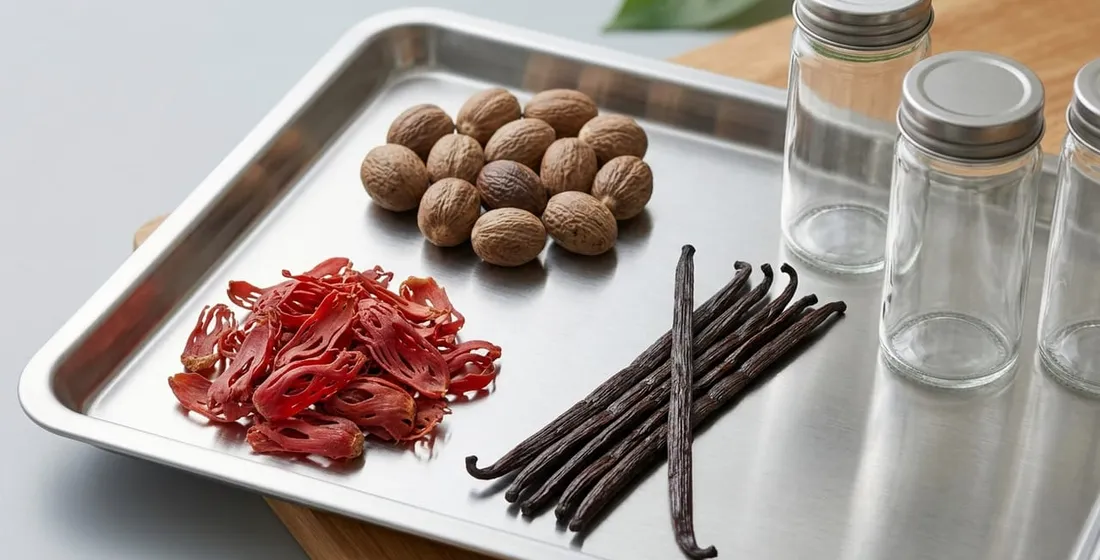
Mace is graded differently. The signal is the blade: bright crimson-to-scarlet colour, whole and unbroken, means fresh, well-cured aril, and Sri Lanka already supplies close to 7% of global mace demand (Sri Lanka Export Development Board, 2025). A premium spec chooses whole blade or fresh-ground over dull, pre-ground stock, because ground mace loses aroma fastest of the three. On the safety line, nutmeg naturally contains myristicin, which is harmless at culinary doses; the specification concern is not myristicin but aflatoxin, and testing to the maximum levels the European Union sets in Regulation 2023/915 gives a domestic premium line a defensible, export-ready bar.
The parameters below are what a brand owner and a contract manufacturer agree before the first run. Each row is a decision, and each decision moves the SKU up or down the shelf.
| Parameter | Commodity approach | Premium spec | Why it matters |
|---|---|---|---|
| Nutmeg grade | Mixed, some BWP | Sound whole kernels only | Aroma, appearance, no distiller-grade defect |
| Volatile oil | Not specified | Defined floor within 5% to 15% (FAO) | Flavour strength and shelf life |
| Particle size (ground) | Coarse, variable | Uniform, controlled band | Even dosing, consistent mouthfeel |
| Mace form | Dull, pre-ground | Whole crimson blade or fresh-ground | Aroma retention and colour |
| Contaminants | Untested | Tested to EU 2023/915 aflatoxin limits | Food safety and export readiness |
None of this needs the brand owner to be a food technologist. It needs the specification written down, and a manufacturer whose line can hold to it batch after batch, the same discipline any move from a kitchen recipe to a 1,500-jar run depends on.
What vanilla grade should a premium Sri Lankan spice line use?
Vanilla is graded by moisture and vanillin. Grade A (gourmet) beans hold 30% to 35% moisture and are used whole; Grade B (extraction) beans sit at 18% to 25% and go into paste or extract. Sri Lanka cures only about 1.5 tonnes of Bourbon-type Vanilla planifolia beans a year (Department of Export Agriculture; Sri Lanka Export Development Board), so scarcity, not preference, often decides the format a range can realistically commit to.
The first specification choice is honesty. If a label says vanilla and the jar carries synthetic vanillin, the premium claim collapses the moment a buyer reads the ingredient line. A genuine premium vanilla SKU uses a real cured bean or a natural extract standardised on vanillin, where high-quality beans run above 2% and typical culinary beans sit between roughly 0.75% and 1.5%. The format then follows the SKU’s job: a whole Grade A pod for a gift or hamper SKU, a speckled paste for a baking-brand line, a standardised natural extract for volume.
Sri Lanka’s vanilla economics explain the price. Curing loses roughly six kilograms of green bean for every kilogram of finished pod, which is why cured Sri Lankan vanilla trades near global reference levels rather than commodity ones. In the R&D room, this is the most common place a premium brief meets reality: a founder wants whole Ceylon pods across the whole range, and the annual cured-bean supply cannot carry it. The workable answer is usually a tiered range, real pods on the halo SKU and a natural extract underneath, specified so the vanillin level stays consistent even as the format changes.
| Vanilla format | Grade | Moisture / vanillin | Best-fit SKU | Relative cost |
|---|---|---|---|---|
| Whole pod | A (gourmet) | 30% to 35% moisture | Gift, hamper, halo SKU | Highest |
| Paste or ground bean | A / B blend | Speckled, visible seed | Baking-brand line | Mid |
| Natural extract | B (extraction) | Standardised vanillin | Volume SKU | Mid to low |
| Synthetic vanillin | Not applicable | No real bean | Not permitted for a vanilla premium claim | Lowest |
Turning three specs into one shelf-ready range
A private-label spice range reaches the shelf as a set of locked specifications plus a production plan. Silk Foods Ceylon fills a first private-label run at a 1,500-jar MOQ per SKU on 300 g glass, from a BRCGS- and FSSC 22000 V6-audited line in Matale. Locking grade, volatile oil, particle size, and vanilla format up front is what lets three SKUs run on one audit and one label-approval cycle, rather than three separate scrambles.
The economic argument for building the range together, rather than one SKU at a time, is the shared cert stack. One BRCGS and FSSC 22000 V6 audit, one SLSI submission workflow, and one label-approval cycle cover a nutmeg SKU, a mace or nutmeg-mace blend, and a vanilla SKU at once. For a brand owner, that turns three product launches into one production block and one compliance timeline. The same logic runs a private-label curry powder or a graded pepper line: the specification is per SKU, but the audit chain is shared.
Service snapshot: private-label spice line at Silk Foods Ceylon
- Service: SFC formulates or fills a brand owner’s spice specification and labels it under the buyer’s brand.
- First-run MOQ: 1,500 jars per SKU (300 g glass); smaller 50 g and 100 g glass formats run on the same block.
- Sample to first PO: 2 to 4 weeks once a spec is locked; 6 to 10 weeks if R&D iterations are needed first.
- Cert coverage: BRCGS- and FSSC 22000 V6-audited, with SLSI clearance and Sri Lanka Food Act labelling on every retail SKU.
- Vanilla note: SKUs using real cured beans plan around bean availability, not a fixed date.
Format is the last specification. Nutmeg and mace suit small glass jars, 50 g to 100 g, where the aroma is protected and the price per gram reads as premium. Vanilla suits a tube or a short glass jar that shows the pod. Across all three, batch-to-batch consistency is the promise the specification makes on every subsequent run, not just the first, which is exactly what a professional line is built to hold.
What does SLSI clearance and labelling require for a packaged spice SKU?
Every packaged spice sold on a Sri Lankan retail shelf must comply with the Sri Lanka Food Act No. 26 of 1980 and its labelling regulations, with SLSI standards applied for quality parameters. A compliant spice label carries net weight, batch code, best-before date, ingredient and allergen declaration, and manufacturer details. For a premium claim, contaminant testing to aflatoxin limits (EU Regulation 2023/915 as a reference bar) protects both the shelf and any later export.
SLSI standards are largely voluntary, though some are mandatory at the point of import, and a retail buyer will usually still ask for the manufacturer’s food-safety audit alongside the product spec. The practical planning point is the calendar: a brand owner should treat the SLSI submission and label approval as a six-to-ten-week window that runs in parallel with production, not after it. A geographical indication term such as Ceylon Nutmeg also carries usage rules, so the on-pack claim should match what the specification and sourcing actually support. The full step-by-step sits in the SLSI submission guide.
This is the section most first-time spice brands underestimate. The recipe is ready months before the label is, and the shelf date slips because the compliance clock started late. Building the certification and labelling work into the same plan as the spec is the difference between a launch date and a hope.
Frequently asked questions
Does Silk Foods Ceylon do private-label manufacturing for nutmeg, mace, and vanilla?
Yes. Silk Foods Ceylon runs private labelling and contract manufacturing from a BRCGS- and FSSC 22000 V6-audited line in Matale, with a 1,500-jar first-run MOQ per SKU on 300 g glass. The R&D team locks grade, volatile-oil floor, and particle size before the first commercial run.
What makes a nutmeg spec premium rather than commodity?
Volatile-oil content and grade. Sound whole nutmeg yields 5% to 15% volatile oil (FAO); a premium spec sets a floor near the top of that band, calls for sound whole kernels over BWP grade, fixes a uniform particle size for ground SKUs, and tests to EU 2023/915 aflatoxin limits.
Can a Sri Lankan spice brand use real Ceylon vanilla?
Yes, within supply. Sri Lanka cures only about 1.5 tonnes of Bourbon-type Vanilla planifolia beans a year (Department of Export Agriculture), so whole Grade A pods suit small halo SKUs while a natural extract covers volume. Synthetic vanillin cannot carry a genuine vanilla premium claim.
How long does a private-label spice SKU take to reach a Sri Lankan shelf?
For a locked recipe, plan 2 to 4 weeks from PO to first commercial batch at Silk Foods Ceylon, plus a 6 to 10 week buffer for SLSI clearance and label approval before a retail listing date. SKUs using real cured vanilla may run longer, subject to bean availability.
How Silk Foods Ceylon can help
For a brand owner building a premium private-label spice range, Silk Foods Ceylon (SFC) operates a cellular-manufacturing facility in Matale that turns a specification into a retail-ready SKU. The in-house R&D team locks grade, volatile-oil floor, particle size, and vanilla format before the first run; private-label first-run MOQs sit at 1,500 jars per SKU on 300 g glass, with lead times of 2 to 4 weeks once a spec is signed off. The line is BRCGS- and FSSC 22000 V6-audited, with SLSI submission support and Sri Lanka Food Act labelling built into the engagement.
To brief a spice-line project, email b2b@esilkroute.com.lk or call +94 76 441 0389 / +94 76 918 5744.
Sources
- Sri Lanka Export Development Board (2025), “Ceylon Nutmeg and Mace”, https://www.srilankabusiness.com/spices/about/nutmeg-cultivation-sri-lanka.html (retrieved 2026-07-11).
- Sri Lanka Export Development Board (2025), “Natural Vanilla from Sri Lanka”, https://www.srilankabusiness.com/spices/vanilla.html (retrieved 2026-07-11).
- Department of Export Agriculture, Sri Lanka, “Vanilla”, https://dea.gov.lk/vanilla/ (retrieved 2026-07-11).
- Food and Agriculture Organization of the United Nations, “Production, handling and processing of nutmeg and mace: composition and constituents”, https://www.fao.org/4/x5047e/x5047e0a.htm (retrieved 2026-07-11).
- European Commission (2023), “Commission Regulation (EU) 2023/915 on maximum levels for certain contaminants in food”, https://eur-lex.europa.eu/eli/reg/2023/915/oj (retrieved 2026-07-11).
- Ministry of Health, Sri Lanka, Food Control Administration Unit, “Sri Lanka Food Act No. 26 of 1980 and labelling regulations”, https://eohfs.health.gov.lk/food/ (retrieved 2026-07-11).
Written by the Silk Foods Ceylon Team. Silk Foods Ceylon (Pvt) Ltd. is a BRCGS- and FSSC 22000 V6-audited contract manufacturer in Matale, Sri Lanka, offering contract manufacturing, private labelling, co-packing, and in-house R&D for local Sri Lankan brand owners, FMCG companies, hotel and restaurant groups, and distributors. To brief a project: b2b@esilkroute.com.lk, +94 76 441 0389, or +94 76 918 5744.