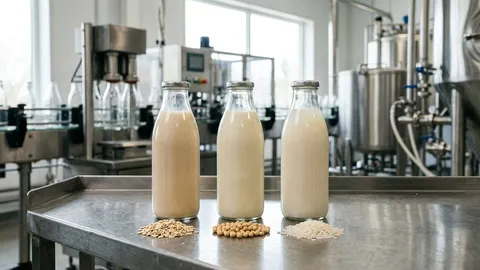
Plant-based milk R&D in Sri Lanka: spray-dry powder vs UHT liquid
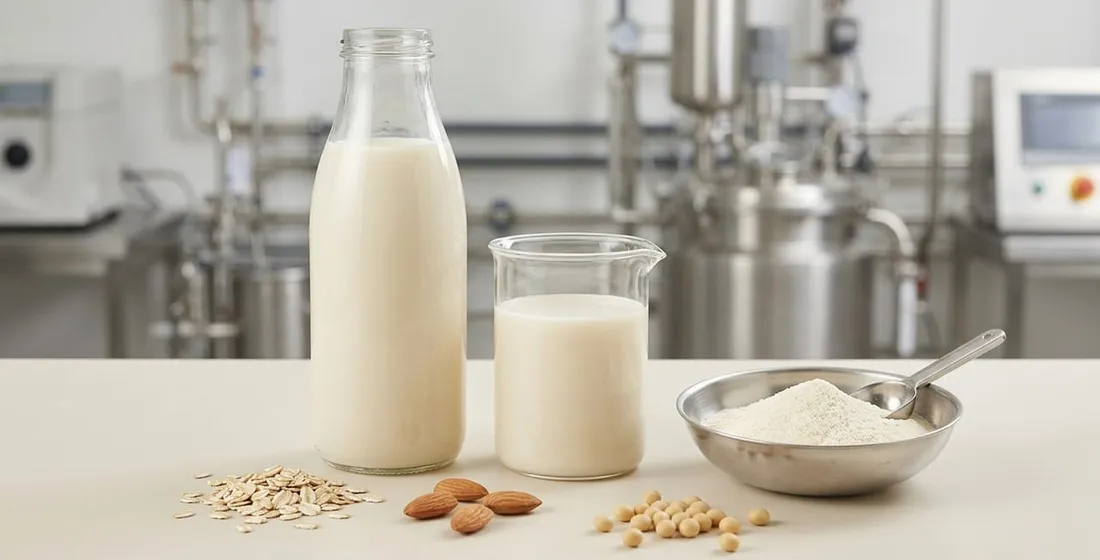
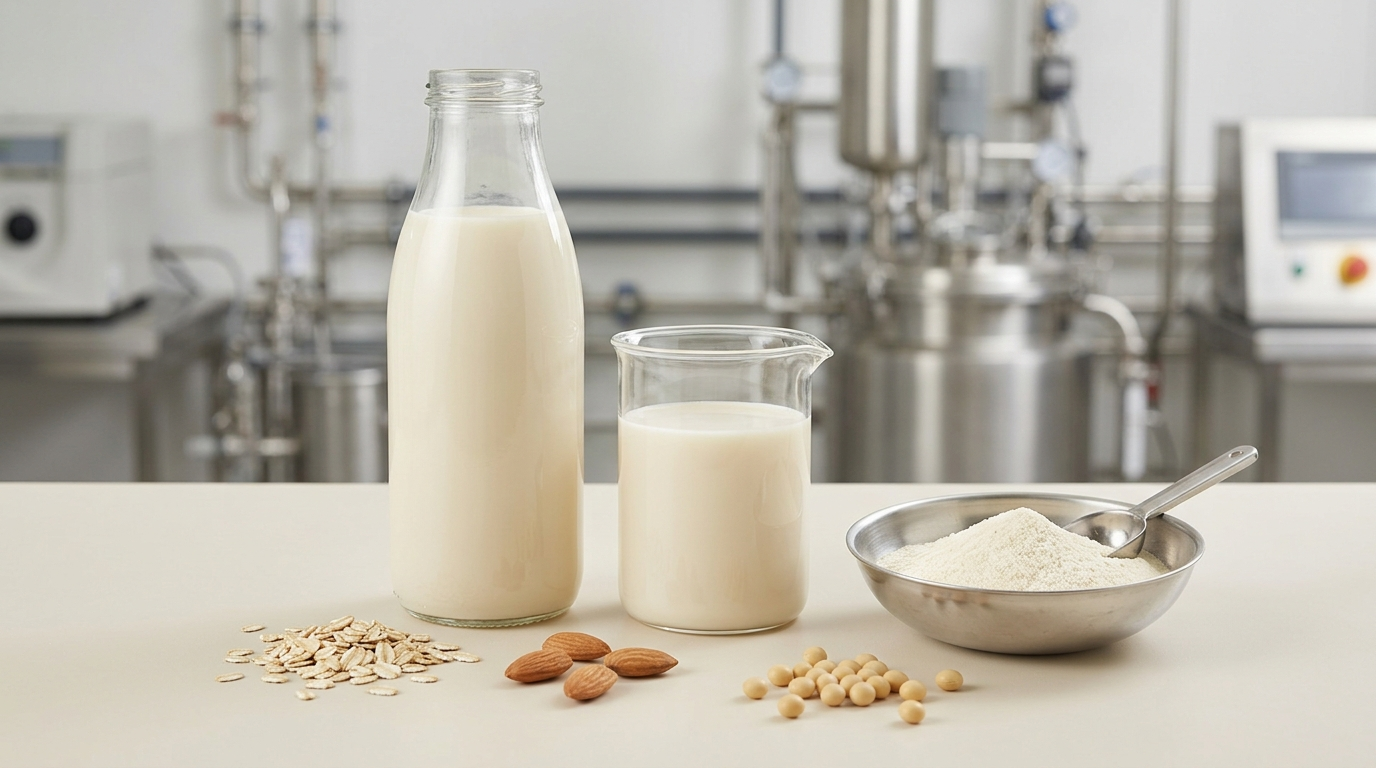
Buyer’s snapshot
- Clinical lactose-tolerance testing of Sri Lankan adults has found roughly 72.5% with lactase deficiency (Senewiratne et al., Gut), which is the demand floor under any local plant-milk launch.
- Plant-based dairy alternatives are one of the faster-moving categories in Sri Lanka’s grocery basket, led by oat, soy, and almond (Euromonitor, 2025).
- The first R&D decision for a plant-milk SKU is format, not flavour: spray-dry powder or shelf-stable liquid. That choice sets shelf life, storage, logistics, and capex.
- Silk Foods Ceylon (SFC) runs both a spray-drier and a glass-bottle beverage line in Matale, under a BRCGS- and FSSC 22000 V6-audited cert stack with SLSI clearance on every retail SKU.
Most local plant-milk inquiries arrive with a flavour and a brand name already chosen. Oat, soy, almond, a label idea, sometimes a working blend from a home blender. The question the brand owner usually has not answered yet is the one that drives most of the cost and shelf strategy: does the product launch as a powder you reconstitute, or as a ready-to-drink liquid? That single format decision sits at the top of the R&D tree, and it changes the line, the shelf life, the logistics, and the price tier before a single flavour iteration runs.
Why is plant-based milk demand real in Sri Lanka?
The demand floor is biological. Clinical lactose-tolerance testing of Sri Lankan adults has put lactase deficiency at roughly 72.5% (Senewiratne et al., Gut), in line with the wider South Asian range. A majority of the adult market processes dairy lactose poorly, which gives a plant-based drink a functional reason to exist beyond lifestyle positioning.
On top of that floor sits a growing category. Plant-based dairy alternatives are among the faster-moving lines in the local grocery basket, led by oat, soy, and almond, with both local and imported brands now on shelf (Euromonitor, 2025). For a local FMCG brand owner, the opening is not whether the category exists. It is which format wins the shelf space the brand is targeting, and that is an R&D and food product development decision before it is a marketing one.
Spray-dry powder vs shelf-stable liquid: the decision tree
The two routes solve the same brief in different physical forms. A spray-dried powder removes the water, ships light, sits on an ambient shelf for a year or more, and reconstitutes at point of use. A shelf-stable liquid keeps the water in, drinks straight from the pack, sits closer to the dairy experience, and costs more to store and move. Neither is better in the abstract. The right answer follows the channel, the shelf-life target, and the capex the brand can carry.
| Decision axis | Spray-dry powder | Shelf-stable liquid (UHT or retort) |
|---|---|---|
| Format | Sachet, pouch, or tin; reconstitute with water | Ready-to-drink bottle or carton |
| Ambient shelf life | Typically 12 to 24 months | Typically 6 to 9 months unopened (Tetra Pak) |
| Cold chain | Not required | Not required if UHT or retort; required if only pasteurised |
| Logistics weight | Light; water removed before shipping | Heavy; full water weight moves with the product |
| Sensory closeness to dairy | Depends on rehydration and emulsification quality | Closest to a dairy drink mouthfeel |
| Best-fit channel | Pantry, value tier, food service, export-bridge | Chilled or ambient RTD shelf, HORECA, café |
| SFC line | Spray-drier | Glass-bottle beverage line (retort) |
The table is the short version. The two sections below are why each column reads the way it does.
What spray-drying actually does to a plant milk
Spray-drying atomises a liquid plant-milk concentrate into a chamber of hot air, so the droplets dry in seconds and fall out as a fine powder. The short, high-temperature exposure is what preserves colour, flavour, and much of the nutrition while pulling moisture down to a level where the powder is shelf-stable without refrigeration. Research on plant beverages confirms the route works without a carrier in many cases, producing a stable reconstitutable powder (Scientific Reports, 2024).
For a brand, the powder route buys three things: a long ambient shelf life, a low shipping weight because the water is gone, and a forgiving distribution model for a market with patchy cold chain. The cost is sensory. A reconstituted plant milk lives or dies on how cleanly it rehydrates, how stable the emulsion is, and whether it separates in the cup. That is where the R&D iterations concentrate, and it is the same discipline as reformulating a home-kitchen recipe for retort: the home version rarely survives the process step unchanged.
UHT and retort: two routes to a shelf-stable liquid
Here is the distinction most briefs blur. A shelf-stable liquid can reach the shelf two ways, and they are not the same line. UHT heats the product to roughly 135 to 150°C for a few seconds, then fills it cold into aseptic packaging, usually a carton or an aseptic-grade bottle (Tetra Pak). Retort fills the product into the final container first, seals it, then sterilises the sealed pack under heat and pressure. UHT protects delicate flavour better and suits cartons; retort suits glass and certain rigid formats and is the in-container route.
The practical consequence for a local brand: the line you can access shapes the format you can sell. SFC’s beverage capability runs on a glass-bottle line, which makes retort the in-container sterilisation route for a shelf-stable liquid there, rather than aseptic-carton UHT. A brand set on a carton format is choosing a different line type, and that is worth knowing at brief stage, not after the first sample. The same plant-milk concentrate can usually go either to the spray-drier for powder or to the plant-based and vegan contract manufacturing beverage line for a retort liquid, which is why the format decision is made once, early, and deliberately.
The label question: can you call it “milk”?
A plant drink is not, by the international standard, milk. The Codex General Standard for the Use of Dairy Terms reserves “milk” for the normal mammary secretion of milking animals, precisely to keep consumers from being misled by dairy terms on non-dairy products (Codex Alimentarius, CXS 206-1999). Locally, Sri Lanka’s Food (Labelling and Advertising) Regulations 2022 carry a general provision against false or misleading labelling, phased to full effect by 1 January 2026 (USDA Foreign Agricultural Service, 2024).
The workable path most brands take is to lead with the plant and a descriptor: “oat drink,” “soya beverage,” “almond drink,” with the plant name doing the heavy lifting and “milk” used carefully, if at all. Settle this at artwork stage alongside the three-language label and allergen disclosure. Soy and tree nuts are declarable allergens, and an almond or soy drink carries one on the face of the pack. Getting the name and the allergen line right on the first artwork is cheaper than a reprint after a retail buyer or an SLSI desk officer flags it.
How many R&D iterations should a brand budget?
Plan for sample iterations, not a single golden batch. The R&D team at the Matale facility typically runs two to four sample rounds before a plant-milk recipe locks for a first commercial run, and the count climbs when the brief changes format midway. The most expensive iteration is the one caused by deciding on powder after the liquid samples are already approved, because the process step, not the flavour, has to be re-solved.
Service snapshot
R&D / NPD (Co-Development on the SFC brochure) at the Matale facility
Scope: in-house formulation for a plant-milk SKU in either format, powder or shelf-stable liquid
Iterations: typically 2 to 4 sample rounds before the recipe locks
Lines available: on-site spray-drier for powder; glass-bottle beverage line (retort) for liquid
First commercial run: beverage MOQ from 1,250 bottles (200 ml); powder by batch
Sample to first PO: 6 to 10 weeks when R&D is needed first; 2 to 4 weeks once a recipe is locked
Cert coverage: BRCGS- and FSSC 22000 V6-audited, with SLSI clearance and Sri Lanka Food Act compliance on every retail SKU
One local wellness brand arrived with a working oat-and-cashew blend from a café kitchen and a plan to bottle it. Two sample rounds in, the distribution review showed most of its target outlets had no reliable chilled space, which made a short-life pasteurised liquid a poor fit. The blend moved to the spray-drier as a reconstitutable oat drink powder, and the ambient shelf life opened up the pantry shelf the brand actually had access to. The flavour work carried across. The format decision, taken two rounds late, cost the rounds in between. That is the iteration a format-first brief avoids.
Frequently asked questions
Can Silk Foods Ceylon develop a plant-based milk recipe for a local brand?
Yes. Silk Foods Ceylon runs in-house R&D and NPD for plant-milk SKUs in either format, spray-dry powder or shelf-stable liquid. The team typically works through two to four sample iterations before a recipe locks, then moves it to the spray-drier or the glass-bottle beverage line for the first commercial run, all under one BRCGS- and FSSC 22000 V6-audited cert stack.
Should a plant-based milk launch as a powder or a UHT or retort liquid?
It follows the channel and the shelf-life target. Powder suits pantry, value-tier, and outlets with no cold chain, with a 12-to-24-month ambient shelf life and light logistics. A shelf-stable liquid via UHT or retort drinks closest to dairy and suits the RTD shelf, with a typical 6-to-9-month ambient shelf life (Tetra Pak), but moves at full water weight.
Can a plant-based drink be labelled “milk” in Sri Lanka?
The international standard reserves “milk” for dairy: the Codex General Standard for the Use of Dairy Terms limits the term to the mammary secretion of milking animals (CXS 206-1999), and Sri Lanka’s labelling regulations prohibit misleading labelling. Most brands market as an “oat drink,” “soya beverage,” or “almond drink,” with the plant name leading and the allergen declared.
What is the MOQ for a plant-based milk SKU at Silk Foods Ceylon?
For a shelf-stable liquid on the glass-bottle line, first-run MOQ starts at 1,250 bottles at 200 ml. A spray-dried powder is scheduled by batch on the spray-drier rather than by bottle count. Once a recipe is locked, lead time is typically 2 to 4 weeks; plan a 6-to-10-week window if R&D iterations are needed first.
How Silk Foods Ceylon can help
For local FMCG brands developing a plant-based milk, Silk Foods Ceylon (SFC) handles the step most briefs underestimate: the format decision and the formulation that follows it. The in-house R&D team prototypes in both directions, a reconstitutable powder on the on-site spray-drier or a shelf-stable liquid on the glass-bottle beverage line, typically across two to four sample rounds before the recipe locks for the first commercial run under contract manufacturing. Beverage first-run MOQ starts at 1,250 bottles (200 ml), and the BRCGS, FSSC 22000, and SLSI cert stack covers the retail shelf and the SLSI submission inside the engagement. The same discipline that runs the retort iteration cycle on a vegan spread applies here.
To brief a plant-milk project, email b2b@esilkroute.com.lk or call +94 76 441 0389 / +94 76 918 5744.
Sources
- Senewiratne B, Thambipillai S, Perera H, “Intestinal lactase deficiency in Ceylon (Sri Lanka),” Gut / via PubMed (PMID 870373). https://pubmed.ncbi.nlm.nih.gov/870373/ (retrieved 2026-06-22)
- Euromonitor International (2025), “Dairy Products and Alternatives in Sri Lanka.” https://www.euromonitor.com/dairy-products-and-alternatives-in-sri-lanka/report (retrieved 2026-06-22)
- Codex Alimentarius (CXS 206-1999), “General Standard for the Use of Dairy Terms,” FAO/WHO. https://www.fao.org/input/download/standards/332/CXS_206e.pdf (retrieved 2026-06-22)
- USDA Foreign Agricultural Service (2024), “Sri Lanka Enacts New Legislation for Food Labeling and Advertising,” documenting the Ministry of Health Food (Labelling and Advertising) Regulations 2022. https://www.fas.usda.gov/data/sri-lanka-sri-lanka-enacts-new-legislation-food-labeling-and-advertising (retrieved 2026-06-22)
- Tetra Pak, “UHT FAQ,” processing temperatures and ambient shelf-life reference. https://www.tetrapak.com/en-us/insights/food-categories/dairy/uht-faq (retrieved 2026-06-22)
- “Powdered plant beverages obtained by spray-drying without carrier addition: physicochemical and chemometric studies,” Scientific Reports (2024). https://www.nature.com/articles/s41598-024-54978-x (retrieved 2026-06-22)
Written by the Silk Foods Ceylon Team. Silk Foods Ceylon (Pvt) Ltd. is a BRCGS- and FSSC 22000 V6-audited contract manufacturer in Matale, Sri Lanka, offering contract manufacturing, private labelling, co-packing, and in-house R&D for local Sri Lankan brand owners, FMCG companies, hotel and restaurant groups, and distributors. To brief a project: b2b@esilkroute.com.lk, +94 76 441 0389, or +94 76 918 5744.