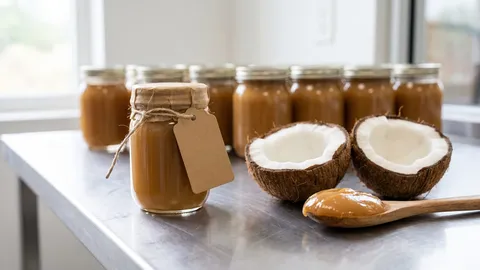
Private-Label Coconut Spread for Sri Lankan Hotel Gift Shops
HORECA snapshot
- Sri Lanka welcomed a record 2.36 million tourists in 2025, up about 15% on the year, and the 2026 target is 3 million (Daily FT, 2025). Gift-shop footfall climbs with every arrival.
- Coconut-based product exports passed USD 1 billion in the first ten months of 2025, with coconut kernel products up about 75% (Sri Lanka Export Development Board, 2025). Coconut is the credible local hero ingredient.
- A gift-shop SKU has a job most in-room amenities do not: it has to travel. Shelf-stable, no cold chain, a shelf life that survives the journey home.
- Silk Foods Ceylon (SFC) private-labels coconut spread into glass jars at a 1,500-jar first-run MOQ, BRCGS- and FSSC 22000 V6-audited, custom-branded on an existing formulation.
- See the jar-format matrix below before briefing a programme.
Sri Lanka’s luxury and boutique hotel groups run gift-shop and in-room programmes that put a property’s name on jars, sachets, and tins a guest can carry home. Most of those SKUs are made by one of a handful of local contract manufacturers, under the hotel’s own brand, on a private-label basis. The procurement criteria narrow the field quickly: SLSI clearance, a current food-safety audit on the manufacturer, low-MOQ flexibility, and a shelf life that survives a suitcase to London or Sydney.
Silk Foods Ceylon (SFC), a BRCGS- and FSSC 22000 V6-audited manufacturer in Matale, builds private-label coconut spread programmes against exactly those criteria. This post is for the gift-shop or food-and-beverage buyer deciding whether a coconut spread belongs on the shelf, what shelf-stable really demands, and how the adjoining-plantation story fits a property positioned on sustainability.
Why a coconut spread earns gift-shop shelf space in 2026
A hotel gift-shop SKU works when it carries the destination home, and coconut does that for Sri Lanka. Coconut-based product exports passed USD 1 billion in the first ten months of 2025, with kernel products up about 75% year on year (Sri Lanka Export Development Board, 2025). A coconut spread reads as authentically local and travels well.
Gift-shop revenue is footfall converted into take-home product, and the footfall is at a record. Sri Lanka welcomed 2.36 million tourists in 2025, a 15% rise on the year, with the government targeting 3 million arrivals in 2026 (Daily FT, 2025). Each arrival is a potential gift-shop transaction, and the SKUs that convert best are the ones a guest recognises as part of the place they just visited.
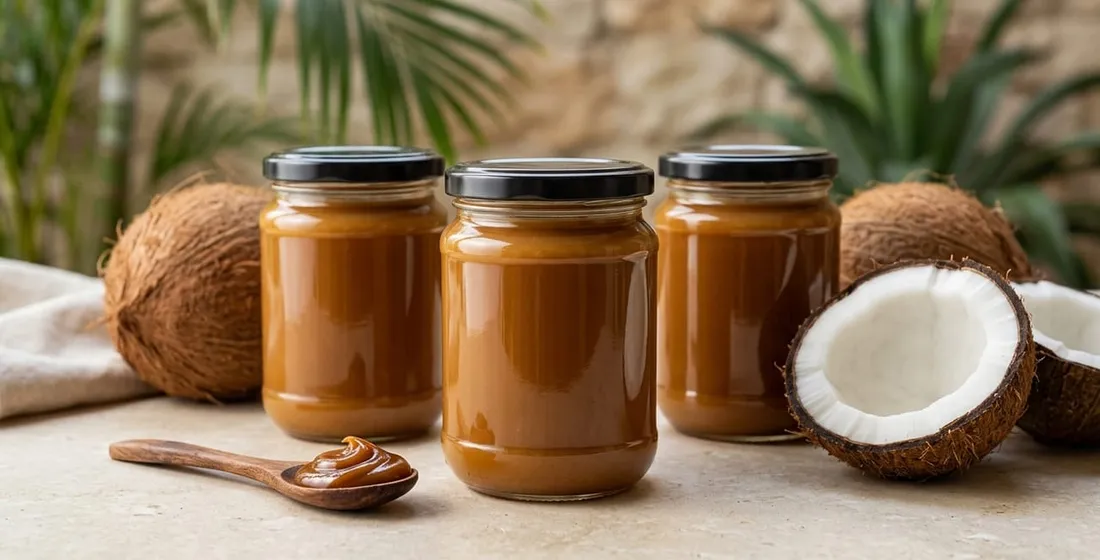
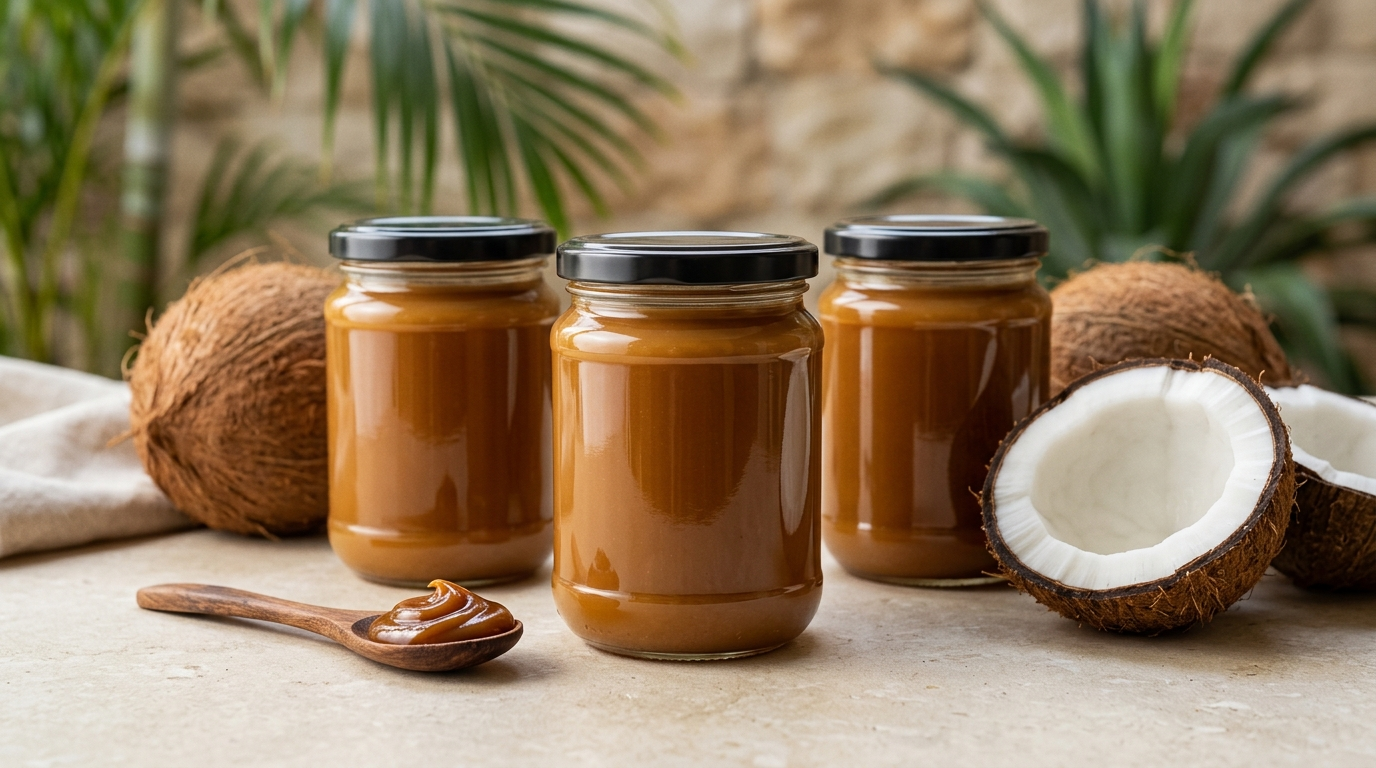
Coconut is that ingredient for Sri Lanka. The spread version, coconut jam, is known locally as pol pani: grated coconut cooked down with syrup into a thick, sweet, spreadable preserve that most Sri Lankan households know from a childhood kitchen. Put it in a sealed glass jar and it becomes a gift-shop SKU that tells a clear story, sits at a comfortable price point, and needs no explanation to a departing guest.
The margin on a gift-shop jar sits in the brand and the provenance, not the recipe. A property does not need to develop a coconut spread from scratch to sell one under its own name, which is why private labelling, rather than contract manufacturing, is the usual route into a gift-shop range. The local retail and HORECA landscape for brand owners sets out where these SKUs sell across the wider market.
What is private labelling for a hotel gift-shop programme?
Private labelling means a manufacturer applies a buyer’s brand to an existing, proven formulation, so the property owns the label and the story while the recipe and the audit stay with the maker. Silk Foods Ceylon carries more than 50 ready-to-go SKUs, coconut products among them, that a hotel can brand without funding recipe development.
On the SFC brochure the service is described as Our Product, Your Brand. The hotel chooses a formulation from the existing catalogue, approves a label design, and the product ships under the property’s brand. That is different from contract manufacturing, where the buyer brings their own recipe, and from R&D, where a new formulation is developed from a brief. For a gift-shop coconut spread the existing formulation almost always fits, so private labelling at Silk Foods Ceylon is the fastest and lowest-risk route.
The SFC private-label catalogue carries more than 50 ready-to-go SKUs that can be relabelled under a buyer’s brand without re-formulation. For a hotel group, the shortcut matters most where the value is the brand and the story rather than the recipe. A coconut spread, a coconut chip, a spice blend, a herbal tea: each can carry a property’s name on a shelf-stable jar or pouch within a single programme. Several properties extend the same approach to private-label in-room amenities beyond the gift shop.
First-run MOQ sits at 1,500 jars per SKU. Because the Matale facility runs on a cellular-manufacturing layout, a property can put several variants, natural, cinnamon, cocoa, pineapple, through one production block on a single audit, rather than treating each as a separate project.
Why shelf-stable is the gift-shop SKU’s hardest requirement
A gift-shop product has to survive a display shelf in a humid climate and then a journey to another continent. Shelf-stable means no refrigeration, a sealed glass jar, and a shelf life measured in months. A coconut spread, cooked and hot-filled into glass, clears that bar where a fresh or chilled amenity cannot.
This is the requirement that quietly rules out most candidate SKUs. An in-room chocolate or a fresh welcome treat cannot leave the property. A gift-shop jar has to. The buyer who carries it home may open it weeks later, in a different climate, after a flight in a suitcase. Shelf-stability is therefore not a nice-to-have. It is the gating spec.
A coconut spread meets the bar by design. Cooked to the right solids and hot-filled into a sealed glass jar, it holds at ambient temperature with a shelf life that typically runs nine to twelve months, no cold chain required. That suits the gift shop, the minibar, the diaspora gifting channel, and the take-home purchase in one formulation. The glass jar also reads as premium and reseals, which fits a gifting price point.
The contrast is the whole argument for the category. Chilled, frozen, or fresh amenities stay inside the hotel. Shelf-stable jars, private-label coconut chips for a hotel minibar, spice blends, and teas are what a guest actually carries out of the gift shop, which is why those formats dominate a well-built range.
The adjoining-plantation framing for a sustainability-positioned property
For a property positioned on sustainability, provenance has to be real, not a label claim. In 2025 the Sri Lanka Tourism Development Authority, with UNDP, certified 100 small and medium tourism enterprises under the National Sustainable Tourism Certification (SLTDA, 2025), a sign that buyers increasingly expect a traceable local supply story behind a gift-shop SKU.
The Matale facility sits at Silk AgTech Park in Hapugasyaya, with an adjoining plantation that supplies fresh produce for R&D and pilot batches. For a sustainability-positioned hotel group, that adjoining-plantation sourcing is a genuine farm-to-jar line rather than a marketing phrase, and the round trip from Colombo is a day, so a buyer can approve samples in person on the property where the raw material grows.
The positioning matters more each season. Sustainable-tourism certification is now a formal programme in Sri Lanka, with the SLTDA and UNDP awarding the National Sustainable Tourism Certification to 100 enterprises in 2025 (SLTDA, 2025). A gift-shop range that can point to a traceable, locally sourced supply chain supports that story in a way a generic imported gift cannot.
One sustainability-positioned property briefed a single coconut spread jar for its gift shop in 2025. Once the provenance line tested well with guests, it added two flavour variants within two quarters. The unlock was not price. It was that the same BRCGS- and FSSC 22000 V6-audited cert stack covered all three variants on one audit, so the second and third SKUs reached the shelf without re-auditing the manufacturer.
Jar format and MOQ: matching the pack to the gift-shop shelf
The format decision is a merchandising and margin decision, not a packaging preference. A taster jar suits a welcome tray or a multi-jar gift set; a larger jar suits a flagship gift or a hamper. Silk Foods Ceylon private-labels across glass-jar sizes from 50 ml to 1 litre, so a property can match the pack to the price point.
Most gift-shop coconut spread programmes settle on two or three jar sizes that map to different shopper moments. The matrix below pairs the common glass formats with where each one earns its place on the shelf.
| Glass jar | Typical fill | Best gift-shop use | Shelf signal |
|---|---|---|---|
| 50 ml mini | 40 to 50 g | Welcome-tray taster, minibar, multi-jar gift set | Sampler |
| 220 ml | 200 to 250 g | Everyday gift-shop jar, in-room amenity | Standard |
| 330 ml | 300 to 350 g | Flagship gift jar, diaspora take-home | Premium |
| 500 ml | 450 to 500 g | Sharing jar, hamper centrepiece | Premium-plus |
First-run MOQ is 1,500 jars per SKU, set deliberately for a hotel programme rather than an export-scale run. The semi-liquid line at the Matale facility fills around 3,000 jars per day, so a 1,500-jar first run is roughly a half-day slot, with the rest of the day available for a second variant or a line changeover. LKR pricing tiers move with jar size, fill weight, and total volume; precise figures are quoted on a brief. A multi-size programme, a 50 ml taster alongside a 330 ml flagship, can run in the same production block.
Does a hotel gift-shop SKU still need full label compliance?
Yes. A gift-shop jar is a packaged food under Sri Lankan law, even when it sells inside a hotel. The Food (Labelling and Advertising) Regulations 2022 take full effect from 1 January 2026 (USDA Foreign Agricultural Service, 2025), so tri-lingual common names, allergen disclosure, and date marking apply to a private-label coconut spread the same as any retail SKU.
The regulation has been through several extensions and now applies in full from the start of 2026 (USDA Foreign Agricultural Service, 2025). For a gift-shop coconut spread, the practical points are specific. The common name appears across the tri-lingual convention, allergens are declared, and the date of manufacture is marked. An English-forward label helps the departing-guest and diaspora buyer, but it does not replace the tri-lingual panel the law requires.
Silk Foods Ceylon handles SLSI submission and label compliance inside the private-label engagement, on a line that is BRCGS- and FSSC 22000 V6-audited, with SLSI clearance and Sri Lanka Food Act compliance on every retail SKU. That audit chain is what a procurement or finance lead checks before a programme is signed, and it is the same stack described in the certification stack for a Sri Lankan FMCG launch. The labelling detail for a coconut SKU specifically is covered in SLSI clearance for a private-label coconut jam.
Service snapshot: Private Labelling at Silk Foods Ceylon
- Service: an existing SFC formulation, custom-branded under the property’s name (Our Product, Your Brand).
- Catalogue: more than 50 ready-to-go SKUs, including coconut spread, coconut chips, spice blends, herbal teas, and capsules.
- Formats: glass jars from 50 ml to 1 L; shelf-stable, ambient, no cold chain.
- First-run MOQ: 1,500 jars per SKU; multiple variants on one production block and one audit.
- Cert coverage: BRCGS- and FSSC 22000 V6-audited, with SLSI clearance and Sri Lanka Food Act compliance on every retail SKU.
FAQ
What is the private-label MOQ for coconut spread at Silk Foods Ceylon?
First-run MOQ is 1,500 jars per SKU. Because the Matale facility uses a cellular-manufacturing layout, several flavour variants can run on one production block and one BRCGS- and FSSC 22000 V6 audit. The semi-liquid line fills around 3,000 jars per day, so a first run is roughly a half-day slot.
Is private-label coconut spread shelf-stable for a hotel gift shop?
Yes. Cooked and hot-filled into a sealed glass jar, a coconut spread holds at ambient temperature with a shelf life that typically runs nine to twelve months, with no refrigeration. That suits the gift shop, the minibar, and the diaspora take-home and gifting channels in one formulation.
Can a hotel group brand an existing Silk Foods Ceylon coconut spread?
Yes. Silk Foods Ceylon carries more than 50 ready-to-go SKUs under its Our Product, Your Brand private-label service. A property approves a formulation and a label design, and the product ships under the property’s name, with no recipe development to fund.
Does a gift-shop coconut spread need SLSI clearance and full labelling?
Yes. A gift-shop jar is a packaged food. The Food (Labelling and Advertising) Regulations 2022 apply in full from 1 January 2026 (USDA FAS, 2025), requiring tri-lingual common names, allergen disclosure, and date marking. SFC handles SLSI submission and label compliance inside the private-label engagement.
What does the adjoining plantation add to a sustainability-positioned hotel’s gift line?
It gives a traceable, locally sourced provenance line for the gift-shop story, with samples approvable in person on the property. With the SLTDA and UNDP certifying 100 enterprises under the National Sustainable Tourism Certification in 2025 (SLTDA, 2025), that traceability increasingly matters to a sustainability-positioned buyer.
How Silk Foods Ceylon can help
For hotel and restaurant groups running gift-shop, in-room, and minibar SKU programmes, Silk Foods Ceylon (SFC) offers a private-label catalogue of more than 50 ready-to-go products, including a shelf-stable coconut spread that travels home in a guest’s suitcase. Custom branding is applied to an existing SFC formulation; the first-run MOQ sits at 1,500 jars per SKU, which keeps a multi-variant gift line on a single production block. The Matale facility is BRCGS- and FSSC 22000 V6-audited, with SLSI clearance on every retail SKU, and the adjoining plantation supports the provenance story for a sustainability-positioned property.
To brief a gift-shop or in-room programme, email b2b@esilkroute.com.lk or call +94 76 441 0389 or +94 76 918 5744.
Sources
Daily FT (2025), “Tourism arrivals grow by 15% to 2.36 m record high in 2025”, https://www.ft.lk/top-story/Tourism-arrivals-grow-by-15-to-2-36-m-record-high-in-2025/26-786582 (retrieved 2026-06-16)
Sri Lanka Tourism Development Authority (2025), “Year in Review 2025”, https://www.sltda.gov.lk/storage/common_media/Year_in_Review_2025_Final_updated_Report_2026_04_02-1.pdf (retrieved 2026-06-16)
Sri Lanka Export Development Board (2025), “Sri Lanka’s Export Performance Exceeded US$ 17.2 Billion in 2025”, https://www.srilankabusiness.com/news/sri-lankas-export-performance-exceeded-us-17.2-billion-in-2025.html (retrieved 2026-06-16)
Sri Lanka Tourism Development Authority and UNDP BIOFIN (2025), “Sri Lanka Celebrates 100 SMEs for Leading the Way in Sustainable Tourism”, https://www.biofin.org/news-and-media/sri-lanka-celebrates-100-smes-leading-way-sustainable-tourism (retrieved 2026-06-16)
USDA Foreign Agricultural Service (2025), “Sri Lanka Extends Implementation of the Food Labeling and Advertising Regulations-2022”, https://www.fas.usda.gov/data/sri-lanka-sri-lanka-extends-implementation-food-labeling-and-advertising-regulations-2022-0 (retrieved 2026-06-16)
Written by the Silk Foods Ceylon Team. Silk Foods Ceylon (Pvt) Ltd. is a BRCGS- and FSSC 22000 V6-audited contract manufacturer in Matale, Sri Lanka, offering contract manufacturing, private labelling, co-packing, and in-house R&D for local Sri Lankan brand owners, FMCG companies, hotel and restaurant groups, and distributors. To brief a project: b2b@esilkroute.com.lk, +94 76 441 0389, or +94 76 918 5744.