Private-label coconut sugar: the GI claim vs the retail story

Buyer's snapshot Sri Lankan coconut exports topped USD 1 billion in 2025, up about 40% on 2024 (Newswire.lk): the value-added coconut shelf is growing. No coconut sugar, coconut treacle, or kithul product holds a registered Geographical Indication in Sri Lanka or the EU as of 2026; Ceylon Cinnamon is the flagship registered GI. A private-label coconut sugar SKU can tell a truthful origin story, but cannot lawfully carry a GI or protected-origin claim, and a low-GI claim needs substantiation under the 2022 labelling rules. Silk Foods Ceylon (SFC) private-labels coconut sugar in glass and kraft from a first run of 1,500 jars, BRCGS- and FSSC 22000 V6-audited and SLSI-cleared. See the claim-by-claim table before signing off any label copy. |
Sri Lanka’s coconut sector crossed USD 1 billion in export earnings in 2025, up roughly 40% on the year before (Newswire.lk, January 2026). On the retail side, the same crop is showing up as a premium natural sweetener: unrefined coconut sugar, sold in glass jars and kraft pouches against a low-glycaemic story. For a private-label brand owner or a hotel gift-shop buyer, the recipe is rarely the hard part. The hard part is the label copy, because half of what a marketing team wants to print is a regulated claim, not a free story.
What a Geographical Indication actually is, and why coconut sugar does not have one
A Geographical Indication (GI) is a legal right that ties a product name to a defined place and a controlled production spec, entered on a state register. In Sri Lanka the framework sits under the Intellectual Property Act No. 36 of 2003, with a registration procedure set by the Registration of Geographical Indications Regulations of 2024 and a national GI register opened in February 2025 (WIPO Lex).
The register is young, and the Sri Lankan GIs named to date are agricultural products led by Ceylon Cinnamon, which became the country’s first EU Protected Geographical Indication in 2022 under Implementing Regulation (EU) 2022/144 (European Commission). The National Intellectual Property Office lists tea, cinnamon, pepper, and cashew among the Sri Lankan GI examples. No coconut product appears on that list.
This matters because a GI is not a marketing adjective. It is enforceable: only producers who meet the registered spec inside the registered area may use the protected name. Coconut sugar has no such entry, so the letters GI cannot sit on the pack as a claim, however Sri Lankan the product genuinely is.
Can a private-label coconut sugar carry a GI or protected-origin claim?
No. As of 2026, no coconut sugar, coconut treacle, or kithul jaggery holds a registered Geographical Indication in Sri Lanka’s national register, opened February 2025, or in the EU register, where Ceylon Cinnamon remains the only Sri Lankan entry (European Commission, 2022). A private-label coconut sugar SKU therefore cannot lawfully print GI or protected origin as a claim.
There is a clean line between a description and a claim. A brand can truthfully state that a product is Sri Lankan-made, or that it is coconut sugar from up-country nectar, because those are factual descriptions. What it cannot do is imply a registered protected status that does not exist. If a producer collective genuinely wants a GI for a coconut product, that is a multi-year process of defining a spec, an area, and a control body, then applying to register it. It is not a label decision made a fortnight before a print run.
The register is young, and coconut is not on it. That can change. A label deadline cannot wait for it.
The origin story you can tell, and the three claims that are still regulated
A private-label coconut sugar can carry a rich origin narrative and still stay inside the rules, as long as marketing keeps description separate from regulated claim. Three things a brand often treats as free story are not: a Geographical Indication, an organic claim, and a glycaemic or nutrient health claim. Each needs a specific basis before it reaches the pack.
| Claim on the pack | Regulated claim? | What it actually requires |
| GI or protected origin | Yes | A registered GI entry. None exists for coconut sugar, so the claim cannot be used. |
| Sri Lankan-made, single-source nectar, small-batch | No (factual description) | Must be truthful and not imply a registered protected status. |
| Organic | Yes | A valid organic certification (USDA Organic or EU Organic) held across the supply chain. |
| Low glycaemic index / GI 35 | Yes (health claim) | Substantiation under the Food (Labelling and Advertising) Regulations 2022. The GI 35 figure is a single contested study. |
| Unrefined, no additives | Conditional | Must match the actual process and the ingredient declaration. |
The low-GI line is the trap. The widely-quoted GI 35 value comes from a single study by the Philippine Food and Nutrition Research Institute and has not been independently replicated; the University of Sydney’s testing service measured coconut sugar at 54, essentially at the high-GI threshold of 55 (Foodwatch). Under the Food (Labelling and Advertising) Regulations 2022, in force since 1 January 2026 (USDA FAS), a nutrient or health claim has to be substantiated. Printing GI 35 on a Sri Lankan pack repeats an unreplicated foreign lab figure, which is exactly the kind of claim a retail buyer’s compliance desk will question.
There is also no international naming standard forcing the product’s hand. The Codex Alimentarius Standard for Sugars, CXS 212-1999, covers white sugar, dextrose, and glucose syrups, but does not define coconut sugar at all (FAO Codex). That freedom cuts both ways. It leaves the burden on the brand and the manufacturer to define the product honestly, and it makes the SLSI submission and the label-copy review the two places where an honest story is checked.
What does a private-label coconut sugar programme involve at Silk Foods Ceylon?
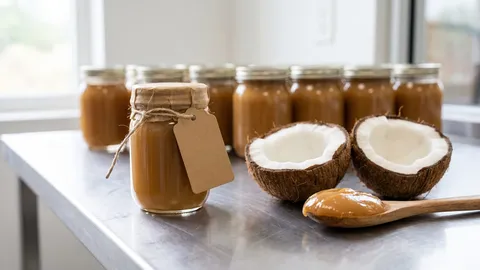
A private-label coconut sugar programme means Silk Foods Ceylon (SFC) supplies and packs the product under the buyer’s brand. At the Matale facility, a first run sits at 1,500 jars in 300 g glass, or an equivalent pouch batch, on a line that is BRCGS- and FSSC 22000 V6-audited, with SLSI clearance and Sri Lanka Food Act labelling built into the engagement. Lead times run 2 to 3 weeks once the spec and artwork lock.
There are two routes to the shelf. Private Labelling applies the SFC coconut sugar spec under the buyer’s own label, the same shortcut that carries a hotel gift-shop coconut spread range. Co-Packing applies when the buyer supplies finished coconut sugar in bulk and the SFC team packs, seals, and labels it into retail formats. R&D and NPD, listed as Co-Development on the SFC brochure, covers a buyer who wants a specific granulation, moisture level, or blend before the label locks.
In 2025, retail buyers across the region tightened what they accept on a nutrient claim, and the Food (Labelling and Advertising) Regulations 2022 came fully into force on 1 January 2026. The practical consequence for a coconut sugar SKU is that the label-copy review now happens before the SLSI submission, not after. The brands that plan the copy sign-off ahead of the SLSI submission reach the shelf on schedule. The ones that print low GI first and check later lose the slot to a re-artwork cycle.
For a hotel gift-shop programme, the origin story is the asset: up-country nectar, small-batch, unrefined. The adjoining plantation at Matale supports that provenance narrative honestly, which is a different thing from claiming a protection the product does not hold.
The spec that decides the retail story: nectar source, moisture, colour, granulation
Because coconut sugar has no Codex or Sri Lankan naming standard, the product spec is a commercial agreement between brand and manufacturer. Four variables carry the retail story, and each is a place where an honest description is earned or lost: the nectar source, the moisture content, the colour, and the granulation.
Nectar source decides whether single-source coconut sugar means what it says, or whether the product is a blend. Moisture content decides caking risk and shelf life; a sugar that clumps in a jar reads as a quality problem regardless of the story. Colour runs from light golden to dark caramel and has to hold batch to batch, or the shelf presentation drifts. Granulation decides whether the sugar pours cleanly or bridges in the pack. A brand that says single-source coconut nectar needs a spec and a supply chain that back the sentence, the same discipline that sits behind coconut oil grades and behind a provenance-led kithul and coconut treacle range.
Spec snapshot: private-label coconut sugar Product: granular coconut sugar from coconut inflorescence nectar Formats: 300 g and 500 g glass jars; 250 g and 500 g kraft pouches; sachets on request First-run MOQ: 1,500 jars, or an equivalent pouch batch Lead time: 2 to 3 weeks once spec and artwork lock; R&D or NPD, if needed first, takes 3 to 4 weeks maximum from signed brief to approved formulation Cert coverage: BRCGS- and FSSC 22000 V6-audited; SLSI clearance and Sri Lanka Food Act labelling on every retail SKU Origin support: adjoining plantation at Matale for an honest provenance story |
Frequently asked questions
Does coconut sugar have a Geographical Indication in Sri Lanka?
No. As of 2026, no coconut sugar, treacle, or kithul product is on Sri Lanka’s national GI register, opened February 2025, or the EU register. Ceylon Cinnamon is the country’s flagship registered GI (EU PGI, 2022). A private-label coconut sugar can tell an origin story but cannot make a GI claim.
Can a private-label coconut sugar be labelled low GI in Sri Lanka?
Only with substantiation. The Food (Labelling and Advertising) Regulations 2022, in force since 1 January 2026, require nutrient and health claims to be supported. The widely-quoted GI 35 figure is a single Philippine study; the University of Sydney measured coconut sugar at 54, near the high-GI threshold of 55.
What is the private-label MOQ for coconut sugar at Silk Foods Ceylon?
A first run sits at 1,500 jars in 300 g glass, or an equivalent pouch batch, at the Matale facility. Lead times run 2 to 3 weeks once the spec and artwork lock. R&D or NPD, if needed first, takes 3 to 4 weeks maximum from signed brief to approved formulation. The line is BRCGS- and FSSC 22000 V6-audited with SLSI clearance.
What can a coconut sugar label say about origin without breaking the rules?
A factual origin statement, such as Sri Lankan-made, single-source coconut nectar, or small-batch, is a description, not a regulated claim, as long as it is truthful and does not imply a registered protected status the product does not hold. Keep GI, organic, and health claims to their evidence.
How Silk Foods Ceylon can help
For hotel groups and private-label brand owners building a coconut sugar SKU for gift-shop, retail, or in-room ranges, Silk Foods Ceylon (SFC) offers a private-label catalogue and packs coconut sugar under the buyer’s brand in glass and kraft formats. First-run MOQs sit at 1,500 jars in 300 g glass, or an equivalent pouch batch, which keeps a multi-SKU range on a single production block. The Matale facility is BRCGS- and FSSC 22000 V6-audited, with SLSI clearance and Sri Lanka Food Act labelling on every retail SKU, and the label-copy review sits inside the engagement so a GI or health claim never reaches the pack unchecked. The adjoining plantation supports an honest provenance story for sustainability-positioned ranges.
To brief a coconut sugar or gift-shop programme, email brands@esilkroute.com.lk or call +94 77 157 7294.
Sources
- WIPO Lex (2024), Registration of Geographical Indications Regulations of 2024 (Gazette No. 2407/04), Sri Lanka, https://www.wipo.int/wipolex/en/legislation/details/22849 (retrieved 2026-07-06).
- European Commission via oriGIn (2022), Recognition of Ceylon Cinnamon as a PGI in the European Union, Implementing Regulation (EU) 2022/144, https://www.origin-gi.com/10-02-2022-recognition-of-ceylon-cinnamon-as-a-pgi-in-the-european-union/ (retrieved 2026-07-06).
- National Intellectual Property Office of Sri Lanka (NIPO), Geographical Indications, https://www.nipo.gov.lk/web/index.php?option=com_content&view=article&id=17&Itemid=148&lang=en (retrieved 2026-07-06).
- Newswire.lk (2026), Coconut exports top USD 1 billion in 2025, up 40%, https://www.newswire.lk/2026/01/02/coconut-exports-top-1-billion-in-2025-up-by-40/ (retrieved 2026-07-06).
- FAO/WHO Codex Alimentarius (1999, revised), Standard for Sugars CXS 212-1999, https://www.fao.org/input/download/standards/338/CXS_212e_u.pdf (retrieved 2026-07-06).
- USDA FAS GAIN (2025), Sri Lanka Extends Implementation of Food Labelling and Advertising Regulations 2022, https://apps.fas.usda.gov/newgainapi/api/Report/DownloadReportByFileName?fileName=Sri+Lanka+Extends+Implementation+of+the+Food+Labeling+and+Advertising+Regulations-2022+by+Additional+Six+Months_Colombo_Sri+Lanka_CE2025-0009.pdf (retrieved 2026-07-06).
Further reading
- Foodwatch (Jemma O’Hanlon, APD), Coconut sugar (University of Sydney glycaemic index 54), https://www.foodwatch.com.au/coconut-sugar/ (retrieved 2026-07-06).
- LankaTalks (2025), Sri Lanka strengthens protection for local products with GI registry launch, https://lankatalks.com/post/sl-strengthens-protection-for-local-products-with-gi-registry-launch (retrieved 2026-07-06).
- Mordor Intelligence (2025), Coconut Sugar Market, https://www.mordorintelligence.com/industry-reports/coconut-sugar-market (retrieved 2026-07-06).
Written by the Silk Foods Ceylon Team. Silk Foods Ceylon (Pvt) Ltd. is a BRCGS- and FSSC 22000 V6-audited contract manufacturer in Matale, Sri Lanka, offering contract manufacturing, private labelling, co-packing, and in-house R&D for local Sri Lankan brand owners, FMCG companies, hotel and restaurant groups, and distributors. To brief a project: brands@esilkroute.com.lk or +94 77 157 7294.