Private-label curry powder for the Sri Lankan supermarket shelf
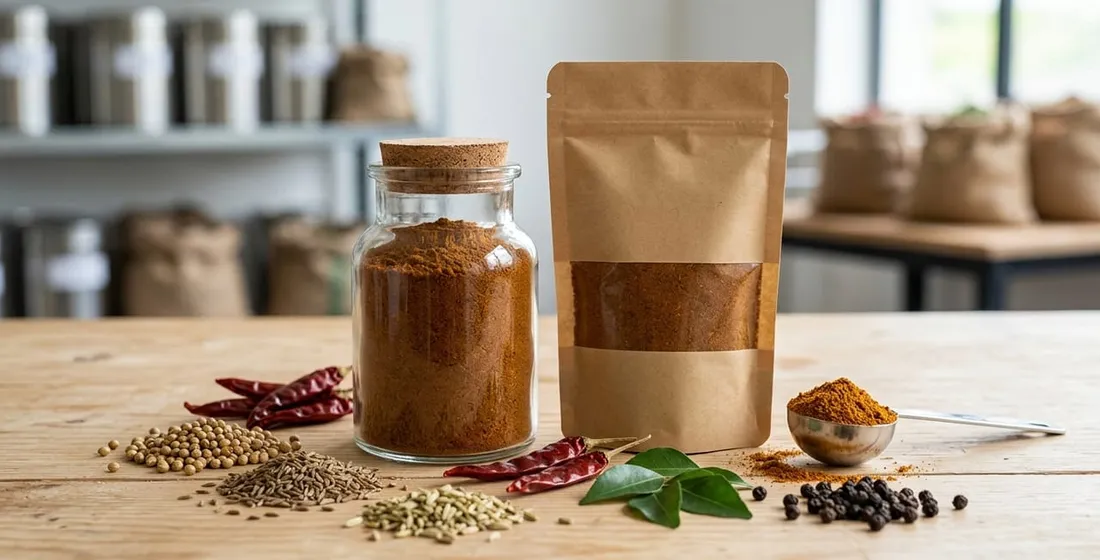
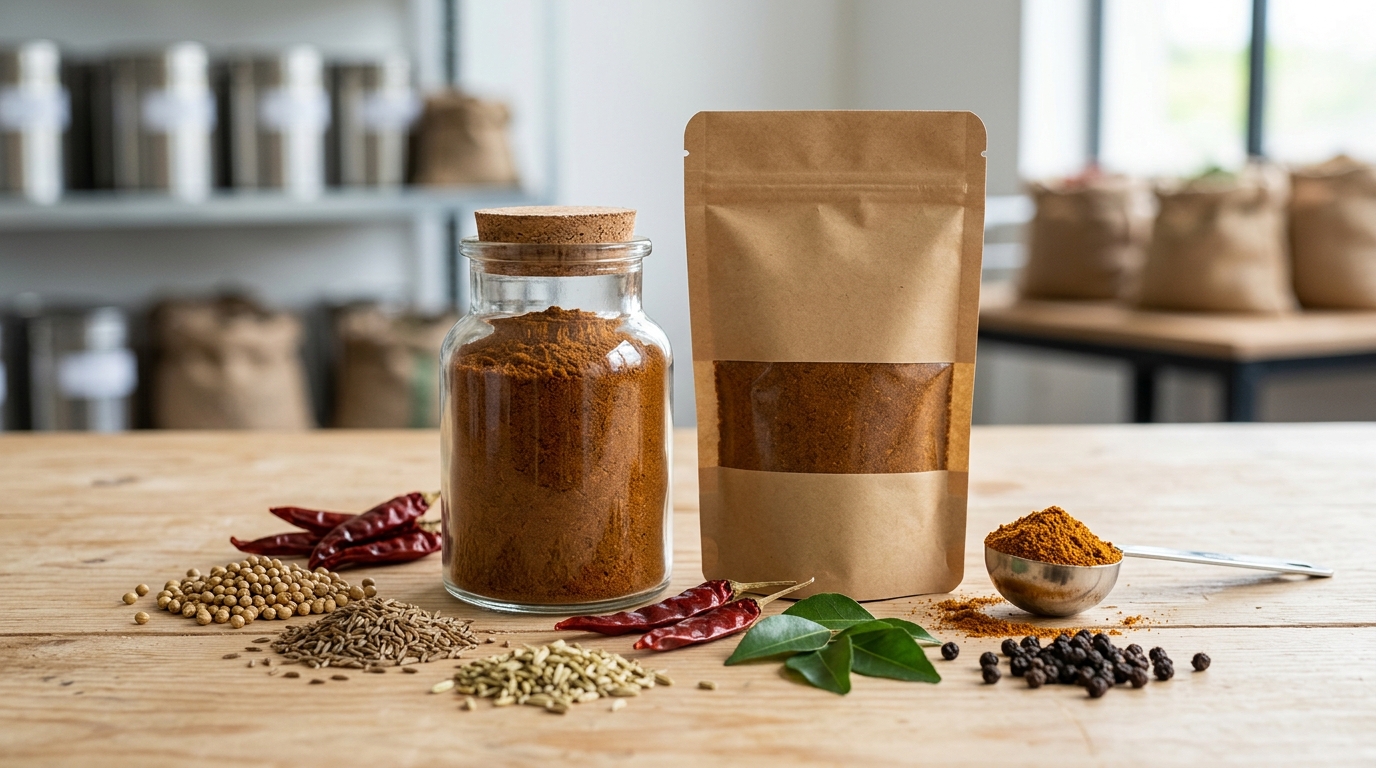
Unlabelled glass jar and kraft pouch of Sri Lankan roasted curry powder beside loose whole spices, the format a private-label SKU takes onto the supermarket shelf.
Buyer's snapshot Modern trade, the supermarket chains, holds roughly 22% to 25% of Sri Lanka's retail market share as of 2024 (Ceylon Today), and the curry-powder aisle is one of the most private-label-active food categories. A private-label curry powder needs an SLS 134-compliant specification plus SLSI clearance before a supermarket buyer will list it. Silk Foods Ceylon (SFC) runs a spice line at 100 to 200 kg per hour, with 50+ ready-to-go private-label SKUs on one BRCGS- and FSSC 22000 V6-audited cert stack. First-run private-label MOQ starts at 1,500 units; plan a six-week buffer for SLSI before the target shelf date. |
The supermarket curry-powder aisle is one of the most crowded shelves in Sri Lankan grocery, and one of the most private-label-active. Modern trade, meaning the supermarket chains, holds roughly 22% to 25% of the country’s retail market share as of 2024 (Ceylon Today). For a brand owner, or a hotel group extending a signature blend into retail, the gap between a curry powder that sells at a kiosk or in a hotel kitchen and a listing on the major supermarket chains is rarely the recipe. It is the manufacturer, the SLS 134 specification, and the SLSI clearance that have to come with it.
What does it take to put a private-label curry powder on the supermarket shelf?
A private-label curry powder reaches a Sri Lankan supermarket shelf through three gates: an SLS 134-compliant product specification, SLSI product certification covering the manufacturer and the SKU, and a retail buyer’s listing decision. Spices and allied products make up about 56% of Sri Lanka’s other-agriculture exports (Sri Lanka EDB, 2024), so the raw-material base is deep. The constraint is compliance, not supply.
Most curry-powder brands in Sri Lanka start small: a family blend, a roasting ratio that works, a kiosk or a hotel kitchen that moves a few hundred packs a month. The shelf is a different animal. A supermarket buyer wants batch-to-batch consistency, a manufacturer audit they can defend to their own quality team, and a label that clears the Sri Lanka Food Act 1980. Understanding the local retail and HORECA landscape helps a first-time buyer match the SKU to the right channel before the brief is written.
Private labelling, contract manufacturing, or co-packing: which route fits a curry powder?
For a curry powder, private labelling is the fastest route to a supermarket shelf: the buyer takes an existing SFC-formulated blend and applies their own brand. Contract manufacturing suits a brand with a locked signature recipe. Co-packing fits a distributor holding imported or bulk powder that only needs retail packing. The right route depends on whether the recipe, not the brand, is the asset.
| Route | What the buyer brings | What SFC does | First-run MOQ | Best fit |
| Private labelling | Brand and label artwork | Relabels an existing SFC curry-powder formulation to the buyer’s brand | 1,500 units | Hotel groups and brand owners who want speed |
| Contract manufacturing | A locked, signed-off recipe | Manufactures the buyer’s own blend on the spice line | 1,500 units, scales up | Brands whose signature blend is the differentiator |
| Co-packing | Finished bulk curry powder | Packs, seals, and labels into retail-ready formats | By batch | Distributors and importers holding bulk |
| R&D / NPD (Co-Development) | An idea, no fixed recipe | Develops the blend over two to four sample iterations | Feeds the routes above | Buyers without a formulation yet |
For a hotel group or brand owner, the SFC private-label catalogue carries 50+ ready-to-go SKUs that can be relabelled under a buyer’s brand without re-formulation, which is the shortcut that matters most when the value is the brand and the story, not the recipe. A full walk-through sits in private labelling at Silk Foods Ceylon. Where the blend itself is the differentiator, contract manufacturing at Silk Foods Ceylon keeps the recipe the buyer’s while the line, the audit, and the SLSI submission move under the SFC umbrella.
The SLS 134 specification and what SLSI clearance checks
SLS 134 is the Sri Lanka Standard specification for curry powder, and SLS 1327 is the code of hygienic practice for spices and dried aromatic plants (Sri Lanka Standards Institution). A private-label curry powder going onto a supermarket shelf needs to meet SLS 134 and carry SLSI clearance; the SLS Mark is the third-party guarantee retail buyers look for first.
In practice, SLSI assesses the manufacturer, samples and tests the product against the standard (composition, moisture, total ash, contaminants, and microbial limits), and checks the label against the Sri Lanka Food Act 1980. For a curry powder, the recurring failure points are moisture out of range and a label that omits a mandatory declaration, not the blend itself.
On the manufacturer side, retail procurement teams read the audit stack. SFC is BRCGS- and FSSC 22000 V6-audited, with SLSI clearance and Sri Lanka Food Act 1980 compliance on every retail SKU. BRCGS and FSSC are the international layers that reassure a buyer’s quality team; SLSI and Food Act compliance are the local floor every packaged food on the shelf has to meet. The full picture is in the certification stack for a Sri Lankan FMCG launch. Plan a six-week buffer for SLSI ahead of the target shelf date, because the calendar moves slower than the production line.
Blend, roast, and grind: the production spec behind a shelf-ready curry powder
A shelf-ready curry powder is a manufacturing spec, not just a recipe: a roasting profile (Sri Lankan dark-roasted versus raw), particle size and mesh consistency, moisture control for shelf life, and a fixed blend ratio that holds across a 1,500-unit batch. The home-kitchen version rarely carries these tolerances until it is engineered for them.
A Sri Lankan roasted curry powder is built on a coriander, cumin, and fennel base, lifted with dried chilli, black pepper, turmeric, and curry leaf, with the roast doing most of the flavour work. Getting that base specified for scale, rather than improvised by eye, is the step covered in specifying coriander, cumin, and fennel for a curry-powder spec. On the SFC spice line, roasting, grinding, and blending run at 100 to 200 kg per hour, with the mesh and moisture targets locked into the batch sheet so every run matches the approved sample.
The R&D team at the Matale facility sees the same gap on most first briefs. A curry-powder blend that tastes right at a one-kilogram kitchen scale drifts when it runs at a few hundred kilograms: the roast goes uneven, the chilli-to-coriander ratio shifts with a new supplier’s moisture, and the colour the buyer approved in a sample jar is not the colour that comes off the line in week three. Locking the spec, not just the recipe, is what keeps a supermarket buyer from delisting the SKU after one inconsistent batch.
MOQ, lead time, and the shelf-date math
First-run private-label MOQ for a curry powder at Silk Foods Ceylon starts at 1,500 units. Lead time runs two to four weeks once a recipe is locked, or six to ten weeks if R&D iterations come first. Add a six-week SLSI clearance buffer before the target shelf date, and the calendar, not the recipe, becomes the binding constraint.
| Format | Sizes | Best channel |
| Kraft pouch | 50 g, 100 g, 250 g, 500 g, 1 kg | Supermarket shelf and e-commerce |
| Glass jar | 220 ml, 330 ml | Premium shelf and hotel gift shop |
| Bulk pack | 1 kg and above | HORECA kitchens and wholesale |
Service snapshot: private-label curry powder at Silk Foods Ceylon Service: an existing SFC curry-powder formulation relabelled to the buyer's brand, or the buyer's own locked recipe run under contract manufacturing. First-run MOQ: 1,500 units. Spice line throughput: 100 to 200 kg per hour. Lead time: 2 to 4 weeks on a locked recipe; 6 to 10 weeks if R&D / NPD comes first. SLSI buffer: about 6 weeks. Cert coverage: BRCGS- and FSSC 22000 V6-audited, with SLSI clearance and Sri Lanka Food Act 1980 compliance on every retail SKU. |
Frequently asked questions
What is the private-label MOQ for curry powder at Silk Foods Ceylon?
First-run private-label curry powder starts at a 1,500-unit MOQ at the Matale facility. The spice line runs at 100 to 200 kg per hour, so a first run is a short production block, and a multi-SKU spice range can share one BRCGS- and FSSC 22000 V6-audited cert stack.
What SLS standard applies to curry powder in Sri Lanka?
Curry powder is covered by SLS 134, the Sri Lanka Standard specification for curry powder, and by SLS 1327, the hygienic code for spices and dried aromatic plants (Sri Lanka Standards Institution). A private-label SKU going onto a supermarket shelf needs to meet SLS 134 and carry SLSI clearance.
How long does SLSI clearance take for a private-label spice blend?
Plan a six-week buffer for SLSI clearance ahead of a supermarket shelf date, on top of the manufacturing lead time. SLSI assesses the manufacturer, samples and tests the product against the relevant Sri Lanka Standard, and checks labelling under the Sri Lanka Food Act 1980.
Can Silk Foods Ceylon develop a new curry-powder recipe for a local brand?
Yes. R&D and NPD (Co-Development on the SFC brochure) is where most first inquiries start. The in-house R&D team at Matale works through two to four sample iterations to lock a blend for batch-to-batch consistency before the recipe moves into a contract manufacturing run.
Does Silk Foods Ceylon co-pack imported bulk curry powder?
Yes. For distributors holding imported or bulk curry powder, SFC offers co-packing: the buyer supplies the finished powder and the team packs, seals, and labels it into Sri Lankan retail-ready kraft pouches or glass jars, with SLSI submission support under the Sri Lanka Food Act labelling framework.
How Silk Foods Ceylon can help
For hotel and restaurant groups and brand owners building a private-label curry powder for the supermarket shelf, Silk Foods Ceylon (SFC) offers a private-label catalogue of 50+ ready-to-go products, including spice blends that can carry a buyer’s brand without re-formulation. First-run MOQ sits at 1,500 units per SKU, and the spice line runs at 100 to 200 kg per hour, which keeps a multi-SKU spice range on a single production block. The Matale facility is BRCGS- and FSSC 22000 V6-audited, with SLSI clearance and Sri Lanka Food Act 1980 compliance on every retail SKU. To brief a private-label or co-packing programme, email b2b@esilkroute.com.lk or call +94 76 441 0389 or +94 76 918 5744.
Sources
- Sri Lanka Standards Institution, “Catalogue index of Sri Lanka Standards” (SLS 134 curry powder; SLS 1327 hygienic practice for spices), https://slsi.lk/wp-content/uploads/2023/01/Index_for_new_catalogue.pdf (retrieved 2026-06-04).
- Sri Lanka Standards Institution, “SLS Mark Product Certification Scheme”, https://www.slsi.lk/ (retrieved 2026-06-04).
- Sri Lanka Export Development Board (2024), “Spices, Herbs and Condiments from Sri Lanka”, https://www.srilankabusiness.com/spices/ (retrieved 2026-06-04).
- Ceylon Today (2024), “Navigating the Modern Trade Landscape in SL”, https://ceylontoday.lk/2024/07/25/navigating-the-modern-trade-landscape-in-sl/ (retrieved 2026-06-04).
- The Sunday Times Business (2024), “Supermarket sector displays resilience amid economic uncertainty”, https://www.sundaytimes.lk/240908/business-times/supermarket-sector-displays-resilience-amid-economic-uncertainty-570167.html (retrieved 2026-06-04).
- Further reading: The Sunday Times Business (2024), “Sri Lanka’s retail industry contributes to 14% of GDP”, https://www.sundaytimes.lk/240908/business-times/sri-lankas-retail-industry-contributes-to-14-of-gdp-570141.html (retrieved 2026-06-04).
Written by the Silk Foods Ceylon Team. Silk Foods Ceylon (Pvt) Ltd. is a BRCGS- and FSSC 22000 V6-audited contract manufacturer in Matale, Sri Lanka, offering contract manufacturing, private labelling, co-packing, and in-house R&D for local Sri Lankan brand owners, FMCG companies, hotel and restaurant groups, and distributors. To brief a project: b2b@esilkroute.com.lk, +94 76 441 0389, or +94 76 918 5744.