Private-Label Jackfruit SKUs for Sri Lankan Hotel Groups
Buyer’s snapshot
- Sri Lanka drew 2.36 million tourist arrivals in 2025, up from 2.05 million in 2024 (Sri Lanka Tourism Development Authority), which lifts demand for local, story-led in-room and gift-shop products.
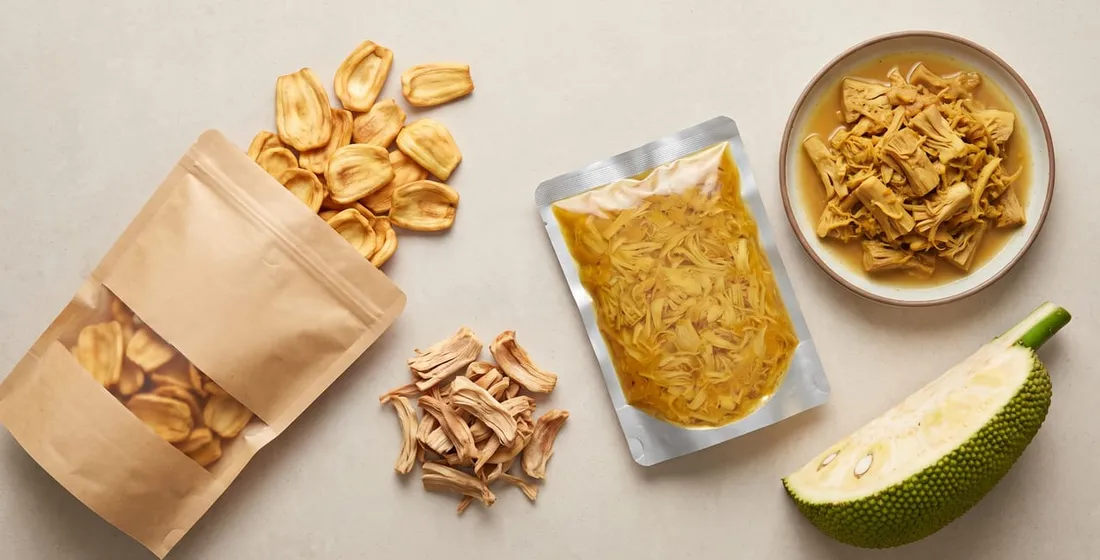
- Two jackfruit SKU families suit a hotel programme: shelf-stable dehydrated jackfruit (chips, dried flesh, flour) and ready-to-serve tender jackfruit curry in retort pouches.
- First-run private-label MOQ sits at roughly 1,500 units per SKU, which keeps a multi-property launch on a single production block.
- Every SKU is manufactured to Codex dried-fruit moisture limits and Sri Lanka Food Act labelling, inside a BRCGS- and FSSC 22000 V6-audited facility.
A boutique hotel group looking for a gift-shop line and an in-room amenity faces the same question every year: what local product carries the property’s story without adding kitchen labour or spoilage risk. Jackfruit answers both sides. It is unmistakably Sri Lankan, it converts cleanly into shelf-stable formats, and it reads well to the plant-forward guest who now fills a large share of arrivals. This post sets out the two jackfruit SKU families a hotel group can commission under its own label, the volumes and lead times involved, and the certifications a procurement team should confirm before signing.
Why does jackfruit fit a hotel private-label programme?
Jackfruit works for hotel retail because it solves a supply problem before it solves a menu one. Fresh young jackfruit is seasonal and labour-heavy to prepare, so serving it à la carte at scale is awkward. Processed into dehydrated snacks or retort-stable curry, it becomes a room-temperature product with a long shelf life, no cold chain, and a consistent portion. For a gift shop or minibar, that means no waste and no daily prep.
The demand context is favourable. Sri Lanka recorded 2.36 million tourist arrivals in 2025, up from 2.05 million the year before, according to the Sri Lanka Tourism Development Authority. More arrivals, and a guest base that increasingly asks for plant-based options, widen the audience for a jackfruit line beyond the novelty buyer. Global plant-based food sales continued to grow through 2024, and jackfruit sits squarely in the meat-alternative conversation, per market trackers including Mordor Intelligence, so a young-jackfruit curry reads as current rather than nostalgic.
What jackfruit SKUs can a hotel group commission?
A hotel private-label programme usually runs two jackfruit families in parallel: a dry snack range for the gift shop and shelf, and a wet ready-to-serve range for the minibar or restaurant retail corner. Silk Foods Ceylon (SFC) develops and packs both to a buyer’s brand, artwork, and format. The table below maps the practical options.
| SKU family | Formats | Shelf life (ambient) | Best channel |
|---|---|---|---|
| Dehydrated jackfruit chips | 40g / 100g stand-up pouch, seasoned or plain | 9 to 12 months | Gift shop, minibar snack |
| Dried jackfruit flesh | 100g / 200g resealable pouch | 9 to 12 months | Retail corner, hamper |
| Jackfruit flour | 250g / 500g kraft pouch | 12 months | Culinary retail, wellness shelf |
| Tender jackfruit curry (retort) | 200g / 300g retort pouch, ready-to-serve | 12 to 18 months | Minibar, restaurant retail, room amenity |
| Tender jackfruit (in brine, base) | 400g pouch or can, cook-from | 18 to 24 months | Kitchen supply, chef-branded line |
Dehydrated formats give the highest margin per gram and travel well in a guest’s suitcase, which matters for a gift-shop SKU. The retort curry is the differentiator: a young jackfruit curry cooked once, sealed hot, and stabilised for the shelf lets a property put its signature dish into a pouch a guest can take home. Both families accept custom seasoning, so a group can tune heat and spice to its own recipe rather than a generic blend.
How does the volume and cost math work for a multi-property group?
The reason private label is viable for a hotel group, rather than only for a national FMCG brand, is the low first-run minimum. SFC sets first-run private-label MOQs at roughly 1,500 units per SKU, which is small enough that a five-SKU launch across a group sits on one production block instead of five separate runs. That keeps changeover cost down and lets a group test the range before committing to volume.
| Stage | Volume per SKU | Indicative use |
|---|---|---|
| Pilot / concept run | 250 to 500 units | Sampling, guest feedback, artwork proof |
| First commercial run | ~1,500 units | Launch across properties |
| Repeat run | 3,000 units and up | Established SKU, better unit economics |
Pricing is quoted in LKR per unit against the confirmed recipe, pouch size, and artwork, so a group sees a landed cost per SKU before it commits. The pilot run exists precisely so a procurement team can put a real product in front of guests and its own chefs before scaling. Unit economics improve at the repeat-run tier, which is where a proven SKU should settle.
One story from the floor: a group that wanted a “taste of the estate” hamper started with a 300-unit pilot of dried jackfruit and a jackfruit-curry pouch, adjusted the curry’s tamarind level after guest comments, and only then locked the 1,500-unit run. The pilot cost less than reprinting a season of collateral, and it caught a recipe tweak that would have been expensive to fix after a full print run of labels.
Which certifications should a hotel procurement team confirm?
Procurement gates on certification and audit history, not on invoice price. For a jackfruit line sold on a Sri Lankan property, the baseline is domestic: SLSI clearance for any retail SKU and Sri Lanka Food Act compliance for the label itself. On top of that, a manufacturer audited to BRCGS and FSSC 22000 V6 gives a procurement team the international food-safety evidence it increasingly expects, and it keeps an export step open if the group ever ships the line to sister properties abroad.
The SFC facility in Matale is BRCGS- and FSSC 22000 V6-audited, with SLSI clearance applied to every retail SKU and Department of Ayurveda registration available where a traditional-claim product needs it. Dehydrated SKUs are manufactured to Codex dried-fruit moisture limits (Codex Standard CXS 360-2020), which is the reference a serious buyer will ask about for dried products, and the retort curry is thermally processed for ambient stability rather than chilled shelf life.
Labelling deserves its own line. The Food (Labeling and Advertising) Regulations 2022, which took effect for pre-packaged food from 2024, require the product name in bold in Sinhala, Tamil, and English, plus net contents in metric units. A private-label pack made at SFC is set up to that standard from the artwork stage, so a hotel group is not left correcting a non-compliant label after the first print run.
How long from brief to first delivery?
A realistic jackfruit private-label timeline runs about eight to twelve weeks from signed brief to first commercial delivery, and the front half is recipe and artwork rather than manufacturing. Dehydrated SKUs move faster than retort curry, because thermal-process validation for a shelf-stable wet product adds a step. The schedule below is the working sequence, not a sales promise, and it assumes prompt artwork sign-off from the buyer.
- Weeks 1 to 2: brief confirmation, recipe direction, pilot batch.
- Weeks 3 to 4: guest and chef tasting, recipe lock, artwork proof.
- Weeks 5 to 6: SLSI documentation, label compliance check, retort validation for wet SKUs.
- Weeks 7 to 8: first commercial run and pack.
- Weeks 9 onward: delivery, with repeat-run scheduling as sell-through data arrives.
Value-added food is where the local processing sector is growing: Sri Lanka’s food and beverage export earnings rose 11.92 percent year on year to USD 274.98 million in the first seven months of 2024, with processed food up 55.98 percent over the period, per the Sri Lanka Export Development Board. A hotel group commissioning a jackfruit line is buying into a category with real manufacturing depth behind it, not a one-off kitchen experiment.
Frequently asked questions
Does Silk Foods Ceylon offer private-label manufacturing for jackfruit products?
Yes. SFC develops and packs both dehydrated jackfruit (chips, dried flesh, flour) and tender jackfruit curry in retort pouches under a buyer’s own brand and artwork. First-run MOQ is roughly 1,500 units per SKU, with 250 to 500-unit pilot batches available for guest tasting before a full run.
What is the minimum order for a hotel jackfruit SKU?
The first commercial run is about 1,500 units per SKU, and a pilot batch of 250 to 500 units is available first for sampling and artwork proofing. A multi-property group can keep several SKUs on a single production block at the first-run tier, which lowers changeover cost across the launch.
Are the jackfruit SKUs shelf-stable without refrigeration?
Yes. Dehydrated jackfruit holds 9 to 12 months at ambient temperature, and tender jackfruit curry in a retort pouch holds 12 to 18 months, both without a cold chain. Dried SKUs are made to Codex moisture limits (CXS 360-2020) and the retort curry is thermally processed for ambient stability.
What certifications does the manufacturer hold?
The Matale facility is BRCGS- and FSSC 22000 V6-audited, with SLSI clearance on every retail SKU and Sri Lanka Food Act-compliant labelling. Department of Ayurveda registration is available where a traditional-claim product requires it. This certification stack is what most hotel procurement teams ask to see before onboarding a supplier.
How long does a jackfruit private-label programme take to launch?
About eight to twelve weeks from signed brief to first commercial delivery, assuming prompt artwork sign-off. Dehydrated SKUs move faster; retort curry adds a thermal-process validation step. The first half of the timeline is recipe and label work, and manufacturing is the shorter back half.
How Silk Foods Ceylon can help
For hotel and restaurant groups running in-room amenity, gift-shop, or minibar SKU programmes, Silk Foods Ceylon offers a private-label catalogue spanning dehydrated jackfruit, tender jackfruit curry, spice blends, coconut SKUs, herbal teas, jams, and vegan formats. Custom branding is applied to existing SFC formulations, and first-run MOQs sit at roughly 1,500 units per SKU, which keeps a multi-SKU hotel programme on a single production block. The Matale facility is BRCGS- and FSSC 22000 V6-audited, with SLSI clearance on every retail SKU. The adjoining plantation supports brand storytelling for sustainability-positioned hotel groups.
To brief an in-room or gift-shop programme, email b2b@esilkroute.com.lk or call +94 76 441 0389 or +94 76 918 5744.
Sources
- Sri Lanka Tourism Development Authority, Year in Review 2025 and Annual Statistical Report 2024. https://www.sltda.gov.lk/storage/common_media/Year_in_Review_2025_Final_updated_Report_2026_04_02-1.pdf (retrieved 17 July 2026)
- FAO/WHO Codex Alimentarius, General Standard for Dried Fruits (CXS 360-2020). https://www.fao.org/fao-who-codexalimentarius (retrieved 17 July 2026)
- Sri Lanka Ministry of Health, Food (Labeling and Advertising) Regulations 2022. https://eohfs.health.gov.lk/food/ (retrieved 17 July 2026)
- Sri Lanka Export Development Board, Export Performance July 2024. https://www.srilankabusiness.com/news/sri-lanka-s-export-performance-in-july-2024.html (retrieved 17 July 2026)
- EconomyNext, Sri Lanka jackfruit export potential and planting drive (2023). https://economynext.com/sri-lanka-sees-export-potential-for-jackfruit-amid-planting-drive-117627/ (retrieved 17 July 2026)
- Mordor Intelligence, Jackfruit Market (2025). https://www.mordorintelligence.com/industry-reports/jackfruit-market (retrieved 17 July 2026)