
Private-Label Spice Blends: A Sri Lankan Distributor's MOQ Math
By the Silk Foods Ceylon Editorial Team
Buyer’s snapshot
- Sri Lanka’s spice and essential-oil exports totalled roughly USD 449.9 million in 2025 (Sri Lanka Export Development Board), and packaged retail blends are one route a distributor can take into private label without building a spice supply chain first.
- The format decision, sachet or jar, sets the MOQ math before a single SKU is formulated: the same 50 kg minimum converts to very different unit counts depending on pack size.
- Silk Foods Ceylon (SFC) grinds and blends spice at 100 to 200 kg per hour, with private-label spice, herb, and fruit-powder SKUs starting at a 50 kg per-SKU minimum.
- The MOQ-to-units table below turns that 50 kg minimum into an actual sachet or jar count.
A local spice and grocery distributor with an established bulk-trading relationship decides to launch a private-label range of retail spice blends, four flavours to start, sold through general trade and a major supermarket chain’s grocery aisle. The recipes are not the distributor’s problem: Silk Foods Ceylon (SFC) already carries formulated curry, tempering, and seasoning blends in its private-label catalogue. What the distributor has to work out before signing a brief is how much the blending line can turn out in a day, whether the range ships in kraft sachets or glass jars, and what a 50 kg per-SKU minimum actually means once it is converted into units on a shelf.
This is a private-labelling scenario, not a co-packing one. The distributor is not supplying its own ground spice for SFC to pack; the range is built from SFC’s own formulated blends under the distributor’s brand. That distinction changes which minimum order quantity applies and which parts of the production schedule the distributor controls versus the ones SFC plans around its own line.
What a private-label spice blend range actually needs from a distributor
Private labelling at Silk Foods Ceylon (SFC) means the distributor licenses an existing SFC-formulated blend, a curry powder, a tempering mix, a seasoning blend, and applies its own brand to the pack. The formulation, the grind spec, and the production schedule stay with SFC. The distributor’s job is the brief: which blends from the catalogue, which pack formats, and which volume tier to commit to for a first order.
That is a different starting point from a distributor who already holds bulk ground spice and wants it packed under a co-packing arrangement, where the raw material and the recipe are the distributor’s own; that route is covered separately in co-packing 50g and 100g spice pouches for the e-commerce tier and in the wider spice and herb co-packing capability one-pager. Private labelling assumes no existing formulation and no raw-material sourcing relationship for spice specifically, which fits a distributor whose trading relationships run through other categories, imported nuts, dried fruit, packaged grocery, and wants to add a spice range without building a spice supply chain first.
For a four-SKU range at the entry MOQ, that means committing to 200 kg of finished blend across the range, 50 kg per SKU, a single production block once the line is scheduled, and a format decision that has to be locked before the batch runs, since kraft pouches and glass jars use different filling equipment. A single-product precedent for the same private-label route sits in private-label curry powder for the Sri Lankan supermarket shelf, where the SLSI and MOQ ground is product-specific rather than a range-level scheduling question.
How much can the pulverizer and blending line turn out in a day?
SFC’s spice line, the crusher, pulverizer, screw feeder, grading and sieve equipment behind the packing hall, runs at 100 to 200 kg per hour depending on the grind and the blend. Across an eight-hour production shift, that puts the line’s raw throughput at roughly 800 to 1,600 kg per day before packing time is subtracted. A four-SKU range at the 50 kg entry MOQ needs 200 kg of finished blend in total, comfortably inside a single shift even at the slower end of that range.
The practical constraint is not the grind rate; it is the changeover between blends. Each SKU that uses a different spice mix needs a clean-down cycle on the pulverizer and the sieve line before the next blend runs, to keep one flavour’s profile out of the next batch. A four-blend range scheduled as four separate changeovers in one day is a tighter fit than the raw kg-per-hour figure suggests, which is why SFC’s production planning typically books same-day multi-SKU runs by changeover count, not by total kilograms alone. The same scheduling logic applies to a multi-SKU seasonal range, covered in sequencing a festive private-label range, where several SKUs share one production block against a fixed date.
A distributor moving from the 50 kg entry tier to the 500 kg, 1,000 kg, or 2,500 kg volume tiers is scheduling proportionally more line time, not a different kind of run. At 100 to 200 kg per hour, a 500 kg batch for one SKU takes two and a half to five hours of grind and blend time alone, before filling starts. A volume-tier reorder across a multi-SKU range is usually planned over more than one production day rather than compressed into the first run’s single block.
Sachet or jar: the format decision that sets the rest of the math
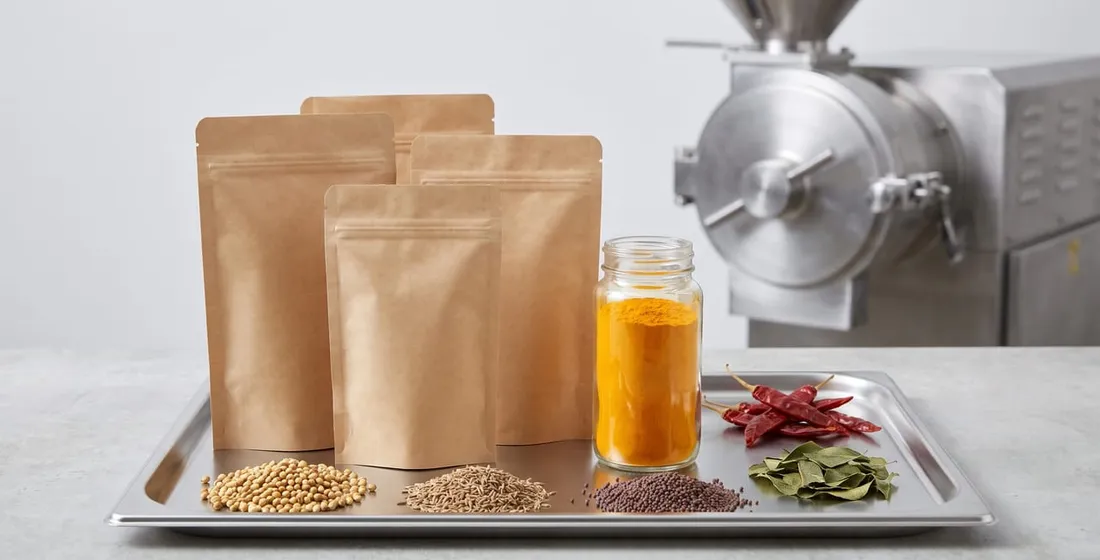
SFC packs private-label spice into two format families: kraft paper pouches (sachets) from 50 g up to 1 kg, filled on the form-fill packing line, and a 40 g glass spice jar, filled and capped on the glass line. The two formats are not interchangeable mid-run. A distributor has to lock the format, and usually the pack size within it, before the production block is scheduled, since the filling equipment and the case-pack count both follow from that choice.
The sachet suits a general trade shelf, where small independent grocers still outnumber the modern trade chains by volume of outlets across Sri Lanka, and the kraft pouch carries a lower per-unit packaging cost that matters at general-trade price points. The glass jar suits a supermarket or gifting shelf, where the buyer is paying for shelf presentation as much as the spice inside it, at a higher per-unit packaging cost and a slower fill rate on the glass line.
One distributor working through this decision at SFC initially briefed a jar-only range for a supermarket listing, then added a sachet SKU at the same 50 kg entry tier once a general trade account asked for a price point the jar format could not hit. The two formats ran as separate line bookings from the same base blend, filled on different equipment, rather than a single combined batch.
Pack weight also changes the label. A pack at or under 25 g, or a liquid at or under 30 ml, sits under a separate declaration exemption threshold under the Food (Labelling and Advertising) Regulations 2026, which is one more reason a very small sachet reads differently on the label than the same blend in a 100 g pouch or a 40 g jar. The label content rule itself does not change with pack format at 50 g and above; only the small-pack exemption does. The barcode and case-pack steps that follow SLSI clearance, whichever format is chosen, are covered in SLSI, barcodes, and case packs for a Sri Lankan supermarket listing.
What the 50 kg MOQ actually looks like once it is packed
A kilogram figure is not a unit count, and a distributor pricing shelf space or a general-trade order needs the unit count, not the kilogram minimum. Converting the entry-tier and volume-tier MOQs by pack size gives the actual number of sachets or jars a first order, or a reorder, puts on a shelf.
| Format and pack size | Units at the 50 kg entry MOQ | Units at the 500 kg volume tier |
|---|---|---|
| Kraft sachet, 50 g | 1,000 units | 10,000 units |
| Kraft sachet, 100 g | 500 units | 5,000 units |
| Kraft pouch, 250 g | 200 units | 2,000 units |
| Kraft pouch, 500 g | 100 units | 1,000 units |
| Kraft pouch, 1 kg | 50 units | 500 units |
| Glass spice jar, 40 g | 1,250 units | 12,500 units |
The jar’s small fill weight is what pushes its unit count well above the pouch formats at the same kilogram minimum, which is worth checking before assuming a jar range costs less to fill a first order than a pouch range does. A distributor sequencing a multi-SKU range across these formats, some flavours in sachet for general trade, others in jar for a supermarket listing, is running the same 50 kg-per-SKU minimum through two different unit counts at once. The sequencing logic for a multi-SKU launch is covered in sequencing a three-SKU private-label range launch.
Spec snapshot: private-label spice blends at Silk Foods Ceylon
- Service: private labelling of an existing SFC-formulated spice blend under the distributor’s own brand
- Line rate: 100 to 200 kg per hour on the crusher, pulverizer, grading, and sieve equipment
- First-run MOQ: 50 kg per SKU, scaling to 500 kg, 1,000 kg, and 2,500 kg volume tiers
- Pack formats: kraft sachets and pouches, 50 g to 1 kg; a 40 g glass spice jar
- Cert coverage: BRCGS- and FSSC 22000 V6-audited, with SLSI clearance and Sri Lanka Food Act 1980 compliance on every retail SKU
- Sample to first PO: typically 2 to 4 weeks on an existing catalogue blend
SLSI clearance and the label steps before the range reaches the channel
A four-SKU range built from existing catalogue blends is assessed on the same already-certified manufacturing site and process, so the SLSI submission is not starting from zero for each flavour. SFC’s production planning team works to a four to eight week window for a new SKU submission on an already-certified line as its own planning assumption, and still holds a six to ten week buffer between quality sign-off and a distributor’s target listing date, since a multi-SKU range multiplies the paperwork even when it does not multiply the underlying risk. The step-by-step submission sequence sits in SLSI step-by-step for a first packaged-food submission.
The tri-lingual label content, common name in Sinhala, Tamil, and English, ingredient list, allergen disclosure, manufacturer name and address, batch code, and expiry date, is close to identical across a four-flavour range built from one manufacturer’s line. What changes SKU to SKU is the flavour name and the ingredient order for that specific blend, not the label’s structure. Locking one label template early, then dropping in the flavour-specific fields, is faster than treating each SKU’s label as a separate design exercise.
Once SLSI clearance and the label are settled, a distributor selling into a major supermarket chain still has the barcode and case-pack registration to complete before the first case ships, a distributor-owned step, not a manufacturer one, walked through in SLSI, barcodes, and case packs for a Sri Lankan supermarket listing. None of that changes because the SKU is a spice blend rather than a jarred product; the gates are the same, only the format-driven case-pack count differs.
Frequently asked questions
What is the MOQ for a private-label spice blend at Silk Foods Ceylon?
A private-label spice, herb, or fruit-powder SKU starts at a 50 kg first-run minimum, scaling to 500 kg, 1,000 kg, and 2,500 kg volume tiers. Converted to units, 50 kg is 1,000 sachets at 50 g or 1,250 jars at 40 g, depending on the pack format chosen.
How long does the spice line take to produce a private-label blend range?
SFC’s spice line grinds and blends at 100 to 200 kg per hour, roughly 800 to 1,600 kg across an eight-hour shift. A four-SKU range at the 50 kg entry MOQ needs only 200 kg total, so the grind-and-blend step fits a single day; changeovers between blends, not the kilogram total, set the real scheduling limit.
Should a private-label spice range use sachets or jars?
It depends on the channel. Kraft sachets suit general trade, the independent grocery shops that outnumber Sri Lanka’s modern trade chains by outlet count, at a lower per-unit packaging cost. Glass jars suit a supermarket or gifting shelf where presentation matters, at a higher per-unit cost and a slower fill rate.
How long does SLSI clearance take for a private-label spice blend?
SFC’s production planning works to a four to eight week window for a first submission on an already-certified line as its own planning assumption. Plan a six to ten week buffer between manufacturer sign-off and a target shelf date, since a multi-SKU range adds paperwork even on an existing formulation.
Can Silk Foods Ceylon develop a new spice blend for a distributor’s private-label range?
Yes. Where the catalogue does not already carry the flavour a distributor wants, SFC’s in-house R&D team formulates a new blend first, typically 2 to 4 sample iterations before the recipe locks, which adds roughly 4 to 6 weeks ahead of the first commercial production run.
How Silk Foods Ceylon can help
For distributors building a private-label spice blend range for Sri Lankan retail, Silk Foods Ceylon (SFC) draws on a private-label catalogue of 50+ ready-to-go SKUs, including curry, tempering, and seasoning blends, that can be relabelled under a distributor’s own brand without a new formulation. The spice line grinds and blends at 100 to 200 kg per hour, and a first-run private-label MOQ starts at 50 kg per SKU, scaling to 500 kg, 1,000 kg, and 2,500 kg as the range earns reorders.
The Matale facility is BRCGS- and FSSC 22000 V6-audited, with SLSI submission support and Sri Lanka Food Act 1980 label compliance built into the standard private-label engagement, and an in-house R&D team on hand where a distributor wants a blend that is not already in the catalogue.
To brief a private-label spice blend range, email b2b@esilkroute.com.lk or call +94 76 441 0389 / +94 76 918 5744.
Sources
Sri Lanka Export Development Board, spices, essential oils, and oleoresins export data: total spice and essential-oil export value of approximately USD 449.9 million in 2025. Sri Lanka Export Development Board (retrieved 15 September 2026).
Sri Lanka Standards Institution, SLS Mark Product Certification Scheme service page, the national certification scheme a packaged-food SKU clears before a retail listing. Sri Lanka Standards Institution (retrieved 15 September 2026).
Ministry of Health and Mass Media, Sri Lanka, Food (Labelling and Advertising) Regulations 2026, Gazette Extraordinary No. 2494/47 of 26 June 2026, in operation from 1 July 2026, including the small-pack declaration exemption threshold. Ministry of Health and Mass Media (retrieved 15 September 2026).
Parliament of Sri Lanka, Food Act, No. 26 of 1980 (and amendments), the parent statute for food labelling, additives and allergen disclosure that the 2026 regulations are made under. FAOLEX, FAO (retrieved 15 September 2026).