Private-Label Vegan Mayonnaise in Sri Lanka: Glass-Jar Retail SKUs
Buyer's snapshot
|
A vegan condiment has to earn two different shelves. One is the supermarket chiller-free aisle, where the jar competes on the strip with established sauce brands and the buyer reads the front label in three seconds. The other is the e-commerce parcel, where the same jar travels in a box with no refrigeration, survives a courier handoff, and arrives looking like the photo. A private-label vegan mayonnaise can win both, but only if the format, the emulsion, and the label are specified for both from the start. The recipe is rarely the bottleneck. The format and the compliance chain usually are.
What does a private-label vegan mayonnaise programme involve?
Private labelling means a manufacturer applies a buyer’s brand to an existing, tested formulation rather than developing a recipe from scratch. Silk Foods Ceylon (SFC) carries vegan mayonnaise as a ready-to-go SKU in its plant-based portfolio, produced on a BRCGS- and FSSC 22000 V6-audited line in Matale, with SLSI clearance on every retail SKU. For a brand owner, that shortcut moves the launch timeline from a formulation project to a packaging-and-label project.
The SFC vegan mayonnaise runs on the semi-liquid line, which fills 3,000 × 300 g glass jars per day. The first-run MOQ sits at 1,500 jars, roughly a half-day of production, with the rest of the day reserved for line changeover and fill validation. The buyer chooses the jar size, the lid, the label artwork, and any flavour variant. The base emulsion, the audit chain, and the SLSI submission move under the SFC umbrella. For a brand owner who has validated demand but does not run a kitchen, that is the whole point of private labelling.
Why vegan mayonnaise fits the supermarket shelf and the e-commerce parcel
A vegan mayonnaise is shelf-stable at ambient temperature before opening, contains no egg, and reads as an allergen-friendly product to a growing share of buyers. That combination is why the category travels well into modern retail and online grocery at the same time. The global egg-free mayonnaise market was about USD 4.9 billion in 2025 and is projected to roughly double by 2035 at a 6.4% compound rate, per Future Market Insights, while vegan mayonnaise specifically is growing near 9% a year. Locally, Sri Lanka’s plant-based and meat-substitute demand has been climbing on health and sustainability grounds (6Wresearch, 2025), and modern trade continues to outpace the broader grocery market (Daily Mirror, 2025).
The format decision is where the two channels diverge. A glass jar reads as premium on a supermarket strip and protects the emulsion, but it is heavy and breakable in a courier parcel. A squeeze bottle ships lighter and survives handling, but it dispenses differently and positions lower. Most private-label programmes that serve both channels run a primary glass jar for the supermarket and gift-retail shelf and a secondary lighter format, or invest in protective secondary packaging for the e-commerce parcel.
| Format decision | Supermarket and gift-retail shelf | E-commerce parcel |
| Glass jar (220 to 500 g) | Premium shelf presence, protects emulsion, reusable | Heavier postage, breakage risk; needs protective secondary packaging |
| Squeeze bottle or pouch | Lower shelf positioning, lighter feel | Lighter postage, survives handling, easy dispense |
| Shelf life | Ambient before opening; refrigerate after opening | Ambient transit, no cold chain needed in transit |
| Tamper-evidence | Induction seal under the lid, shrink band | Induction seal is the trust signal when the buyer cannot inspect in store |
The table is the short version of a longer conversation. For most local brand owners launching one SKU, a single glass-jar format for both channels, with a tamper-evident induction seal and a parcel-rated secondary box for online orders, is the simplest place to start.
Can you call an eggless product “mayonnaise” on a Sri Lankan label?
This is the question that catches most first-time vegan-condiment brands, and it is a labelling decision, not a marketing one. Under the Codex standard for mayonnaise, the product is defined as an emulsion of edible oil in an aqueous phase that includes egg yolk, so a strictly egg-free product does not meet the classical standard of identity for “mayonnaise” (FAO, Codex Alimentarius). Regulators in other markets have acted on exactly this point: in 2015 the US FDA challenged an eggless product’s use of the term “mayo” on standard-of-identity grounds.
For a Sri Lankan retail SKU, the practical path is to qualify the descriptor so the front-of-pack is honest and the back-of-pack is compliant. “Vegan mayonnaise,” “plant-based mayo,” “egg-free sandwich spread,” or “vegan dressing” are the common routes, with the egg-free and plant-based status declared clearly and the ingredient list and allergen statement built to the Sri Lanka Food Act 1980 framework and the Ministry of Health Food (Labelling and Advertising) Regulations, which are phasing in through 1 January 2026 (USDA Foreign Agricultural Service, documenting the Sri Lankan regulations, 2024). Getting the descriptor right before artwork goes to print saves a re-label cycle and a delayed shelf date.
This is the kind of question SFC’s team works through with a brand owner during the label-approval window, alongside the SLSI submission. The wording on the jar is part of the spec, not a separate task handled after production.
The glass-jar format decision: size, headspace, and seal
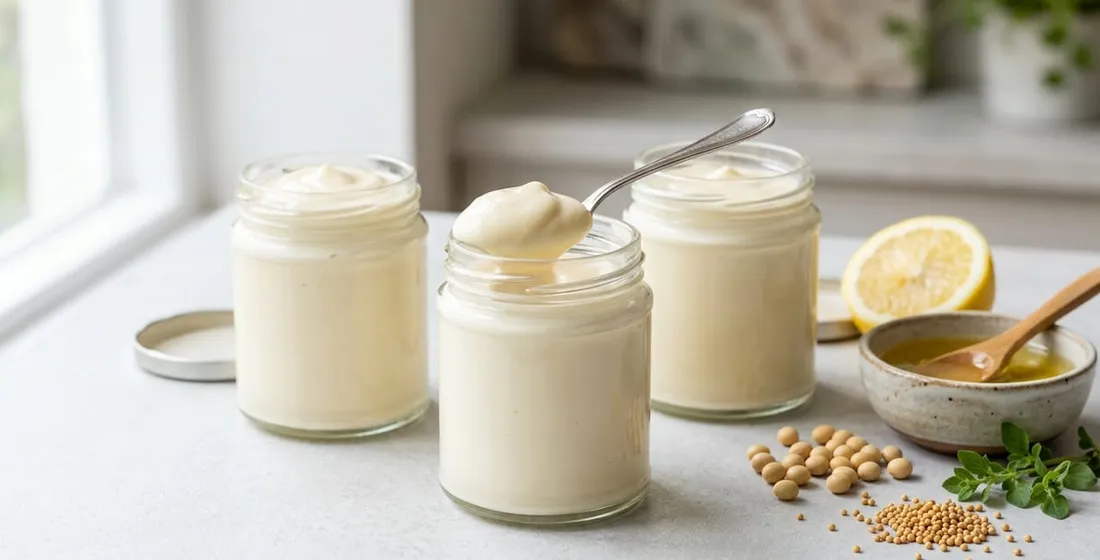
The glass-jar choice is three decisions in one: jar size, fill headspace, and seal type. SFC fills vegan mayonnaise into plain glass jars at retail-friendly sizes (220, 330, and 500 g are common), and the emulsion is filled with controlled headspace so the product sits clean below the lid line and the induction seal bonds reliably. A mayonnaise is a sensitive emulsion, so the fill temperature, the headspace, and the seal all affect both shelf appearance and shelf stability.
The most common adjustment the R&D team sees on a first private-label mayo run is not flavour, it is fill and finish. A home or small-batch version of a vegan mayo often looks right in a bowl but separates or weeps at the lid line once it sits in a sealed jar for a few weeks. Tightening the emulsion for a stable headspace and a clean induction seal is usually one to two short iterations, and it is the difference between a jar that photographs well for an e-commerce listing and one that arrives looking split. For a buyer adding a custom flavour variant (garlic, chilli, herb), SFC’s in-house R&D typically runs two to four sample iterations before the recipe locks for the first commercial run.
MOQ, lead time, and the SLSI window for a first run
A private-label vegan mayonnaise on an existing SFC formulation moves on a short timeline because the recipe and the audit are already in place. The first-run MOQ is 1,500 jars per SKU. Once the label artwork and jar format are confirmed, production-to-dispatch on the existing recipe runs about two to three weeks. If the buyer wants a custom flavour developed first, add roughly four to six weeks of R&D and sampling before the run is scheduled.
Service snapshot: Private Labelling vegan mayonnaise at Silk Foods Ceylon
|
The SLSI step is the one most likely to move a launch date, so it belongs on the calendar early. For a packaged retail SKU with a stable formulation, SLSI clearance usually runs four to eight weeks, and the prudent plan holds a six to ten week buffer between the manufacturer’s QA sign-off and the date the SKU needs to be on shelf or live on an e-commerce listing. The maths is simpler than the broker layer makes it sound: lock the format, submit early, and the rest is a production slot.
Frequently asked questions
What is the private-label MOQ for vegan mayonnaise at Silk Foods Ceylon?
The first-run MOQ is 1,500 jars per SKU on the existing vegan mayonnaise formulation, roughly a half-day on the semi-liquid line, which fills 3,000 jars per day. The buyer chooses jar size, lid, and label; the base recipe and the audit chain are already in place.
Can a vegan, egg-free product be called “mayonnaise” on a label?
Under the Codex standard, mayonnaise is defined to include egg yolk, so an egg-free product sits outside the classical standard of identity. The common compliant route is a qualified descriptor such as “vegan mayonnaise,” “plant-based mayo,” or “egg-free dressing,” with allergen and ingredient declarations built to the Sri Lanka Food Act framework.
Is a vegan mayonnaise shelf-stable for e-commerce shipping?
Yes, before opening. A vegan mayonnaise is ambient-stable in a sealed jar, so it ships in an e-commerce parcel without a cold chain. After opening it should be refrigerated. The induction seal under the lid is the tamper-evidence signal for an online buyer who cannot inspect the jar in store.
How long does SLSI clearance take for a private-label vegan mayo SKU?
For a packaged retail SKU with a stable formulation, SLSI clearance typically runs 4 to 8 weeks. The sensible plan holds a 6 to 10 week buffer between the manufacturer’s QA sign-off and the target shelf or e-commerce launch date, which keeps the listing date off the critical path.
Can Silk Foods Ceylon develop a custom flavour variant?
Yes. SFC’s in-house R&D team adjusts the base vegan mayonnaise for a custom flavour (garlic, chilli, herb) over roughly two to four sample iterations before the recipe locks. A custom variant adds about four to six weeks ahead of the first commercial run; an existing-flavour run skips that step.
How Silk Foods Ceylon can help
For local brand owners and distributors building a private-label vegan condiment for the supermarket shelf and the e-commerce channel, Silk Foods Ceylon (SFC) carries vegan mayonnaise as a ready-to-go formulation in its plant-based portfolio. Custom branding is applied to the existing recipe; the first-run MOQ sits at 1,500 glass jars per SKU, with the semi-liquid line filling 3,000 jars per day, which keeps a first launch on a single production block. The Matale facility is BRCGS- and FSSC 22000 V6-audited, with SLSI clearance and Sri Lanka Food Act compliance on every retail SKU, and the in-house R&D team handles custom flavour variants and the fill-and-seal tuning that a glass-jar emulsion needs.
To brief a private-label vegan mayonnaise programme, email brands@esilkroute.com.lk or call +94 76 441 0389 / +94 76 918 5744.
Sources
- Future Market Insights (2025), “Egg-Free Mayonnaise Market Size, Demand & Trends 2025-2035,” https://www.futuremarketinsights.com/reports/egg-free-mayonnaise-market (retrieved 2026-06-26).
- Persistence Market Research (2025), “Vegan Mayonnaise Market Size, Trends & Revenue,” https://www.persistencemarketresearch.com/market-research/vegan-mayonnaise-market.asp (retrieved 2026-06-26).
- Statista (2025), “Grocery Delivery - Sri Lanka, Market Forecast,” https://www.statista.com/outlook/emo/online-food-delivery/grocery-delivery/sri-lanka (retrieved 2026-06-26).
- 6Wresearch (2025), “Sri Lanka Meat Substitutes Market (2025-2031),” https://www.6wresearch.com/industry-report/sri-lanka-meat-substitutes-market (retrieved 2026-06-26).
- Daily Mirror (2025), “Consumer goods in modern trade record strong growth momentum over 3 years,” https://www.dailymirror.lk/business/Consumer-goods-in-modern-trade-record-strong-growth-momentum-over-3-years/215-335839 (retrieved 2026-06-26).
- FAO, Codex Alimentarius, “Regional Standard for Mayonnaise,” https://www.fao.org/fao-who-codexalimentarius (retrieved 2026-06-26).
- USDA Foreign Agricultural Service (2024), GAIN report documenting Sri Lanka’s Food (Labelling and Advertising) Regulations 2022 (phased to 1 January 2026), https://fas.usda.gov/data (retrieved 2026-06-26).
Written by the Silk Foods Ceylon Team. Silk Foods Ceylon (Pvt) Ltd. is a BRCGS- and FSSC 22000 V6-audited contract manufacturer in Matale, Sri Lanka, offering contract manufacturing, private labelling, co-packing, and in-house R&D for local Sri Lankan brand owners, FMCG companies, hotel and restaurant groups, and distributors. To brief a project: brands@esilkroute.com.lk, +94 76 441 0389, or +94 76 918 5744.