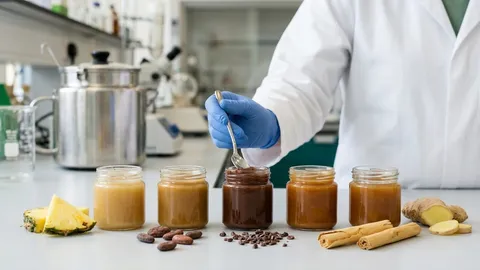
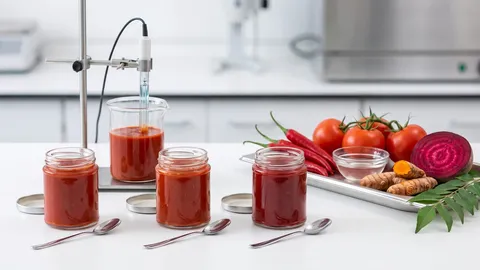
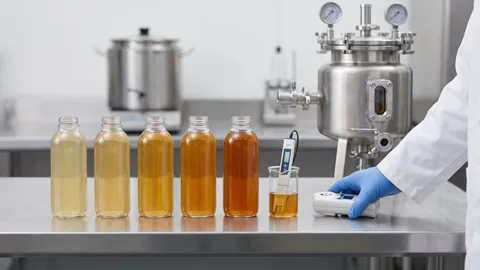
Reformulating a kitchen recipe for retort and 1,500-jar consistency
Buyer’s snapshot
- Processed food exports from Sri Lanka rose 40.4% in 2025, the fastest-growing slice of a food and beverage export category worth USD 583.9 million (Export Development Board, reported December 2025). Local shelves are following the same demand curve.
- A recipe that works in a home kitchen rarely survives a 1,500-jar retort run without reformulation. The gap is process, not taste.
- Silk Foods Ceylon (SFC) runs an in-house R&D team in Matale that typically takes 2 to 4 sample iterations to lock a recipe for a first commercial batch.
- This post covers what changes between the kitchen and the line, the cost and timeline to expect, and where SLSI clearance fits.
Most local Sri Lankan FMCG brands begin in a kitchen or a small home-scale operation. The recipe works there: the founder has made it a hundred times, friends and a few retail testers love it, and the margin looks healthy on a spreadsheet. Somewhere between five thousand and twenty thousand monthly units, the kitchen stops being the answer. Retail buyers ask for a manufacturer audit, batch-to-batch consistency starts to drift, and the recipe that was reliable at one-litre scale behaves differently in a retort and a 1,500-jar run. That moment, when a working recipe meets a commercial process, is where R&D reformulation earns its keep.
Why does a home-kitchen recipe fail at commercial scale?
A home-kitchen recipe usually fails at commercial scale because the cooking process changes, not the ingredient list. In a kitchen, a cook stirs a small pot to an eyeballed thickness and fills jars warm. On a commercial line, the same product passes through a jacketed kettle, a defined fill weight, sealed glass, and a thermal process with a measured lethality value. Heat penetrates a sealed jar differently than an open pot. The section below covers the four variables that move when production scales.
The four variables that shift are heat transfer, water activity and pH, headspace, and shear. A kitchen cook never has to think about any of them. A reformulation does. Heat transfer changes because a 300 g sealed glass jar in a retort heats from the outside in, so the centre reaches sterilising temperature minutes after the wall does. That lag changes texture, colour, and how much the product cooks overall. A spread that was glossy at kitchen scale can turn grainy or split once it spends 40 minutes climbing to commercial sterility.
What is retort reformulation?
Retort reformulation is the adjustment of a recipe so it stays safe, stable, and consistent after the thermal sterilisation that makes a sealed jar or pouch shelf-stable. Under the Codex Alimentarius code of hygienic practice for low and acidified low-acid canned foods (CXC 23), any product with an equilibrium pH above 4.6 must receive a scheduled heat process designed to control Clostridium botulinum. For a low-acid spread, sauce, or curry base, that process is the constraint the recipe has to be built around.
The reference target most processors design to is an F0 of at least 3 minutes, equivalent to a 12-log reduction of Clostridium botulinum spores at 121.1 degrees Celsius, per a 2024 review of retort processing in Food Science and Nutrition. Hitting that number reliably in a 1,500-jar batch is a process question with recipe consequences. Raise the sugar or salt and water activity drops, which changes how heat moves and how the product sets. Drop the pH below 4.6 with an acidulant and the required process shortens, which protects flavour. A good reformulation tunes the recipe so the safe process is also the one that keeps the product tasting like the founder intended.
How an R&D reformulation actually runs
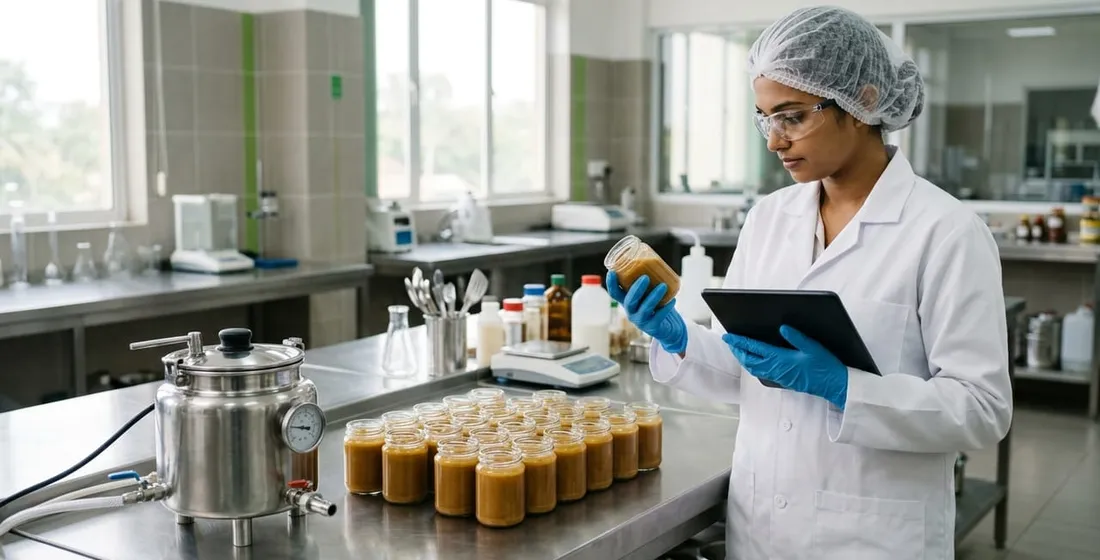
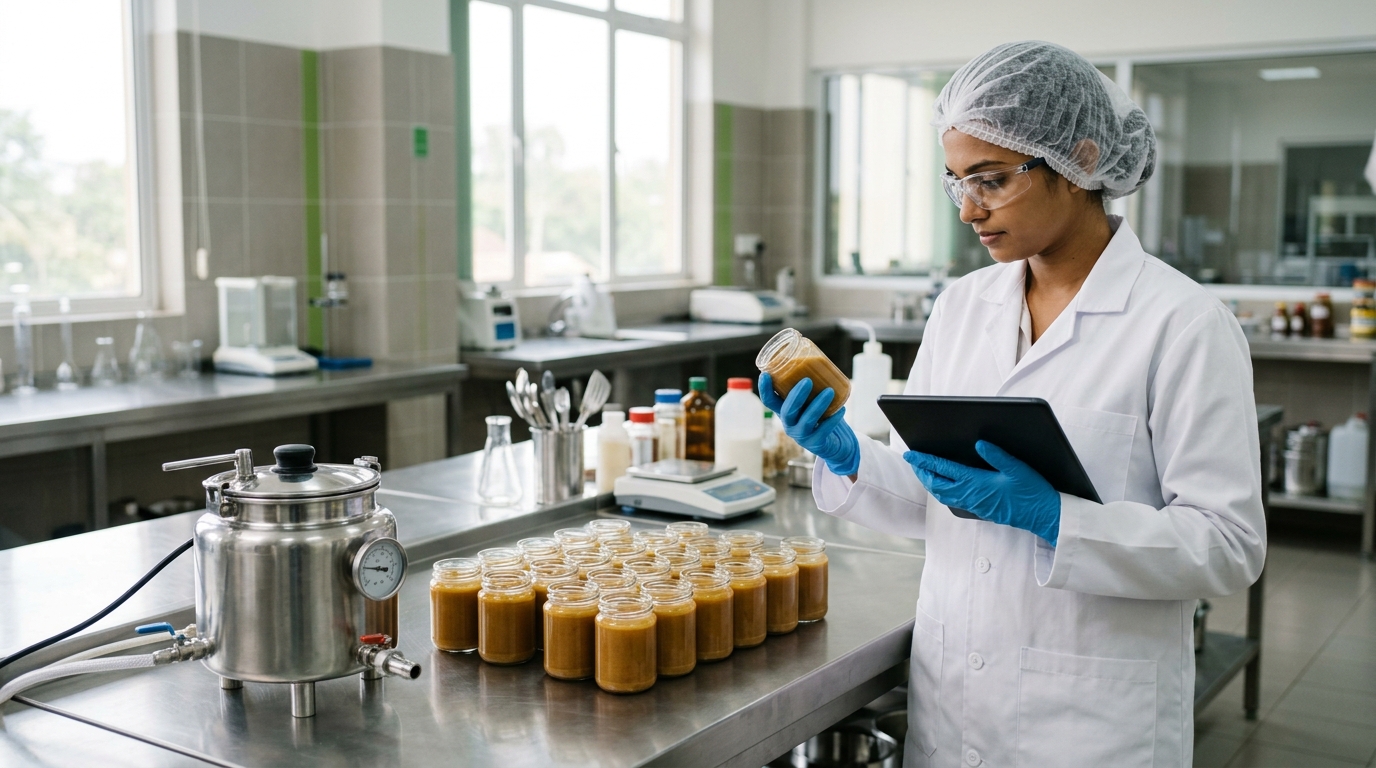
An R&D reformulation at Silk Foods Ceylon runs as a short, structured loop rather than a single rewrite. The in-house R&D team in Matale takes the founder’s working recipe, identifies which variables will move under retort and at batch scale, and produces sample iterations against a fixed brief. Most recipes lock in 2 to 4 iterations. The loop is deliberately tight because every iteration costs sample materials, formulation hours, and a retort trial slot.
A typical cycle looks like this:
- Brief and benchmark. The founder’s recipe is documented, tasted, and measured: pH, target fill weight, viscosity, and the sensory markers that define the product. This is the reference every later sample is judged against.
- First pilot batch. The recipe is scaled to a small pilot in a jacketed kettle, filled into the same glass jar the retail SKU will use, and run through a retort trial. The result almost always differs from the kitchen version. That difference is the work.
- Iterate the formulation. Acidulant, hydrocolloid, sugar, salt, and process timing are adjusted to bring the retorted sample back toward the benchmark. Two to three iterations usually close the gap.
- Confirm consistency. The locked recipe is run again to confirm it holds across fill weights and a representative batch, not just one lucky jar.
- Hand to production and SLSI. Once the spec is signed off, the same recipe moves to a first commercial run under contract manufacturing, with SLSI submission running in parallel.
A founder watching that loop for the first time often expects step three to take one pass. It usually takes two or three, and budgeting for that is the difference between a launch that lands on its shelf date and one that slips.
Kitchen scale versus a 1,500-jar commercial run
The table below names the variables that change between a home kitchen and a first commercial batch, and what each one means for the recipe.
| Variable | Home kitchen | 1,500-jar commercial run | Reformulation consequence |
|---|---|---|---|
| Heat process | Stir to thickness, fill warm | Sealed jar, scheduled retort process to F0 of 3+ | Texture, colour, and set all shift; recipe rebuilt around the process |
| Batch consistency | One pot, judged by eye | Fixed fill weight across 1,500 units | Viscosity and dosing tightened so every jar matches |
| pH and water activity | Rarely measured | Measured; pH 4.6 is the safety line (Codex CXC 23) | Acidulant or sugar adjusted to control the required process |
| Shelf stability | Eaten within days | Months at ambient | Preservation built in, not assumed |
| Audit and clearance | None | Manufacturer audit plus SLSI | Recipe and process documented to a standard |
The takeaway for a buyer is simple. The recipe is still yours. What changes is everything around it, and that is precisely what an R&D engagement is for.
Service snapshot: R&D / NPD at Silk Foods Ceylon
Service: in-house formulation work (Co-Development on the SFC brochure) for buyers adapting a recipe to a commercial process
Iterations: typically 2 to 4 samples before a recipe locks
Pilot tools: jacketed kettles, small mixing tanks, retort trials, an adjoining plantation for fresh herbal raw material
Sample to first PO: 6 to 10 weeks when R&D comes first; 2 to 4 weeks once the recipe is locked
Cert coverage: BRCGS- and FSSC 22000 V6-audited, with SLSI clearance and Sri Lanka Food Act compliance on every retail SKU
What does a reformulation cost, and how long does it take?
A reformulation is priced on iterations and trials, not on a single flat fee, so the cost tracks how far the kitchen recipe sits from a stable commercial process. A clean recipe that needs only minor process tuning is cheaper than one that splits, separates, or browns under retort and needs structural rework. Plan a 6 to 10 week window from first brief to a locked recipe ready for a first commercial batch, then add the contract-manufacturing lead time on top.
The honest framing here is the iteration count. The R&D team at the Matale facility logs roughly 40 first-brief inquiries per quarter, and the single most common gap is not the recipe itself but that the home-kitchen version has never been adjusted for retort temperatures, glass-jar headspace, or batch-to-batch consistency at 1,500 units. A founder who budgets for one iteration and gets three reads it as a cost overrun. A founder who budgets for three and locks in two reads it as ahead of schedule. The work is the same; the expectation is what differs.
For a local FMCG brand running this maths, the choice between R&D / NPD (Co-Development on the SFC brochure) and going straight to contract manufacturing depends on whether the recipe is genuinely locked. If it works in the home kitchen but has not been adjusted for retort or for a 1,500-jar batch, R&D comes first. Once the spec is signed off, the same line produces the first commercial run.
Where SLSI fits in a reformulation
SLSI clearance is the gating step for any packaged food going onto a Sri Lankan supermarket shelf, and it runs in parallel with the back end of a reformulation, not after it. The Sri Lanka Standards Institution’s product certification scheme requires a documented quality management system covering process control, inspection, testing, and traceability, per its 2025 scheme requirements. A recipe locked without that documentation in mind has to be reopened later, which costs time.
Running the two together matters because most of the data SLSI wants, the scheduled process, the pH and fill-weight records, the batch consistency evidence, is generated during the reformulation itself. Capturing it as the recipe locks, rather than reconstructing it afterward, is what keeps a launch on its shelf date. For a local brand, the practical consequence is a six-to-ten-week buffer between manufacturer-side sign-off and a supermarket listing. Planning that buffer on the calendar matters more than any single line item in the submission.
Frequently asked questions
Why does my home-kitchen recipe change when it is made commercially?
The recipe does not change; the process around it does. A sealed glass jar heated in a retort to commercial sterility cooks differently than an open pot, which shifts texture, colour, and set. Under Codex CXC 23, any product above pH 4.6 needs a scheduled heat process, and the recipe has to be tuned to survive it.
Can Silk Foods Ceylon develop or adapt a recipe for a local Sri Lankan brand?
Yes. Silk Foods Ceylon’s in-house R&D team in Matale handles formulation and reformulation work, typically taking 2 to 4 sample iterations to lock a recipe for a first commercial batch. The same facility then produces the first run under contract manufacturing, with SLSI submission support inside the engagement.
How long does a reformulation take before I can launch?
Plan a 6 to 10 week window from first brief to a locked recipe when R&D is needed first, then add contract-manufacturing lead time of 2 to 4 weeks. SLSI clearance runs in parallel with the back end of the reformulation, so the documentation is generated as the recipe locks rather than afterward.
What is the first commercial batch size for a jarred product?
First-run MOQ for spreads and similar semi-liquids at Silk Foods Ceylon sits at 1,500 jars in 300 g glass, which is a single-day run on the semi-liquid line at 3,000 jars per day. Beverages start at 1,250 bottles and capsules at 180 bottles.
Do I need SLSI clearance before I can sell to a supermarket?
Yes. SLSI clearance is the gating step for any packaged food on a Sri Lankan supermarket shelf, and retail buyers usually also ask for a current FSSC 22000 V6 audit on the manufacturer. SLSI’s 2025 product certification scheme requires a documented quality management system covering process control, testing, and traceability.
How Silk Foods Ceylon can help
For local FMCG brands moving a kitchen recipe into professional production, Silk Foods Ceylon (SFC) operates a 10,000 sq ft cellular-manufacturing facility in Matale with an in-house R&D team that adapts recipes for retort and batch-scale consistency, typically across 2 to 4 sample iterations. Once a recipe locks, the same line runs the first commercial batch, with first-run MOQs of 1,500 jars for spreads, 1,250 bottles for beverages, and 180 bottles for capsules. The facility is BRCGS- and FSSC 22000 V6-audited, with SLSI clearance and Sri Lanka Food Act compliance on every retail SKU, and SLSI submission support sits inside the standard engagement.
To brief a reformulation or a first commercial run, email b2b@esilkroute.com.lk or call +94 76 441 0389 / +94 76 918 5744.
Sources
- Export Development Board / Daily Mirror, “Sri Lanka exports top US$ 17.2bn in 2025” (processed food exports +40.4%; food and beverage exports USD 583.9 million), reported December 2025. https://www.dailymirror.lk/breaking-news/Sri-Lanka-exports-top-US-17-2bn-in-2025/108-331344 (retrieved 2026-06-14)
- The Island / Lanka News Room, “SL’s food processing industry seen as wielding vast potential to boost national growth” (over 96% of fruit and vegetables consumed fresh without value addition), March 2025. https://www.lankanewsroom.com/2025/03/news-room-sls-food-processing-industry-seen-as-wielding-vast-potential-to-boost-national-growth-the-island/ (retrieved 2026-06-14)
- Sri Lanka Standards Institution, SLS Mark Product Certification Scheme, Quality Management System Requirements, 2025. https://slsi.lk/en/downloads/ (retrieved 2026-06-14)
- Codex Alimentarius, Code of Hygienic Practice for Low and Acidified Low-Acid Canned Foods (CXC 23-1979, rev. 1993), FAO/WHO. https://www.fao.org/input/download/standards/24/CXP_023e.pdf (retrieved 2026-06-14)
- Jimenez et al., “Understanding retort processing: A review,” Food Science & Nutrition, 2024 (Wiley). https://onlinelibrary.wiley.com/doi/full/10.1002/fsn3.3912 (retrieved 2026-06-14)
Written by the Silk Foods Ceylon Team. Silk Foods Ceylon (Pvt) Ltd. is a BRCGS- and FSSC 22000 V6-audited contract manufacturer in Matale, Sri Lanka, offering contract manufacturing, private labelling, co-packing, and in-house R&D for local Sri Lankan brand owners, FMCG companies, hotel and restaurant groups, and distributors. To brief a project: b2b@esilkroute.com.lk, +94 76 441 0389, or +94 76 918 5744.