Spray-dried fruit powder contract manufacturing in Sri Lanka
Buyer’s snapshot
- Sri Lanka loses 30 to 40% of its fruit harvest after picking, per post-harvest loss assessments published in 2025. Spray drying turns ripe surplus fruit into a free-flowing powder with a long shelf life.
- Silk Foods Ceylon (SFC) spray-dries banana, mango, papaya, and pineapple powders on a BRCGS- and FSSC 22000 V6-audited line in Matale.
- First-run MOQ for a spray-dried fruit powder is 50 kg, a single-day batch, with volume tiers at 500, 1,000, and 2,500 kg.
- The MOQ-and-lead-time table and the fruit-by-fruit process table are below.
Sri Lanka grows more than 900,000 metric tons of fruit and vegetables a year, and loses a large share of the fruit before it reaches a buyer. Post-harvest loss assessments put the figure at 30 to 40 percent of the harvest. A mango glut in May is a pricing problem for a grower and a sourcing opportunity for a brand owner who can convert ripe fruit into something that does not spoil. Spray-dried fruit powder is one of the cleanest ways to make that conversion: a free-flowing, shelf-stable ingredient that holds the colour and most of the flavour of the fruit it came from.
What is fruit powder contract manufacturing, and how does spray drying work?
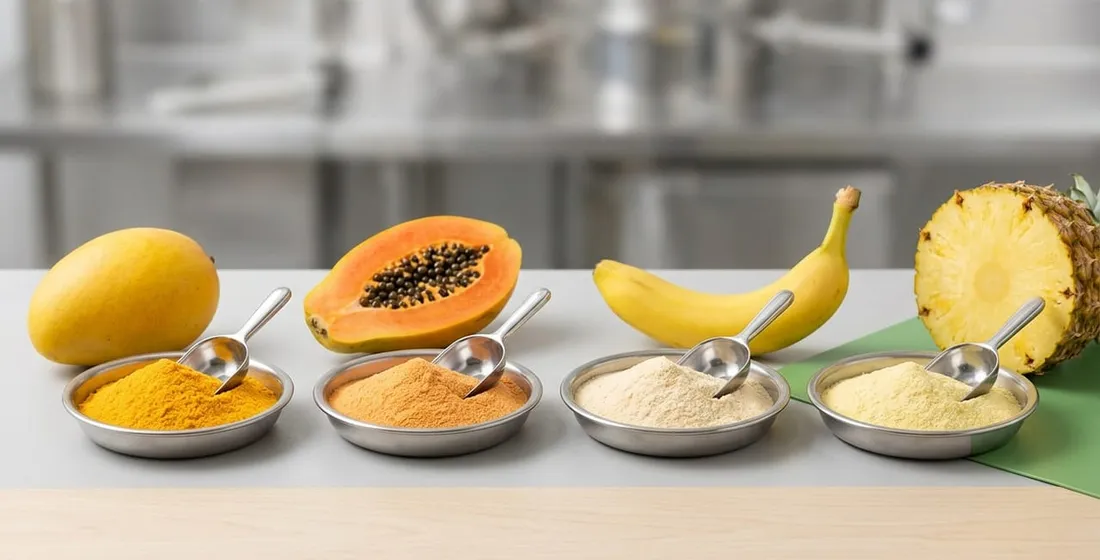
Fruit powder contract manufacturing means a brand owner brings the brief, and the manufacturer turns fruit pulp or juice into a dry powder at commercial scale. Silk Foods Ceylon (SFC) runs a spray-dry line in Matale for banana, mango, papaya, and pineapple. Spray drying atomises a liquid feed into hot air, pulling moisture out in seconds while keeping most of the colour and flavour intact.
The line itself is a short sequence. Ripe fruit is washed, pulped, and blended in a preparation tank, passed through a pipe filter and a colloid mill so the feed is smooth and even, then pumped to the spray drier. Inside the chamber, the feed is sprayed into hot air, the droplets dry almost instantly, and a fine powder falls out at the base. The finished powder usually sits at 3 to 5 percent moisture, which is what gives it a 12 to 24 month shelf life in a sealed pouch.
Because the Matale facility is laid out for cellular manufacturing, the same spray drier that runs a fruit powder one day can run a plant-milk powder the next. That is the same spray-dry route covered in the post on spray-dry powder versus UHT liquid for plant-based milk, and it sits inside the wider contract manufacturing service at Silk Foods Ceylon.
Why banana, mango, papaya, and pineapple behave differently on the line
Tropical fruit purees are high in low-molecular-weight sugars, mainly fructose, glucose, and sucrose, plus organic acids. That chemistry gives them a low glass transition temperature, which is a problem on a hot spray drier: the droplets turn sticky and cling to the chamber wall instead of falling as a free powder. Yield drops and the run can stall. The standard fix is a carrier, usually maltodextrin, which raises the glass transition temperature and lets a clean, non-sticky powder form.
The carrier ratio is the real formulation decision, not an afterthought. More maltodextrin makes the run easier and the powder more stable on the shelf, but it lowers the fruit-solids percentage a brand can put on the label. A clean-label smoothie powder and a low-cost beverage premix often want the same fruit but a different carrier load. Banana is the outlier of the four: riper banana carries more starch and less free sugar, so it is less sticky and can take a lighter carrier load, while a milled green-banana flour is a separate product made on the grinding line, not the spray drier.
How the four fruits run on the spray-dry line
| Fruit | Feed | Carrier load | Powder colour | Common use |
|---|---|---|---|---|
| Mango | Ripe pulp | Moderate to high | Bright orange-yellow | Beverage premix, smoothie powder, bakery |
| Papaya | Ripe pulp | Moderate to high | Warm orange | Nutrition blends, smoothie powder, colour |
| Pineapple | Juice or pulp | High (acidic, very sticky) | Pale yellow | Beverage premix, confectionery, seasoning |
| Banana | Ripe pulp | Light to moderate | Pale cream | Bakery, cereal, infant-style and sports nutrition |
What is the MOQ and lead time for a fruit powder run?
The first-run MOQ for a spray-dried fruit powder at Silk Foods Ceylon is 50 kg, which is a single-day batch, with volume tiers stepping down the per-kilogram rate at 500, 1,000, and 2,500 kg. Lead time runs 2 to 3 weeks from purchase order to dispatch on a settled specification. If the carrier ratio and target moisture still need development, add the R&D window: budget 6 to 10 weeks from brief to first commercial batch.
Service snapshot: spray-dried fruit powder at Silk Foods Ceylon
- Service: contract manufacturing of spray-dried banana, mango, papaya, and pineapple powder
- First-run MOQ: 50 kg (single-day batch); tiers at 500, 1,000, and 2,500 kg
- Lead time: 2 to 3 weeks PO to dispatch on a settled spec; 6 to 10 weeks if R&D is needed first
- Cert coverage: BRCGS- and FSSC 22000 V6-audited, plus SLSI clearance and Sri Lanka Food Act compliance on every retail SKU
- Formats: 50 g to 1 kg kraft pouches, bulk 25 kg and 50 kg sacks with food-grade liner
The R&D team at the Matale facility sees the same pattern on most fruit powder inquiries: the buyer has a clear idea of the fruit and the end product, but no fixed carrier ratio or moisture target. A first sample at a higher maltodextrin load almost always runs clean; the harder iterations are the ones chasing a higher fruit-solids claim without losing flowability. Two to four sample rounds usually settle it, and that work happens before the line books a commercial slot.
Fruit powder order ladder
| Order tier | Volume | What it suits |
|---|---|---|
| First run | 50 kg | A single-day batch to validate the spec and a first retail launch |
| Tier 1 | 500 kg | A committed SKU moving into modern-trade or e-commerce listing |
| Tier 2 | 1,000 kg | A multi-channel SKU or a small export trial |
| Tier 3 | 2,500 kg | A volume programme at the lowest per-kilogram rate |
Where does fruit powder sell, and what does the label need?
Fruit powder is an ingredient before it is a product, which is why it travels across so many categories. The global fruit powders market was valued at about USD 20.22 billion in 2025, with spray drying accounting for roughly 61 percent of production technology, per Future Market Insights. Locally, the demand sits in beverage premixes and smoothie powders, bakery and confectionery, dairy and frozen desserts, sports and infant-style nutrition, and as a natural colour and flavour. The diaspora gifting channel and hotel groups running breakfast and mixology programmes are two further local segments that take small, branded volumes.
For the Sri Lankan shelf, the label is governed by SLSI clearance and the Sri Lanka Food Act 1980 framework, updated by the Ministry of Health Food (Labelling and Advertising) Regulations 2022, which phase in fully by 1 January 2026. The ingredient list has to declare the fruit and the carrier, so maltodextrin and any anti-caking agent appear by name, alongside allergen statements, net weight, and country of origin. The fruit-solids percentage matters here too: a powder marketed on its fruit content needs a formulation that can defend the claim. The detail on clearance is in the post on the SLSI submission, step by step, and the cert layers are in BRCGS, FSSC 22000 V6, and SLSI for a local FMCG brand.
Do you need a finished recipe, or can the powder spec be developed?
A finished recipe is not the starting requirement. R&D and NPD (Co-Development on the SFC brochure) is where most fruit powder projects actually begin, because the variables that decide a good powder, the carrier type and ratio, the target moisture, the particle size, and how the powder reconstitutes in water or milk, are formulation work rather than a kitchen recipe. The in-house R&D team handles 2 to 4 sample iterations before the spec locks for contract manufacturing. That same path runs for plant-based and vegan formats and is set out in full in the guide to R&D and NPD at Silk Foods Ceylon.
Frequently asked questions
Does Silk Foods Ceylon make fruit powder for local brands?
Yes. Silk Foods Ceylon spray-dries banana, mango, papaya, and pineapple powder at its BRCGS- and FSSC 22000 V6-audited facility in Matale. The first-run MOQ is 50 kg, a single-day batch, with volume tiers at 500, 1,000, and 2,500 kg, and SLSI clearance support is included in the contract manufacturing engagement.
How is fruit powder made?
Most tropical fruit powder is spray-dried. Ripe fruit is washed, pulped, and blended into a smooth liquid feed, then sprayed into hot air inside a spray drier, where the droplets lose moisture in seconds and fall as a fine powder at about 3 to 5 percent moisture. The result is a free-flowing, shelf-stable ingredient.
Why is maltodextrin added to fruit powder?
Tropical fruit purees are high in sugars and acids, which makes the droplets sticky on a hot spray drier and causes them to cling to the chamber instead of forming powder. Maltodextrin, a carrier, raises the glass transition temperature so a clean, non-sticky, free-flowing powder forms. The ratio is balanced against the fruit-solids percentage on the label.
What is the minimum order for a fruit powder run at Silk Foods Ceylon?
The first-run minimum is 50 kg, which is a single-day batch on the spray-dry line. Volume tiers that lower the per-kilogram rate sit at 500, 1,000, and 2,500 kg. Lead time is 2 to 3 weeks from purchase order to dispatch on a settled spec, or 6 to 10 weeks if the formulation still needs R&D.
Do fruit powders need SLSI clearance for the Sri Lankan market?
Yes. Any packaged fruit powder sold on the local retail shelf needs SLSI clearance and a label compliant with the Sri Lanka Food Act 1980 and the Ministry of Health Food (Labelling and Advertising) Regulations 2022, which phase in fully by 1 January 2026. The label must declare the fruit, the carrier, allergens, net weight, and country of origin.
How Silk Foods Ceylon can help
For local FMCG brands turning surplus or seasonal fruit into a shelf-stable SKU, Silk Foods Ceylon (SFC) spray-dries banana, mango, papaya, and pineapple powder on a 10,000 sq ft cellular-manufacturing line in Matale that carries a single BRCGS- and FSSC 22000 V6-audited cert stack across 50+ ready-to-go SKUs. The first-run MOQ is 50 kg, a single-day batch, with tiers at 500, 1,000, and 2,500 kg, and the in-house R&D team sets the carrier ratio, moisture, and particle size before the line books a slot. SLSI submission support sits inside the standard engagement.
To brief a fruit powder project, email brands@esilkroute.com.lk or call +94 76 441 0389 / +94 76 918 5744.
Sources
Senanayake, S. et al. (2025), “Present Status of Postharvest Practices and Losses of Fruits and Vegetables in Sri Lanka”, International Journal of Environmental and Agriculture Research. https://ijoear.com/assets/articles_menuscripts/file/IJOEAR-AUG-2025-43.pdf (retrieved 2026-06-25).
Sri Lanka Export Development Board, “Fruits, Nuts and Vegetables: Overview” (national output above 900,000 MT/yr). https://www.srilankabusiness.com/fruits-and-vegetables/overview.html (retrieved 2026-06-25).
Future Market Insights (2025), “Fruit Powders Market” (USD 20.22 bn in 2025; spray drying ~61% of technology). https://www.futuremarketinsights.com/reports/fruit-powders-market (retrieved 2026-06-25).
USDA Foreign Agricultural Service (2024), “Sri Lanka Enacts New Legislation on Food Labeling and Advertising” (Food (Labelling & Advertising) Regulations 2022, phased to 1 Jan 2026). https://apps.fas.usda.gov/newgainapi/api/Report/DownloadReportByFileName?fileName=Sri+Lanka+Enacts+New+Legislation+for+Food+Labeling+and+Advertising_Colombo_Sri+Lanka_CE2023-0011.pdf (retrieved 2026-06-25).
Sablani, S. et al., “Production of mango powder by spray drying and cast-tape drying”, Powder Technology (carrier agents and stickiness in fruit powder spray drying). https://www.sciencedirect.com/science/article/abs/pii/S0032591016307100 (retrieved 2026-06-25).
Sri Lanka Standards Institution, packaged-food product certification scheme (SLS marks for the local retail shelf). https://www.slsi.lk/ (retrieved 2026-06-25).
Written by the Silk Foods Ceylon Team. Silk Foods Ceylon (Pvt) Ltd. is a BRCGS- and FSSC 22000 V6-audited contract manufacturer in Matale, Sri Lanka, offering contract manufacturing, private labelling, co-packing, and in-house R&D for local Sri Lankan brand owners, FMCG companies, hotel and restaurant groups, and distributors. To brief a project: brands@esilkroute.com.lk, +94 76 441 0389, or +94 76 918 5744.