Specifying turmeric curcuminoid content for a private-label capsule
Buyer's snapshot • Whole turmeric powder carries 2 to 9% total curcuminoids; a standardised extract carries about 95%. The same 500 mg capsule fill can hold anywhere from 25 mg to 475 mg of active compound depending on that one line in the brief. • Sri Lankan turmeric runs 3 to 7% curcumin against 2 to 3.5% for imported Indian material, per Daily FT (2022). • Four numbers settle a turmeric capsule spec: curcuminoid percentage by HPLC, fill weight, whole-powder-or-extract, and heavy-metal limits. • Silk Foods Ceylon (SFC) runs a capsule line at 200,000 capsules per day on a 180-bottle first-run MOQ, BRCGS- and FSSC 22000 V6-audited. • Turmeric capsules carrying Ayurvedic claims need Department of Ayurveda registration alongside SLSI clearance. |
Ask ten Sri Lankan brand owners to brief “a turmeric capsule” and you get ten different products that share a name and nothing else. One means 500 mg of ground turmeric. Another means a 95% curcumin extract that is twenty times stronger. A third has not decided, and assumes the manufacturer will. The product name is not the contract. The spec is. For a turmeric capsule, the spec line that matters most is curcuminoid content, and most first briefs leave it blank.
Silk Foods Ceylon is a BRCGS- and FSSC 22000 V6-audited contract manufacturer at Silk AgTech Park in Hapugasyaya, Matale, with a capsule line, an in-house R&D team, and a spice belt on its doorstep. The questions below are the ones the R&D team asks before a turmeric capsule brief becomes a production run, written so a founder can answer them before the first sample call.
What does turmeric curcuminoid content actually mean?
Curcuminoids are the active yellow compounds in turmeric, and there are three of them: curcumin, demethoxycurcumin, and bisdemethoxycurcumin. Curcumin is the largest share at roughly 75% of total curcuminoids, with demethoxycurcumin at 10 to 20% and bisdemethoxycurcumin under 5%, per the Linus Pauling Institute at Oregon State University. A spec that says “curcumin” usually means total curcuminoids, so write the brief in those words to avoid an argument at COA stage.
The distinction matters because lab certificates report total curcuminoids, not curcumin alone. When a brief asks for “5% curcumin” and the certificate of analysis reports “5.2% total curcuminoids by HPLC,” those are the same target stated two ways. Locking the vocabulary up front, total curcuminoids by a named method, removes the most common spec dispute on a turmeric SKU.
Whole turmeric powder or standardised extract: the spec that sets the dose
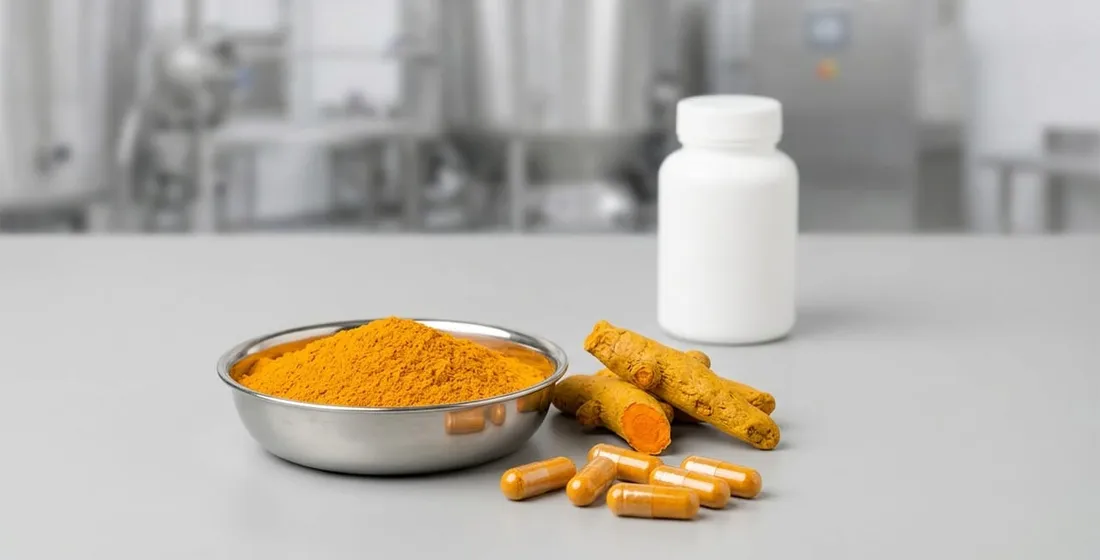
This single decision changes the active content of the capsule by an order of magnitude. Whole turmeric powder (kaha in Sinhala) holds 2 to 9% total curcuminoids, and Sri Lankan turmeric sits at the higher end, 3 to 7% curcumin versus 2 to 3.5% for imported Indian material, per Daily FT (2022). A standardised extract is concentrated to about 95% curcuminoids. A 500 mg capsule of whole Sri Lankan powder at 5% carries roughly 25 mg of curcuminoids; the same 500 mg as a 95% extract carries about 475 mg. That is close to a twentyfold gap between two capsules that look identical on a shelf.
Neither is the correct answer in the abstract. A whole-powder capsule is a traditional turmeric product, sits naturally inside an Ayurvedic-claim positioning, and costs less per bottle. An extract capsule is a curcumin supplement, delivers a clinically-relevant dose in one or two capsules, and commands a higher price point on the pharmacy and wellness retail shelf. The spec decision is really a product-positioning decision wearing a chemistry coat.
| Spec axis | Whole turmeric powder | Standardised 95% extract |
| Total curcuminoids | 2 to 9% (Sri Lankan 3 to 7%) | About 95% |
| Active per 500 mg capsule | About 25 mg at 5% | About 475 mg |
| Positioning | Traditional turmeric, Ayurvedic-claim fit | Curcumin supplement, clinical-dose fit |
| Bioavailability aid | Often paired with black pepper | Often paired with piperine or lipid carrier |
| Relative cost per bottle | Lower | Higher (extraction cost) |
| COA line to specify | Total curcuminoids % by HPLC, plus origin | Total curcuminoids % by HPLC, plus solvent residue |
How is curcuminoid content measured and verified?
Curcuminoid content is verified by high-performance liquid chromatography, or HPLC, which separates and quantifies the three curcuminoids and reports a total percentage. A defensible spec asks for total curcuminoids as a minimum percentage by HPLC, names the test on the certificate of analysis, and sets an acceptance window rather than a single number. “Minimum 4% total curcuminoids by HPLC” is a spec a lab can pass or fail. “High curcumin” is not.
The reason to write a minimum, not an approximate, is batch variation. Turmeric is an agricultural input, and curcuminoid content shifts with variety, soil, harvest timing, and drying. A whole-powder capsule built on a single-figure target will drift below it on a low-curcumin batch. A minimum-with-window spec, paired with a per-batch COA, turns that drift into a documented pass rather than a silent shortfall the brand owner discovers when a customer sends the product for independent testing.
Why bioavailability belongs in the turmeric capsule spec
Curcumin is famously hard for the body to absorb on its own, which is why the absorption strategy is part of the spec, not an afterthought. The classic reference point is Shoba and colleagues (1998) in Planta Medica, who reported that piperine, the active compound in black pepper, raised curcumin bioavailability by 2,000% in human volunteers. A turmeric capsule can address absorption with a small piperine inclusion, a lipid or phytosome carrier, or neither, and each route is a different formulation and a different label claim.
The brief should state whether a bioavailability enhancer is included and at what ratio, because it changes the ingredient list, the allergen review, and the dose math. A capsule sold on a clinical-curcumin promise that omits any absorption aid is a weaker product than its label implies. The in-house R&D and NPD team at the Matale facility treats the enhancer decision as a first-pass question, alongside fill weight and extract grade, so the sample reflects the finished product rather than a placeholder.
The contamination spec most turmeric briefs miss
Turmeric carries a documented adulteration risk that belongs in every capsule spec: heavy metals, and lead in particular. A 2024 study in Science of the Total Environment found lead chromate, a bright yellow industrial pigment added to deepen turmeric colour, used as an adulterant across South Asian supply chains at concentrations exceeding 500 mg/kg, with peak lead readings above 1,100 micrograms per gram in the worst districts. For a capsule that a customer takes daily, an unspecified heavy-metal limit is the gap that turns a wellness product into a liability.
A turmeric capsule spec should set explicit limits for lead, arsenic, cadmium, and mercury, and require a heavy-metal panel on the per-batch COA. The single most common gap the R&D team sees on a turmeric brief is not the curcuminoid figure; it is a brief that specifies the active to two decimal places and says nothing about contaminants. Sourcing raw material from a traceable supplier, then testing every batch, is cheaper than a recall. The Matale spice belt on the facility’s doorstep shortens that supplier loop, which matters when a new batch has to be verified before it enters a capsule run.
What a turmeric capsule spec needs for the Sri Lankan shelf
A turmeric capsule going onto a Sri Lankan retail or pharmacy shelf clears three regulatory layers, and the curcuminoid spec touches the claim layer directly. SLSI clearance is the gating step for shelf eligibility; Sri Lanka Food Act 1980 compliance governs the label, including a tri-lingual product name, allergen disclosure, the manufacturer SLS number, and country-of-origin, with the Food (Labelling and Advertising) Regulations 2022 phasing in to 1 January 2026 per USDA FAS reporting. Any Ayurvedic or traditional-health claim on the capsule adds Department of Ayurveda registration as a parallel submission.
The certification stack on the manufacturer is the trust signal that sits underneath the label. BRCGS- and FSSC 22000 V6-audited production, with SLSI clearance and Sri Lanka Food Act compliance on every retail SKU, plus Department of Ayurveda registration where a turmeric capsule carries a traditional claim, is the order a procurement reviewer reads. For a brand owner planning an export step later, the BRCGS and FSSC layer is already sunk cost rather than a future re-audit.
Spec snapshot: a turmeric capsule brief that a manufacturer can quote • Active form: whole turmeric powder or standardised extract (state which) • Curcuminoid target: minimum total curcuminoids % by HPLC, with an acceptance window • Fill weight per capsule and capsules per bottle • Bioavailability aid: piperine, lipid carrier, or none, with ratio • Heavy-metal limits: lead, arsenic, cadmium, mercury, tested per batch • Capsule shell: vegetable HPMC or gelatin • Claim route: food supplement or Ayurvedic claim (drives Department of Ayurveda step) |
Frequently asked questions
How much curcumin should a turmeric capsule have?
It depends on the product. A whole-powder capsule at 500 mg holds about 25 mg of curcuminoids at 5%; a 95% extract capsule at 500 mg holds about 475 mg. Decide the positioning first, traditional turmeric or clinical curcumin, then set the curcuminoid percentage as a minimum by HPLC.
What is the difference between turmeric and curcumin on a capsule label?
Turmeric is the whole rhizome powder, 2 to 9% curcuminoids. Curcumin refers to the standardised active concentrated to about 95%. Sri Lankan turmeric runs 3 to 7% curcumin, higher than imported Indian material at 2 to 3.5%, per Daily FT (2022). The label should reflect which one is in the capsule.
Do turmeric capsules need Department of Ayurveda registration in Sri Lanka?
If the capsule carries an Ayurvedic or traditional-health claim, yes, registration under the Department of Ayurveda runs parallel to SLSI clearance. A turmeric capsule positioned strictly as a food supplement without traditional claims follows the SLSI and Sri Lanka Food Act route. The claim language decides the pathway.
What is the MOQ for a private-label turmeric capsule at Silk Foods Ceylon?
The first-run MOQ on capsules is 180 bottles per SKU, set deliberately low for a local brand’s first commercial run. The Matale capsule line runs up to 200,000 capsules per day, so the constraint is the brand’s launch volume, not the line.
Can Silk Foods Ceylon develop a turmeric capsule spec from scratch?
Yes. The in-house R&D and NPD team works from a positioning brief to a locked spec, choosing extract grade, fill weight, bioavailability aid, and contaminant limits, typically across two to four sample iterations before a recipe locks for production.
How Silk Foods Ceylon can help
For founders launching a first turmeric capsule, Silk Foods Ceylon (SFC) operates a cellular-manufacturing facility in Matale that handles the path from a positioning brief to a verified, retail-ready capsule. First-run MOQs sit at 180 bottles per SKU, with the capsule line running up to 200,000 capsules per day, so the spec and the COA, not the volume, are the work. The in-house R&D team sets the curcuminoid target, the extract grade, the bioavailability aid, and the heavy-metal limits before the sample run, and the facility is BRCGS- and FSSC 22000 V6-audited, with SLSI submission support and Department of Ayurveda registration handled where a traditional claim applies.
To brief a turmeric capsule project, email brands@esilkroute.com.lk or call +94 77 157 7294.
Sources
- Daily FT (2022), “Self-sufficiency in turmeric calls for new processes in supply chain and value addition,” https://www.ft.lk/agriculture/Self-sufficiency-in-turmeric-calls-for-new-processes-in-supply-chain-and-value-addition/31-732748 (retrieved 2026-06-27).
- Linus Pauling Institute, Oregon State University, “Curcumin,” Micronutrient Information Center, https://lpi.oregonstate.edu/mic/dietary-factors/phytochemicals/curcumin (retrieved 2026-06-27).
- Shoba G, Joy D, Joseph T, Majeed M, Rajendran R, Srinivas PS (1998), “Influence of piperine on the pharmacokinetics of curcumin in animals and human volunteers,” Planta Medica 64(4):353-356, https://pubmed.ncbi.nlm.nih.gov/9619120/ (retrieved 2026-06-27).
- Forsyth JE et al. (2024), “Evidence of turmeric adulteration with lead chromate across South Asia,” Science of the Total Environment, https://www.sciencedirect.com/science/article/pii/S0048969724051532 (retrieved 2026-06-27).
- USDA Foreign Agricultural Service, GAIN report documenting Sri Lanka Food (Labelling and Advertising) Regulations 2022 (phased to 1 January 2026), https://fas.usda.gov/data (retrieved 2026-06-27).
- Sri Lanka Standards Institution and Department of Ayurveda, Ministry of Health, regulatory frameworks for packaged-food clearance and Ayurvedic-product registration, https://www.slsi.lk (retrieved 2026-06-27).
Written by the Silk Foods Ceylon Team. Silk Foods Ceylon (Pvt) Ltd. is a BRCGS- and FSSC 22000 V6-audited contract manufacturer in Matale, Sri Lanka, offering contract manufacturing, private labelling, co-packing, and in-house R&D for local Sri Lankan brand owners, FMCG companies, hotel and restaurant groups, and distributors. To brief a project: brands@esilkroute.com.lk or +94 77 157 7294.