Vegan cheese spread R&D: the colloid mill and iteration count
Buyer's snapshot
|
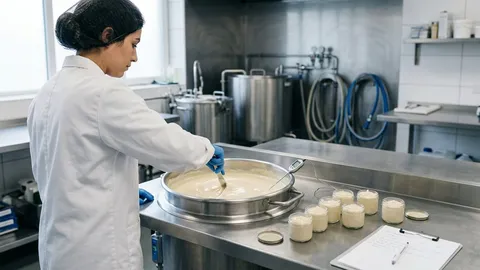
Most local vegan cheese spreads in Sri Lanka start the same way: a working recipe from a home kitchen or a small cafe batch, and a brand owner who wants it in a glass jar on a shelf. The recipe is usually not the problem. The recipe tastes right. What breaks is the step nobody photographs, the moment the batch goes through the mill and comes out either silky or grainy.
A vegan cheese spread is an oil-in-water emulsion held together by starch and an emulsifier. Whether it reads as smooth and cheese-like or chalky and separated depends on how small and how evenly the fat droplets and solid particles are distributed. That is mechanical work, not a recipe tweak, and at Silk Foods Ceylon (SFC), a contract manufacturer in Matale, it is where a plant-based R&D brief actually gets decided. This post is the machine-side companion to the retort iteration cycle post, which covers what each sample round fixes on the recipe side.
What does a colloid mill do to a vegan cheese spread?
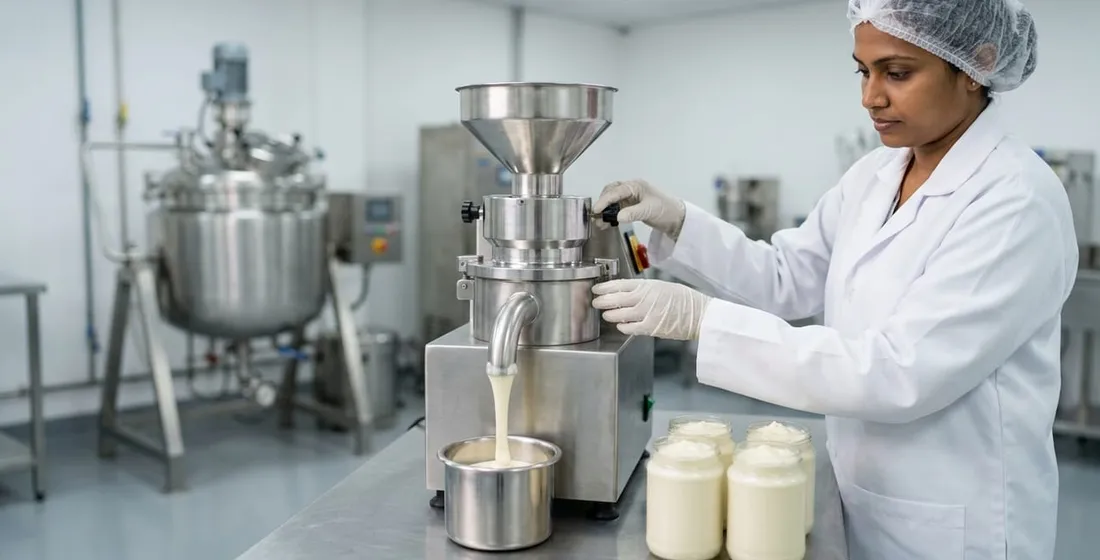
A colloid mill is a wet-milling machine that forces a liquid or semi-liquid between a fast-spinning rotor and a fixed stator, shearing droplets and particles down to a fine, even size. For a vegan cheese spread, it is the tool that turns a coarse, grainy mix into a glossy, spreadable paste. Food-engineering references put a colloid mill’s working particle size at roughly 1 to 5 microns, fine enough that the tongue reads the spread as continuous rather than gritty (Food Engineering, 2024).
The physics is simple to state and easy to get wrong. Coconut oil, water, starch, and an emulsifier can be mixed in a kettle and still fail as a spread, because kettle mixing leaves fat droplets too large and unevenly sized. Under a colloid mill, the same batch passes through a narrow gap at high shear, the droplets shrink, the surface area for the emulsifier to work on multiplies, and the matrix holds together. Research on vegan cheese spread confirms that its eating quality is governed by microstructure and rheology, not ingredient list alone (Journal of Culinary Science and Technology, 2024). The mill is what sets that microstructure.
Colloid mill spec: the gap, the RPM, and what particle size buys you
The colloid mill has two settings that matter for a spread: the gap between rotor and stator, and the rotor speed. The gap is adjustable, commonly from about 0.025 mm upward, and rotor speeds run in the 3,000 to 20,000 RPM range. A tighter gap and higher speed mean higher shear, smaller particles, and a smoother spread, up to the point where over-milling heats the batch and starts to thin it. The R&D job is to find the gap that gives a clean mouthfeel without cooking the emulsion.
At SFC, the pilot mill is run as a sweep: the same locked recipe is passed at three or four gap settings in one session, and each pass is jarred and assessed cold for grain, gloss, and spreadability. That converts an abstract texture goal into a spec line the production team can hold, a gap number and an RPM, rather than a vague instruction to make it smooth. The table below maps what the buyer feels to what the mill is doing.
| Mill setting | Approximate particle size | What the buyer tastes | R&D use |
| Wide gap, lower RPM | Coarse, above 25 microns | Grainy, chalky, visible separation over time | Baseline only; usually rejected |
| Mid gap, mid RPM | Roughly 10 to 25 microns | Acceptable but slightly grainy on the tongue | Fallback if fine milling thins the batch |
| Narrow gap, higher RPM | Roughly 1 to 5 microns | Smooth, continuous, cheese-like | Target for most spreads |
| Very narrow gap, top RPM | Sub-micron, with heat rise | Smooth but at risk of thinning and oil release | Over-milled; back the gap off |
A local brand owner does not need to memorise micron figures. The point is that smoothness is a machine spec, not a lucky batch, and that spec travels with the recipe from the pilot run to every commercial run after it.
Where the colloid mill and the retort meet
The mill and the retort are the two levers that decide whether a shelf-stable vegan cheese spread works, and they interact. Retort sterilisation seals the jar and heats it under pressure to commercial sterility. For a low-acid product like a cheese spread, the process benchmark is an F0 of at least 3 minutes at 121.1 C, the thermal dose equivalent to a 12D reduction of Clostridium botulinum spores (US FDA, 21 CFR Part 113). That dose is what earns an ambient shelf life instead of a chilled one.
Here is why the two levers cannot be set in isolation. A finely milled emulsion, with small even droplets, survives the retort far better than a coarse one, because large fat droplets are the first thing to coalesce and weep oil when the jar hits 121 C. So the mill setting does two jobs at once: it fixes the texture and it fixes the heat stability. Getting the particle size right at the mill reduces the number of retort trials needed later, which is exactly why SFC runs the mill sweep and the first heat trial close together rather than weeks apart. The recipe-side detail of what each retort round corrects is covered in the retort iteration cycle companion post; the same milling logic drives the emulsion work behind a private-label vegan mayonnaise, which lives or dies on droplet size in the same way.
How many sample iterations does a vegan cheese spread need?
Most retort-ready vegan cheese spreads lock in two to four R&D sample iterations at SFC, and the count is driven by how many variables are open at the start. An iteration here means one full cycle: adjust the recipe or the mill gap, make a pilot batch, retort it, then assess the cold jar for texture, oil release, and spread. A brief that arrives with a stable flavour and only needs the machine spec tuned can land in two iterations. A brief that is still moving on fat level, starch type, and emulsifier at the same time needs three or four, because each open variable multiplies the combinations the mill and retort have to resolve.
The SFC R&D team logs the drivers rather than promising a fixed number, because an honest iteration count is a scheduling tool, not a sales line. When a brief opens too many variables at once, the better path is to close the flavour and fat decisions at kitchen scale first, then bring a near-locked recipe in for the mill and retort work. That is the same discipline behind reformulating a kitchen recipe for retort at 1,500-jar consistency. The matrix below shows what pushes the count up.
| Iteration driver | Fewer iterations (2) | More iterations (3 to 4) |
| Flavour and fat level | Locked at kitchen scale before the brief | Still being decided during R&D |
| Emulsifier and starch system | Chosen and stable | Being trialled against each other |
| Target texture | One clear reference the buyer can name | Vague or shifting |
| Mill and retort interaction | Milled fine early, heat-stable first pass | Coarse first pass, oil release under heat |
The single most common gap the R&D team sees is not the recipe. It is that the buyer’s home version was never milled or heat-treated at all, so it has no baseline for either lever. Closing that gap is what the first iteration is for.
From a locked spec to the first commercial run
Once the recipe, the mill gap, and the retort schedule are all signed off, the same line produces the first commercial batch. This is the handoff from R&D and NPD (Co-Development on the SFC brochure) to Contract Manufacturing: the spec is the buyer’s, and the line, the audit, and the SLSI submission move under the SFC umbrella. First-run MOQ for a spread sits at 1,500 jars in 300 g glass, and lead time runs roughly 5 to 7 weeks from brief to first batch when R&D is needed first (R&D takes 3 to 4 weeks maximum from signed brief to approved formulation), or 2 to 3 weeks once a spec is locked.
For a local brand, the value of doing the mill and retort work properly once is that it does not have to be repeated. The gap number and the F0 schedule are recorded as the production spec, so batch two and batch fifty come out of the same line at the same texture. That repeatability is the whole point of moving off a kitchen and onto an audited line, the same logic that takes a plant-based patty from R&D to a first contract run. Every retail SKU still clears SLSI and carries a Sri Lanka Food Act compliant trilingual label, the local floor covered inside the standard engagement and detailed in the SLSI submission walkthrough.
Frequently asked questions
Does Silk Foods Ceylon develop vegan cheese spreads for local Sri Lankan brands?
Yes. Silk Foods Ceylon runs in-house R&D and NPD for plant-based formats, including retort-ready vegan cheese spreads, at its Matale facility. The team handles the colloid mill spec and the retort schedule, typically over two to four sample iterations, before the recipe locks for contract manufacturing at a 1,500-jar first run.
What is a colloid mill and why does a vegan cheese spread need one?
A colloid mill shears an oil-in-water mix between a fast rotor and a fixed stator, reducing particle size to roughly 1 to 5 microns (Food Engineering, 2024). For a vegan cheese spread, that fine, even milling is what makes the paste smooth and spreadable rather than grainy, and it also improves how the emulsion holds under retort heat.
How many R&D iterations does a retort-ready vegan cheese spread take?
Usually two to four sample iterations at Silk Foods Ceylon. A near-locked recipe that only needs the mill gap and retort schedule tuned can finish in two; a brief still open on fat level, starch, and emulsifier at the same time runs to three or four, because each open variable adds combinations the mill and retort have to resolve.
Why does a shelf-stable vegan cheese spread need retort at all?
Retort sterilisation drives the sealed jar to commercial sterility at an F0 of at least 3 minutes at 121.1 C, a 12D reduction of Clostridium botulinum spores (US FDA, 21 CFR Part 113). That is what gives the spread an ambient shelf life, so it can sit on a supermarket shelf or ship through a Sri Lankan e-commerce marketplace with no cold chain.
How Silk Foods Ceylon can help
For local FMCG brands moving a vegan cheese spread from a kitchen recipe to a shelf-stable jar, Silk Foods Ceylon (SFC) runs the machine-side R&D that decides whether the spread works: a colloid mill for the particle-size spec and a retort line for the heat schedule, both in-house at the Matale facility so a mill-gap sweep and a heat trial happen in one pilot session. Plan two to four sample iterations inside the 3 to 4 week R&D window (signed brief to approved formulation), then roughly 5 to 7 weeks from brief to first batch, dropping to 2 to 3 weeks once the spec is locked. First-run MOQ is 1,500 jars in 300 g glass. The facility is BRCGS- and FSSC 22000 V6-audited, with SLSI clearance and Sri Lanka Food Act compliance on every retail SKU.
To brief a project, email brands@esilkroute.com.lk or call +94 77 157 7294.
Sources
- Sri Lanka Export Development Board (2025), “Food and Beverages Products Export Performance,” https://www.srilankabusiness.com/food-and-beverages/about/export-performance.html (retrieved 2026-07-07).
- Food Engineering (2024), “Colloid mills,” https://www.foodengineeringmag.com/articles/85055-colloid-mills-2 (retrieved 2026-07-07).
- Journal of Culinary Science and Technology (2024), “Development and Optimization of Vegan Cheese Spread: Studies in Rheology and Microstructure,” https://www.tandfonline.com/doi/abs/10.1080/15428052.2024.2359448 (retrieved 2026-07-07).
- US Food and Drug Administration, “Guide to Inspections of Low Acid Canned Food,” 21 CFR Part 113, https://www.fda.gov/ (retrieved 2026-07-07).
- Ministry of Health, Sri Lanka (2022), “Food (Labelling and Advertising) Regulations 2022,” in force 1 January 2026, https://www.health.gov.lk/ (retrieved 2026-07-07).
Further reading:
- ScienceDirect (2025), “Formulation factors influencing the production of dairy-free cheese alternatives,” https://www.sciencedirect.com/science/article/pii/S2772566925001156 (retrieved 2026-07-07).
Written by the Silk Foods Ceylon Team. Silk Foods Ceylon (Pvt) Ltd. is a BRCGS- and FSSC 22000 V6-audited contract manufacturer in Matale, Sri Lanka, offering contract manufacturing, private labelling, co-packing, and in-house R&D for local Sri Lankan brand owners, FMCG companies, hotel and restaurant groups, and distributors. To brief a project: brands@esilkroute.com.lk or +94 77 157 7294.