Warehousing, Despatch and Stock Ownership at a Sri Lanka Co-Packer
By the Silk Foods Ceylon Editorial Team
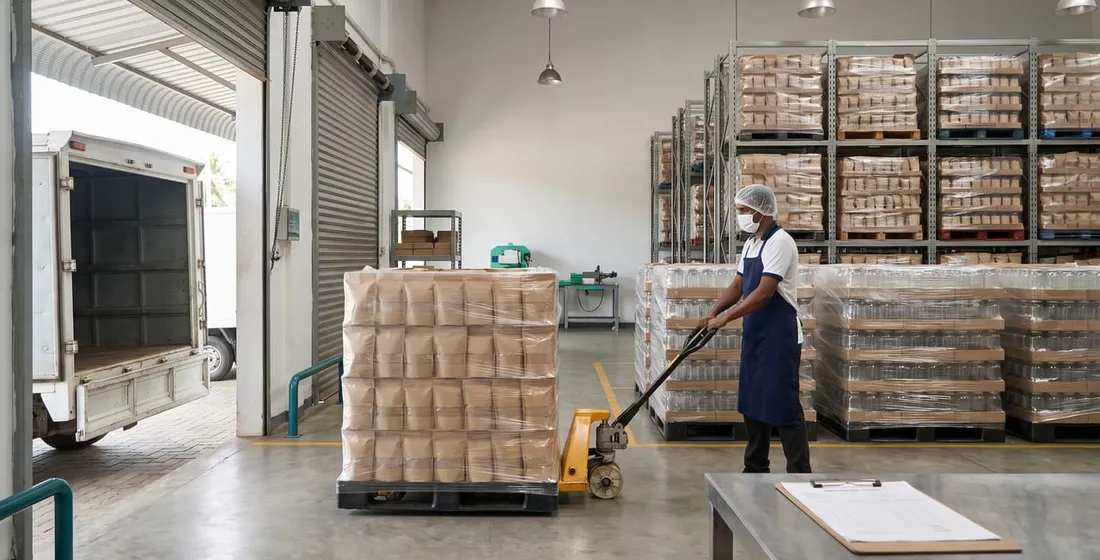
A worker moves a wrapped pallet toward the loading bay at a Sri Lankan co-packing warehouse, with racked stock and a delivery truck visible at the dock.
Buyer's snapshot
|
Sri Lanka’s freight and logistics market is on track to grow from USD 7.78 billion in 2025 to USD 8.11 billion in 2026, and non-temperature-controlled warehousing already accounts for roughly 91.5% of that revenue (Mordor Intelligence, 2025). For a distributor converting imported almonds, cashews, dates, oats, or bulk spices into Sri Lankan retail-ready SKUs, most of that warehousing sits inside a co-packer’s four walls, not the distributor’s own. The two questions that matter most are simpler than the market numbers: what actually happens to a pallet between arrival and despatch, and who owns the stock while it sits in someone else’s warehouse.
What warehousing and despatch cover inside a co-packing engagement
A distributor asking what co-packing warehousing includes is really asking about four linked steps: receiving the buyer’s finished goods, storing them correctly, packing and labelling to a Sri Lankan retail spec, and despatching a batch-traceable, stock-reconciled shipment. At Silk Foods Ceylon, all four sit inside one BRCGS- and FSSC 22000 V6-audited facility in Matale.
Co-packing at Silk Foods Ceylon (SFC) runs on a simple division of labour. The distributor supplies finished goods, typically imported bulk almonds, cashews, dates, oats, or spices arriving by container. The SFC team at the Matale facility handles the packing, labelling, and SLSI submission support that turns that bulk into a Sri Lankan retail-ready SKU.
Packaging format sits inside this same conversation. SFC’s co-packing line runs kraft pouches from 50 g to 1 kg, glass jars from 50 ml to 1 L, and 60-count capsule bottles, so the same warehousing and despatch discipline applies whether the finished SKU is a spice pouch, a jar of coconut spread, or a bottled supplement. The Spice and herb co-packing in Sri Lanka capability one-pager covers the packing-line side of this in more depth; this post is about what happens before and after the line runs.
None of this is unique to SFC. Every co-packer that handles a distributor’s imported bulk is, functionally, running a small third-party logistics operation alongside the packing line. How Silk Foods Ceylon works lays out the full service map; the warehousing and despatch layer is what makes the packing promise deliverable on schedule.
How a pallet moves from receiving to the packing line
Pallet-in at a Sri Lankan co-packer starts with a match against the distributor’s own delivery note, a weight check, and a visual inspection for damage, pest activity, or moisture before the pallet is released from a holding zone onto the packing floor.
A pallet arriving at the Matale facility is checked against the distributor’s delivery note and purchase order before anything else happens. The receiving team confirms unit count and weight, then inspects for physical damage, pest activity, or moisture ingress, since bulk almonds, cashews, and dates travel through humid transit conditions before they reach a Sri Lankan warehouse.
A pallet that passes this check moves into a holding zone, not straight onto the packing floor. Holding separates goods awaiting release from goods cleared for packing, which matters when a distributor runs multiple SKUs through the same facility on a staggered schedule. Frozen and chilled formats use SFC’s reefer storage; ambient dry goods sit in general warehousing under standard stock rotation.
Stock rotation follows first-in, first-out sequencing by default, with first-expired, first-out applied whenever a distributor’s own shelf-life data calls for it. A pallet that sits in holding for three weeks behind a newer, faster-moving SKU is a scheduling problem worth raising with the co-packer directly, not a detail to assume is handled correctly.
What does batch traceability at despatch actually mean?
Batch traceability at despatch means every outgoing pallet carries a batch or code number that satisfies the Food Act’s labelling requirement, is backed by a Certificate of Analysis for that batch, and can be traced back through the co-packer’s internal goods-received reference to the original import shipment.
The Codex Alimentarius Commission defines traceability, or product tracing, as the ability to follow the movement of a food through specified stages of production, processing, and distribution (FAO/WHO Codex Alimentarius Commission, CXG 60-2006). For a co-packed SKU, that ability has to survive the handoff between the distributor’s import paperwork and the co-packer’s own warehouse records.
Sri Lanka’s Food (Labelling and Advertising) Regulations, made under the Food Act No. 26 of 1980, require a batch number or code number, or a decipherable code marking, on every packaged food label (FAOLEX, Food Act No. 26 of 1980, consolidated text). That single line on a retail label is the visible end of a longer chain: SFC’s internal goods-received reference for the incoming pallet, cross-referenced to the distributor’s own import batch or lot number, cross-referenced again to the code that ends up printed on the packed SKU.
The GS1 Global Traceability Standard describes the same chain in more formal terms: a batch or lot identifier limits the traceable group to a smaller set of instances, and location and logistics-unit identifiers (GLN for a facility, SSCC for a logistics unit) let each step in that chain be captured as an event rather than assumed (GS1, 2025). SFC does not require a distributor to run GS1-standard identifiers for a Sri Lankan retail listing, but the underlying discipline, batch-level identification, a documented receiving event, and a documented despatch event, is what a Certificate of Analysis and a stock reconciliation report are built to prove.
One Sri Lankan distributor consolidating three imported nut and dried-fruit lines into single-origin retail pouches at Silk Foods Ceylon initially assumed the co-packer’s traceability record and the distributor’s own import documentation were the same paper trail. They were not. The distributor’s customs and import batch numbers covered the shipping container; SFC’s internal goods-received reference covered the pallet inside the warehouse; the code number on the packed SKU’s retail label was a third, separate reference. Once all three were cross-referenced on a single stock reconciliation sheet, a retail-listing query about one pouch could be traced back to the exact pallet, and the exact import shipment, in under a day.
Pallet-in vs pallet-out: what changes hands and what gets checked
The receiving side and the despatch side of a co-packing run ask different questions of the same pallet. The table below sets out what happens at each end, and which party is responsible for the paperwork.
| Checkpoint | Pallet-in (receiving) | Pallet-out (despatch) |
| Documentation | Distributor’s delivery note matched to the purchase order; a goods-received note is issued | A despatch note is issued, matched to the batch’s Certificate of Analysis and the stock reconciliation report |
| Batch identification | Distributor’s import batch or lot number recorded against SFC’s internal goods-received reference | A batch or code number is applied to the packed SKU, satisfying the Food Act labelling requirement |
| Quality check | Visual inspection for damage, pest activity, or moisture; weight checked against the delivery note | Random carton check against the packed spec; Certificate of Analysis issued for the batch |
| Stock ownership | Distributor retains title; SFC holds the goods as custodian for the duration of the packing run | Title reverts to the distributor at despatch, closed out by a signed goods-out note |
| Storage | Staged in a holding zone before release to the packing line | Held in a despatch-ready zone pending the distributor’s own transport or a carrier pickup |
Read across the table, the pattern is that documentation and ownership move together. Every point where a batch or code number changes, a document is issued to match it. A distributor who can’t produce a goods-received note for a pallet that supposedly entered the facility three weeks ago has found a real gap, not a paperwork formality.
Who owns the stock, and when does ownership change hands?
In a co-packing engagement, the distributor retains title to the finished goods throughout; the co-packer holds the stock as a custodian during the packing window, and ownership reverts to the distributor at despatch, evidenced by a signed goods-out note and a stock reconciliation report.
Co-packing is structurally different from contract manufacturing on the ownership question. In contract manufacturing, the manufacturer produces the buyer’s recipe from its own raw materials and work-in-progress stock. In co-packing, the distributor supplies finished goods, so the distributor owns the physical stock before, during, and after the packing run. SFC’s role during the packing window is custodian, not owner.
That custodial period is where a stock reconciliation report earns its keep. A reconciliation report matches the quantity that arrived on pallet-in against the quantity that left on pallet-out, with any wastage, quality-hold deductions, or sample retentions itemised in between. A distributor who receives a reconciliation report showing 1,000 kg in and 1,000 kg out, with no accounting for the normal handling loss on a repack run, should ask what got left off the sheet rather than treat the round number as good news.
Goods-in-custody insurance is the other half of the ownership question. Because title stays with the distributor throughout, the distributor’s own risk exposure runs the whole time the stock sits in the co-packer’s warehouse, unless the co-packing agreement specifies otherwise. Asking a co-packer directly what coverage applies to goods in their custody, rather than assuming it mirrors the co-packer’s own product liability cover, closes a gap that only shows up after something goes wrong.
What should a distributor ask to see before signing a co-packing agreement?
Buyer's checklist: before you sign
|
None of these are unusual requests. A co-packer with a current BRCGS and FSSC 22000 V6 audit chain should be able to produce all seven within a normal sales conversation. A co-packer that can’t produce a sample traceability log or a mock recall record, specifically, is the clearest early signal that the warehousing side of the operation has not kept pace with the packing side.
Co-packing vs private labelling: where warehousing responsibility sits
The warehousing and ownership questions in this post apply specifically to co-packing, where the distributor supplies finished goods. Private labelling works differently: SFC formulates and manufactures the SKU from its own raw materials, and the buyer’s brand goes on an SFC-owned recipe. Warehousing responsibility for raw materials and work-in-progress sits with SFC throughout a private-label run, since SFC owns the stock until the finished SKU is invoiced to the buyer.
For a distributor deciding between the two, the practical test is simple: if the goods already exist and need packing, labelling, and SLSI submission support, that’s co-packing. If the goods don’t exist yet and need a recipe, that’s private labelling, and the private-label tea bag programme post covers how that ownership model plays out for a different buyer segment. Certification coverage is identical either way: BRCGS- and FSSC 22000 V6-audited, with SLSI clearance and Sri Lanka Food Act compliance on every retail SKU. The 2026 founder’s maths on contract manufacturing post and the vegan plant milk contract manufacturing post both work through what changes when SFC owns the recipe and the raw materials instead.
Frequently asked questions
What is batch traceability at despatch, and why does it matter for a co-packed SKU?
Batch traceability at despatch means the outgoing pallet carries a batch or code number required under Sri Lanka’s Food Act labelling regulations, backed by a Certificate of Analysis and a documented link back to the goods-received record. It matters because a retail-listing query or a recall has to trace back to source in hours, not days.
Who owns the stock during a co-packing run at Silk Foods Ceylon?
The distributor retains title to the finished goods throughout a co-packing run at Silk Foods Ceylon (SFC); SFC holds the stock as custodian during the packing window. Ownership formally reverts to the distributor at despatch, closed out by a signed goods-out note and a stock reconciliation report.
Does Silk Foods Ceylon issue a Certificate of Analysis for co-packed batches?
Yes. Every co-packed batch produced at the Matale facility is issued a Certificate of Analysis matched to the batch’s code number, as part of the standard BRCGS- and FSSC 22000 V6-audited quality process.
What documents should a distributor ask for before signing a co-packing agreement?
A distributor should ask for the warehouse’s pallet-in inspection procedure, a sample traceability log from a completed run, the Certificate of Analysis cadence, a sample stock reconciliation report, goods-in-custody insurance confirmation, and evidence of a mock recall drill.
How long does co-packing take from finished-goods arrival to despatch?
Co-packing at Silk Foods Ceylon typically runs one to two weeks from the arrival of finished goods to despatch, depending on SKU count, packaging format, and whether SLSI submission support is required for a new listing.
How Silk Foods Ceylon can help
For distributors converting imported bulk, almonds, cashews, dates, oats, and spices, into Sri Lankan retail-ready SKUs, Silk Foods Ceylon (SFC) operates a dedicated co-packing capability at the Matale facility, with the buyer supplying finished goods and the SFC team handling packing, labelling, warehousing, and SLSI submission support under the Sri Lanka Food Act labelling framework. Packaging options span 50 g to 1 kg kraft pouches, glass jars from 50 ml to 1 L, and 60-count capsule bottles, with a typical one- to two-week lead time from finished-goods arrival to despatch. The BRCGS and FSSC 22000 V6 cert stack on the repacker side, alongside a documented pallet-in and pallet-out record, reassures retail procurement teams on the audit chain behind a private-label listing. To brief a co-packing or consolidation plan, email brands@esilkroute.com.lk or call +94 77 157 7294.
Sources
- Mordor Intelligence (2025), “Sri Lanka Freight and Logistics Market Size, Growth, Share & Research Report,” https://www.mordorintelligence.com/industry-reports/sri-lanka-freight-and-logistics-market (retrieved 2026-08-28).
- Sri Lanka Standards Institution, “Systems Certification Services,” https://slsi.lk/en/services/systems-certification/ (retrieved 2026-08-28).
- FAOLEX (FAO), “Food Act No. 26 of 1980, Sri Lanka” and the Food (Labelling and Advertising) Regulations, https://www.fao.org/faolex/results/details/en/c/LEX-FAOC014452/ (retrieved 2026-08-28).
- FAO/WHO Codex Alimentarius Commission, “Principles for Traceability/Product Tracing as a Tool Within a Food Inspection and Certification System” (CXG 60-2006), https://www.fao.org/fao-who-codexalimentarius/sh-proxy/tr/?lnk=1&url=https%3A%2F%2Fworkspace.fao.org%2Fsites%2Fcodex%2FStandards%2FCXG+60-2006%2FCXG_060e.pdf (retrieved 2026-08-28).
- GS1 (2025), “GS1 Global Traceability Standard,” https://www.gs1.org/standards/gs1-global-traceability-standard/current-standard (retrieved 2026-08-28).
- Daily FT (2025), “Unlocking Potential of Logistics Industry: Addressing Challenges and Leveraging Opportunities,” https://www.ft.lk/shippingaviation/Unlocking-potential-of-logistics-industry-Addressing-challenges-and-leveraging-opportunities/21-784416 (retrieved 2026-08-28).
Written by the Silk Foods Ceylon Team. Silk Foods Ceylon (Pvt) Ltd. is a BRCGS- and FSSC 22000 V6-audited contract manufacturer in Matale, Sri Lanka, offering contract manufacturing, private labelling, co-packing, and in-house R&D for local Sri Lankan brand owners, FMCG companies, hotel and restaurant groups, and distributors. To brief a project: brands@esilkroute.com.lk or +94 77 157 7294.