Sugar, Salt and Fat Colour Code Compliance in Sri Lanka
By the Silk Foods Ceylon Editorial Team
Buyer’s snapshot
- The Food (Colour Coding for Sugar, Salt and Fat) Regulations 2019 were gazetted as Gazette Extraordinary No. 2119/3 on 17 April 2019 and came into operation on 1 June 2019.
- A solid or semi-solid food carries a red logo above 22 g sugar, 1.25 g salt or 17.5 g fat per 100 g, and a green logo below 5 g, 0.25 g and 3 g respectively.
- Regulation 7 lists nine exemptions. Spices, condiments, curry mixtures and flavouring mixtures sold in a separate pack are outside the regulations, and so are products packaged solely for export.
- Each logo is fixed at no less than 2 cm by 1 cm, on the main panel, with the nutrient word in Sinhala, Tamil and English. That makes it an artwork constraint rather than a print afterthought.
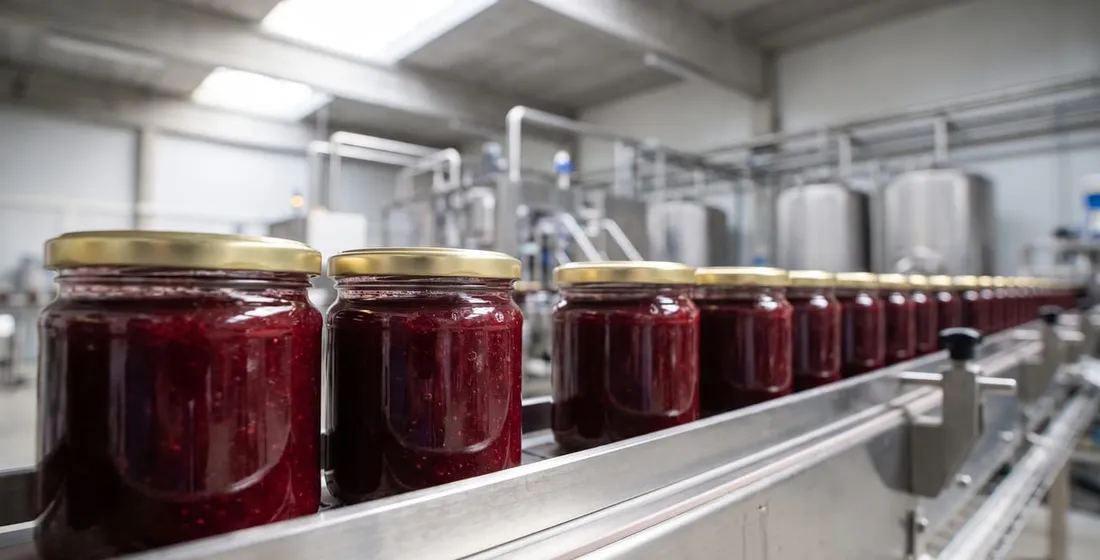
- A standard fruit jam sits several times above the red sugar threshold, so the logo belongs in the first artwork brief rather than in a finding at submission.
A Sri Lankan brand owner briefing a first jam, spread or sauce usually treats the front of the pack as a design question. Part of it is a regulatory one. Since 1 June 2019, a separate instrument from the labelling regulations has required a sugar, salt or fat logo on the main panel of most solid and semi-solid packaged foods, sized and coloured to a fixed specification.
The instrument is short. Three thresholds per nutrient, one logo specification, nine exemptions. What makes it worth reading before artwork rather than after is that the thresholds are set per 100 g, and the categories a first-time brand owner is most likely to launch sit well above them.
What follows is the threshold table, the logo specification, the exemption list, and where the colour code lands in a production schedule.
What the colour code regulations cover
Sri Lanka’s front-of-pack colour code for solid food comes from the Food (Colour Coding for Sugar, Salt and Fat) Regulations 2019, gazetted as Gazette Extraordinary No. 2119/3 on 17 April 2019 and operative from 1 June 2019. It is listed as current on the Ministry of Health regulations register, and it applies to solid and semi-solid food rather than to drinks.
Regulation 2(1) is the operative bar. No person shall package, sell, expose for sale, or advertise any solid or semi-solid food containing an amount of sugar, salt or fat specified in Schedule I unless that food is labelled in the manner the regulations set out. The obligation attaches to the pack, not to the recipe.
Regulation 2(2) covers food that has to be prepared or reconstituted before it is eaten and is still solid or semi-solid afterwards. A locally manufactured product of that kind is labelled under these regulations. An imported one has a label made under these regulations affixed to the container.
Liquids sit under their own instrument, the Food (Colour Coding for Sugar Levels - Liquid) Regulations 2022, which works on a per 100 ml basis and on different bands. A beverage brief is a different compliance conversation, covered in the note on flavour pivots and beverage line economics.
Which colour does a solid or semi-solid food carry?
Schedule I sets three bands for each of the three nutrients, all declared per 100 g of the food. The bands are read independently, so one pack can carry a red sugar logo beside a green salt logo. Nothing in the regulations nets the three together into a single score.
Colour code bands, Food (Colour Coding for Sugar, Salt and Fat) Regulations 2019, Schedule I
| Nutrient (per 100 g) | Green | Amber | Red |
|---|---|---|---|
| Total sugar | Less than 5 g | 5 g to 22 g | More than 22 g |
| Total salt | Less than 0.25 g | 0.25 g to 1.25 g | More than 1.25 g |
| Total fat | Less than 3 g | 3 g to 17.5 g | More than 17.5 g |
The definitions matter as much as the numbers. Regulation 8 defines sugar as total sugar in the form of monosaccharides and disaccharides, salt as total salt in the form of sodium chloride, and fat as total fatty acid in the form of triglycerides. A formulation is assessed on what the finished product contains, not on what was added to the mixing vessel.
Why a fruit jam lands on red before the recipe is written
For a fruit preserve the red sugar logo is a category characteristic, not a formulation failure. Sugar in a jam is the setting and preservation system, working through water activity and soluble solids, so it is not a sweetener level that can be dialled down to clear a threshold without changing the product. A conventional jam sits well above 22 g per 100 g.
The useful consequence is that the decision in front of a brand owner is not how to avoid the red logo. It is how the artwork looks with the red logo on it from the first draft. Teams that discover the logo late redraw a pack they had already signed off, which is the expensive order to do it in.
A reduced-sugar reformulation is a genuine R&D project rather than a substitution, because the set, the shelf life and the preservative ceiling all move together. That work is covered in the note on clean-label reformulation of an existing SKU, and the range economics in the note on a private-label jam and fruit preserve range.
Is a spice or condiment pack exempt?
Regulation 7 takes nine categories outside the regulations altogether. The list is worth reading in full before assuming a SKU is caught, because two of the nine cover products a Sri Lankan manufacturer makes constantly.
- any primary agricultural product, defined to include cereals, pulses, vegetables, roots and tubers, fruits, salt, sugar, meat and fish;
- spices, condiments, curry mixtures or flavouring mixtures sold in a separate pack;
- food for special dietary uses, or where the label prominently displays that it is to be used under medical guidance or on the recommendation of a medical practitioner;
- a package of food whose nature, quality, quantity, origin or brand is requested by the purchaser and which is weighed, counted or measured in the purchaser’s presence;
- bulk packs, where the retail packs inside them comply with the regulations;
- infant milk formulae;
- products packaged solely for export purpose only;
- a solid or semi-solid food that becomes a liquid at consumption level once prepared or reconstituted per the label directions;
- a solid or semi-solid food manufactured before the date the regulations came into operation.
The exemption in paragraph (b) attaches to the pack rather than to the ingredient. A curry mixture sold in its own pack is outside the regulations. The same blend carried inside a ready sauce is part of a finished food that is assessed on its own sugar, salt and fat content, and a sauce built on a spice base can reach the salt threshold easily. The contrast is set out in the note on a private-label curry powder for the supermarket shelf.
Paragraph (g) is narrower than it first reads. It exempts products packaged solely for export purpose only. A SKU that runs one artwork for both the local shelf and an export case is not packaged solely for export, so a dual-destination run does not sit inside the exemption. That is a reading of the wording rather than a ruling from the regulator, and it is worth confirming at submission, but it is the reading a brand owner should plan artwork against.
What the logo has to look like
Regulations 3, 4 and 5 specify the sugar, salt and fat logos in identical terms, and the specification is dimensional rather than stylistic. Each logo is no less than 2 cm in height and 1 cm in width. The nutrient word appears inside the logo in Sinhala, Tamil and English, in bold white, at a minimum 2 mm font size.
The numeric value for that nutrient sits in a white box within the logo, in bold black, at a minimum 1.5 mm font size. Regulation 8 fixes the colours in RGB terms: red is R230, amber is R255, G195 and B9, and green is G195, or the equivalent in each case.
Regulation 6 puts the logos in the main panel of the label, in close proximity to each other. The regulation defines the main panel as the front of pack, the part of the label most likely to be displayed under customary conditions of display for retail sale, which removes the option of moving the logos to a back panel to protect a design.
The proviso to regulation 6 is the one that catches a small format. Where the logos cover more than 25% of the surface area of the main panel, they move to the dispenser pack instead. Three logos at the minimum size occupy 6 square centimetres, so the proviso starts to apply on any main panel smaller than roughly 24 square centimetres. Sachets, portion packs and small gift-line jars are the formats where that arithmetic bites.
How the colour code changes an artwork brief
Two requirements make the colour code a scheduling item rather than a design one. The nutrient word has to be set in Sinhala and Tamil as well as English, which is a translation and proofing step. The numeric value has to be the content per 100 g of the finished product, which cannot be settled until the formulation is locked and analysed.
The sequence that goes wrong is familiar on incoming briefs. Artwork is commissioned from the development recipe, the formulation then moves during R&D, and the declared number no longer describes what comes off the line. The value has to be redrawn and the plates remade, and the print lead time is spent twice.
The order that holds is narrow: lock the formulation, analyse the finished product, declare the values, then brief artwork, then print. At Silk Foods Ceylon a first private-label run of spreads is 1,500 jars in 300 g glass, and the window from a locked recipe to finished goods is typically 2 to 4 weeks. Where R&D runs first, plan 6 to 10 weeks. The print step is the one that punishes a late change, and the sequencing is set out in the note on artwork and print lead times.
Where the colour code sits beside the other label instruments
The colour code is its own instrument and does not travel with the others. The mandatory label fields, the language split and the date codes come from the Food (Labelling and Advertising) Regulations 2026, covered in the note on the 2026 labelling rules, under which a nutrition panel obligation also follows separately.
What may be in the product is a third instrument again. The Food (Preservatives) Regulation 2019, Gazette Extraordinary No. 2113/16, names a permitted preservative and a maximum level for each food in its Schedule II, and the categories it leaves out are as significant as the ones it lists. That reading is worked through in the note on coconut aminos and vinegar.
For a brand owner the practical point is that clearing one instrument says nothing about the other two. A label that carries every mandatory field under the 2026 regulations can still be non-compliant for want of a 2 cm sugar logo on the main panel.
Frequently asked questions
What are Sri Lanka’s sugar, salt and fat colour code thresholds?
Under the Food (Colour Coding for Sugar, Salt and Fat) Regulations 2019, a solid or semi-solid food carries a red logo above 22 g sugar, 1.25 g salt or 17.5 g fat per 100 g. Amber covers 5 to 22 g sugar, 0.25 to 1.25 g salt and 3 to 17.5 g fat. Below those bands the logo is green.
Are spices and curry powders exempt from the colour code?
Regulation 7(b) exempts spices, condiments, curry mixtures and flavouring mixtures sold in a separate pack. The exemption attaches to the pack, so a curry mixture sold on its own is outside the regulations while the same blend carried inside a ready sauce forms part of a finished food assessed on its own content.
Does an export-only SKU need a colour code logo?
Regulation 7(g) exempts products packaged solely for export purpose only. The wording is narrow. A SKU packed under one artwork for both the local shelf and an export case is not packaged solely for export, so a dual-destination run falls outside the exemption on that reading. Confirm the position at submission.
How large does the colour code logo have to be?
Each logo must be no less than 2 cm in height and 1 cm in width, with the nutrient word in Sinhala, Tamil and English in bold white at a minimum 2 mm font size, and the numeric value in a white box in bold black at a minimum 1.5 mm font size, displayed on the main panel of the pack.
Does Silk Foods Ceylon handle colour code compliance for a private-label SKU?
Yes. The colour code declaration forms part of the standard artwork and compliance step in a contract manufacturing or private labelling engagement. A first private-label run of spreads is 1,500 jars in 300 g glass, with 2 to 4 weeks from a locked recipe, or 6 to 10 weeks where R&D runs first.
How Silk Foods Ceylon can help
For founders launching a first commercial run, Silk Foods Ceylon (SFC) operates a cellular-manufacturing facility in Matale that handles the steps between a tested recipe and a retail-ready SKU, including the analysis and artwork work the colour code depends on. First-run MOQs are 1,500 jars for spreads in 300 g glass, 1,250 bottles for beverages in 200 ml, and 180 bottles for capsules.
Lead times typically run 2 to 4 weeks once a recipe is locked. Where R&D iterations are needed first, plan a 6 to 10 week window. The Matale facility is BRCGS- and FSSC 22000 V6-audited, with SLSI submission support built into a standard contract manufacturing engagement, and the same compliance step covers brand owners supplying the major supermarket chains, Sri Lankan hotel groups and local distributors.
To brief a project, email b2b@esilkroute.com.lk or call +94 76 441 0389 / +94 76 918 5744.
Sources
- Government of Sri Lanka, Ministry of Health. Food (Colour Coding for Sugar, Salt and Fat) Regulations 2019, Gazette Extraordinary No. 2119/3 of 17 April 2019. eohfs.health.gov.lk. Retrieved 20 September 2026.
- Government of Sri Lanka, Ministry of Health. Food (Preservatives) Regulation 2019, Gazette Extraordinary No. 2113/16 of 5 March 2019. eohfs.health.gov.lk. Retrieved 20 September 2026.
- Government of Sri Lanka, Ministry of Health. Food (Colour Coding for Sugar Levels - Liquid) Regulations 2022, the separate instrument covering liquid foods. eohfs.health.gov.lk. Retrieved 20 September 2026.
- Ministry of Health, Directorate of Environmental Health, Occupational Health and Food Safety. Current Regulations register under the Food Act No. 26 of 1980. eohfs.health.gov.lk. Retrieved 20 September 2026.
Written by the Silk Foods Ceylon Team. Silk Foods Ceylon (Pvt) Ltd. is a BRCGS- and FSSC 22000 V6-audited contract manufacturer in Matale, Sri Lanka, offering contract manufacturing, private labelling, co-packing, and in-house R&D for local Sri Lankan brand owners, FMCG companies, hotel and restaurant groups, and distributors. To brief a project: b2b@esilkroute.com.lk, +94 76 441 0389, or +94 76 918 5744.