Coconut jam flavour variants: the R&D route in Sri Lanka
Buyer's snapshot Sri Lanka's coconut exports crossed USD 1,033.9 million in the first ten months of 2025, up 43.83% year on year, with value-added products leading the growth (EconomyNext, 2026). A flavoured coconut jam range sits in that value-added tier. A flavoured coconut jam range is four separate formulation problems, not one recipe with four add-ins: pineapple, cocoa, ginger, and cinnamon each behave differently under retort heat and across a shelf life. Silk Foods Ceylon runs an in-house R&D team at the Matale facility and makes coconut jam in exactly these four variants on a line that fills 3,000 jars a day, with a 1,500-jar first run per flavour. The R&D step, not the production step, is where a four-flavour range is won or lost. Plan for R&D of three to four weeks maximum, from signed brief to approved formulation, before the first commercial batch. See the flavour-by-flavour table below. |
Most local Sri Lankan brand owners arrive at a flavoured coconut jam range the same way. The plain jam works, it sells at a kiosk or on an online store, and the obvious next move is a line of variants that gives the shelf four facings instead of one. The recipe feels close. Then the first retort trial browns the pineapple batch, the cocoa jar separates, and the ginger tastes twice as strong as the kitchen sample. The gap between a good idea and a shelf-ready range is an R&D process with its own calendar.
Why a flavour range is an R&D project, not a recipe tweak
A flavoured coconut jam range is four separate formulation problems that happen to share a base. Silk Foods Ceylon (SFC) develops each variant against retort temperature, jar headspace, pH, and shelf stability before any of them locks for a commercial run. A home kitchen makes one jar at a time and eats it within a week. A 1,500-jar batch has to hold colour, texture, and flavour for months on an ambient shelf. The base coconut jam is forgiving. The flavour additions are not, and each one fails in its own way.
Coconut jam sits in the semi-liquid category at the Matale facility, the same line that fills spreads and sauces. That line runs 3,000 by 300 g glass jars per day, so a four-SKU range is production-trivial once the recipes lock. The work sits upstream, in the R&D team, and it is the same discipline covered in reformulating a kitchen recipe for retort and 1,500-jar consistency.
What is coconut jam, and where do the four variants come from?
Coconut jam is a smooth, spreadable coconut-based paste, cooked down from coconut milk or cream with sugar to a golden-brown set. It is close in spirit to the pol pani and coconut-treacle sweeteners familiar on a Sri Lankan table, but formulated as a shelf-stable retail spread. In 2025, the fastest-growing coconut export lines were value-added products rather than raw kernel: coconut cream rose 93.16%, coconut oil 78%, and coconut milk 61% over the year (The Morning, citing the Export Development Board and the Ceylon Chamber of Coconut Industries, 2026). A flavoured jam range is built for that same value-added tier.
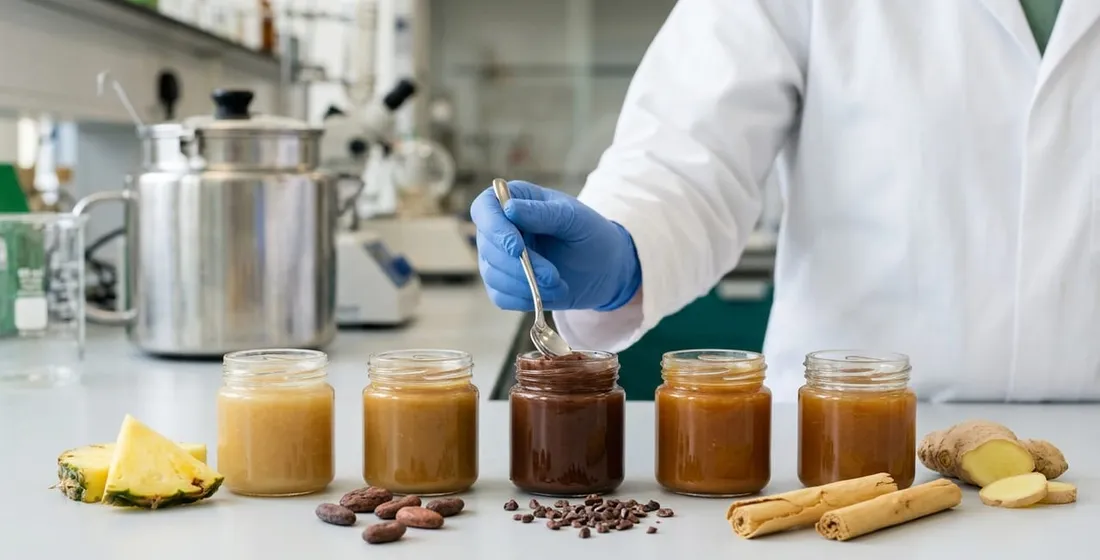
The four novel variants SFC produces, pineapple, cocoa, ginger, and cinnamon, each add a familiar Sri Lankan flavour to the base. The same four-flavour logic runs through other SFC coconut SKUs, including the coconut chips range in the same cocoa, pineapple, cinnamon, and ginger set. A brand owner briefing a jam range is usually building a small coconut portfolio, not a single SKU.
How the R&D team takes each flavour from brief to a locked spec
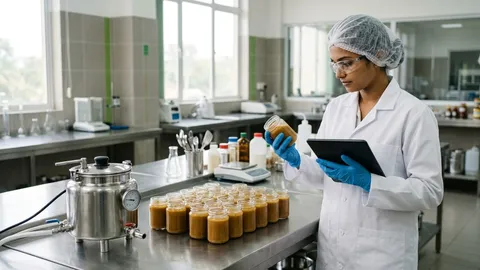
The R&D team at the Matale facility plans for two to four sample iterations per flavour before a recipe locks for contract manufacturing. Most first-brief inquiries arrive with a working home-kitchen version that has never been adjusted for retort temperature, glass-jar headspace, or batch-to-batch consistency at 1,500 units. A flavoured range multiplies that gap by the number of variants, because each addition reacts differently to the same heat step.
The iteration cycle is the same for each variant, run in parallel rather than in series. The team fixes the base coconut jam first, then dials in one flavour at a time against four checkpoints: pH and food-safety margin, colour hold after retort, texture and sediment at rest, and flavour balance at week one versus later in the shelf life. A sample that tastes right on day one but drifts by the twelfth week fails the same as one that separates in the jar. It is the same iteration discipline SFC applies across categories, including the vegan cheese spread R&D cycle.
One local coconut brand briefed all four flavours at once and expected a single sign-off. The pineapple variant alone took three iterations to hold its colour after retort, because the fruit acid kept pushing the batch toward browning. The other three locked faster. Briefing the flavours as four parallel problems, each with its own iteration budget, is what keeps the range on one schedule instead of four.
Service snapshot: R&D and NPD at Silk Foods Ceylon Service: in-house R&D (Co-Development on the SFC brochure) turns a flavour brief into a locked, retort-stable recipe Iterations: typically 2 to 4 sample rounds per flavour before the recipe locks Sample turnaround: iterations run inside the 3 to 4 week R&D window (signed brief to approved formulation); the base recipe is fixed before variants are dialled in Hand-off: once locked, the same semi-liquid line produces the first commercial run under contract manufacturing Cert coverage: BRCGS- and FSSC 22000 V6-audited, with SLSI clearance on every retail SKU |
What actually changes flavour by flavour: pineapple, cocoa, ginger, cinnamon
Each variant carries a distinct R&D risk, and naming those risks upfront is what keeps a four-flavour range on schedule. The table below is the working map the R&D team briefs against.
| Variant | Main R&D challenge | What the team adjusts |
| Pineapple | Fruit acid lowers pH and drives browning and extra moisture; fermentation risk if under-processed | pH and sugar balance, retort schedule, colour hold, fruit form (puree vs concentrate) |
| Cocoa | Cocoa fat and solids separate and sediment; bitterness competes with the coconut sweetness | Emulsion stability, cocoa type and loading, sweetness balance, sediment control at rest |
| Ginger | Pungency is volatile and batch-variable; the heat step can over- or under-express it | Dosing form (fresh vs dried vs extract), heat-step timing, batch-to-batch consistency of the ginger note |
| Cinnamon | Species choice (Ceylon vs cassia), sediment, and a flavour that blooms over shelf life | True Ceylon cinnamon dosing, particle vs infusion, week-one vs later balance |
The cinnamon variant is where the R&D team leans on origin. Sri Lanka’s true Ceylon cinnamon (Cinnamomum verum) is a different species from the cassia that dominates the global cinnamon trade, and the two are not interchangeable in a spread. In a peer-reviewed survey of ground cinnamon, cassia samples carried 2,650 to 7,017 mg of coumarin per kg, while a true cinnamon sample imported from Sri Lanka registered below the limit of detection (The Scientific World Journal, 2012). Germany’s Federal Institute for Risk Assessment sets the tolerable daily intake for coumarin at 0.1 mg per kg of bodyweight (BfR). For a coconut jam eaten by the spoonful, the low-coumarin profile of true Ceylon cinnamon is the safer base, and its flavour is more delicate, which changes the dosing.
What certifications a flavoured coconut jam range needs
A flavoured coconut jam is a packaged food, so the certification floor is the same as any retail SKU: SLSI clearance for shelf eligibility and Sri Lanka Food Act 1980 compliance for the label. The label work grows with the flavours. The cocoa variant can add an allergen line, the ingredient declarations differ per SKU, and each jar carries the tri-lingual product name, net weight, ingredient list in descending order, allergen disclosure, manufacturer name and SLS number, and expiry in the prescribed format. The SLSI submission for a coconut jam is covered in detail in SLSI clearance for a private-label coconut jam.
Above the local floor, the SFC facility is BRCGS- and FSSC 22000 V6-audited, the combination the higher tier of local private-label programmes and any later export step ask for on the manufacturer. The full picture of the certification stack a local manufacturer carries sits alongside SLSI and the Food Act, not in place of them.
MOQ, lead time, and how a four-flavour range schedules
The first-run MOQ for a coconut jam at Silk Foods Ceylon is 1,500 jars per flavour on the 300 g glass-jar format, and the semi-liquid line fills 3,000 jars a day. Because the Matale facility is laid out for cellular manufacturing, all four variants run on one line configuration and one audit, so a brand owner does not re-qualify the manufacturer for each new flavour. The economics of a range look very different from four separate single-SKU launches.
| Item | Figure | Note |
| First-run MOQ per flavour (300 g glass jar) | 1,500 jars | About a half-day production run per SKU |
| Semi-liquid line capacity | 3,000 jars/day | The same line fills all four variants |
| Four-SKU range | 1 audit, 1 line configuration | Cellular manufacturing; no re-audit per flavour |
| Lead time, locked recipe | 2 to 3 weeks | Purchase order to dispatch on an existing formulation |
| Lead time, R&D-first | Roughly 5 to 7 weeks in total | 3 to 4 weeks maximum of R&D (signed brief to approved formulation) ahead of the 2 to 3 week production slot |
| Sample iterations per flavour | 2 to 4 | Before the recipe locks for contract manufacturing |
Lead time is where the R&D-first path shows. A range built on an existing, locked recipe runs two to three weeks from purchase order to dispatch. A range that still needs formulation, which most flavoured jam briefs do, runs roughly five to seven weeks in total, because up to three to four weeks of R&D (signed brief to approved formulation) sits in front of the production slot. A brand owner planning a shelf date works backwards from that window, not from the production date. The same math applies to a private-label coconut spread built for gift-shop and retail channels.
Frequently asked questions
Can Silk Foods Ceylon develop new coconut jam flavours for a local brand?
Yes. The in-house R&D team at the Matale facility develops coconut jam variants (pineapple, cocoa, ginger, cinnamon, or a custom flavour) from a brief, typically across two to four sample iterations before the recipe locks. First-run production is 1,500 jars per flavour on the 300 g glass-jar format.
Why does true Ceylon cinnamon matter in a coconut jam?
Ceylon cinnamon (Cinnamomum verum) carries very low coumarin, unlike cassia, which held 2,650 to 7,017 mg per kg in a peer-reviewed survey (The Scientific World Journal, 2012). For a spread eaten by the spoonful over weeks, the low-coumarin base is the safer and more delicate choice.
What is the MOQ for a private-label coconut jam range?
The first-run MOQ is 1,500 jars per flavour on the 300 g glass-jar format, roughly a half-day run each. Because the Matale facility uses cellular manufacturing, all four variants run on one line configuration and one audit, so a four-SKU range does not multiply the qualification cost.
How long does a flavoured coconut jam range take from brief to first batch?
A range built on a locked recipe runs two to three weeks from purchase order to dispatch. A range that needs formulation, which most flavoured briefs do, runs roughly five to seven weeks in total, because three to four weeks of R&D at most sits ahead of the production slot.
How Silk Foods Ceylon can help
For local FMCG brands building a coconut jam range, Silk Foods Ceylon (SFC) runs an in-house R&D team alongside a 10,000 sq ft cellular-manufacturing facility in Matale, so a four-flavour brief develops and produces on one BRCGS- and FSSC 22000 V6-audited line. The R&D team plans two to four sample iterations per flavour; first-run production is 1,500 jars per SKU on the semi-liquid line that fills 3,000 jars a day. SLSI submission support sits inside the standard engagement, and all four variants run on one audit rather than four separate qualifications.
To brief a coconut jam range, email brands@esilkroute.com.lk or call +94 77 157 7294.
Sources
- EconomyNext (2026), “Sri Lanka coconut export revenue crosses USD 1bn in Jan-Oct last year”, https://economynext.com/sri-lankas-coconut-export-revenue-crosses-usd-1-bn-in-jan-oct-last-year-ministry-255602/ (retrieved 2026-07-01).
- The Morning (2026), “Coconut export growth led by value-added products”, https://www.themorning.lk/articles/Ud3soFY0cgASlaRsvSPk (retrieved 2026-07-01).
- The Scientific World Journal (2012), “Coumarin in Ground Cinnamon Products”, https://pmc.ncbi.nlm.nih.gov/articles/PMC3385612/ (retrieved 2026-07-01).
- German Federal Institute for Risk Assessment (BfR), “FAQ on coumarin in cinnamon and other foods”, https://www.bfr.bund.de/en/service/frequently-asked-questions/topic/faq-on-coumarin-in-cinnamon-and-other-foods/ (retrieved 2026-07-01).
- Further reading: Central Bank of Sri Lanka (2025), “Manufacturing and Services PMI, October 2025”, https://www.cbsl.gov.lk/en/news/sl-pmi-manufacturing-services-october-2025 (retrieved 2026-07-01).
Written by the Silk Foods Ceylon Team. Silk Foods Ceylon (Pvt) Ltd. is a BRCGS- and FSSC 22000 V6-audited contract manufacturer in Matale, Sri Lanka, offering contract manufacturing, private labelling, co-packing, and in-house R&D for local Sri Lankan brand owners, FMCG companies, hotel and restaurant groups, and distributors. To brief a project: brands@esilkroute.com.lk or +94 77 157 7294.