R&D for a Kashaya-Format Herbal SKU: The Ayurveda Registration Track
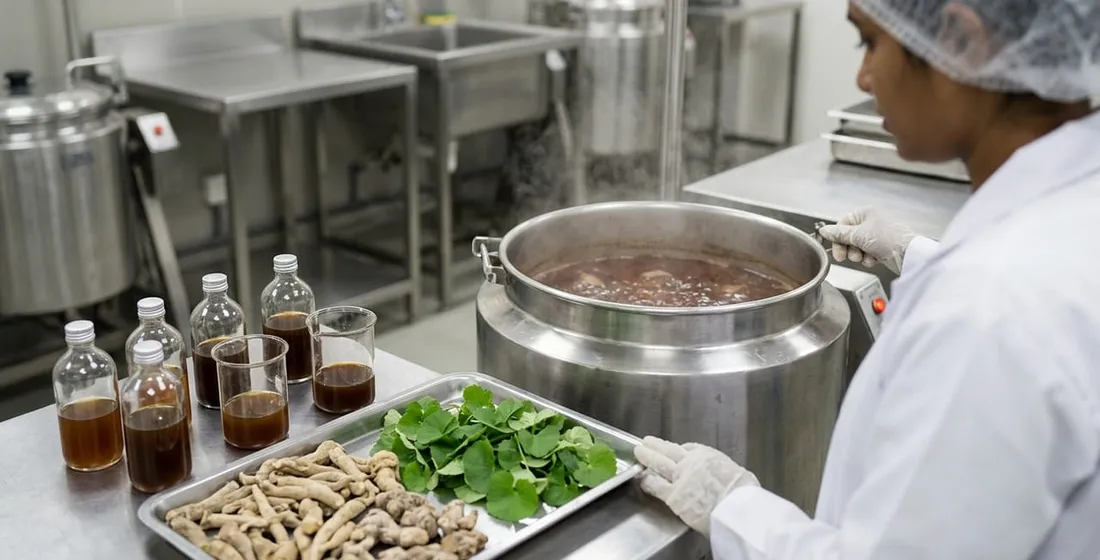
A gloved food-technology worker in a hairnet tends a stainless-steel jacketed kettle simmering a dark herbal decoction, beside a stainless tray of raw ashwagandha root and gotukola leaves and a row of unlabelled glass sample bottles filled with kashaya.
Buyer's snapshot
|
A traditional kashaya is brewed to be finished within a day. A 2019 Sri Lankan pharmacognosy study put a number on that limit: a 24-hour shelf life, after which the decoction’s phytochemical profile starts to shift (Dahanayake et al., Evidence-Based Complementary and Alternative Medicine, 2019). That number is the entire R&D brief for a brand owner who wants the same formulation on a shelf six months from now, not a kitchen counter tomorrow morning.
Silk Foods Ceylon (SFC) runs that reformulation work through its in-house R&D team, at a BRCGS- and FSSC 22000 V6-audited facility in Matale, Sri Lanka. Registration support for any SKU carrying a traditional claim runs alongside it. For a Sri Lankan wellness brand owner, the two workstreams have to move together. Sequencing them, finish the recipe, then submit, then wait, adds months a launch date does not have.
What makes a kashaya-format SKU different from a capsule or a herbal tea?
A kashaya is a water-based decoction, the classical Ayurvedic liquid form. That is distinct from a capsule (encapsulated dried powder) or a herbal tea (a hot-water infusion brewed at point of use). Traditional kashaya is prepared and consumed within 24 hours, per the 2019 Sri Lankan study cited above. A packaged, retail-ready kashaya SKU has to close that shelf-life gap first.
For a Sri Lankan FMCG brand owner, the appeal is real. A wellness brand with an existing ashwagandha or gotukola capsule range often already knows its customer wants the traditional liquid format, not just the capsule. The R&D question is narrower: does the finished product still taste and hold its active compounds the way the classical decoction does, once it has to survive months on a shelf instead of a day in a kitchen?
The Matale R&D team has fielded kashaya-format briefs from three separate local wellness brands over the past two quarters. Each conversation converges on the same tension. The brand wants the traditional decoction’s register, but a home-brewed batch does not survive bottling or a six-month best-before date without a preservative system, a concentration step, or a switch to freeze-dried or spray-dried powder.
Two regulatory tracks apply to a kashaya SKU, and they are not interchangeable
A packaged herbal liquid in Sri Lanka can be positioned as a food product under SLSI and the Sri Lanka Food Act 1980, or as a traditional Ayurvedic product under Department of Ayurveda registration. The Sri Lanka Export Development Board notes that herbal finished products carrying a health or traditional claim need approval from the Drug Formulatory Committee, appointed under the Department of Ayurveda. That approval has to land before the product reaches the local market or an export shipment. The track a brand chooses depends on the label language, not the ingredients.
| Dimension | SLSI + Sri Lanka Food Act track (food positioning) | Department of Ayurveda registration (traditional claim) |
| Governing framework | Sri Lanka Food Act 1980 and SLSI standards | Ayurveda Act and Department of Ayurveda regulations |
| What triggers this track | No therapeutic or traditional-medicine claim on the label | Any Ayurvedic, traditional, or therapeutic claim language |
| Approval body | SLSI | Department of Ayurveda, via the Drug Formulatory Committee |
| Application forms | SLSI product submission | Form A (manufactory) and Form B (product) |
| Typical local review window | 4 to 8 weeks for a stable formulation | Runs in parallel with R&D; budget alongside the SLSI window, not after it |
| Label language allowed | Ingredient, nutrition, and generic wellness descriptors only | Traditional or Ayurvedic claim language, once registered |
Read the fork the way a buyer briefs it. The same kashaya recipe can launch as a wellness beverage under SLSI alone, or as a registered Ayurvedic product carrying traditional claim language, but not both on the same label. Most kashaya-format briefs at Silk Foods Ceylon (SFC) choose the Ayurveda track, since the traditional positioning is usually the reason the format was requested in the first place.
For the food-only track, the SLSI packaged-food submission process sets out the SLSI submission steps in full.
Registering a kashaya product with the Department of Ayurveda
Local Ayurveda drug and product registration runs through the Department of Ayurveda, Ministry of Health. Form A covers the manufacturing facility; Form B covers each individual product, filed in English or Sinhala. Every finished herbal product carrying a therapeutic claim needs sign-off from the Drug Formulatory Committee before it reaches the local market or an export shipment, per the Sri Lanka Export Development Board. For a kashaya SKU, the formulation, the herb sourcing, and the exact claim wording all go into that submission.
The submission asks for more than a recipe. It wants the source of the active herbs, the manufacturing process, and the precise claim language the brand intends to print. The Department prefers own cultivation or a controlled grower system for the herbs, particularly on export-track SKUs. A kashaya blend built around gotukola or ashwagandha needs the claim wording locked before submission, not adjusted afterward: a revised herb ratio or a new claim can trigger resubmission.
A registered kashaya SKU also needs the certification stack a Sri Lankan FMCG launch needs covering the manufacturer side of the audit chain.
How does the R&D cycle run alongside the registration process?
Running formulation R&D and Department of Ayurveda registration in sequence adds months a brand owner does not need to lose: finish the recipe, then submit, then wait. Silk Foods Ceylon (SFC) structures a kashaya-format brief so sample iteration and the registration paperwork start in the same week. The claim language the Department reviews has to match the final formulation regardless of which finishes first.
One local wellness brand brought SFC’s R&D team a kashaya concept built around a family recipe using seven herbs, including gotukola and ashwagandha. The first sample held its colour and aroma for four weeks in cold storage. Then the active compounds began to drift on lab testing, well short of the six-month shelf life a retail SKU needs. Two reformulation rounds later, concentrating the decoction and adjusting the preservation system brought the shelf-stable version in line with the registration submission running in parallel the whole time. Neither the R&D fix nor the paperwork waited on the other.
Service snapshot: R&D / NPD at Silk Foods Ceylon (Co-Development on the SFC brochure) Service: in-house formulation team develops or reformulates a recipe, including adjusting a traditional preparation for retail shelf life Sample iterations: typically 2 to 4 rounds before a kashaya-format recipe locks Sample turnaround: 2 to 4 weeks per iteration First-run MOQ once locked: 1,250 bottles (200 ml glass, beverage-line format) Cert coverage: BRCGS- and FSSC 22000 V6-audited facility, plus SLSI clearance, Sri Lanka Food Act compliance, and Department of Ayurveda registration support for Ayurvedic-claim SKUs |
The claim-language discipline matters more than any single ingredient choice. A brand that reformulates its kashaya blend after the Department has reviewed a different herb ratio risks resubmission. That is the most common delay Silk Foods Ceylon (SFC) sees on Ayurveda-registration SKUs.
What does the R&D and registration timeline look like end to end?
A kashaya SKU that needs both formulation R&D and Department of Ayurveda registration typically runs 6 to 10 weeks from brief to a locked, registered recipe. That is roughly the window Silk Foods Ceylon (SFC) budgets for any private-label SKU that needs new formulation work before its first commercial run. The registration paperwork and the sample iterations run on the same clock, not back to back.
- Weeks 1 to 2: the brief locks, the first kashaya sample is brewed and sent for lab testing, and Form A/B paperwork for the Department of Ayurveda submission begins in parallel.
- Weeks 3 to 6: two to three reformulation rounds address shelf life, concentration, and preservation, while the Drug Formulatory Committee reviews the claim language already filed.
- Weeks 6 to 10: the recipe locks once both the lab results and the registration decision land, and the first commercial run of 1,250 bottles books a line slot.
The two-track approach only works if the claim language submitted in week one survives to the final formulation. Locking the wording early, then testing against it, costs less time than reformulating first and hoping the registration catches up.
The claim-language discipline mirrors the wellness-claim labelling fork other herbal SKUs run into, where the same fork between a factual descriptor and a regulated therapeutic claim decides the registration track.
Kashaya, freeze-dried powder, or capsule: choosing the retail format
Sri Lankan researchers compared a traditional kashaya decoction against freeze-dried, spray-dried, and semi-solid ganasara reformulations. The freeze-dried version held a phytochemical profile and antioxidant activity closest to the fresh decoction (Dahanayake et al., 2019). For a brand owner, the finding reframes the choice: a bottled liquid kashaya is not the only way to keep the traditional format’s character on a shelf.
A ready-to-use liquid kashaya in a 200 ml glass bottle keeps the traditional consumption format a customer recognises, at the cost of a preservation system and cold-chain sensitivity. A freeze-dried or spray-dried kashaya powder, reconstituted at home, extends shelf life further and runs on the same capsule-adjacent production line Silk Foods Ceylon already runs for a 180-bottle capsule MOQ. The trade-off is asking the customer to prepare it rather than drink it straight from the bottle. Most first-time kashaya briefs at SFC start with the liquid format and keep the powder route as the fallback if shelf-life testing does not clear a commercial threshold.
Once the formulation and the Ayurveda registration both lock, production moves from R&D to Contract Manufacturing at the same Matale facility, on the same cert stack, without a second audit. A brand that already runs a private-label Ayurvedic capsule SKU on the SLSI and Ayurveda registration parallel track typically adds the kashaya SKU to the same production block. That means drawing on the same herb sourcing and traceability discipline the capsule range already uses, rather than opening a separate manufacturer relationship.
Frequently asked questions
Can Silk Foods Ceylon develop a kashaya-format recipe from scratch?
Yes. The in-house R&D team at the Matale facility takes a brief, whether it starts from a family recipe or a new formulation. It runs 2 to 4 sample iterations to solve shelf life, concentration, and preservation before locking the recipe. Sample turnaround runs 2 to 4 weeks per iteration.
Does a kashaya SKU need Department of Ayurveda registration?
Only if the label carries a traditional or therapeutic claim. A kashaya-style beverage sold on ingredient and wellness descriptors alone can go to market under SLSI and Sri Lanka Food Act compliance. Any product using Ayurvedic or traditional-medicine claim language needs registration through the Department of Ayurveda’s Drug Formulatory Committee first.
How long does Department of Ayurveda registration take alongside R&D?
Silk Foods Ceylon typically budgets 6 to 10 weeks from brief to a locked, registered recipe when formulation R&D and Ayurveda registration run in parallel, similar to the window budgeted for any private-label SKU that needs new formulation work.
What is the first-run MOQ for a bottled kashaya SKU?
Once a kashaya recipe is locked and registered, the first commercial run at Silk Foods Ceylon starts at 1,250 bottles in 200 ml glass, the same beverage-line MOQ used for other liquid formats at the Matale facility.
Can a kashaya formula be sold as a powder instead of a liquid?
Yes. Freeze-dried or spray-dried kashaya powder extends shelf life beyond the bottled liquid format and can run on the same capsule-adjacent production line. A 2019 Sri Lankan study found the freeze-dried version retained a phytochemical profile closest to the fresh decoction among the reformulation methods tested.
How Silk Foods Ceylon can help
For a Sri Lankan brand owner developing a kashaya-format herbal SKU, Silk Foods Ceylon (SFC) runs formulation R&D and Department of Ayurveda registration support in parallel through its in-house R&D team at the Matale facility. Sample iterations typically turn in 2 to 4 weeks each, with 2 to 4 rounds standard before a kashaya recipe locks. A first commercial run starts at 1,250 bottles in 200 ml glass once the formulation and the registration both clear. The Matale facility is BRCGS- and FSSC 22000 V6-audited, with SLSI clearance, Sri Lanka Food Act compliance, and Department of Ayurveda registration support built into the engagement.
To brief a project, email b2b@esilkroute.com.lk or call +94 76 441 0389 / +94 76 918 5744.
Sources
- Department of Ayurveda, Ministry of Health (2026), “Regulation of Local Ayurveda Drugs/Products Registration”, https://ayurveda.gov.lk/docs/regulation-of-local-ayurveda-drugs-products-registration/ (retrieved 2026-07-13).
- Sri Lanka Export Development Board, “Ayurvedic and Herbal Products in Sri Lanka: Overview”, https://www.srilankabusiness.com/ayurvedic-and-herbal/overview.html (retrieved 2026-07-13).
- Newswire.lk (2025), “Sri Lanka Ayurvedic Drugs Corporation launches 7 new products”, https://www.newswire.lk/2025/12/31/sri-lanka-ayurvedic-drugs-corporation-launches-7-new-products/ (retrieved 2026-07-13).
- Dahanayake, J.M., Perera, P.K., Galappatty, P., Perera, H.D.S.M. and Arawwawala, L.D.A.M. (2019), “Comparative Phytochemical Analysis and Antioxidant Activities of Tamalakyadi Decoction with Its Modified Dosage Forms”, Evidence-Based Complementary and Alternative Medicine, PMC6521515, https://pmc.ncbi.nlm.nih.gov/articles/PMC6521515/ (retrieved 2026-07-13).
- Sri Lanka Standards Institution / Department of Commerce, “Obtain License to Use SLS Mark”, https://stepbysteptrade.lk/procedure/70?l=en (retrieved 2026-07-13).
Written by the Silk Foods Ceylon Team. Silk Foods Ceylon (Pvt) Ltd. is a BRCGS- and FSSC 22000 V6-audited contract manufacturer in Matale, Sri Lanka, offering contract manufacturing, private labelling, co-packing, and in-house R&D for local Sri Lankan brand owners, FMCG companies, hotel and restaurant groups, and distributors. To brief a project: b2b@esilkroute.com.lk, +94 76 441 0389, or +94 76 918 5744.