What a Shelf-Life File Holds Before a Product Can Carry a Date
By the Silk Foods Ceylon Editorial Team
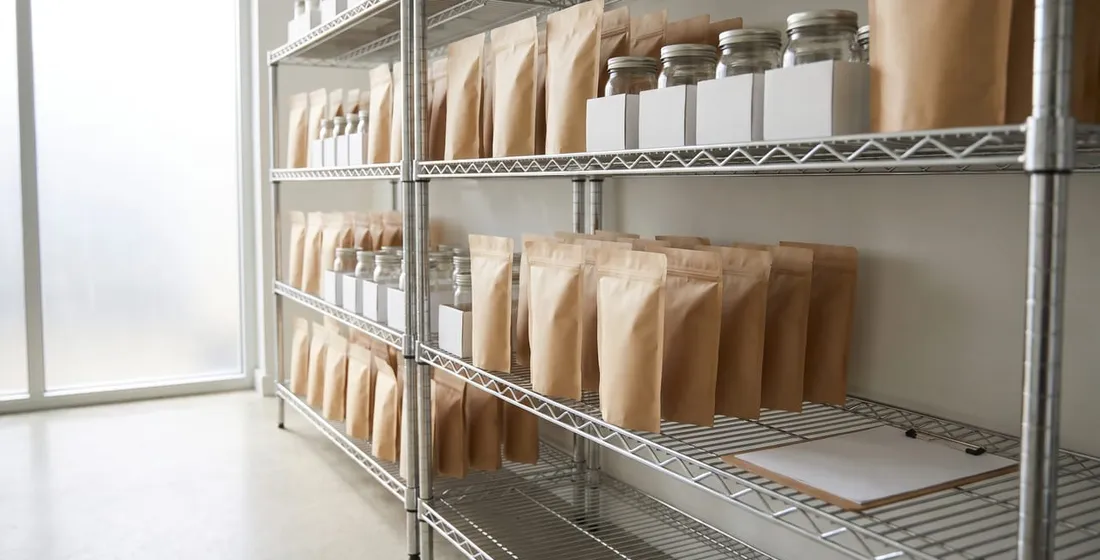
Wire shelving in a bright quality-control room holding batches of blank kraft pouches and glass jars, separated by white cards, with a blank clipboard on a lower shelf.
Buyer’s snapshot
- Since 1 July 2026 a packaged food sold in Sri Lanka must carry a numerical date of expiry, written as Expiry, Use before, Use by or Best Before, and selling it past that date is prohibited (Food (Labelling and Advertising) Regulations 2026, regulation 5).
- The regulations set how the date is printed. They do not say how it is worked out, so the proof sits in a file kept by the brand owner.
- Seven records make up a file a buyer, an auditor or an inspector can read without phoning anyone: pack description, storage statement, protocol, sample record, result sheets, deviation log and a signed conclusion.
- Silk Foods Ceylon (SFC) scopes the study inside R&D (3 to 4 weeks at most, signed brief to approved formulation), so the file exists before the artwork is printed.
A first-run brand owner usually thinks of shelf life as a number: 12 months, 18 months, whatever the competitor prints. Behind that number there is supposed to be a folder. When a buyer or an inspector asks how the date was set, the folder is the answer. Without it, the number is an opinion.
Silk Foods Ceylon (SFC) manufactures packaged food at Matale for Sri Lankan brand owners, and this post covers what that folder contains. The choice between real-time and accelerated storage is in shelf-life and accelerated stability testing for a Sri Lankan SKU. This post starts where the study ends: which records exist, who signs, and how a result becomes the printed date.
What is a shelf-life file, and who asks to see it?
A shelf-life file is the set of records that shows how a printed date was derived: what was tested, under which storage conditions, what was measured, and who decided the date. It sits beside the product specification and the label artwork. Retail buyers read it when a listing depends on residual life at delivery, auditors read it as part of a food-safety system, and an inspector may read it after a complaint, because under regulation 5(4) of the 2026 labelling regulations no person may sell, offer for sale, expose, keep for sale or transport for sale any food after its date of expiry. The date is a legal position, and the file is how a brand owner defends it.
The Food and Drink Federation’s guidance on setting shelf life describes a sequence: agree the recipe and storage conditions, identify what makes the food unpalatable or unsafe, predict its life, design the test regime, test, set the date, then reassess routinely or after an ingredient or process change (Food and Drink Federation, 2017). Each step in that chain leaves a record, and the records together are the file.
Which seven records make up the file?
Seven, in the order they are created. Each answers one question a reader will ask, and a gap in any of them is where a reviewer pushes.
| Record | What it holds | The question it answers |
|---|---|---|
| 1. Product and pack description | Recipe version, ingredient suppliers, pack material, closure, liner, fill and headspace | What exactly was tested? |
| 2. Storage statement | Ambient, chilled or frozen, any humidity or light limit, and the distribution conditions assumed | Under what conditions does the date hold? |
| 3. Study protocol | Predicted life, pull points, parameters, pass and fail limits, written before the first pull | What counted as a pass, and was that decided in advance? |
| 4. Sample record | Batch numbers, production dates, line used, how samples were drawn across the run, where retained | Was the tested product the product that will be sold? |
| 5. Result sheets | Each pull: laboratory, method, date, raw values, sensory notes | What did the product actually do? |
| 6. Deviation log | Missed pulls, temperature excursions, retests, and what was decided about each | What went wrong, and was it handled in the open? |
| 7. Signed conclusion | Tested period, the date chosen, date type, storage wording for the label, name and date of the decision | Who decided, on what evidence, and when? |
The protocol is written before the results exist, and pass limits stated in advance are worth more than a conclusion that explains them afterwards. Industry guidance also says to make the test batch in exactly the same manner and on the same equipment as normal production, and to sample throughout a long run, which is what record 4 proves (Food and Drink Federation, 2017).
The shelf-life file is one folder inside the wider set described in what a food maker keeps before launch.
How does the result become the printed date?
Through a decision recorded in record 7, not through a calculation. The last pull that passed is evidence of how long the product lasted in the study. It is not automatically the date the pack carries. The date printed has to survive warehouses, trucks and shop shelves the brand does not control, and the FDF guidance says plainly to allow for abuse that may occur when the product is out of the producer’s hands, and not to assume the food will be kept in perfect conditions after it leaves the factory (Food and Drink Federation, 2017).
So a sound conclusion states four things. The period tested. The date chosen, and the reasoning for any gap between the two. The type of date. And the storage wording that goes on the label.
The type of date follows the failure mode. The Codex general standard defines the date of minimum durability, “best before”, as the end of the period under stated storage conditions during which the product stays fully marketable and keeps the qualities claimed for it, adding that the food may still be perfectly satisfactory after it. A use-by date carries a harder meaning: after it, the food should not be regarded as marketable (Codex Alimentarius, CXS 1-1985). A shelf-stable dry product that fades in flavour or colour fits best before. A product where safety is the limit fits use by. The Sri Lankan regulations accept either wording, so the file, not the printer, decides which.
Codex also says the label must carry any special storage conditions if the validity of the date depends on them (CXS 1-1985, section 4.7). That is why record 2 exists. If the study held the pack at ambient room temperature and the label says nothing, the date is claiming more than the file proved.
One detail catches teams in the last week. Where only a month and year are printed as the date of expiry, the regulations deem it to be the last day of that month. A “Best Before 03/2027” pack is therefore dated 31 March 2027, so the file should count to that day and not to the first (Government of Sri Lanka, Gazette 2494/47, 2026). The label rules themselves are laid out in Sri Lanka’s 2026 food labelling regulations.
What does the file look like at each stage of a first project?
It grows in four steps, each adding records and replacing none.
- Brief and formulation. Records 1 and 2 are drafted, because the pack and the storage claim are choices made with the recipe. At SFC this sits inside the R&D window of 3 to 4 weeks at most.
- Trial batch. Record 3, the protocol, is fixed. Record 4 starts: the trial batch is made on the line that will make the commercial one, and samples are drawn and retained.
- Study. Records 5 and 6 fill in as each pull is tested. If an early read is needed for a listing conversation, a provisional date can be recorded, labelled as provisional, until the full-term result lands.
- Release and verification. Record 7 is signed. After launch, industry guidance says to schedule end-of-life safety and quality testing routinely, even when nothing has changed, because variation in ingredients or the supply chain can shift the result without anyone noticing (Food and Drink Federation, 2017).
A chilled product carries a different record 2 and different limits from an ambient one, as covered in chilled or ambient: how shelf life shapes the format.
When does the file have to be reopened?
When anything it describes changes. The Irish food safety authority says laboratory work to set a shelf life should not need repeating unless the food or its production process is modified or changed (Food Safety Authority of Ireland, page retrieved 2026). The part brand owners miss is the reverse: once the food or process does change, the file stops covering the product.
The triggers are specific, and they are worth writing into record 7 so the next reader sees them:
- A new ingredient, a changed ingredient supplier, or a changed grade of an existing one.
- A different pack: film, jar, closure, liner or fill weight.
- A process change: a different cook, dry, fill or seal step.
- A longer claim, or a move from ambient to a warmer or more humid distribution route.
A planning scenario shows how this plays out. Suppose a brand owner has a file for a stand-up pouch of a dry snack, tested in one laminate. Six months in, a supplier shortage makes the packer offer a second laminate of the same thickness. The two films look alike, but nothing in the file says the second blocks moisture or oxygen as well. The file covers pouch A, so the same date on pouch B is a new claim with no evidence behind it. The honest options are a short bridging study on the new film, or a shorter date until one is done.
What should a brief say about the file?
Four lines in the brief settle most arguments later, at any manufacturer.
- The date you intend to claim, and whether any artwork is already printed with it.
- The pack that will be sold, with closure, liner and film specified, since the file covers the pack and not the product alone.
- The conditions the pack will meet, stated as ambient, chilled or frozen, with any air-conditioned assumption declared.
- Who keeps the file, where it is stored and who signs record 7.
Where SFC walks away: a brief that asks for a date to be printed before any study has been planned, or one that copies the date from a similar product on a competitor’s shelf. Industry guidance lists copying a similar product’s shelf life as something not to do, and a copied date gives the brand a printed claim with no file behind it. That is a conversation to have before the first batch, not after.
Frequently asked questions
What is a shelf-life file for a packaged food?
It is the set of records that shows how the printed date was derived: the pack and recipe tested, the storage conditions, the protocol, the samples, the results, any deviations and a signed conclusion. Industry guidance sets the steps in order, and each step leaves a record (Food and Drink Federation, 2017). The file is what a buyer or inspector reads.
Can a first-run brand copy a competitor’s best-before date?
No. Industry guidance lists copying the shelf life assigned to a similar product as a mistake, because a different recipe, pack or process changes how long the food lasts (Food and Drink Federation, 2017). In Sri Lanka the date is also a legal limit: selling past it is prohibited under regulation 5(4) of the 2026 labelling regulations.
Do I need to retest after the product is on sale?
Not to repeat the original work, unless the food or its process changes (Food Safety Authority of Ireland, page retrieved 2026). Industry guidance still advises scheduling routine end-of-life testing after launch, because small changes in ingredients or the supply chain can move the result. Record each check in the file so the conclusion stays current.
Does Silk Foods Ceylon set up the shelf-life file inside a contract manufacturing project?
Yes. Silk Foods Ceylon (SFC) scopes the study inside R&D, which takes 3 to 4 weeks at most from signed brief to approved formulation, so the protocol and the pack description exist before artwork is printed. The brief states which tests a laboratory runs. Small runs are welcome, quote on request.
How Silk Foods Ceylon can help
For founders and first-run brand owners, Silk Foods Ceylon (SFC) runs formulation, the shelf-life study scope and the first commercial batch inside one project at its Matale facility, so the date on the label rests on a file and not on a guess. Formulation takes 3 to 4 weeks at most from signed brief to approved formulation, and an existing recipe typically reaches a first PO in 2 to 4 weeks. Small first runs are welcome and quoted on request. The facility is BRCGS- and FSSC 22000 V6-audited, with SLSI submission support and Sri Lanka Food Act labelling compliance built into a standard engagement.
To brief a project, email b2b@esilkroute.com.lk or call +94 77 157 7294.
Sources
- Government of Sri Lanka (2026), Extraordinary Gazette No. 2494/47 of 26 June 2026, Food (Labelling and Advertising) Regulations 2026, regulation 5 on date of expiry and the sale prohibition, and the month-and-year rule. eohfs.health.gov.lk (retrieved 6 November 2026).
- Codex Alimentarius Commission, CXS 1-1985, General Standard for the Labelling of Prepackaged Foods, definitions of date of minimum durability and use-by date, and section 4.7 on storage conditions. fao.org (retrieved 6 November 2026).
- Food and Drink Federation (2017), Industry Guidance on Setting Product Shelf-Life, Version 1, on the test sequence, abuse allowance, representative production and routine reassessment. fdf.org.uk (retrieved 6 November 2026).
- Food Safety Authority of Ireland, Shelf-life Determination, on repeating laboratory work only when the food or process changes. fsai.ie (retrieved 6 November 2026).