Glass Jar, Retort Pouch or Bottle for a First Retail SKU
By the Silk Foods Ceylon Editorial Team
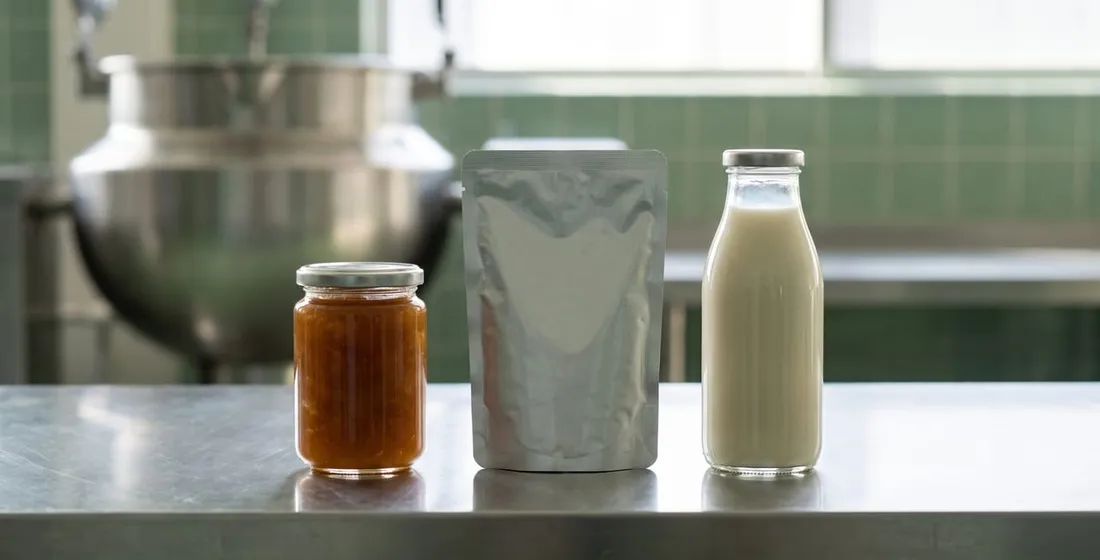
A stainless steel inspection table in a packing hall, with one plain glass jar of golden fruit spread, one silver retort pouch of cooked sauce and one clear glass bottle of pale plant milk, all unlabelled.
Buyer’s snapshot
- The pack is chosen before the recipe is finished, because it sets the heat process, the freight bill, the label area and how many supplier lines sit behind your quote.
- In a 2021 retort study, the same product reached sterilisation value in 62 minutes in pouches and 67 minutes in glass jars (FAO AGRIS, 2021).
- Silk Foods Ceylon (SFC) fills glass jars, glass bottles and retort-processed packs at Matale. Small runs are welcome, quote on request, in every format.
- The table below compares the three packs on process, freight, shelf presence and failure points.
A founder with a tested sauce, spread or plant milk usually asks a contract manufacturer one question first: what will it cost per unit? The honest answer starts one step earlier. Cost per unit depends on the pack, and the pack depends on how the product is made safe, how it travels and where it will sit on a shelf.
This guide is for a brand choosing the pack for its first retail SKU. It compares a glass jar, a retort pouch and a glass bottle on the decisions that move a quote. It does not cover capsules, sachets or kraft pouches for dry goods, which are handled in minimum order quantity by format: capsule, pouch and sachet.
What does the pack decide before the recipe is final?
The pack decides the heat process, because a low-acid food in a sealed container has to be processed at a time and temperature proven for that exact container. University of British Columbia course notes describe the retort pouch as a plastic and aluminium laminate that heats faster than a glass bottle or metal can, so the same safety target is reached in less time (University of British Columbia, FNH 200).
That is why a recipe cannot simply be poured into a different pack late in the project. A change of pack means a change of process, and a changed process can change texture, colour and flavour. It also reopens the shelf-life question.
Three things follow from the pack choice, and each shows up in the quote:
- The heat process, including how long each batch occupies the retort.
- The packaging components: jar and lid, pouch and outer carton, bottle and cap, plus the labels each needs.
- The freight and breakage allowance between the factory and the shelf.
The retort stage is worth a closer look, because it is where the formats differ most. The related post on retort cycle time for a 300 g curry pouch walks through one pouch format in detail.
How do glass and pouch behave in the retort?
Pouches heat through faster and glass heats through slower. A 2021 case study in a steam-air retort measured a come-up time of 24 minutes with pouches and 28 minutes with glass jars, and a holding phase of 62 minutes against 67 minutes to reach the same sterilisation value. The authors called the 9-minute overall gap significant in commercial processing (FAO AGRIS, 2021).
Glass brings its own handling rules. The same course notes say filled glass must go through the retort with extra care to avoid breakage from thermal shock, and must be packed with extra protection in transport because it is heavy and fragile (University of British Columbia, FNH 200). A pouch has the opposite weakness: it needs an outer carton so it is not punctured in handling.
Here is the part that surprises first-time buyers. Faster processing does not make a pouch automatically cheaper. The study’s authors stress that each packaging material, stacking method and product changes the sterilisation thermodynamics, so a heat-penetration study is needed for each combination (FAO AGRIS, 2021). The time saved on paper is only real once that work is done for your product.
Which pack suits which product?
Match the pack to the product’s texture and the shelf it will sit on. Spreads, chutneys, pickles and jams suit glass jars, because a wide mouth lets a spoon in and the buyer can see the contents. Pourable drinks and oils suit glass bottles. Cooked sauces and ready meals suit pouches, because they heat through quickly and ship light.
SFC’s catalogue covers all three. Glass jars run from 50 ml to 1 L, including 220 ml, 330 ml and 500 ml sizes. Glass bottles run on the beverage line at 200 ml. The retort at the Matale facility handles shelf-stable bottled and pouched goods.
| Factor | Glass jar | Retort pouch | Glass bottle |
|---|---|---|---|
| Best for | Spreads, chutneys, pickles, jams | Cooked sauces, curries, ready meals | Plant milks, juices, oils, syrups |
| Heat process | Slower heat penetration; careful retort loading for thermal shock | Faster heat penetration; pouch stacking has to be validated | Same glass rules as a jar; headspace and cap seal matter |
| Freight and handling | Heavy and fragile; needs divided cartons | Light; needs an outer carton against punctures | Heavy and fragile; needs divided cartons |
| Shelf presence | Visible product, reusable look | Large flat print area, less rigid on a shelf | Visible product, suits chilled or ambient fixtures |
| Main failure point | Lid seal and glass breakage | Seal integrity and punctures | Cap seal and glass breakage |
| Components in the quote | Jar, lid, label, divided carton | Pouch, outer carton, label or print | Bottle, cap, label, divided carton |
For a deeper look at one glass format, see private-label vegan mayonnaise in a glass jar. For the bottle line, see contract manufacturing a vegan plant milk on a glass bottle line.
How does the pack change shelf life?
The pack sets the barrier and the process sets the safety, but only a shelf-life study settles the date on the label. Published comparisons of pack types give wide, vendor-dependent ranges, and none of them replaces testing the actual product in the actual pack. Treat any quoted months for a format as a starting hypothesis, not a promise.
Shelf life also depends on formulation, fill, the sterilisation conditions and storage. A tomato-based sauce, a coconut-based spread and a plant milk age differently in the same jar. The method for setting a date is covered in accelerated stability testing for a shelf-life claim, and the choice between chilled and ambient is in chilled or ambient: shelf life and retail fixture by format.
One practical rule for a first SKU: pick the pack, run the study in that pack, and print the date only after the study. A founder who prints a date borrowed from a competitor’s jar carries the risk of a product the study never covered.
What moves the cost per unit?
Cost per unit is the sum of the product, the pack, the process and the freight, and the pack touches three of the four. This guide gives no price per format, because a figure without your recipe, size and quantity would mislead. It shows instead which lines move, so the quote can be read.
Glass adds weight, which raises freight, and adds a breakage allowance that sits inside the landed cost. A pouch lowers weight but adds an outer carton and the validation work. A bottle adds a capping step and a cap component. Components arrive from outside suppliers, and supplier minimums for jars, lids and pouch film often set the practical size of a first run before the factory line does.
That is why SFC quotes a first run per project and does not publish a minimum. Small runs are welcome, quote on request. The levers that bring a quote down are set out in four levers that lower a co-manufacturing quote.
What a buyer can do to keep the quote honest
- Fix the pack format and size before asking for a price, and ask for the same quote on a second format to see the difference.
- Ask which pack components are bought in and which come from the factory’s stock.
- Ask whether a heat-penetration study is already done for that pack, or has to be added to the project.
- Agree the carton plan: divided cartons for glass, an outer carton for pouches.
What does the label need on each pack?
Every retail pack needs the same legal minimum, and the pack decides how easily it fits. The Food (Labelling and Advertising) Regulations 2026, gazetted by the Government of Sri Lanka, require net contents in SI units, grams or kilograms for solids and millilitres or litres for liquids (Government of Sri Lanka, Gazette 2494/47, 2026). Check the current gazette for the full list of mandatory items.
A flat pouch gives the widest print face. A small jar or a 200 ml bottle gives less room, so the mandatory text, the ingredient list and the brand compete for the same area. A buyer who has seen the pack in hand, with draft label text on it, finds problems before artwork is paid for. The artwork timeline is covered in marketplace-ready food SKU packaging.
A scenario to plan for: the sample round that changes the pack
Picture a brand that arrives with a sauce it sells from a home kitchen, and has planned a glass jar for shelf appeal. The first sample round shows the sauce thins at the process temperature. The R&D team then runs the same sauce in a pouch, where the faster heat-through can let the texture hold. The brand moves to the pouch for its first run and keeps the jar for a later, thicker product.
The lesson is not that pouches win. It is that the pack was a result of the sample round and not an input to it. A brand that treats the first sample as a pack test as well as a taste test saves a second round later.
How to decide in four questions
- Is the product thick enough to hold in a spoon, or does it pour? Thick leans jar, pourable leans bottle or pouch.
- Where does it sell first? A rigid, visible pack suits a gift or specialty shelf; a light pack suits online orders and long freight.
- How much breakage can the margin carry? If the answer is little, glass needs a firm carton plan.
- What does the heat study say? The pack that holds texture and colour at the process temperature is usually the pack to use.
Where SFC walks away: a brand that wants a shelf-stable date printed before any study has run. That date would be borrowed from someone else’s product, and SFC will not put it on a label.
Frequently asked questions
Is a retort pouch cheaper than a glass jar?
Not automatically. A pouch weighs less and heats faster, with a 62-minute hold against 67 minutes for jars in one 2021 study (FAO AGRIS, 2021), but it adds an outer carton and a validation study. The cheaper pack is the one whose full quote, including freight and breakage, is lower for your product.
Can I change the pack after the first sample?
You can, but the heat process changes with it. Each packaging material, stacking method and product combination needs its own heat-penetration study (FAO AGRIS, 2021). A change after approval usually means a new sample and a new shelf-life study, so decide before the sample is signed off.
How is shelf life set for a new pack?
By testing the product in that pack. Format ranges quoted by suppliers vary widely and do not account for your formulation. A study in the chosen pack, followed by a date on the label, is the sound order of work, and the factory can plan the study into the project timeline.
Does Silk Foods Ceylon run glass jars, bottles and retort pouches for a first retail SKU?
Yes. Silk Foods Ceylon offers Contract Manufacturing at its Matale facility across glass jars from 50 ml to 1 L, 200 ml glass bottles and retort-processed packs. Small runs are welcome, quote on request. In-house R&D, at 3 to 4 weeks at most from signed brief to approved formulation, can test the product in more than one pack.
How Silk Foods Ceylon can help
For founders choosing the pack for a first retail SKU, Silk Foods Ceylon (SFC) runs the product through the options at its Matale facility: glass jars, 200 ml glass bottles and retort-processed packs on a cellular-manufacturing floor. Small first runs are welcome and quoted on request. If a recipe needs reworking for a pack, in-house R&D takes 3 to 4 weeks at most from signed brief to approved formulation, and an existing recipe typically reaches a first PO in 2 to 4 weeks. The facility is BRCGS- and FSSC 22000 V6-audited, with SLSI clearance and Sri Lanka Food Act compliance support for every retail SKU.
To brief a project, email b2b@esilkroute.com.lk or call +94 77 157 7294.
Sources
- FAO AGRIS (2021), “A Case-study: Temperature Distribution and Heat Penetration in Steam-air Retort, Using Glass Jars and Retort Pouches”, on come-up time, holding time and the need for a heat-penetration study per pack. agris.fao.org (retrieved 2 November 2026).
- University of British Columbia, FNH 200, “6.8 Material Used for Packing Thermally Processed Foods”, on glass jars, retortable pouches and thermal shock. wiki.ubc.ca (retrieved 2 November 2026).
- Government of Sri Lanka (2026), Extraordinary Gazette No. 2494/47, Food (Labelling and Advertising) Regulations 2026, on net contents in SI units. documents.gov.lk (retrieved 2 November 2026).
Written by the Silk Foods Ceylon Team. Silk Foods Ceylon (Pvt) Ltd. is a BRCGS- and FSSC 22000 V6-audited contract manufacturer in Matale, Sri Lanka, offering contract manufacturing, private labelling, co-packing, and in-house R&D for local Sri Lankan brand owners, FMCG companies, hotel and restaurant groups, and distributors. To brief a project: b2b@esilkroute.com.lk or +94 77 157 7294.