Retort Cycle Time and Daily Output: A 300 g Curry Pouch Spec
By the Silk Foods Ceylon Team
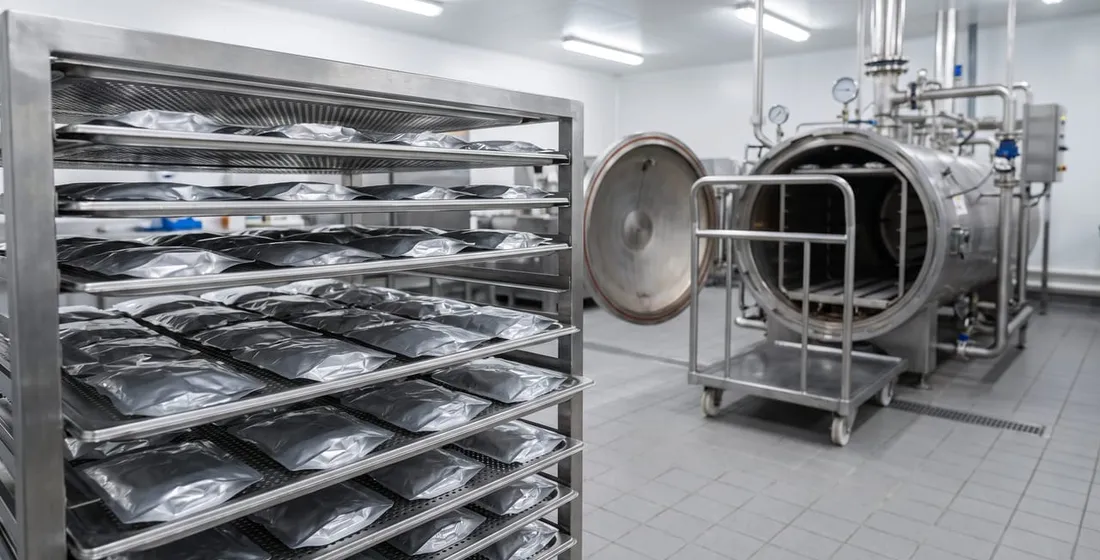
A loading rack of blank silver foil retort pouches laid flat on perforated stainless steel trays, beside an open horizontal retort vessel and an empty loading trolley on a clean tiled floor.
Buyer’s snapshot
- Canada’s food inspection guidance defines come-up time and process time separately, and a retort run is only as short as the sum of its phases plus loading and cooling.
- In this planning scenario, 1,500 curry pouches take between 10 and 26 hours of retort time, depending on how many pouches a validated load holds and how long one cycle runs.
- Silk Foods Ceylon (SFC) treats load size and cycle length as spec items, not details to settle after the quote.
- The throughput table and the buyer’s checklist are the two sections to take into a briefing.
A retort vessel that completes one cycle every 90 minutes can finish at most 16 loads in 24 hours, and the real figure is lower once loading, unloading and cooling water are counted. For a 300 g heat-and-eat curry pouch, that one number decides how many pouches clear the machine in a day more firmly than the filling speed does.
The earlier retort scenario for a 300 g jackfruit curry pouch covered the R&D side: the F0 target, the solids share and the 16-week plan from brief to released stock. This post is the production-side spec sheet for the same pouch. It sets out which format factors are fixed, how the cycle is built, and what that does to daily output for a local FMCG mid-tier brand planning a first run.
A note on method. The pouch dimensions, load sizes and cycle times below are planning figures that show how the arithmetic works. They are not the rated capacity of any vessel, and they are not a quote. The definitions, standards and regulations cited are real.
What does a 300 g curry pouch spec fix before anyone books a retort?
Seven items, and they are fixed before heat testing, because each one changes either the process or the load. The table lists them with the effect each has on throughput.
| Spec item | Scenario value | Effect on daily output |
|---|---|---|
| Net content | 300 g, declared in g | Sets fill volume per pouch |
| Maximum filled thickness | 20 mm, laid flat | Sets how fast the centre heats, so the hold time |
| Solids share | 165 g minimum per pouch | Slows heat penetration as it rises |
| Pouch structure | Four-layer foil laminate | Sets the retort temperature the film is rated for |
| Process target | F0 of 6 minutes at the slowest point | Sets the hold time at temperature |
| Load pattern | Pouches per tray, trays per load, fixed at validation | Sets pouches per cycle |
| Cooling method | Water cooling with overpressure | Sets the tail of the cycle |
The 2026 labelling regulations require net contents in g for a solid or semi-solid pack. The fill target sits above 300 g by a tolerance the plant’s QA lead sets against that label claim, and the reasoning on drained weight is in the earlier scenario post.
How is a retort cycle built, and which parts are fixed?
A cycle has five phases, and only two of them belong to the scheduled process. Loading and unloading belong to the plant. Come-up and hold belong to the process authority. Cooling sits in between and carries a safety job as well as a speed job.
- Loading: filled, sealed pouches go onto trays in the validated pattern.
- Come-up: heating until the retort reaches process temperature. The Canadian Food Inspection Agency’s heat-penetration guidance defines this as the time from the start of heating until the retort reaches processing temperature.
- Process time: the period from the end of come-up to the end of heating. This is where the lethality is delivered.
- Cooling: a 2024 review in Food Science and Nutrition (Jimenez et al.) lists a come-down stage after the hold and notes that cooling can burst pouches, which is why overpressure air is applied during cooling.
- Unloading and staging for the incubation hold.
The same review gives a typical retort range of about 115 to 121 °C at 15 to 20 psi above atmospheric. A scheduled process lives inside that range, and the film has to be rated for it. A pouch that bursts costs the whole tray, so the cooling profile stays inside what the validated schedule allows.
How does pouch thickness change the cycle?
Directly. Thickness is the one format factor that moves the hold time most. The Canadian guidance says the maximum thickness of a flexible package is directly related to the cold-spot temperature history, that thicker packages heat more slowly, and that studies should be carried out at the maximum specified package thickness.
For a buyer, that wording has two consequences.
First, the thickness limit on the spec sheet is a ceiling the production line has to hold on every fill. A pouch that comes off the filler at 24 mm when the study ran at 20 mm is outside the validated process, whatever the cycle clock says.
Second, a thin, flat pouch is a throughput asset. NIFTEM, India’s national food technology institute, reports in training material uploaded in 2022 that the thin pouch profile reduces processing times by about 30 to 40 per cent against rigid containers. The Jimenez review adds that agitating retorts can cut processing time by up to 27 per cent against static ones. Whether a given vessel agitates is a question for the quote stage, not an assumption.
Spec snapshot: scenario 300 g curry pouch, production view
- Pack: 300 g net, four-layer foil retort pouch, 20 mm maximum filled thickness
- Process: F0 of 6 minutes, scheduled and signed by a qualified process authority
- Load: one validated pattern of pouches per tray and trays per load, laid flat
- Cycle phases to quote: load, come-up, process time, cooling, unload
- First run planning figure: 1,500 pouches, about 450 kg of finished product
- Held after the run: incubation of production samples before release
How many pouches clear the machine in a day?
Daily output is pouches per load multiplied by loads per day. Loads per day is the available retort time divided by the full cycle, rounded down, because a half cycle does not finish a load.
On one vessel and one eight-hour shift, a 90 minute cycle gives five loads (480 divided by 90 is 5.3). At 150 pouches per load, that is 750 pouches, or 225 kg of curry, in a shift. The first-run planning figure of 1,500 pouches then needs ten loads, which is 15 hours of retort time on a single vessel.
The table shows how far that moves when only the two variables change. Each cell is the retort time to run 1,500 pouches on one vessel, with no turnaround delays.
| Pouches per validated load | 75 minute cycle | 90 minute cycle | 105 minute cycle |
|---|---|---|---|
| 100 | 18.8 hours (15 loads) | 22.5 hours (15 loads) | 26.3 hours (15 loads) |
| 150 | 12.5 hours (10 loads) | 15.0 hours (10 loads) | 17.5 hours (10 loads) |
| 200 | 10.0 hours (8 loads) | 12.0 hours (8 loads) | 14.0 hours (8 loads) |
The best and worst cells differ by a factor of 2.6. Nothing about the recipe changed between them. This is why a brief that states a daily volume without a load size or a cycle length cannot be quoted properly.
The R&D team at the Matale facility sees the same gap in retort briefs: the recipe is described in detail and the daily volume is stated as a wish, but nobody has written down how many pouches the validated load will hold. The result is a first-run date that moves by a day or more once the load pattern is fixed. The earlier scenario described the 1,500-pouch first run as one production day across several retort loads. The table shows what has to be true for that to hold: a load of about 200 pouches and a cycle near 75 minutes, or a plan that accepts two shifts.
Two caveats keep the table honest. It assumes a single vessel that never waits, which no plant achieves. And it uses whole loads, so a run of 1,550 pouches needs the same number of loads as 1,600, and a short last load costs a full cycle.
Does the barrier film change the cycle?
It sets the ceiling the cycle has to stay under. NIFTEM describes the usual retort pouch as a polyester or nylon outer layer for printability and toughness, a middle aluminium foil layer as the main barrier to oxygen and water vapour, and a polypropylene inner layer that seals and touches the food. India’s Central Institute of Fisheries Technology uses a three-ply polyester, aluminium foil and cast polypropylene laminate, sterilised at 121 °C, for its fish curries in pouches, which it reports keep at room temperature for more than a year.
That is the logic behind the foil choice for a 12-month ambient claim. It has a cost the earlier scenario named: foil blocks the microwave, so the pack says boil in the pouch or empty and heat. A clear high-barrier pouch is microwavable, but the barrier layers differ, and NIFTEM names EVOH and PVDC among the alternatives. Ask the film supplier for the rated retort temperature and pressure of the exact structure, and send it to the process authority before the schedule is drawn. A film rated for a lower temperature forces a longer hold, and the hold is the slice of the cycle that sets daily output.
Printed film also has its own lead time, which runs in parallel with validation, as set out in artwork and print lead time for private label.
Where does the filling line fit, and what happens to partial loads?
The filler and sealer have to stage one full validated load before the retort door closes. If they cannot, the retort waits or runs short, and a short load costs a full cycle. That makes the filler’s real hourly rate relevant, not its nameplate speed, and it makes pouch handling a throughput step of its own: filled pouches go onto trays flat and in the validated pattern, not into a tub.
Part loads need a plan. The Canadian guidance notes that rack design and container orientation affect heat transfer and should be understood for each study. So ask the process authority, before the first run, whether a part load needs filler pouches to keep the pattern the validation covered, and who pays for them. That one question avoids an argument on the day.
Where SFC walks away
Silk Foods Ceylon does not quote a daily output for a retort SKU before the load pattern and film are fixed. A brand owner who wants the volume committed first and the format settled later will be asked to settle the format.
The wider issue of moving a kitchen recipe onto a validated schedule is covered in reformulating a kitchen recipe for retort and batch consistency, and the shelf-life side of the same pouch in accelerated stability testing for shelf life.
What should the brief to a contract manufacturer state?
Six things. Send them together and the first quote can include a retort schedule, a cycle estimate and a first-run date.
Buyer’s checklist: retort pouch brief
- Net content in g, and the minimum solids per pouch if the pack carries visible pieces.
- Maximum filled thickness, laid flat.
- Pouch structure and the film supplier’s rated retort temperature and pressure.
- First-run size and the daily volume you actually need after it.
- Whether part loads are acceptable, and who carries the cost of filler pouches.
- Label artwork date, because printed pouches have their own lead time.
The five-input structure in the quote-ready pack for contract manufacturing is a good frame for the commercial side, and how a test batch actually works explains what happens between a signed schedule and a first commercial run. For a smaller-format comparison, sachet and stick-pack co-packing shows how a non-retort format is planned.
Frequently asked questions
How long is a retort cycle for a 300 g curry pouch?
It depends on the scheduled process, but every cycle has loading, come-up, process time, cooling and unloading. The Canadian Food Inspection Agency defines come-up and process time separately, and a 2024 review gives a retort range of 115 to 121 °C. This post uses 75 to 105 minutes as a planning range, not a rated figure.
Does a thinner pouch shorten the retort cycle?
Yes. The Canadian guidance says thicker flexible packages heat more slowly and that studies should run at the maximum specified thickness. NIFTEM training material from 2022 reports a 30 to 40 per cent cut in processing time for thin pouches against rigid containers. The ceiling therefore has to be enforced on the filling line.
Why can’t a brand just add more pouches per tray to raise daily output?
Because the validated load pattern is part of the process. The Canadian guidance says rack design and container orientation affect heat transfer and should be studied. A denser pattern changes how heat reaches each pouch, so it needs the process authority’s review before it is used on a commercial run.
Can Silk Foods Ceylon run a retort curry pouch as contract manufacturing?
Yes, after R&D / NPD has fixed the format. SFC runs a retort at its Matale facility, and the in-house team takes a brief to an approved formulation in 3 to 4 weeks at most. The load pattern, rated cycle and first-run size are confirmed in the quote, not assumed.
How Silk Foods Ceylon can help
For a ready-meal brand owner moving a curry from a chilled or kitchen format to an ambient pouch, Silk Foods Ceylon runs R&D / NPD (Co-Development on the SFC brochure) and Contract Manufacturing at its cellular-manufacturing facility at Silk AgTech Park in Hapugasyaya, Matale. The in-house team fixes format, thickness and load pattern with a qualified process authority, then hands a signed schedule to production for a first-run planning figure of 1,500 pouches. R&D runs 3 to 4 weeks at most from signed brief to approved formulation. The facility is BRCGS- and FSSC 22000 V6-audited, with SLSI clearance and Sri Lanka Food Act compliance on every retail SKU.
To brief a retort project, email b2b@esilkroute.com.lk or call +94 77 157 7294.
Sources
- Canadian Food Inspection Agency, Heat-penetration studies, on come-up time, process time, maximum package thickness, overpressure and rack design. inspection.canada.ca (retrieved 25 October 2026).
- Jimenez, P.S., Bangar, S.P., Suffern, M. and Whiteside, W.S. (2024), “Understanding retort processing: A review”, Food Science and Nutrition 12(3), on cycle stages, 115 to 121 °C, overpressure cooling and agitation. pmc.ncbi.nlm.nih.gov (retrieved 25 October 2026).
- NIFTEM, India, Ready-to-eat packaging training material (uploaded 2022), on retort pouch layers and the 30 to 40 per cent processing time reduction. niftem.ac.in (retrieved 25 October 2026).
- Central Institute of Fisheries Technology, India, Fish curry in retortable pouches, on the three-ply polyester, aluminium foil and cast polypropylene laminate, 121 °C and room-temperature keeping. cift.res.in (retrieved 25 October 2026).
- Government of Sri Lanka, Food (Labelling and Advertising) Regulations 2026, Gazette Extraordinary No. 2494/47, net contents in g, in operation from 1 July 2026. eohfs.health.gov.lk (retrieved 25 October 2026).
Written by the Silk Foods Ceylon Team. Silk Foods Ceylon (Pvt) Ltd. is a BRCGS- and FSSC 22000 V6-audited contract manufacturer in Matale, Sri Lanka, offering contract manufacturing, private labelling, co-packing, and in-house R&D for local Sri Lankan brand owners, FMCG companies, hotel and restaurant groups, and distributors. To brief a project: b2b@esilkroute.com.lk or +94 77 157 7294.