
Powder to capsule: fill weight, cap size, and bottle count
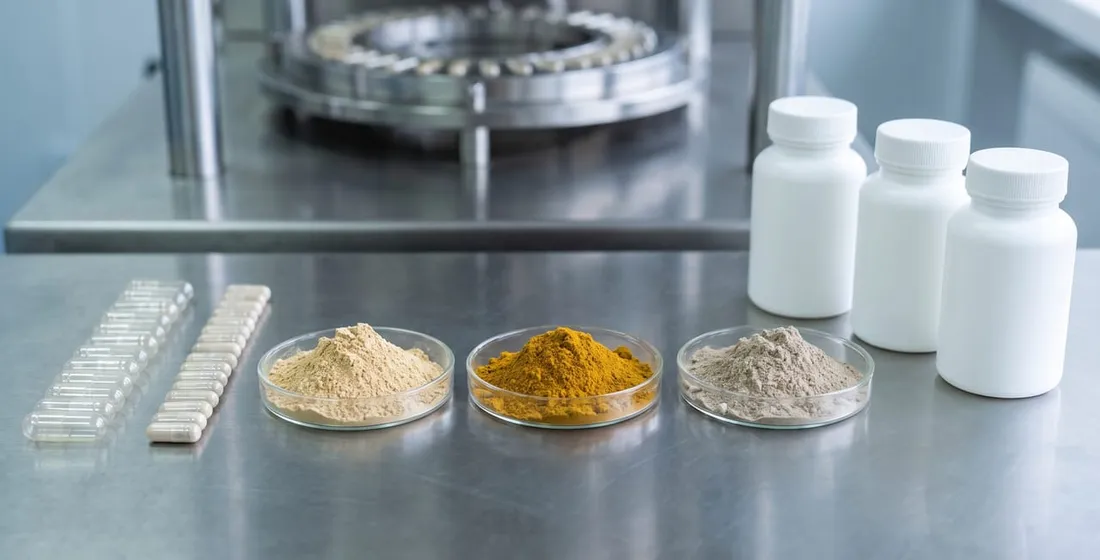
By the Silk Foods Ceylon Editorial Team
Buyer’s snapshot
- Maximum fill weight is the capsule body volume multiplied by the tapped bulk density of the powder. Qualicaps states the rule in its Quali-V technical manual.
- Triphala churna measured 0.5 g/mL tapped in a 2024 study. A size 00 vegetarian shell holds 0.93 mL, so it carries about 465 mg. A 500 mg triphala capsule does not fit one.
- Turmeric measured 0.611 to 0.636 g/mL tapped in 2023, so the same shell carries about 570 to 590 mg of it.
- A 180-bottle first run at Silk Foods Ceylon (SFC) is 10,800 capsules, or 3.6 to 5 kg of powder per SKU.
A capsule brief usually arrives as a dose and a bottle. Five hundred milligrams of triphala, sixty capsules to a bottle. Both numbers are ordinary on their own. Put together, they can describe a capsule nobody will want to swallow. The powder decides that, and it decides it before anyone picks a shell.
This post runs one composite scenario from milled powder to a shelf-ready bottle. Two Ayurvedic SKUs, the capsule size each forces, the raw material a first run consumes, and the registration touchpoints that follow. Every physical figure below comes from a capsule maker’s technical manual or a peer-reviewed density measurement, read at source.
The scenario: two herb powders and one 60-count bottle
In this composite scenario, a Colombo-based Ayurvedic brand is taking its first two SKUs to a contract manufacturer. One is a triphala capsule, the other a turmeric capsule. Both are briefed at 500 mg of powder per capsule, 60 capsules per bottle, in vegetarian shells. The brand has already bought raw material.
That last sentence is the expensive one. Raw material was ordered against a dose the brand wrote down, not a fill weight anyone measured. Until the powder is tapped and weighed, the briefed dose is only a hypothesis about a shell. These two herbs behave differently enough that one of them breaks it.
Everything downstream follows from that measurement: capsule size, capsules per bottle, kilograms of powder per run, and whether the dose survives the filling machine.
What actually decides the capsule size?
A two-piece capsule is a container with a fixed internal volume. What varies is how much a given powder weighs when it occupies that volume. Qualicaps prints the rule in its Quali-V technical manual. Approximate maximum fill weight equals the capsule body volume multiplied by the tapped bulk density of the formulation.
The same manual adds a point worth keeping. The relationship holds even on automatic fillers, where the dosing mechanism measures powder independently of the capsule. So the shell does not do the dosing. It sets a ceiling the dosing stays under.
Capsule sizes run on a standard series, and the numbers run backwards. Size 5 is the smallest in common use, size 000 the largest. Vegetarian HPMC shells sit slightly under their gelatin equivalents, which matters because HPMC is what an Ayurvedic brief usually specifies.
| Capsule size | Gelatin body volume (mL) | HPMC body volume (mL) | Gelatin closed length (mm) |
|---|---|---|---|
| 000 | 1.37 | not offered in the Quali-V range | 25.9 |
| 00 | 0.95 | 0.93 | 23.5 |
| 0 | 0.68 | 0.67 | 21.4 |
| 1 | 0.50 | 0.48 | 19.3 |
| 2 | 0.37 | 0.37 | 17.8 |
| 3 | 0.30 | 0.28 | 15.8 |
| 4 | 0.21 | 0.21 | 14.4 |
Two cautions on that table. The fill weights it produces are maxima, not targets, and a production fill weight sits under the ceiling so the tamping has somewhere to go. The closed length column is a machine setup number, and Qualicaps says so directly: it is a set-up recommendation, not an acceptance criterion. It also tells you what a customer has to swallow.
Running the maths on two real powders
Triphala churna has a published figure. A 2024 quality-control study in the Journal of Medicinal and Natural Products measured a lab-prepared churna sieved through a number 44 mesh. Bulk density came in at 0.4 g/mL, tapped density at 0.5 g/mL.
Turmeric has one too. A 2023 study in the Journal of Spices and Aromatic Crops measured low-temperature ground turmeric across four grinding methods. It came in at 0.507 to 0.538 g/mL loose and 0.611 to 0.636 g/mL tapped. Turmeric is the denser powder, and the gap changes the brief.
| HPMC capsule size | Body volume (mL) | Triphala at 0.5 g/mL tapped | Turmeric at 0.611 to 0.636 g/mL tapped |
|---|---|---|---|
| 00 | 0.93 | about 465 mg | about 570 to 590 mg |
| 0 | 0.67 | about 335 mg | about 410 to 425 mg |
| 1 | 0.48 | about 240 mg | about 295 to 305 mg |
| 2 | 0.37 | about 185 mg | about 225 to 235 mg |
Read the triphala column against the brief. The largest vegetarian shell in common use carries about 465 mg of this powder, and the brief asked for 500 mg. That is not a formulation problem or a pricing problem. It does not fit.
Going up a size does not rescue it. A gelatin size 000 holds 1.37 mL, or about 685 mg at 0.5 g/mL, so the dose fits with room to spare. It is also a 25.9 mm capsule, and a customer who struggles with it once does not buy the second bottle.
The turmeric SKU gets the opposite answer. At 0.611 to 0.636 g/mL tapped, a size 00 carries roughly 570 to 590 mg, so 500 mg sits inside it with headroom. The same 500 mg will not fit a size 0, which tops out around 425 mg.
One brief produces two outcomes. Turmeric goes to a size 00 at the briefed dose. Triphala has three honest exits, and the brand picks one before raw material is committed.
- Drop the dose to 450 mg and run a size 00, which keeps one capsule per serving.
- Keep 500 mg as a serving and split it across two size 1 capsules at 240 mg each, which changes both the directions and the capsules per bottle.
- Densify the powder. Finer milling and granulation raise tapped density, and so the ceiling, at the cost of a processing step and a fresh measurement.
Curcuminoid content is a separate line in a turmeric brief, and fill weight does not settle it. The turmeric curcuminoid spec covers why whole powder and standardised extract behave like different products inside an identical shell.
Why 180 bottles is not a capacity number
The first-run minimum for capsules at the Matale facility is 180 bottles per SKU. At 60 capsules a bottle, that is 10,800 capsules. The capsule line fills 100,000 capsules in a single shift and 200,000 in a day.
Put those together and the minimum looks strange. A whole first run is about a tenth of one shift’s output, which is under an hour of actual filling. The machine is not what sets the number.
What sets it is everything around the filling. Changeover and cleaning between two botanical powders take the same time whether the run is 180 bottles or 1,800. Powder is milled and sieved in batches, samples are retained for the batch record, and bottles and labels come from suppliers with their own minimums.
Most first briefs land wrong here, and it shows up as a storeroom. A brand arrives at the R&D team at Matale having already bought a 25 kg or 50 kg sack. That is how the raw-material trade quotes. The run needs 3.6 to 5 kg of it. Buy five times what a run consumes and the surplus ties up working capital in a material with a finite life. It then pushes the brand toward a dose that empties the sack.
| Line | Triphala, size 00 at 465 mg | Turmeric, size 00 at 580 mg |
|---|---|---|
| Bottles in a first run | 180 | 180 |
| Capsules per bottle | 60 | 60 |
| Capsules in the run | 10,800 | 10,800 |
| Powder at the ceiling fill weight | about 5.0 kg | about 6.3 kg |
| Share of one 100,000-capsule shift | about 11 per cent | about 11 per cent |
The economics behind that minimum, including where the money actually goes, are set out in the 180-bottle MOQ breakdown. The bottle carries its own cost question, covered in white versus black capsule bottles.
How much powder does the run actually need?
Multiply capsules by fill weight and you have the theoretical raw material. Triphala needs about 3.6 kg at a size 0 and about 5.0 kg at a size 00. One capsule-size decision moves the order by nearly 40 per cent. That figure is still a floor, because machine priming, setup rejects and retained samples come off the same sack.
Flow behaviour is why the ceiling is not the target. Triphala measured 0.4 g/mL loose against 0.5 g/mL tapped, giving up a fifth of its volume under tapping. A mechanism metering by volume hands you a different weight depending on how settled the powder was. Turmeric’s gap is narrower, which means steadier weights and a different check frequency on the same machine.
Both figures come from published lots, not the brand’s lot. Particle size, moisture and drying method all move them, so the sample goes before the order. What a supplier must be able to tell you about a lot is covered in herb sourcing and traceability.
Which registration touchpoints does the fill decision trigger?
A capsule carrying an Ayurvedic claim sits with the Department of Ayurveda. The governing statute is the Ayurveda Act No. 31 of 1961, amended by the Ayurveda (Amendment) Act No. 19 of 2023. That amendment was certified on 9 October 2023. Its new section 7(g) makes the provision of quality Ayurveda articles, substances and drugs an object of the Act.
The Department publishes application forms rather than a procedure narrative. Form A registers or renews a manufactory of an Ayurveda article, substance or drug, and Form B covers Ayurveda products.
Two things are not published, and a brand planning a launch should hear that plainly. There is no fee schedule on the Department’s site, though the 2023 amendment confirms fees exist, and there is no processing timeline either. Any week count circulating for Ayurveda registration is somebody’s anecdote. Ask the Department directly.
The label has a separate gate. The Food (Labelling and Advertising) Regulations 2026 came into operation on 1 July 2026 under Gazette Extraordinary No. 2494/47 of 26 June 2026. Regulation 13(6)(a) requires prior written approval of the Chief Food Authority before a health claim or functional nutrient claim appears on a label. Regulation 14(1) extends that to advertising one in any medium. Regulation 13(10)(a)(II) applies where a listed nutrient exceeds one third of the relevant reference value.
There is a window on some of that. A Ministry of Health directive of 5 August 2026 granted relief on the regulation 13(10) clauses, from 1 July to 31 December 2026. It also told authorised officers to hold off on action under 13(6)(a) and 14(1) until further notice. Relief is not repeal, and the date is close.
The Sri Lanka Standards Institution (SLSI) sits differently from what most briefs assume. The SLS mark scheme is voluntary except where a product has been gazetted compulsory. The Consumer Affairs Authority’s published Directions list carries no food supplement, capsule or herbal product. The US International Trade Administration recorded in June 2026 that only 32 of roughly 2,000 Sri Lankan standards are mandatory. For a capsule SKU that makes the mark a procurement decision, not a precondition to sell.
| Touchpoint | Instrument | What it asks of this SKU |
|---|---|---|
| Manufactory registration | Ayurveda Act No. 31 of 1961 as amended by Act No. 19 of 2023; Department Form A | The manufacturing site is registered for Ayurveda articles, substances or drugs |
| Product registration | Department of Ayurveda Form B | Each Ayurveda product is registered in its own right |
| Registration fees and timeline | Not published by the Department | Confirm both directly with the Department before fixing a launch date |
| Health or functional nutrient claim on the label | Labelling Regulations 2026, reg 13(6)(a) | Prior written approval of the Chief Food Authority before the claim is displayed |
| Advertising the same claim | Labelling Regulations 2026, reg 14(1) | Prior written approval, in print, electronic, outdoor or any other medium |
| Nutrient above one third of the reference value | Labelling Regulations 2026, reg 13(10)(a)(II) | Prior written approval before sale; relief ran only to 31 December 2026 |
| SLS mark | Sri Lanka Standards Act No. 6 of 1984; CAA Directions under s.12 | Voluntary for this category, since capsules are not on the compulsory list |
The Ayurveda and SLSI route comparison covers running the two tracks in parallel, and the 2026 labelling checklist covers the wider label rules.
The sequence from powder to shelf-ready bottle
The order matters more than the length of any single step. Measure before you buy, and lock the claim before you print.
- Send a sample of the actual raw material, not a catalogue specification. Loose and tapped density are measured on the lot that will be filled.
- Fix the capsule size and target fill weight from that measurement, then check the closed length is one a customer will swallow.
- Settle the dose and the capsules per bottle together, since a split dose changes both.
- Calculate raw material from the target fill weight, and agree the allowance for priming, rejects and retained samples on top.
- Run a trial fill and check weights through it, more often for a powder with a wide gap between loose and tapped density.
- Put the label claim in for prior written approval before artwork goes to print, then book the run and order raw material against the calculated figure.
On the manufacturing side the windows are known. A sample against an existing recipe dispatches in one to two weeks, and an R&D iteration runs two to four weeks. Purchase order to dispatch is two to three weeks on a locked recipe, six to ten where formulation work comes first.
The registration side has no published window, and this post will not invent one. That is an argument for opening the Department of Ayurveda and Chief Food Authority conversations alongside the bench work rather than after it. One brand doing exactly that is in the first private-label capsule run case study.
Where the powder maths says wait
Three briefs come up often enough to name, and each is cheaper to catch at the brief than at the fill. The first is a dose that needs a size 000. If the arithmetic only works in a 25.9 mm capsule, the product has a swallowing problem the brand meets later as a repeat-purchase problem. Reformulating the serving is the cheaper fix.
The second is raw material bought before the spec locked. Silk Foods Ceylon says so at the brief stage, not after the first invoice. A sack already in a storeroom starts distorting the dose decision the moment it arrives.
The third is a launch date with no room for a claim approval. Bottles are wanted on a shelf next month, the label carries a health claim, and no approval is in hand. That is a choice between a delayed launch and a label the brand cannot defend. Dropping the claim for the first run is usually the better trade.
Frequently asked questions
What size capsule do I need for a 500 mg herbal powder?
It depends on the powder’s tapped density. Maximum fill weight is the capsule body volume multiplied by that density. Turmeric at 0.611 to 0.636 g/mL tapped fits 500 mg into a size 00. Triphala at 0.5 g/mL tapped carries only about 465 mg in the same shell, so 500 mg does not fit.
How much powder does a 180-bottle capsule run need?
A 180-bottle run at 60 capsules per bottle is 10,800 capsules. At a 335 mg fill weight that is about 3.6 kg of powder, and at 465 mg about 5.0 kg. Priming, setup rejects and retained samples sit on top, agreed against the actual lot.
Does a herbal capsule need the SLS mark in Sri Lanka?
Not as a condition of sale. The SLS product certification scheme is voluntary except for products gazetted as compulsory, and the Consumer Affairs Authority’s published Directions list carries no supplement, capsule or herbal product. The US International Trade Administration reported in June 2026 that only 32 of about 2,000 Sri Lankan standards are mandatory.
Does a health claim on a supplement label need approval in Sri Lanka?
Yes. Regulation 13(6)(a) of the Food (Labelling and Advertising) Regulations 2026, in operation since 1 July 2026, requires prior written approval of the Chief Food Authority before a health or functional nutrient claim is displayed. Regulation 14(1) applies the same requirement to advertising that claim in any medium.
Does Silk Foods Ceylon offer contract manufacturing for Ayurvedic capsules?
Yes. The capsule line at the Matale facility fills 100,000 capsules per single shift and 200,000 a day, with a first-run minimum of 180 bottles per SKU. The facility is BRCGS- and FSSC 22000 V6-audited, and the in-house R&D team sets fill weight and capsule size from a measured sample of the brand’s own raw material.
How Silk Foods Ceylon can help
For Sri Lankan Ayurvedic and wellness brands taking a capsule SKU to a first commercial run, Silk Foods Ceylon (SFC) runs contract manufacturing on a capsule line filling 100,000 capsules per single shift and 200,000 a day, from a first-run minimum of 180 bottles per SKU. The in-house R&D team at the Matale facility measures the loose and tapped density of the brand’s own raw material before a capsule size, a fill weight, or a raw-material order is fixed. The facility is BRCGS- and FSSC 22000 V6-audited, and registration support sits inside a standard engagement.
To brief a project, email b2b@esilkroute.com.lk or call +94 76 441 0389 / +94 76 918 5744.
Sources
Qualicaps, Quali-V Technical Manual, section 3.2, capsule dimensions and the rule that approximate maximum powder fill weight equals body volume multiplied by the tapped bulk density of the formulation. Qualicaps (retrieved 12 September 2026).
ACG Associated Capsules, Hard Gelatin Capsule Shells technical manual, dimensions and capsule capacity by powder density. ACG Associated Capsules (retrieved 12 September 2026).
Parihar et al., quality control of Triphala Churna, Journal of Medicinal and Natural Products, 2024, 1(1):100003. Bulk density 0.4 g/mL, tapped density 0.5 g/mL, Hausner ratio 1.25. Journal of Medicinal and Natural Products (retrieved 12 September 2026).
Sapariya, Joshi and Dabhi, physical properties of turmeric powder, Journal of Spices and Aromatic Crops, 2023, 32(1):24-33. Loose bulk density 0.507 to 0.538 g/mL, tapped density 0.611 to 0.636 g/mL across four grinding methods. Journal of Spices and Aromatic Crops (retrieved 12 September 2026).
Parliament of Sri Lanka, Ayurveda (Amendment) Act No. 19 of 2023, certified 9 October 2023, published in the Gazette of 13 October 2023. Sections 3, 7(g) and 7A. Parliament of Sri Lanka (retrieved 12 September 2026).
Department of Ayurveda, Sri Lanka, application forms register. Form A for a manufactory of an Ayurveda article, substance or drug; Form B for Ayurveda products; Form C for import and export registration. No fee schedule and no processing timeline are published. Department of Ayurveda (retrieved 12 September 2026).
Ministry of Health and Mass Media, Sri Lanka, directive EOHFS/FCAU/06/2023 of 5 August 2026 on the Food (Labelling and Advertising) Regulations 2026, Gazette Extraordinary No. 2494/47 of 26 June 2026, in operation from 1 July 2026. Regulations 13(6)(a), 13(10)(a)(II) and 14(1), and the relief period to 31 December 2026. Ministry of Health (retrieved 12 September 2026).
Consumer Affairs Authority, Sri Lanka, Directions issued under section 12 of the Consumer Affairs Authority Act No. 9 of 2003, the published compulsory-standards list. Consumer Affairs Authority (retrieved 12 September 2026).
US International Trade Administration, Country Commercial Guide, Sri Lanka: Standards for Trade, updated 12 June 2026. About 2,000 standards, of which 32 are mandatory. International Trade Administration (retrieved 12 September 2026).
Silk Foods Ceylon, internal capability data for the Matale facility: 100,000 capsules per single shift and 200,000 a day on the capsule line; 180-bottle first-run minimum per capsule SKU; sample dispatch 1 to 2 weeks on an existing recipe; 2 to 4 weeks per R&D iteration; purchase order to dispatch 2 to 3 weeks on a locked recipe and 6 to 10 weeks where formulation work comes first. silkfoodsceylon.com (retrieved 12 September 2026).