Home Blend to 1,500 Sachets: A Drink-Powder First Run in 14 Weeks
By the Silk Foods Ceylon Team
Buyer’s snapshot
- Food inflation in Sri Lanka ran at 8.7 per cent year on year in September 2026 (Central Bank of Sri Lanka, September 2026). A sachet price set in week 0 of a 14-week project needs headroom by week 14.
- A drink mix is not one of the seven foods for which the Sri Lanka Standards Institution (SLSI) makes the SLS mark compulsory, so this calendar was set by the bench and the label, not by a permit.
- In this genericised case, a 2 kg home blend became a 1,500-sachet first run at Silk Foods Ceylon (SFC) in 14 weeks, with R&D held inside its 3 to 4 week window.
- The batch ladder, the fill-weight table and the week-by-week calendar are the three sections to take into a planning meeting.
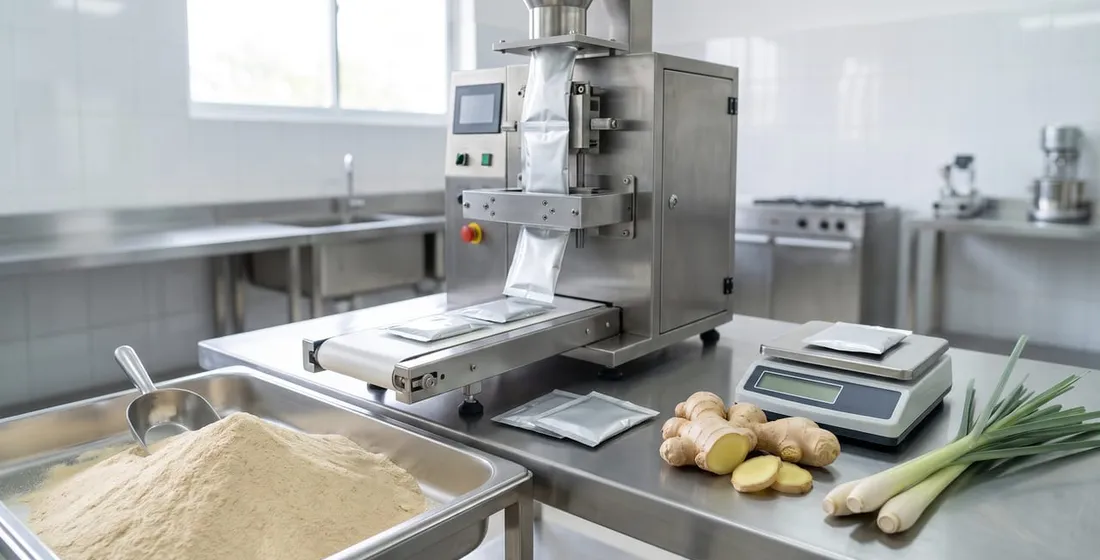
The founder in this case sold a ginger and lemongrass instant drink mix in 100 g jars, about 250 a month through a weekend market and an online marketplace, blended two kilograms at a time in a mixing bowl. A local distributor serving office canteens and pharmacy counters offered a listing on one condition: 15 g single-serve sachets in a carton of ten, made by a certified manufacturer, with a compliant label. The order was 150 cartons, which is 1,500 sachets.
This post maps how that project ran at the Matale facility: what each batch was for, how the fill weight was set, where the label window went and where the 14 weeks were spent. The format rules for sachets (laminate, line speed, the full tolerance table) are in sachet and stick-pack co-packing for powdered drinks.
A note on method. This is a genericised composite built from the pattern of first-run powder briefs at Silk Foods Ceylon; the brand is not one client and the figures are representative. The regulations, standards and dates are real.
Why did a product that already sold need four more batches?
A home blend that sells proves one thing: people buy it. It cannot prove that a sachet filled from a 25 kg hopper tastes the same as a jar scooped from a bowl, or that the powder still pours after three weeks on a Colombo shelf. Each batch answered a question the one before could not.
| Stage | Batch | Sachets at 15 g | What the batch had to prove |
|---|---|---|---|
| Home blend (founder) | 2 kg, hand mixed | About 130 | The product sells |
| R&D bench rounds | 1 kg each, three rounds | About 65 each | Particle match, flow, moisture, sugar level |
| Pilot batch | 5 kg | About 330 | Fill weight on the machine, shelf-life start, carton fit |
| First commercial run | 25 kg | 1,500, plus overfill and losses | Consistency across one production block |
The pilot is the batch founders leave out of their plans, and it is the one the calendar depends on. It was the first powder through the sachet machine, so it set the fill weight; it started the shelf-life check; its samples were analysed for the nutrition panel the carton will eventually carry.
The first-run quantity was the distributor’s, not the line’s. SFC publishes no per-sachet minimum for a powder; the unit booked is a production block, typically a single day, as set out in minimum order quantities by format.
The three bench rounds: particle size, moisture, sugar
R&D ran from a signed brief in week 1 to an approved formulation in week 4, inside the 3 to 4 week maximum SFC holds for R&D. Each round fixed a problem the home blend had never faced.
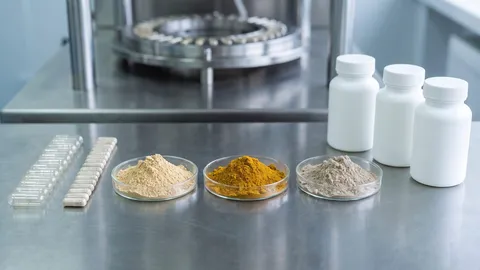
Round one was segregation. Ginger ground in a domestic grinder is coarse; cane sugar is fine. In a bowl the difference is invisible. In a hopper the sugar sifts down through the ginger, so sachets from the top of a run taste sweet and sachets from the bottom taste hot. Test sachets hand filled from the top and bottom of the home blend showed the ginger share moving by roughly a third either way. Milling the ginger and lemongrass on the grinding and sieving line to one sieve fraction, and grinding the sugar to match, held it within about 5 per cent.
Round two was moisture. Ginger dried in a home oven caked the blend within a week in Colombo humidity. The bench specified the ginger’s moisture, set a water activity release target for the blend and added a permitted anti-caking agent at the level the additive rules allow. In a 2023 study of a spray-dried fruit powder in aluminium laminate, the untreated powder’s water activity rose from 0.28 to 0.71 over 180 days at ambient conditions and its degree of caking doubled from 10 to 21 per cent; powder treated with tricalcium phosphate rose only to 0.60 and 12 per cent (Bashir et al., Foods, 2023).
Round three was sugar, and it was where the team changed its view. The home blend carried about 70 g of sugar per 100 g, far past the 22 g line at which a solid food takes a red logo under the Food (Colour Coding for Sugar, Salt and Fat) Regulations 2019, so the first bench note planned around a red logo. Read in full, the regulations exempt a solid food that becomes a liquid once reconstituted per the label directions, and a drink mix is exactly that. Whether the separate liquid instrument reaches a reconstituted drink was put to the Food Control Administration Unit for a written view, and the artwork kept a reserved space until the answer came. The thresholds and exemptions are in sugar, salt and fat colour code compliance.
Where did the label window go?
Six weeks, against a plan of four. The sachet itself was the easy part. The Food (Labelling and Advertising) Regulations 2026, in operation from 1 July 2026, disapply the main-panel particulars for a pre-packaged food of 25 g or less, provided the container it is customarily sold from is at the point of sale and labelled in full (regulation 5(3)). A 15 g sachet in a labelled carton of ten qualifies. The brand kept the laminate plain, coded batch and expiry on each sachet by choice and put the whole label on the carton. That kept printed laminate, 8 to 13 working weeks in SFC’s working plan, off the critical path; a folding carton was quoted at three weeks.
The carton then had to carry everything, and two of its lines could not be fixed until the bench had finished.
| Label line | What the 2026 regulations require | When it could be fixed |
|---|---|---|
| Common name | ”Ginger and lemongrass instant drink mix” in bold, in all three languages or two on the main panel and the third on any panel, at least one third of the brand-name height and at least 3 mm (regulations 5(1)(a), 6(a)) | Week 1 |
| Ingredient percentages | Ginger and lemongrass are named in the product name, so each is a characterising ingredient whose percentage goes in the ingredient list (regulation 9(2)) | Week 4, when round three locked the recipe |
| Health claim | ”Supports digestion” is a health claim and needs prior written approval from the Chief Food Authority (regulation 13(6)(a)) | Dropped for launch; application planned after the first run |
| Nutrition panel | Mandatory for all food products one year after the gazette date of 26 June 2026 (Schedule II, 1.2) | Space reserved; pilot analysis values added at the first reprint |
| Date marking | Expiry in any two of Sinhala, Tamil and English (regulation 5(1)(c)) | Week 5, once the shelf-life check had started |
The percentages are the line that caught the founder out. Because the product name leads with two ingredients, the regulations ask for the proportion of each, and a proportion cannot be printed until the recipe stops moving. Artwork commissioned in week 2 would have been redrawn in week 4, so the proof rounds began in week 5. The claim cost no time only because it was dropped early: a claim submission has its own window and fee, which the five-input quote pack treats as a quote line. The wider checklist is in Sri Lanka’s 2026 food labelling rules.
How accurate did a 15 g sachet have to be?
The legal floor comes from OIML R 87, the international recommendation that Sri Lanka’s pre-pack inspection follows. For a nominal quantity from 0 to 50 g the tolerable deficiency is 9 per cent of the labelled weight (OIML R 87, 2004), which on 15 g is 1.35 g. Three rules apply together: the lot average must be at least 15 g, no more than 2.5 per cent of sachets may fall below 13.65 g, and none may fall below 12.30 g.
The first rule is the one that costs money. Because the average cannot sit below the label, the filler is set above it, and how far above depends on how steadily the machine holds a dry blend. The pilot’s weight record put most sachets within a quarter of a gram of the setting, so the target fill was set at 15.3 g, a 2 per cent overfill.
| Run size | Overfill powder at 0.3 g per sachet | Scale |
|---|---|---|
| 1,500 sachets (this first run) | 450 g | A rounding error on a 25 kg batch |
| 10,000 sachets | 3 kg | A bench batch |
| 100,000 sachets | 30 kg | More than this project’s whole first run |
At 1,500 sachets the overfill was not worth a conversation. The reason to settle it on the pilot anyway is the third row: a blend that needs 0.3 g of headroom at launch needs 30 kg of free powder a year later, and the way to shrink that is a tighter particle size and a steadier flow, both bench decisions.
The 14 weeks, week by week
Week 0 is the day the founder handed over a jar and the distributor’s carton spec. Week 14 is the first delivery.
| Weeks | Stage | Batch in use |
|---|---|---|
| 0 | Brief taken; drink mix confirmed outside the seven compulsory SLS food products; quote inputs collected | Home blend |
| 1 to 4 | Three bench rounds, signed brief to approved formulation | 1 kg bench batches |
| 3 to 4 | Quote issued; production block provisionally booked | None |
| 5 to 6 | Pilot batch; fill-weight trial; shelf-life check started; nutrition analysis | 5 kg pilot |
| 5 to 10 | Label window: carton artwork, three proof rounds, colour-code view requested, claim dropped | Artwork only |
| 7 to 10 | Carton printed; plain laminate drawn from stock | None |
| 11 | Pre-run: cartons and laminate in, coder set for batch and expiry, weights rechecked | Pilot sachets |
| 12 | First commercial run, one production block | 25 kg |
| 13 | Release: certificate of analysis, batch record, retained samples; carton packing | 1,500 sachets |
| 14 | First delivery to the distributor | 1,500 sachets |
Service snapshot: a first drink-powder run at Silk Foods Ceylon
- Service: contract manufacturing of the brand owner’s dry blend, milled and sieved on the grinding line and filled on the form-fill packing machine at Matale
- Run unit: a production block, typically a single day; no published per-sachet minimum
- Lead time: 2 to 3 weeks from a locked recipe to a first run; R&D, where needed first, 3 to 4 weeks maximum from signed brief to approved formulation
- Certification: BRCGS- and FSSC 22000 V6-audited, with Sri Lanka Food Act labelling compliance checked on every retail SKU
- Submission: SLSI documentation prepared inside the engagement where the SLS mark is sought; SLSI publishes no processing time, so the window is confirmed at submission
The run itself took a small part of the block. Set-up, the first-article weight check, the changeover and the clean-down took the rest, which is why a 1,500-sachet run and a 5,000-sachet run cost almost the same in line time. The maths is in stick-pack changeover costs and batch size. The distributor’s second order, placed in week 16, was for 6,000 sachets.
What would the founder do differently?
Three things, each about sequence rather than money.
- Read the label rules before the first bench round. The percentage line and the claim approval were both discoverable in week 0, and would have moved the artwork brief forward by two weeks.
- Bring the distributor’s carton spec to the quote, not after it. The carton let the laminate stay plain, and the plain laminate made 14 weeks possible. The format decision was the schedule decision.
- Size the first run to the block as well as to the order. The block would have carried 5,000 sachets for nearly the same line cost, and the second order arrived four weeks later anyway.
For comparison, the bottled fruit drink case ran 17 weeks because its category carries a compulsory SLS permit. The powder ran faster because its calendar had no permit on it, not because the line was quicker.
Where SFC walks away
A blend that is still moving: that is an R&D brief of 3 to 4 weeks at most, and it comes before a block is booked. A health claim with no approval plan: the Chief Food Authority’s written approval is a task with its own window, not a line of artwork. A few hundred sachets with no forecast behind them: the block costs what it costs, and the founder is better told so in week 0.
Frequently asked questions
What is the minimum first run for a drink-powder sachet at Silk Foods Ceylon?
Silk Foods Ceylon publishes no per-sachet minimum. The unit booked is a production block, typically a single day, and a 1,500-sachet first run fits inside one with capacity to spare. Lead time is 2 to 3 weeks from a locked recipe; where R&D is needed first, it takes 3 to 4 weeks maximum from signed brief to approved formulation.
Does a 15 g drink sachet need a full food label in Sri Lanka?
Not on the sachet. Regulation 5(3) of the Food (Labelling and Advertising) Regulations 2026 disapplies the main-panel particulars for a pre-packaged food of 25 g or less, provided the container it is customarily sold from is at the point of sale and fully labelled. A labelled carton of ten sachets meets that condition.
Can a drink powder say “supports digestion” on the pack in Sri Lanka?
Not without approval. Under regulation 13(6)(a) of the Food (Labelling and Advertising) Regulations 2026, every health claim and nutrient function claim needs prior written approval from the Chief Food Authority before it appears on a label or in an advertisement. In this case the brand dropped the claim for launch and planned the application afterwards.
Does a drink mix need the SLS mark to be sold in Sri Lanka?
No. The Sri Lanka Standards Institution lists seven food products for which the SLS mark is compulsory for local manufacturers, all under Gazette No. 746/4 of 1992, and drink mixes are not among them. The mark remains available as a voluntary certification; SLSI publishes no processing time for it, so the window is confirmed with SLSI at submission.
How Silk Foods Ceylon can help
For founders moving a powder blend from a kitchen to a sachet, Silk Foods Ceylon (SFC) runs contract manufacturing at its cellular-manufacturing facility at Silk AgTech Park in Hapugasyaya, Matale: milling and sieving on the grinding line, blending to a locked formulation, and filling on the form-fill packing machine with batch and expiry coding. The run unit is a production block, with 2 to 3 weeks from a locked recipe to a first run and R&D of 3 to 4 weeks maximum where the blend needs work first. The facility is BRCGS- and FSSC 22000 V6-audited, and the label review against the 2026 regulations sits inside the engagement.
To brief a project, email b2b@esilkroute.com.lk or call +94 77 157 7294.
Sources
- Central Bank of Sri Lanka (2026), “CCPI-based headline inflation remained unchanged in September 2026” (press release, 30 September 2026), https://www.cbsl.gov.lk/en/node/20961 (retrieved 2026-10-24).
- Ministry of Health, Sri Lanka (2026), Food (Labelling and Advertising) Regulations 2026, Gazette Extraordinary No. 2494/47 of 26 June 2026, regulations 5(1), 5(3), 6, 9(2) and 13(6), and Schedule II paragraph 1.2, https://www.eohfs.health.gov.lk/food/images/2494-47_E.pdf (retrieved 2026-10-24).
- Ministry of Health, Sri Lanka (2019), Food (Colour Coding for Sugar, Salt and Fat) Regulations 2019, Gazette Extraordinary No. 2119/3 of 17 April 2019, Schedule I thresholds and the exemption for food reconstituted to a liquid, https://eohfs.health.gov.lk/food/images/pdf/regulations/Colour-coding-solids-English.pdf (retrieved 2026-10-24).
- International Organization of Legal Metrology (2004), OIML R 87, “Quantity of product in prepackages”, Edition 2004 with erratum of 16 June 2008, Table 2 and clause 3, https://www.oiml.org/en/files/pdf_r/r087-e04.pdf (retrieved 2026-10-24).
- Sri Lanka Standards Institution (2026), “Information for Local Manufacturers”, on the seven food products for which the SLS mark is compulsory under Gazette No. 746/4 of 21 December 1992, https://slsi.lk/web/information-for-local-manufacturers/ (retrieved 2026-10-24).
- Bashir, O. et al. (2023), “Influence of Anticaking Agents and Storage Conditions on Quality Characteristics of Spray Dried Apricot Powder”, Foods, 12(1), 171, https://doi.org/10.3390/foods12010171 (retrieved 2026-10-24).
- Silk Foods Ceylon, internal capability data for the Matale facility: production block as the run unit for sachets; R&D 3 to 4 weeks maximum; 2 to 3 weeks from locked recipe to first run; printed laminate 8 to 13 working weeks in the working plan.
Written by the Silk Foods Ceylon Team. Silk Foods Ceylon (Pvt) Ltd. is a BRCGS- and FSSC 22000 V6-audited contract manufacturer in Matale, Sri Lanka, offering contract manufacturing, private labelling, co-packing, and in-house R&D for local Sri Lankan brand owners, FMCG companies, hotel and restaurant groups, and distributors. To brief a project: b2b@esilkroute.com.lk or +94 77 157 7294.