Kitchen Batch to SLSI-Cleared Shelf SKU in Sri Lanka: A Case Study
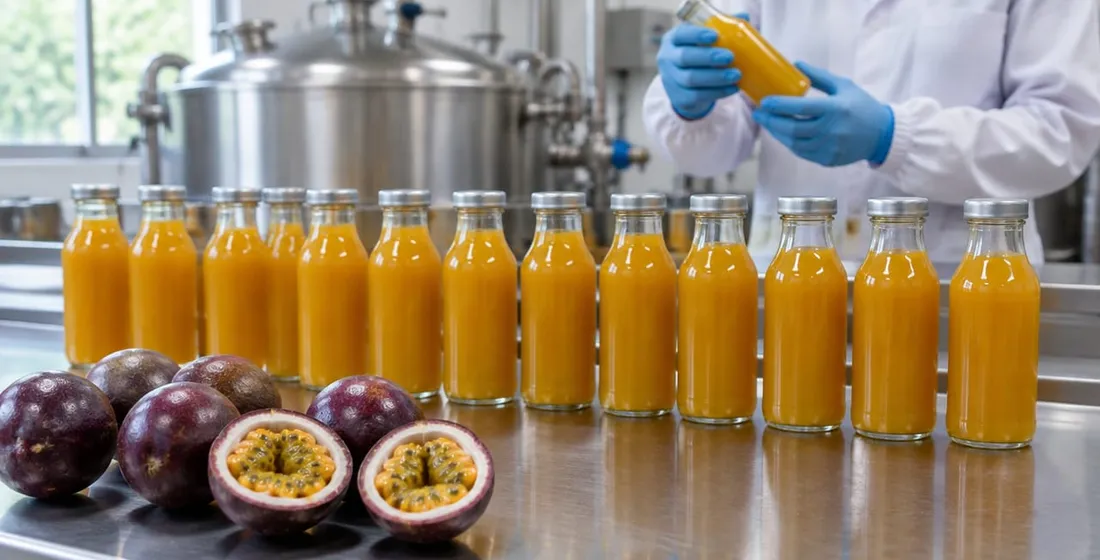
A row of unlabelled 200 ml glass bottles of golden passion fruit drink on a stainless steel line, with whole and halved passion fruits in front and a gloved worker checking a bottle beside a jacketed kettle.
Buyer’s snapshot
- Ready-to-serve fruit drinks are one of seven food products for which the Sri Lanka Standards Institution (SLSI) lists the SLS mark as compulsory for local manufacturers, under SLS 729 and Gazette No. 746/4 of 1992.
- That makes a bottled fruit drink a useful case: the shelf date depends on a permit, a label and a sugar logo, not only on the recipe.
- In this genericised case, a 25-litre kitchen batch became a 1,250-bottle first run at Silk Foods Ceylon (SFC), with 19 weeks from first sample to first delivery.
- The week-by-week table and the batch-size ladder are the two sections to take into a planning meeting.
Most first briefs arrive with a product that already sells. The founder in this case made a passion fruit drink in a home kitchen, bottled it by hand in 200 ml glass, and sold roughly 400 bottles a month through weekend markets, two cafes and a small office-delivery round. A Persona D (local distributor) offered a listing across a chain of neighbourhood groceries, on one condition: a certified manufacturer, an SLS mark and a compliant label. What follows is how that project ran, what each batch size was for, and where the 19 weeks went.
A note on method. This is a genericised composite built from the pattern of first-run beverage briefs at the Matale facility. The brand is not one client, and the numbers are representative of how these projects run rather than copied from one file. The regulations and dates are real.
Why did a fruit drink need a permit before anything else?
Because the category is on the compulsory list. SLSI’s guidance for local manufacturers names ready-to-serve fruit drinks under SLS 729 as a product for which the SLS mark is compulsory, from Gazette No. 746/4 of 21 December 1992. The Consumer Affairs Authority restated the requirement publicly in November 2025.
For most food categories, the SLS mark is voluntary, and that is the rule founders usually hear first. Jams, sauces, spice blends and capsules sit outside the compulsory list, as set out in which retail categories make the SLS mark mandatory. A ready-to-serve fruit drink is one of the exceptions, alongside cordials, squash concentrates, canned fish, condensed milk and brown sugar.
That changed the order of work on day one. The R&D team’s first question was not how the drink tasted. It was whether the site, the process and the product could pass a two-audit, two-sample-round assessment, because nothing could be sold without it.
How many batch sizes does one SKU go through?
Four, and each one answers a different question. The founder’s kitchen batch proved people would buy the drink. It could not prove anything else, because a hand-filled 25-litre pot does not behave like a hot-filled production run.
| Stage | Batch size | Bottles (200 ml) | What the batch had to prove |
|---|---|---|---|
| Kitchen batch (founder) | 25 litres | About 110 | The product sells |
| R&D bench iterations | 5 litres each, three rounds | About 20 each | Hot-fill temperature, pulp settling, sugar level |
| Pilot batch | 60 litres | About 280 | Shelf life, lab samples, sensory check, SLSI sample draws |
| First commercial run | 250 litres | 1,250 | Line consistency at half a line day |
The 200 ml beverage line at the Matale facility runs 2,500 bottles a day, so the 1,250-bottle first-run minimum is half a production day. The pilot batch is the one founders skip in their own planning, and it is the one the calendar depends on: the SLSI route draws two sets of samples for laboratory testing, and those bottles have to come from a process that matches the commercial one.
What changed between the kitchen and the bench was mostly heat and settling. A drink that looks uniform in a jug separates in a bottle after a week on a warm shelf. The three bench rounds adjusted the hot-fill temperature, the pulp particle size and the stabilising step until a bottle held its appearance through the shelf-life check. The wider version of that problem is covered in reformulating a kitchen recipe for retort and batch consistency.
The 19 weeks, stage by stage
Week zero is the day the founder handed over a kitchen sample and the brief. Week 19 is the first pallet arriving at the distributor’s warehouse.
| Weeks | Stage | Batch in use |
|---|---|---|
| 0 | Kitchen sample tasted, brief taken, SLS 729 confirmed as compulsory | Kitchen batch |
| 1 to 6 | Three R&D iterations, two weeks each | 5-litre bench batches |
| 7 to 8 | Pilot batch made; shelf-life check started | 60-litre pilot |
| 7 to 10 | SLSI application and desktop evaluation | Documents only |
| 9 to 14 | Label-approval window: three artwork proof rounds, one extra R&D round and a redraw | Artwork, one 5-litre bench batch |
| 11 to 15 | Pre-assessment audit, first sample round, final assessment, second sample round | Pilot bottles |
| 16 to 17 | Permit committee and agreement; purchase order placed, bottles and labels ordered | None |
| 18 | First commercial run | 1,250 bottles |
| 19 | First delivery | 1,250 bottles |
SLSI publishes no turnaround time in weeks for this scheme. Its route runs seven stages, from the application through a desktop evaluation, an on-site pre-assessment, two rounds of sample testing and a final on-site assessment to the permit committee. Silk Foods Ceylon plans a six to ten week buffer between manufacturer-side sign-off and a shelf date for that reason. In this case the SLSI stages took roughly ten weeks from application to permit, at the long end of that buffer. The stage mechanics are set out in the SLSI packaged-food submission walkthrough.
Service snapshot: Contract Manufacturing for a bottled drink
- Service: SFC manufactures the brand owner’s recipe on the 200 ml glass-bottle beverage line at the Matale facility
- First-run minimum: 1,250 bottles, half of the line’s 2,500-bottle day
- Lead time: 2 to 4 weeks from a locked recipe to a first run; 6 to 10 weeks when R&D iterations come first
- Certification: BRCGS- and FSSC 22000 V6-audited, with Sri Lanka Food Act labelling compliance on every retail SKU
- Submission: SLSI documentation prepared inside the engagement, with the permit signatory agreed at the start
Where did the label-approval window go?
Six weeks, against a plan of four. The label on a bottled fruit drink in 2026 answers to two instruments at once, and one of them changed while the artwork was in proof.
The first is the Food (Labelling and Advertising) Regulations 2026, gazetted as Extraordinary No. 2494/47 and in operation from 1 July 2026 for food manufactured from that date. A first run in week 18 fell well after that date, so the label had to carry the common name in bold in Sinhala, Tamil and English, the expiry date in at least two languages, and the other mandatory particulars covered in the 2026 labelling regulations.
The second is the sugar colour code for liquids. The founder’s kitchen recipe carried about 12 g of sugar per 100 ml. The first R&D brief set a target of 10 g, which sat in the amber band under the 2022 liquid regulations, where red began above 11 g.
Then the rule moved. An Extraordinary Gazette dated 23 June 2026 lowered the red threshold for drinks to 8 g per 100 ml, with amber from 2.5 g to 8 g and green below 2.5 g. The artwork was in its second proof round. A 10 g drink that had been amber was now red. The founder had a choice: redraw the pack with a red logo, or go back to the bench.
They went back to the bench. One more R&D round took the drink to 7.5 g per 100 ml, the sensory panel accepted it, and the artwork was redrawn for an amber logo. That cost two weeks, and it is the lesson of the case that travels furthest: a sugar target set with less than 1 g of headroom below a band edge is a target that one gazette can undo. The same amendment introduced an alternative logo format for glass bottles where space is tight, which helped on a 200 ml bottle. Print lead times behind the redraw are covered in artwork and print lead time as the private-label gate.
What would the founder do differently?
Three things, all about sequence rather than money.
- Confirm the compulsory standard before the first bench batch. The founder had spent a month on bottle design before learning the drink needed an SLS permit. That month bought nothing.
- Set the sugar target with headroom. A target at least 1 g per 100 ml inside the band would have survived the June amendment without a redraw.
- Start the shelf-life check with the pilot batch, not after it. The pilot bottles served three purposes (shelf life, lab samples, sensory checks), so a pilot run made early shortened everything downstream. Where shelf life has not been established, accelerated stability testing is the step that sets it.
For comparison, the capsule version of this journey ran 14 weeks, as told in the case study of a first private-label capsule run. The drink took longer because of the compulsory permit and the extra pilot batch, not because of the line.
Where SFC walks away
Silk Foods Ceylon does not book a line slot for a ready-to-serve fruit drink whose brand owner plans to “sort out SLS later”. In a compulsory category, a first run without a permit is stock that cannot legally be sold.
Frequently asked questions
Does a ready-to-serve fruit drink need SLS certification in Sri Lanka?
Yes. The Sri Lanka Standards Institution lists ready-to-serve fruit drinks under SLS 729 among the food products for which the SLS mark is compulsory for local manufacturers, from Gazette No. 746/4 of 1992. Imported fruit drinks need prior approval under the Import Inspection Scheme instead.
What are Sri Lanka’s sugar colour code bands for drinks in 2026?
An Extraordinary Gazette dated 23 June 2026 amended the liquid sugar colour code. A drink above 8 g of sugar per 100 ml carries a red logo, 2.5 g to 8 g carries amber, and below 2.5 g carries green. The red threshold was previously 11 g per 100 ml.
How long does it take to go from a kitchen batch to a first shelf delivery?
In this genericised Silk Foods Ceylon case, 19 weeks from first sample to first delivery for a bottled drink in a compulsory SLS category. SLSI publishes no turnaround time, so SFC plans a six to ten week buffer between manufacturer sign-off and the shelf date.
What is the first-run MOQ for a bottled drink at Silk Foods Ceylon?
The first-run minimum for contract manufacturing a beverage is 1,250 bottles of 200 ml, half a production day on a line that runs 2,500 bottles daily. Lead time is 2 to 4 weeks on a locked recipe and 6 to 10 weeks when R&D comes first. The facility is BRCGS- and FSSC 22000 V6-audited.
How Silk Foods Ceylon can help
For a founder moving a bottled drink from a home kitchen to a retail shelf, Silk Foods Ceylon runs Contract Manufacturing on a 200 ml glass-bottle beverage line at its cellular-manufacturing facility at Silk AgTech Park in Hapugasyaya, Matale. The first-run minimum is 1,250 bottles, half of a 2,500-bottle line day, with 2 to 4 weeks from a locked recipe to a first run, or 6 to 10 weeks when the in-house R&D team adjusts the kitchen recipe first. The facility is BRCGS- and FSSC 22000 V6-audited, and SLSI documentation and label compliance checks sit inside the engagement rather than beside it.
To brief a first run, email b2b@esilkroute.com.lk or call +94 76 441 0389 / +94 76 918 5744.
Sources
- Sri Lanka Standards Institution, Information for Local Manufacturers, on products for which the SLS mark is compulsory, including ready-to-serve fruit drinks (SLS 729) under Gazette No. 746/4 of 21 December 1992, Direction No. 93 of the Internal Trade Department. slsi.lk (retrieved 26 September 2026).
- Sri Lanka Standards Institution, SLS Mark Product Certification, on the seven-stage route from application to permit, including two on-site assessments and two rounds of sample testing. slsi.lk (retrieved 26 September 2026).
- Newswire, “SLS mark mandatory for ready-to-serve fruit drinks: CAA”, 2 November 2025, on the Consumer Affairs Authority requirement for locally made and imported fruit drinks. newswire.lk (retrieved 26 September 2026).
- OnLanka, “Sri Lanka tightens sugar labelling rules for liquid food products”, 3 July 2026, and Xinhua, “Sri Lanka amends sugar color-code label rules for liquid foods”, 4 July 2026, on the Extraordinary Gazette of 23 June 2026 lowering the red threshold from 11 g to 8 g per 100 ml. onlanka.com, news.cn (retrieved 26 September 2026).
- Government of Sri Lanka, Food (Labelling and Advertising) Regulations 2026, Gazette Extraordinary No. 2494/47 of 26 June 2026, in operation from 1 July 2026. eohfs.health.gov.lk (retrieved 26 September 2026).
- Further reading: Ministry of Health, Food (Colour Coding for Sugar Levels - Liquid) Regulations, original instrument. eohfs.health.gov.lk (retrieved 26 September 2026).
Written by the Silk Foods Ceylon Team. Silk Foods Ceylon (Pvt) Ltd. is a BRCGS- and FSSC 22000 V6-audited contract manufacturer in Matale, Sri Lanka, offering contract manufacturing, private labelling, co-packing, and in-house R&D for local Sri Lankan brand owners, FMCG companies, hotel and restaurant groups, and distributors. To brief a project: b2b@esilkroute.com.lk, +94 76 441 0389, or +94 76 918 5744.