Sauce contract manufacturing in Sri Lanka: the first-run maths
By the Silk Foods Ceylon Editorial Team
Buyer’s snapshot
- A first-run minimum is an equipment number before it is a commercial one. At the Matale facility a sauce or spread in a 300 g glass jar starts at 1,500 jars, described internally as a half-day production block, and a pourable sauce in a 200 ml glass bottle starts at 1,250 bottles.
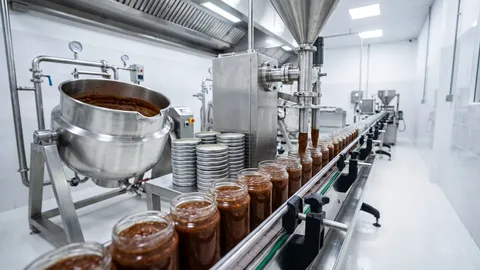
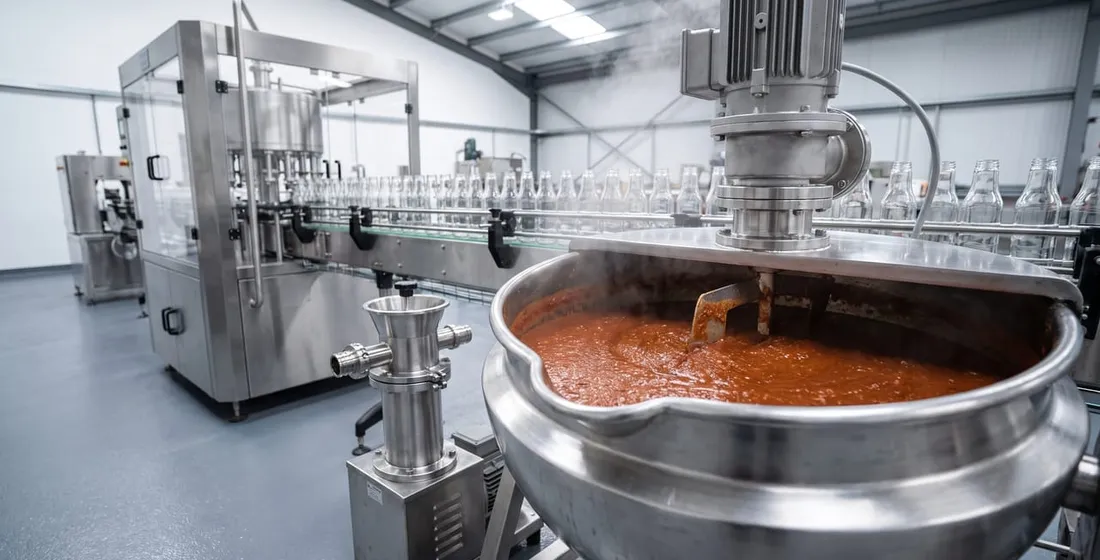
- The container decides the machine route. A pourable sauce runs the homogenizer and liquid filling line; a thick sauce or paste runs the semi-liquid jar route after the colloid mill.
- Acidity decides the heat process and therefore the line time. Codex puts the low-acid boundary at an equilibrium pH of 4.6 with a water activity above 0.85, which is the measurement most first briefs arrive without.
- Glass tooling adds roughly a week of lead before a run can be booked, and changeover, clean-down, coder setup, the first-article check and QA sampling do not shrink when the batch does.
- The comparison table below sets the bottle route against the jar route on minimum, machine path and lead time.
Most Sri Lankan sauce brands start with a stockpot, a hand blender and a recipe that works. The recipe is rarely the problem. The problem arrives when a retail buyer asks who manufactures the product, and the honest answer has to be a certified site rather than a rented kitchen.
At that point the founder almost always asks for a price per bottle. It is the wrong first question. What decides a first commercial run is how much sauce one kettle charge makes, and how many bottles that charge fills. Price is downstream of that.
Why a first-run minimum is a machine number
A minimum order quantity in contract manufacturing reads like a commercial policy. It is closer to a description of the equipment. A jacketed steam kettle holds a fixed charge. The batch is cooked, milled, held at temperature and filled in one continuous pass, because a cooked sauce that sits and cools between steps is a different product by the time it reaches the capper.
At Silk Foods Ceylon (SFC), a contract-manufactured sauce or spread in a 300 g glass jar starts at 1,500 jars, and that quantity is described internally as a half-day production block. A 200 ml glass bottle format on the liquid filling line starts at 1,250 bottles. Neither figure is a negotiating position. Each is roughly what a single charge yields once filled into that container.
That matters for a founder deciding how much stock to commit. Asking for 600 bottles does not halve the cost of 1,250. The kettle is still charged once, cleaned once, and the line set up once. What halves is the finished stock those fixed costs are spread across, which moves the cost per bottle the wrong way.
The maths is simpler than the quotation process usually makes it look. One charge, one changeover, one setup, one quality cycle.
The wider version of that calculation, contract manufacturing against financing a line of your own, is worked through in the 2026 founder’s maths.
Bottle or jar, and which line the sauce runs on
The container is usually treated as a branding decision. On the floor it is a routing decision, because a pourable sauce and a thick paste do not travel through the same machines. The table below sets the two routes side by side.
| Pourable sauce, 200 ml glass bottle | Thick sauce or paste, 300 g glass jar | |
| First-run minimum at SFC | 1,250 bottles | 1,500 jars, a half-day block |
| Machine route | Kettle, pipe-type duplex filter, homogenizer, liquid filling machine, glass bottle capping machine | Kettle, colloid mill, semi-liquid filling into jar, lug or twist closure |
| What the format suits | Chilli sauce, table sauce, dressing, thin marinade | Garlic or coriander paste, relish, chutney, thick condiment |
| Heat process | Hot fill if acidified below pH 4.6, otherwise a validated retort schedule | Hot fill if acidified below pH 4.6, otherwise a validated retort schedule |
| Lead-time note | Glass tooling adds about a week before booking | Glass tooling adds about a week before booking |
A pourable chilli sauce travels the duplex filter, the homogenizer and the filler. A thick garlic or coriander paste is too viscous for that path and goes to a jar off the semi-liquid route, after the colloid mill.
Deciding this early is worth more than it sounds. Cap tooling, fill volume, label height and the declared net contents all follow the container, and redrawing artwork after the format moves is the most common avoidable cost in a first run. Under regulation 5(1)(c) of the Food (Labelling and Advertising) Regulations 2026, in operation from 1 July 2026, the net contents have to appear on the main panel in SI units, g or kg for solids and ml or l for liquids, so the number the filler is set to and the number the label carries are the same decision. The same regulation carries a proviso that suits a bottled sauce: for bottled food products the date of expiry, batch number and date of manufacture may be stamped indelibly on the bottle neck at a letter size of not less than 1.5 mm, which keeps the front label clean.
One clause catches sauces specifically. Where a food is packaged in a liquid medium, the declaration required is the net drained weight rather than the total fill. A chutney carrying solids in brine or oil therefore has two numbers to agree, and they are not interchangeable.
Fill has a standard of its own. The Codex regional standard for chilli sauce, adopted in 2011 and amended in 2013, sets a minimum fill of not less than 90 percent of the container water capacity, measured as the volume of distilled water at 20 degrees Celsius the sealed container holds. Headspace is allowed, underfilling is a defect.
Where a brand is launching several condiment SKUs at once rather than one, the range version of this decision, including the jar against retort pouch comparison, is covered in the curry paste range playbook.
What the colloid mill fixes that the recipe cannot
A sauce that separates in the bottle is rarely a recipe fault. It is usually a particle-size fault. A colloid mill forces the batch through a narrow gap between a fast-spinning rotor and a fixed stator, shearing solids and oil droplets down to a fine, even size measured in single-digit microns rather than in the fractions of a millimetre a blender leaves behind.
For a sauce, that matters in three places at once. Fine, even particles hold suspension longer, so the bottle does not show a water layer at the neck after a fortnight on shelf. A tighter emulsion survives heat better, because large oil droplets coalesce and weep first when the container reaches sterilising temperature. And the mouthfeel reads as continuous rather than grainy.
A kitchen blender cannot reach that range, which is the most common reason a recipe that behaves perfectly at home behaves differently at 1,250 bottles. The mill has two settings that decide the outcome, the rotor to stator gap and the rotor speed, and a first run closes both with pilot batches rather than opinions.
The mill-side detail, including how many sample rounds a gap sweep usually takes, is set out in the colloid mill and iteration count.
Where does the sauce sit on the acid scale?
This is the question that sets the schedule, and most first briefs arrive without an answer to it. The Codex Alimentarius code of hygienic practice for low-acid and acidified low-acid canned foods, adopted in 1979 with editorial corrections in 2011, puts the line at an equilibrium pH of 4.6. A food counts as low-acid where any component has a pH above 4.6 and a water activity above 0.85.
A sauce held below 4.6 by tamarind, lime or added acetic acid is an acidified food and can be hot filled and held. A sauce above 4.6 is a low-acid food in a hermetically sealed container and needs a validated thermal process under pressure. The University of Georgia Cooperative Extension put the practical figure in 2025 at 240 to 260 degrees Fahrenheit, roughly 116 to 127 Celsius. The published minimum lethality for a low-acid food is an F0 value of 3 minutes at 121.1 Celsius, which is the twelve decimal reduction cook for Clostridium botulinum.
The consequence is line time, and line time is cost. An acidified sauce books the kettle and the filler. A low-acid sauce books the kettle, the filler and the retort, plus a cooling cycle before palletising. The same 1,250 bottles occupy a longer block on the second route.
The clause worth reading twice is the component test. A sauce with an acidified continuous phase but low-acid particulates, coconut, dhal, cashew or dried fish, is still a low-acid food. Measuring the blended sample and stopping there is one of the more common ways a first brief specifies the wrong process.
The research and development team at the Matale facility sees the same gap most quarters. A founder arrives with a working recipe, a target of twelve months at ambient, and no pH reading at all. The reading takes minutes on a calibrated meter. Finding out afterwards that the sauce needs a retort schedule the quotation never carried costs a re-quote and a slot.
What each heat trial actually corrects on the recipe side is walked through in reformulating a kitchen recipe for retort and 1,500-jar consistency, and the evidence behind a printed shelf life is a separate exercise, set out in accelerated stability testing.
The costs that do not shrink when the run does
Six line items stay roughly constant whether the batch is 600 bottles or 1,250. Line changeover. Clean-down. Coder and filler setup for the new format. The first-article check. The QA sampling the quality plan requires. And the glass tooling that adds about a week of lead before the run can be booked.
Those are per-block costs. They are why a smaller run does not produce a proportionally smaller invoice, and why halving the minimum raises the cost per bottle rather than lowering the bill.
Service snapshot: contract manufacturing at Silk Foods Ceylon
|
There is a lever, and it is not the minimum. It is the second run. Setup work done once is largely reusable, so a brand committing to a repeat slot in the same format and recipe buys that changeover on far better terms than one that changes container between runs.
Counting the weeks from a locked recipe to a first pallet
No regulator publishes this timeline, so treat the sequence below as an operator plan built backwards from a target shelf date. It assumes the recipe is already locked and no new formulation work is required.
- Week 1. Measure the pH on the finished sauce and on any low-acid particulate in it, and settle the container. Those two decisions fix the heat process and the machine route.
- Week 1 to 2. Lock the fill, the closure and the declared net contents, then release artwork to print. Glass tooling adds about a week, so the container order and the print file move together.
- Week 2. Run a pilot batch through the colloid mill and the heat schedule the pH reading indicates, and read the cold sample for separation, viscosity and colour rather than flavour alone.
- Week 2 to 3. Agree the quality plan: which checks happen at what frequency, who signs them, and what the first-article pack is read against.
- Week 3 to 4. Book the block. One kettle charge, one changeover, one filler setup, one QA cycle, and a first-article pack read before the block finishes.
- Week 4 onward. The SLSI file runs alongside the production plan, so the listing date is planned around the assessment calendar rather than the packing calendar.
Two to three weeks from purchase order to dispatch is realistic for an existing recipe at SFC. Where formulation work is needed first, add 3 to 4 weeks at most (signed brief to approved formulation) ahead of the 2 to 3 week production run, roughly 5 to 7 weeks in total, with the two to four sample iterations run inside that R&D window.
The category also has published Sri Lankan specifications. On the SLSI inspection schedule in the Sri Lanka Customs tariff guide, tomato sauce and ketchup sit under SLS 260 and chillie sauce under SLS 581. That schedule governs imports, so confirm current domestic applicability with the Sri Lanka Standards Institution, but the specification exists and is worth reading before a recipe locks.
Retail clearance runs on its own clock. SLSI publishes the assessment sequence for an SLS mark permit rather than a duration, so confirm the current window with SLSI at submission and hold a buffer between manufacturer sign-off and a target shelf date.
Buyer's checklist: settle these before asking for a quotation
|
The submission itself, document by document, is broken down in the SLSI packaged food submission, step by step.
Frequently asked questions
What is the minimum order for a contract-manufactured sauce in Sri Lanka?
At Silk Foods Ceylon a sauce or spread in a 300 g glass jar starts at 1,500 jars, about a half-day production block, and a pourable sauce in a 200 ml glass bottle starts at 1,250 bottles on the liquid filling line. Both figures reflect a single kettle charge and one line setup rather than a commercial policy.
Why does a sauce separate in the bottle after a few weeks?
Usually because the particle size is too coarse to hold suspension, not because the recipe is wrong. A colloid mill shears the batch between a fast rotor and a fixed stator down to single-digit microns, which keeps solids and oil droplets dispersed and helps the emulsion survive heat processing. A domestic blender does not reach that range.
Does a Sri Lankan sauce need a full retort schedule?
It depends on acidity. Codex puts the boundary at an equilibrium pH of 4.6, with low-acid status applying where any component is above pH 4.6 and above 0.85 water activity. Below 4.6 a sauce can be hot filled; above it, a validated pressure process at roughly 116 to 127 Celsius is required, per University of Georgia Cooperative Extension guidance published in 2025.
How long does a first sauce production run take?
For a locked recipe, 2 to 3 weeks from purchase order to dispatch at SFC, with glass tooling adding about a week before the run can be booked. Where formulation work is needed first, add 3 to 4 weeks at most (signed brief to approved formulation) ahead of the production run, roughly 5 to 7 weeks in total, with the two to four sample iterations run inside that R&D window.
Does Silk Foods Ceylon manufacture sauces to a brand owner’s own recipe?
Yes. Contract manufacturing at the Matale facility produces the buyer’s locked recipe on SFC equipment, covering the jacketed steam kettle, colloid mill, homogenizer, liquid filling line, glass bottle capping and retort. The site is BRCGS and FSSC 22000 V6 audited, with SLSI submission support included in a standard contract manufacturing engagement.
How Silk Foods Ceylon can help
For a local sauce or condiment brand moving a working recipe into its first commercial run, Silk Foods Ceylon (SFC) operates a cellular-manufacturing facility in Matale where cooking, milling, filling, capping and heat processing happen on one audited site. First-run minimums are 1,500 jars for a 300 g glass jar sauce or spread and 1,250 bottles for a 200 ml glass bottle format, with lead times of 2 to 3 weeks from purchase order to dispatch on a locked recipe. The facility is BRCGS and FSSC 22000 V6 audited, with SLSI clearance and Sri Lanka Food Act compliance handled on every retail SKU, and the in-house research and development team can close a pH reading, a mill gap and a heat schedule inside one pilot session.
To brief a first sauce run, email brands@esilkroute.com.lk or call +94 77 157 7294.
Sources
FAO and WHO Codex Alimentarius Commission, Code of Hygienic Practice for Low-Acid and Acidified Low-Acid Canned Foods, CAC/RCP 23-1979, editorial corrections 2011, clause 2.1 defining an acid food as one with a natural pH of 4.6 or below, clause 2.2 on an acidified low-acid food attaining an equilibrium pH of 4.6 or lower after heat processing, and the low-acid definition at a pH greater than 4.6 with a water activity greater than 0.85 (retrieved 2026-09-07): Codex CAC/RCP 23-1979
FAO and WHO Codex Alimentarius Commission, Regional Standard for Chilli Sauce, CXS 306R-2011, adopted 2011 and amended 2013, clause 7.1.1(a) requiring the product to occupy not less than 90 percent of the water capacity of the container, defined as the volume of distilled water at 20 degrees Celsius the sealed container holds, and clause 2.1(c) on processing by heat before or after hermetic sealing (retrieved 2026-09-07): Codex CXS 306R-2011
University of Georgia Cooperative Extension, Preserving Acidified Foods Using the Hot-Fill-Hold Process, publication C1328-03, 2025, on products at or above pH 4.6 requiring a thermal process under pressure at 240 to 260 degrees Fahrenheit (retrieved 2026-09-07): UGA Extension C1328-03
Holden, Wolfe, Ogejo and Cummins, Introduction to Biosystems Engineering, Virginia Tech Libraries Open Education Initiative, 2021, section 6.2 on the minimum thermal treatment for a low-acid food reaching an F0 value of 3 minutes, F0 being the time at 121.1 degrees Celsius for twelve decimal reductions of Clostridium botulinum (retrieved 2026-09-07): Principles of Thermal Processing of Packaged Foods
Ministry of Health and Mass Media, Sri Lanka, Food (Labelling and Advertising) Regulations 2026, Gazette Extraordinary No. 2494/47 of 26 June 2026, in operation from 1 July 2026, regulation 5(1)(c) on net contents declared on the main panel in SI units and the net drained weight where a food is packaged in a liquid medium, regulation 5(2)(a)(i) on a complete list of ingredients in descending order of ingoing weight at the time of manufacture, and the proviso permitting the date of expiry, batch number and date of manufacture to be stamped on the bottle neck of bottled food products at not less than 1.5 mm (retrieved 2026-09-07): Gazette Extraordinary No. 2494/47
Sri Lanka Customs, SLSI Schedule 1(A) to the National Imports Tariff Guide, document dated 2015 and 2016 as posted, listing tomato sauce and ketchup under HS 2103.20 against SLS 260 and chillie sauce under HS 2103.90 against SLS 581 (retrieved 2026-09-07): Sri Lanka Customs SLSI Schedule 1(A)
Sri Lanka Standards Institution, SLS Mark Product Certification, 2026, on the published assessment sequence of application, desktop evaluation, pre-assessment, product testing, final on-site assessment and permit committee, with no processing timeline published (retrieved 2026-09-07): SLSI SLS mark product certification
Written by the Silk Foods Ceylon Editorial Team. Silk Foods Ceylon (Pvt) Ltd. is a BRCGS and FSSC 22000 V6 audited contract manufacturer in Matale, Sri Lanka, offering contract manufacturing, private labelling, co-packing and in-house research and development for local Sri Lankan brand owners, FMCG companies, hotel and restaurant groups, and distributors. To brief a project: brands@esilkroute.com.lk or +94 77 157 7294.