Granola and muesli contract manufacturing in Sri Lanka: MOQ and cost
Buyer’s snapshot
- Muesli is a dry blend. Granola is a bake. That single difference cuts finished output per shift from roughly 600 kg to roughly 250 kg, and it is the reason the two products carry different minimum order quantities.
- First-run MOQ at Silk Foods Ceylon is 2,000 pouches for granola and 1,500 pouches for muesli, both at a 250 g fill.
- A 2,000 pouch granola run costs about LKR 443 per pouch ex-factory, or roughly LKR 886,000 for the run. At 10,000 pouches the same recipe lands near LKR 384.
- Printed pouch film, not the recipe, is the long pole. Budget 3 to 4 weeks for film and 9 to 10 weeks brief to first pallet.
A granola brand usually arrives at a contract manufacturer at the same moment. The recipe works. It sells 40 pouches a weekend at a Colombo market or through an Instagram page, the clusters hold together, and a supermarket buyer has just asked for a listing and a price list. The question at that point is not whether the recipe is good. It is whether a 500 kg bake produces the same cluster as a 4 kg home oven, what 2,000 pouches actually costs to put on a shelf, and how many weeks stand between a signed brief and a pallet at the distribution centre.
Sri Lanka’s grocery retail market was estimated at USD 794 million in 2025 and is projected to reach USD 1,383 million by 2032, a compound annual growth rate of 8.3 percent, according to 6Wresearch. Breakfast cereal sits inside that growth as a premium, health-positioned category, and it is one of the few shelves where a small local brand can sit next to an import without being priced out. The mainstream cereal shelf in Sri Lanka is held by a small number of large domestic manufacturers, which leaves the toasted-cluster and no-added-sugar tiers relatively open to a smaller brand.
What a granola run involves that a muesli run does not
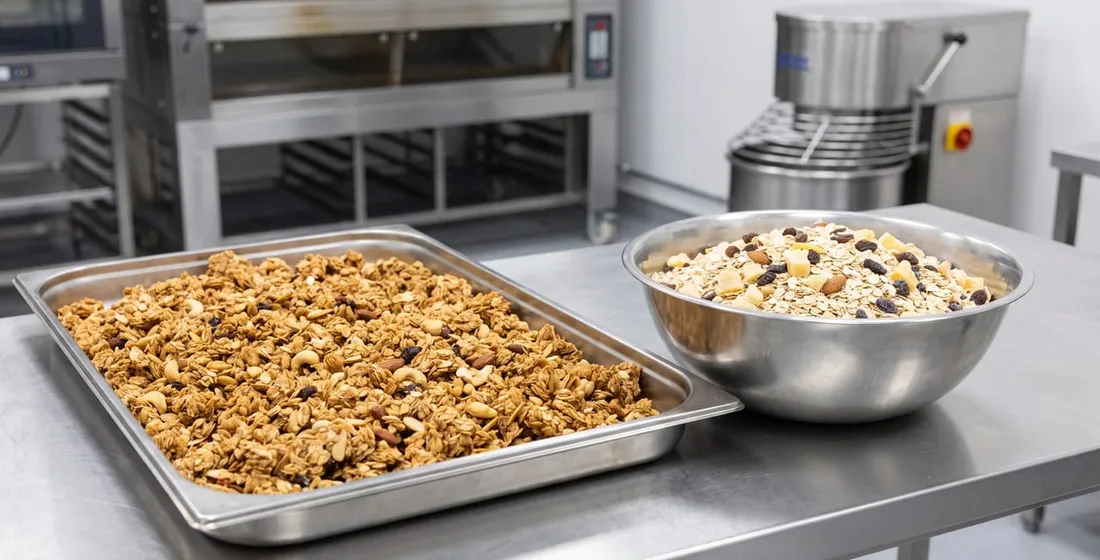
Muesli is a weigh-and-blend product. Rolled oats, dried fruit, nuts and seeds go into a ribbon blender in a fixed sequence, run for a set time, and go straight to the filler. Nothing is cooked. Granola adds a wet stage and a thermal stage: oil and a syrup binder are mixed through the dry base, the wet mass is spread on trays, baked until the sugars set, then cooled, broken and screened to a target cluster size before the heat-sensitive inclusions such as raisins or dried mango are blended back in.
That sequence is why the two products behave differently on a production schedule. A blend line can turn over several batches in a shift. A bake line is limited by oven tray count and by cool-down, because warm granola cannot be screened without shattering the clusters or blended with dried fruit without sweating the pouch. Finished output per shift falls by more than half.
| Process step | Muesli | Granola |
| Ingredient weighing and dry blend | Yes | Yes |
| Wet mix with oil and syrup binder | No | Yes |
| Tray bake | No | Yes, 18 to 25 minutes |
| Forced cooling | No | Yes, 40 to 60 minutes |
| Cluster break and screening | No | Yes |
| Blend heat-sensitive inclusions | In the single blend | Yes, after cooling |
| Fill, seal, code | Yes | Yes |
| Typical finished output per shift | About 600 kg | About 250 kg |
How much can a line produce in a day?
Capacity questions get answered in kilograms of finished product, not in machine ratings. At the Silk Foods Ceylon (SFC) facility in Matale, a dry-blend schedule turns out up to 1,200 kg of finished muesli in a day, while a two-shift tray-bake schedule turns out 400 to 500 kg of finished granola. Pouching runs separately at 3,500 to 4,000 units a day at a 250 g fill, which means the filler is rarely the constraint on a first run. The oven is.
| Process stage | Daily capacity | What sets the ceiling |
| Dry blending, muesli | Up to 1,200 kg finished | Blender batch size and flavour changeover |
| Wet mix and tray bake, granola | 400 to 500 kg finished | Oven tray count and cool-down time |
| Cluster break and screening | About 500 kg | Screen deck throughput |
| Filling and sealing, 250 g pouch | 3,500 to 4,000 pouches | Filler cycle and seal dwell |
| Coding, case packing, palletising | About 4,000 pouches | Line staffing |
For a brand owner the practical reading is that a 2,000 pouch granola order, which is 500 kg of finished product, occupies roughly one full bake day plus part of a pouching day. A 2,000 pouch muesli order occupies less than half a day. Those two facts drive everything downstream, including the minimum order quantity and the per-unit conversion cost.
Which pouch format should a first SKU use?
The default first granola SKU in Sri Lanka is a 250 g stand-up kraft pouch with a clear window. It sits at a price point local shoppers will test, it fits the shelf planogram at the major supermarket chains, and it ships well through the local e-commerce marketplaces without secondary protection. Larger 400 g packs improve the price-per-100 g story but tie up more working capital in a first run, and sachets are useful for HORECA in-room amenity programmes and sampler bundles rather than for shelf.
| Format | Fill weight | Primary channel | Typical shelf life |
| Stand-up kraft pouch with window | 250 g | Major supermarket chains | 9 months |
| Stand-up kraft pouch | 400 g | Same chains, family tier | 9 months |
| Flat sachet | 40 to 50 g | Hotel in-room amenity, sampler bundles, e-commerce | 6 months |
| Bulk laminate bag | 1 kg | Hotel buffet, cafe and bakery supply | 6 months |
Pouch choice is also a co-packing decision rather than a manufacturing one when a brand already has finished product and only needs filling and sealing. The same 250 g kraft format is covered in more depth in co-packing 250 g kraft pouches, and the smaller e-commerce tier is covered in the 50 g and 100 g pouch tier.
What is the MOQ per SKU, and why is it set there?
Minimum order quantity in a granola or muesli programme is set by two things: the smallest batch a blender or an oven schedule can run without wasting a changeover, and the smallest printed film order a converter will accept. First-run MOQ at Silk Foods Ceylon is 2,000 pouches for granola and 1,500 pouches for muesli, both at a 250 g fill, which works out to 500 kg and 375 kg of finished product respectively. Muesli sits lower because it does not consume oven time.
The changeover is the part brand owners tend to underestimate. Every SKU switch on a blend or bake line costs a full wet clean, an allergen verification and a start-up sample, and that cost is fixed whether the run is 300 pouches or 3,000. Spreading it across 300 pouches would put conversion cost above the ingredient cost, which is the point at which the numbers stop working for the brand rather than for the factory. A 2,000 pouch floor is where the arithmetic turns.
What does a first granola run cost in LKR?
The table below prices a representative 250 g granola: 55 percent rolled oats, 15 percent nuts and seeds, 12 percent dried fruit, 8 percent coconut oil and 10 percent syrup binder, packed in a printed stand-up kraft pouch. Figures are ex-factory in Sri Lankan rupees at August 2026 input costs, and they exclude the brand’s own distribution, listing fees and marketing.
| Cost line | 2,000 pouch first run | 10,000 pouch repeat run |
| Ingredients, including 4 percent process loss | LKR 283 | LKR 283 |
| Printed stand-up kraft pouch | LKR 46 | LKR 31 |
| Conversion: blend, bake, cool, screen, fill, seal, code | LKR 105 | LKR 62 |
| Case, shrink and palletising | LKR 9 | LKR 8 |
| Ex-factory cost per pouch | LKR 443 | LKR 384 |
| Value of the run | LKR 886,000 | LKR 3,840,000 |
At a trade price of LKR 668 to the retailer, which supports a shelf price near LKR 890 after a standard supermarket margin, the first run returns a gross margin of about 34 percent to the brand. The same recipe at 10,000 pouches returns about 43 percent. That nine point gap is the entire commercial argument for treating the first run as a market test rather than as a profit centre, and for planning the second run before the first one lands.
Two lines in that table move the most. Printed pouch film drops sharply with quantity because short digital print runs carry a plate and setup premium. Conversion drops because the fixed changeover is spread wider. Ingredient cost barely moves, since oats, cashew and dried fruit are bought at commodity terms that a 500 kg lot does not improve.
Where do the oats come from, and what does that do to the schedule?
Oats are not grown commercially in Sri Lanka, so every granola and muesli programme in the country runs on imported rolled or flaked oats, classified under HS 1104.12. The applicable duty stack, including customs duty, PAL, CESS, SSCL and VAT, is published in the Sri Lanka Customs National Imports Tariff Guide 2026. Buying from a local importer’s existing stock removes the import lead time but adds a margin layer; importing directly against a run saves that margin but adds 4 to 6 weeks and a minimum container commitment that a first-run brand rarely justifies.
Incoming grain quality is a documented control, not an assumption. Granola and muesli fall under SLS 1725 Part 1:2021, the Sri Lanka Standards Institution specification for processed multi/mixed grain food products, and the oats in them under SLS 1725 Part 3:2021 for rolled oats, both listed in the SLSI standards catalogue. In 2022 SLSI circulated draft amendments to the SLS 1725 parts to bring their maximum aflatoxin levels into line with European Union Regulation 1881/2006, a change notified to World Trade Organization members and reported by the USDA Foreign Agricultural Service. In practice that means a granola programme should hold a certificate of analysis for every incoming oat and nut lot, and should keep those certificates with the batch record rather than in a supplier folder.
What compliance applies before the pouch reaches a supermarket shelf?
Labelling is the first gate. The Food Act No. 26 of 1980 and its labelling regulations require the product name, an ingredient list in descending order of weight, net weight, batch code, date of manufacture and expiry, the manufacturer’s name and address, and a nutrition declaration. Supermarket buyers at the major multiples generally ask for a Sri Lanka Standards Institution product certification mark on top of that, which is voluntary in law but close to mandatory in commercial practice. Related certification questions are covered in contract manufacturing certifications in Sri Lanka.
The Matale facility operating these runs is BRCGS certified and holds FSSC 22000 V6, which matters less for a purely local listing and a great deal for a brand that later wants to sell the same SKU into an export market or into a hotel group’s central procurement. SLSI submission support sits inside a standard contract manufacturing engagement, so the brand owner is not left assembling a technical file alone.
One boundary is worth naming early. A plain granola or muesli is a food product under the Food Act. The moment a formulation carries a traditional health claim, for example an ashwagandha or gotu kola addition sold on a wellness benefit, the SKU moves toward Department of Ayurveda registration and a different timeline. Brands that want a functional angle without that overhead usually keep the claim nutritional, such as high fibre or no added sugar, and support it with a laboratory nutrition panel.
How long does it take from brief to first pallet?
A first granola SKU takes 9 to 10 weeks. Repeat runs of a locked recipe take 2 to 4 weeks. The gap between those two numbers sits almost entirely in artwork and printed film, not in the kitchen. The broader cost and timing picture for a first commercial run is set out in the 2026 founder’s maths for contract manufacturing.
| Week | What happens | Who holds the critical path |
| 1 | Brief, recipe review, costing against a target shelf price | Brand owner |
| 2 to 3 | Bench trials, three iterations, cluster size and sweetness locked | SFC research and development |
| 4 | 25 kg pilot bake, shelf-life samples placed on accelerated test | SFC |
| 5 | Artwork approval and printed pouch film ordered | Brand owner |
| 6 to 8 | Film printing and delivery | Film converter |
| 9 | Commercial bake, cooling, screening and pouching | SFC |
| 10 | Quality release, batch documentation, delivery | SFC |
One brand owner arrived in Matale with a granola that had been baked in a domestic oven at 4 kg a time and sold through a weekend market for two years. The recipe transferred almost unchanged. What did not transfer was the cluster: at tray scale the binder spread differently and the first pilot came out closer to loose toasted oats than to the clusters customers recognised. Two bench iterations fixed it by lifting the syrup ratio and shortening the bake. The whole detour cost nine days. The artwork, submitted late in week six, cost three weeks.
Brands adding fruit inclusions often price a dehydrated component at the same time, since a locally dried mango or pineapple piece can replace an imported one at a better landed cost. That route is covered in dehydrated fruit snack SKUs.
Frequently asked questions
Does Silk Foods Ceylon offer contract manufacturing for granola and muesli?
Yes. Silk Foods Ceylon runs both dry-blend muesli and tray-baked granola at its Matale facility, with a first-run minimum of 2,000 pouches for granola and 1,500 for muesli at a 250 g fill. The engagement covers recipe scale-up, pilot baking, shelf-life testing, pouching, coding and SLSI submission support.
What is the minimum order quantity for a granola SKU in Sri Lanka?
First-run granola MOQ at Silk Foods Ceylon is 2,000 pouches at 250 g, which is 500 kg of finished product. The floor is set by oven changeover economics and by the smallest printed film order a converter will accept, not by warehouse policy. Muesli sits lower at 1,500 pouches because it skips the bake.
How long does a granola contract run take from brief to delivery?
Budget 9 to 10 weeks for a first SKU and 2 to 4 weeks for a repeat run of a locked recipe. Bench trials and pilot baking take about four weeks. Printed pouch film takes three to four weeks and is usually the critical path, so artwork approval is the single deadline worth protecting.
Do granola and muesli need SLSI certification to sell in Sri Lankan supermarkets?
Sri Lanka Standards Institution product certification is voluntary in law, while Food Act No. 26 of 1980 labelling compliance is mandatory. In practice buyers at the major supermarket chains ask for the SLS mark on packaged cereal, so most brands treat it as a listing requirement rather than an option.
Can a granola SKU be made without imported oats?
Not in the conventional sense, since oats are not grown commercially in Sri Lanka and arrive under HS 1104.12. Brands wanting a local-content story usually keep imported oats as the base and localise the inclusions instead, using Sri Lankan coconut chips, cashew, treacle and dried tropical fruit to carry the origin claim.
How Silk Foods Ceylon can help
For founders taking a granola or muesli recipe from a home oven to a first commercial run, Silk Foods Ceylon (SFC) operates a cellular-manufacturing facility in Matale that handles every step between a tested recipe and a retail-ready pouch. First-run MOQs are 2,000 pouches for granola and 1,500 pouches for muesli at a 250 g fill, with dry-blend capacity to 1,200 kg a day and tray-bake capacity of 400 to 500 kg of finished granola a day. Lead times run 2 to 4 weeks on a locked recipe, or 9 to 10 weeks when research and development plus printed film sit in front of the run. The facility is BRCGS certified and holds FSSC 22000 V6, with SLSI submission support built into a standard contract manufacturing engagement.
To brief a project, email brands@esilkroute.com.lk or call +94 76 441 0389 / +94 76 918 5744.
Sources
Sri Lanka Customs, National Imports Tariff Guide 2026, HS Chapter 11. customs.gov.lk. Retrieved 16 August 2026.
USDA Foreign Agricultural Service, GAIN reports on Sri Lanka’s draft amendments (Number 1) to SLS 1725:2021, processed grain-based food products, 2022.
Sri Lanka Standards Institution, Sri Lanka Standards Catalogue 2023 (SLS 1725 Parts 1 to 4, processed grain-based food products). slsi.lk. Retrieved 1 October 2026.
6Wresearch, Sri Lanka Food and Grocery Retail Market Outlook, 2025 base year. 6wresearch.com. Retrieved 16 August 2026.
Sri Lanka Export Development Board, processed food export performance, 2026. srilankabusiness.com. Retrieved 16 August 2026.