In-House Kitchen vs Contract Manufacturer in Sri Lanka: Total Cost
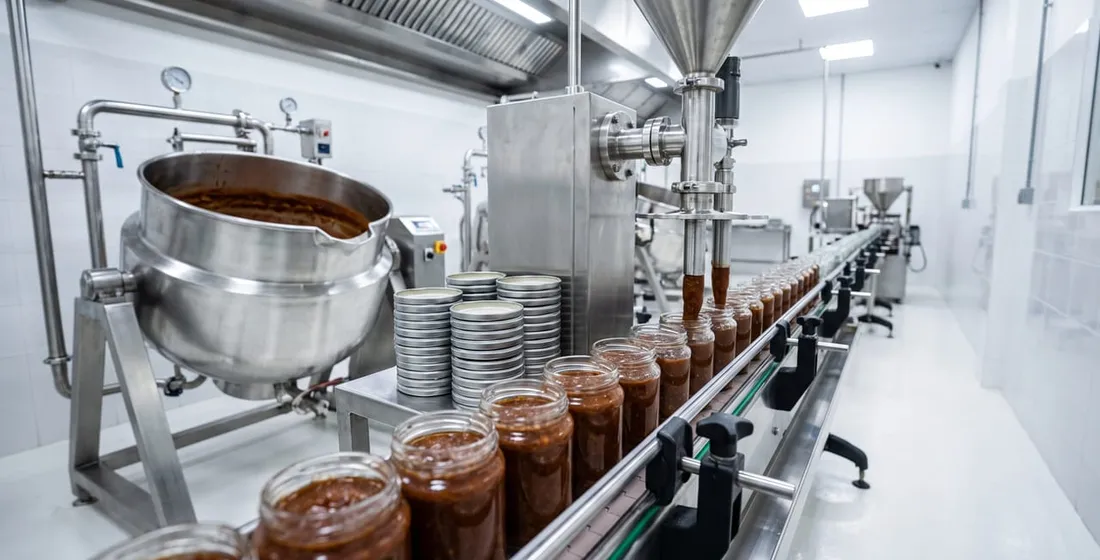
A stainless steel sauce production line with a steam-jacketed kettle and a filling machine filling rows of plain unlabelled glass jars with thick brown sauce, with stacks of metal lids beside the line.
Buyer’s snapshot
- In this worked model, a certified one-shift sauce line costs about LKR 3.07 million a month before it fills a single jar. That covers the capital charge, the QA and production team, the compliance cycle and the building.
- At 20,000 jars a month, that fixed cost works out to LKR 154 a jar. It drops below LKR 50 only when the line runs close to its full 66,000-jar monthly capacity.
- Against an illustrative contract manufacturing conversion charge of LKR 60 a jar, the in-house line breaks even at about 64,000 jars a month, or 97% utilisation.
- Silk Foods Ceylon (SFC) runs first commercial batches from 1,500 jars in a half-day block, with no capex, no multi-year volume lock and the audit cycle already carried on site.
An established Sri Lankan FMCG brand (Persona B) sells a range of cooking sauces. Its own kitchen unit makes about 6,000 jars a month, and a modern-trade listing plus a new distributor could take it to 20,000 or more within a year. The board has two options on the table. One is to build a certified line of its own. The other is to move production to a contract manufacturer. The price of machinery is the number most boards compare. It is also the least useful number in the decision.
This explainer lays out the full cost on both sides: the capex avoided, the commitment each route asks for, the per-unit LKR cost at three volumes, and the compliance load a manufacturer carries for the brand. A note on method: the LKR figures below are planning assumptions for a 300 g glass-jar sauce, set out so a finance team can replace them with its own. They are not a quote. The interest rate, tariff, wage and regulatory references are real.
What does an in-house line really cost per month?
About LKR 3.07 million a month in this model, whether the line runs or not. Machinery is only one part of it. The other parts are the people, the audit cycle and the building, and together they cost more than the machinery.
| Fixed cost line (monthly, planning assumptions) | LKR |
|---|---|
| Capital charge: LKR 60 million line and fit-out, 7-year depreciation plus interest | 1,310,000 |
| Team: QA lead, lab technician, production supervisor, maintenance, 8 operators | 1,060,000 |
| Compliance cycle: third-party audits, consultants, external lab tests, calibration, pest control | 300,000 |
| Building, utility fixed and demand charges, insurance | 400,000 |
| Total fixed cost per month | 3,070,000 |
The capital line is the one that has moved most in 2026. The Central Bank of Sri Lanka raised the Overnight Policy Rate to 8.75% in May 2026 and held it there at its 22 July 2026 review. The model assumes a 12% commercial borrowing rate on top of that policy rate. The other lines are also rising. The national minimum wage rose to LKR 30,000 a month from 1 January 2026, up from LKR 27,000, and trained food operators are paid well above that floor. The Public Utilities Commission of Sri Lanka (PUCSL) raised tariffs by 18% from 11 May 2026 for industrial supplies above 42 kVA (the I-2 and I-3 categories), while small industrial supplies (I-1) stayed unchanged. A line with a steam kettle, a colloid mill and a pasteuriser is usually above 42 kVA. Headline inflation reached 8.0% in August 2026, according to the Central Bank, so no line in that table is going to get cheaper on its own.
The wider 2026 case, including the policy-rate move and the certification timeline, is set out in contract manufacturing in Sri Lanka: the 2026 founder’s maths. This post adds the per-jar numbers.
How does the per-jar cost change with volume?
Fixed cost per jar falls as volume rises, and the model only matches the contract charge when the line is almost full. A one-shift line at 3,000 jars a day and 22 working days has a ceiling of 66,000 jars a month. The model adds LKR 12 a jar for variable conversion (energy, cleaning chemicals, consumables). It leaves out ingredients, jars and labels, because they cost roughly the same on either route.
| Monthly volume | In-house fixed cost per jar | In-house conversion per jar | Contract manufacturing conversion per jar (illustrative) |
|---|---|---|---|
| 6,000 jars (today’s kitchen volume) | LKR 512 | LKR 524 | LKR 60 |
| 20,000 jars (after the new listing) | LKR 154 | LKR 166 | LKR 60 |
| 40,000 jars | LKR 77 | LKR 89 | LKR 60 |
| 64,000 jars (break-even, 97% of capacity) | LKR 48 | LKR 60 | LKR 60 |
Break-even is where LKR 3.07 million divided by volume, plus LKR 12, equals LKR 60. That is about 64,000 jars a month, or 97% of the line’s capacity. This is the utilisation trap: an in-house line competes on cost only when it runs almost full, every month, on one format. A seasonal brand that sells 30,000 jars in the festive months and 12,000 in the rest of the year pays the full LKR 3.07 million every month anyway.
The contract charge in the table is a single illustrative figure. Real quotes are tiered by run size and fold several line items together. How to take one apart is covered in how to read a contract manufacturing quote in Sri Lanka. The model does not change much with a different quote. A contract charge of LKR 80 still puts break-even at about 45,000 jars a month, which is 68% utilisation, held every month of the year.
What does each route commit the brand to?
Both routes involve a minimum commitment. They differ in how long it lasts and how easy it is to exit.
| Commitment | In-house line | Contract manufacturing at SFC |
|---|---|---|
| Capital | LKR 60 million, recovered over about 7 years | None |
| Minimum volume | Whatever keeps the line near 97% full | 1,500 jars per run, in a half-day block |
| Staff | A trained team on payroll between runs | None; the team is the manufacturer’s |
| Building | Lease or purchase of a food-grade unit | None |
| Exit | Sell used equipment at a discount, settle the loan | Stop placing purchase orders |
| Time to first certified batch | Build, registration, operating records, then audits | About 2 to 3 weeks from purchase order for a locked recipe |
A contract manufacturer’s minimum order quantity (MOQ) is often described as the price of outsourcing. In practice it is much smaller than the commitment that comes with a line of your own. At SFC, a semi-liquid run starts at 1,500 jars, and glass-jar tooling adds about one week to the first run only. The brand also keeps the option of producing two or three SKUs in consolidated runs as the range grows, which a single-format line of its own cannot easily do. How that first run is sized for a sauce, and why the minimum is a machine number rather than a policy, is covered in sauce contract manufacturing in Sri Lanka: the first-run maths.
What compliance load does a manufacturer carry for you?
Most of it, apart from the brand’s own label decisions. In the SFC R&D and QA team’s experience, established brands tend to underestimate this cost more than any other. It is a set of recurring obligations, not a single approval, and each one needs an owner.
- Premises registration. Under the Food (Registration of Premises) Regulations 2019, in force from 1 January 2020 under the Food Act No. 26 of 1980, no food may be manufactured in premises that are not registered with the relevant Food Authority. That is the Municipal Council or the Medical Officer of Health, depending on the area. The certificate expires every two years, so renewal is a scheduled task.
- Product certification. For categories on the compulsory list, the SLS mark adds fees and audits. The Sri Lanka Standards Institution (SLSI) charges LKR 5,000 to process an application and an annual fee from LKR 25,000, banded by turnover. The line-by-line build-up is in what SLSI certification costs a first-time Sri Lankan brand.
- Third-party food safety audits. Modern-trade and export-curious buyers increasingly ask for BRCGS or FSSC 22000 V6. Each scheme has annual audits, corrective-action deadlines and records to maintain every week. SFC already holds BRCGS and FSSC 22000 V6 at the Matale facility, covering more than 50 SKUs under one audit, as set out in contract manufacturing certifications in Sri Lanka.
- Labelling. The Food (Labelling and Advertising) Regulations 2026 (Gazette Extraordinary No. 2494/47) apply to food manufactured from 1 July 2026. SFC reviews artwork against them before print. The brand still approves its own claims and artwork on either route.
- The daily work. This covers HACCP records, calibration, water and environmental testing, pest control, allergen control, traceability and recall drills. It is what the QA lead and the lab technician in the fixed cost table are paid to do.
Under contract manufacturing, every item on that list except the brand’s own label decisions sits in the manufacturer’s quality system. With an in-house line, all of it sits with the brand.
When is building your own line the right answer?
When three things are true at the same time. Steady volume on one format sits above about 60,000 jars a month, all year round. The process is proprietary enough that the brand should not share it. And the brand already has, or can finance, a food-grade building and a QA lead. If all three hold, the per-jar numbers favour a line of your own, and the brand also gets full control of its schedule.
Most Persona B brands are not there yet. A common route is a hybrid: keep the existing kitchen for new product development and small test batches, and move the core SKUs to a contract manufacturer until volume on one format justifies a line. The step from a kitchen to a first commercial run is set out in home kitchen to contract manufacturing: your first Sri Lanka run.
Where SFC walks away
Silk Foods Ceylon will tell a brand when its own numbers favour building a line. If a brand’s steady single-format volume is near the break-even in the table, the honest advice is to run the model with its own figures before signing either a loan or a supply agreement.
Frequently asked questions
Is it cheaper to make food in-house or use a contract manufacturer in Sri Lanka?
It depends on utilisation. In this planning model, a certified one-shift sauce line costs about LKR 3.07 million a month in fixed cost, which is LKR 154 a jar at 20,000 jars. It matches an illustrative LKR 60 contract charge only near 64,000 jars a month, which is 97% of a 66,000-jar capacity, at an 8.75% policy rate.
What minimum order does a contract manufacturer need for a sauce?
At Silk Foods Ceylon, a first commercial run of a semi-liquid product such as a sauce, chutney or spread starts at 1,500 glass jars, filled in a half-day block. Glass-jar tooling adds about one week to the first run. The minimum is set per run, with no multi-year volume commitment, unlike a line financed over about seven years.
What licences does an in-house food factory need in Sri Lanka?
At minimum, premises registration with the Food Authority under the Food (Registration of Premises) Regulations 2019, renewed every two years, plus label compliance under the Food (Labelling and Advertising) Regulations 2026. Categories on the SLSI compulsory list also need the SLS mark, with a LKR 5,000 processing fee and an annual fee from LKR 25,000.
Can Silk Foods Ceylon take over production from a brand’s own kitchen?
Yes. SFC manufactures the brand’s own recipe under Contract Manufacturing at its BRCGS- and FSSC 22000 V6-audited Matale facility. For a locked recipe, dispatch typically follows 2 to 3 weeks after the purchase order. Semi-liquid capacity runs to 3,000 jars a day, and the in-house R&D team can scale a kitchen recipe before the first 1,500-jar run.
How Silk Foods Ceylon can help
For local FMCG brands shifting from in-house production to professional contract manufacturing, Silk Foods Ceylon (SFC) operates a 10,000 sq ft cellular-manufacturing facility in Matale with the line flexibility to run 50+ ready-to-go SKUs on a single BRCGS- and FSSC 22000 V6-audited cert stack. Capacity ranges across formats: 3,000 jars a day on semi-liquids, 2,500 × 200 ml bottles a day on beverages, 200,000 capsules a day, 15,000 patties a day and 30,000 nuggets a day. The in-house R&D team works alongside production planning, so a multi-SKU move from a brand’s own kitchen can run in parallel rather than one SKU at a time. USDA Organic and EU Organic apply on relevant SKUs, SLSI submission support sits inside the standard engagement, and every retail SKU is built for Sri Lanka Food Act compliance.
To brief a project, email b2b@esilkroute.com.lk or call +94 76 441 0389 / +94 76 918 5744.
Sources
- Central Bank of Sri Lanka, “The Central Bank of Sri Lanka keeps the Overnight Policy Rate (OPR) unchanged”, Monetary Policy Review No. 4 of 2026, 22 July 2026, OPR maintained at 8.75%. cbsl.gov.lk (retrieved 29 September 2026).
- Central Bank of Sri Lanka, “CCPI-based headline inflation accelerated in August 2026”, 31 August 2026, headline inflation 8.0% in August from 7.3% in July. cbsl.gov.lk (retrieved 29 September 2026).
- Public Utilities Commission of Sri Lanka, Decision on Electricity Tariffs, May 2026, approved tariffs effective from 11 May 2026, including the 18% change for I-2 and I-3 industrial categories. pucsl.gov.lk (retrieved 29 September 2026).
- WageIndicator Foundation, “Minimum Wage Updated in Sri Lanka from 01 January 2026”, national minimum wage LKR 30,000 a month, up from LKR 27,000. wageindicator.org (retrieved 29 September 2026).
- The Morning, “Food premises registration process in SL: Issues in definitions”, 1 July 2024, on the Food (Registration of Premises) Regulations 2019, the Food Authority and the two-year certificate. themorning.lk (retrieved 29 September 2026).
- Sri Lanka Standards Institution, GL-CP-02A, SLS Mark Product Certification Scheme, Fee Structure for Local Manufacturers, issue 10. slsi.lk (retrieved 29 September 2026).
- Government of Sri Lanka, Food (Labelling and Advertising) Regulations 2026, Gazette Extraordinary No. 2494/47, in operation from 1 July 2026. eohfs.health.gov.lk (retrieved 29 September 2026).
Written by the Silk Foods Ceylon Team. Silk Foods Ceylon (Pvt) Ltd. is a BRCGS- and FSSC 22000 V6-audited contract manufacturer in Matale, Sri Lanka, offering contract manufacturing, private labelling, co-packing, and in-house R&D for local Sri Lankan brand owners, FMCG companies, hotel and restaurant groups, and distributors. To brief a project: b2b@esilkroute.com.lk, +94 76 441 0389, or +94 76 918 5744.