How to Read a Contract Manufacturing Quote in Sri Lanka

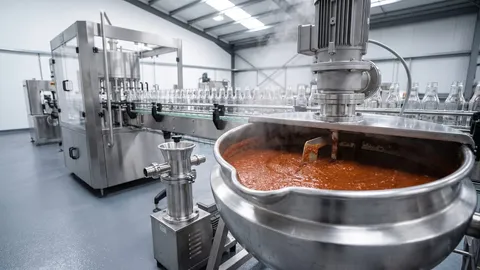
A food-production worker in full PPE (hairnet, mask, apron, gloves) adjusts a stainless-steel capping head as blank, unlabelled glass bottles move along a filling line in a Sri Lankan contract-manufacturing facility.
Buyer's snapshot Two written quotes for the same recipe can land 15 to 20 percent apart on unit price, and the gap is rarely the ingredients. It is how each maker folds tooling, retort and QA charges into the number. At Silk Foods Ceylon, a 300 g glass-jar sauce or spread starts at 1,500 jars and a 200 ml beverage bottle at 1,250 bottles, with glass tooling adding roughly a week of lead before either run books. A retort line item exists because Codex Alimentarius sets the low-acid boundary at an equilibrium pH above 4.6, which triggers a validated heat schedule instead of a simple hot fill. The table below sets four common quote line items side by side so two written quotes can be read against the same structure. Written for a brand owner already holding two or more written quotes to compare, not for a founder still costing a concept on paper. |
Two quotes for the same private-label coconut jam land on a founder’s desk two weeks apart. One reads LKR 145 a jar. The other reads LKR 168. The recipe is identical, the jar size is identical, and the instinct is to take the lower number and move on. That instinct is usually premature. A contract-manufacturing quote is rarely one number. It is four line items folded into one, and two Sri Lankan makers rarely fold them the same way. Reading the folds, not comparing the total, is what actually protects a first commercial run.
What line items actually sit inside a Sri Lankan contract-manufacturing quote?
A contract-manufacturing quote usually bundles four things into one unit price: the base production charge, a tooling and artwork one-off, a retort or QA validation charge, and a label-approval or SLSI submission line. At Silk Foods Ceylon, the base production charge covers the kettle or line time, ingredient handling and labour, spread across the batch the quote is calculated against. The other three line items are where two quotes for an identical recipe start to diverge, because each maker decides differently whether they are billed once, billed per run, or folded quietly into the per-unit number.
The certification and submission piece is its own decision point: some makers include SLSI document preparation in the unit price, others bill it as a separate line, and a few leave it for the brand owner to run alone. What the cert stack itself covers, BRCGS through Sri Lanka Food Act compliance, is set out in the certification stack for Sri Lankan contract manufacturing, and what SLSI registration alone costs in the first year is broken down in what SLSI certification costs a first-time Sri Lankan brand.
Why the same recipe prices differently at two makers
A unit price is a fraction: the fixed costs of a production run divided by how many units that run fills. The kettle charge, the changeover and the QA sampling cost close to the same whether a maker assumes a 1,500-jar batch or a 600-jar batch. A maker who quotes against the smaller, unstated batch shows a higher per-unit number for the identical process. A maker who quotes against the full first-run minimum shows a lower number for the same real cost. Neither maker is being dishonest. They are answering a question the founder never asked: what batch size is this price actually built on?
The mechanics of that fraction, worked through for a 300 g jar and a 200 ml bottle at Silk Foods Ceylon, are laid out in the sauce contract-manufacturing first-run maths. The short version: asking for 600 bottles instead of 1,250 does not halve the invoice, because the kettle is still charged once and the line is still set up once.
Four line items compared: what each one is really pricing
Once the base production charge is set aside, three line items decide most of the gap between two written quotes.
| Line item | What it covers | Billed how | Easiest place to hide a cost |
| Base production charge | Ingredients, labour, kettle or line time | Per unit, against a stated (or unstated) batch size | Quoting per unit against an unstated smaller batch understates the real cost at MOQ |
| Tooling and artwork | Change parts for a new jar or bottle neck, cap, or capsule size; print plates or a digital label setup | One-off, once per format or artwork change | Sometimes folded into a generic ‘setup fee’ instead of itemised |
| Retort or QA validation | Heat-process schedule sign-off, in-process lab sampling, shelf-life check | One-off per recipe or format; repeats only if either changes | Skipped entirely by a maker with no accredited lab, which is a bigger risk than a missing line item |
| Label approval and SLSI submission | Document preparation and the SLS mark application sequence | Mostly one-off per SKU, with a small annual renewal after | Quoted as ‘included’ without stating whose name is on the submission |
Reading a quote against this structure turns one number into four questions. A founder who asks all four before signing rarely gets surprised by a change order mid-run.
What is a tooling and artwork one-off, and when does a maker charge for it?
A tooling one-off applies whenever a new format needs a physical change to the line: a different jar or bottle neck finish, a new cap size, a new capsule bottle diameter, or a different pouch film width. It is charged once per format, not once per order, which is why the second and third SKU on the same jar size usually skip this line entirely. Artwork is a separate one-off tied to the print method rather than the machine. As SFC’s artwork and print lead-time breakdown sets out, a rotogravure-printed laminate pouch carries a minimum run near 10,000 units where a digitally printed label can start near 250, and that gap alone can decide which print method a first SKU actually uses.
What do retort and QA line items actually pay for?
A retort or QA line item exists because of one measurement: the finished product’s equilibrium pH. Codex Alimentarius sets the boundary for a low-acid canned or retorted food at a pH above 4.6, and any product above that line needs a validated pressure heat process rather than a simple hot fill (FAO and WHO Codex Alimentarius Commission, Code of Hygienic Practice for Low-Acid and Acidified Low-Acid Canned Foods, CAC/RCP 23-1979). In the United States, that validated schedule has to be established and signed off by a qualified process authority under 21 CFR Part 113, and Sri Lankan contract manufacturers apply the same technical discipline even where no equivalent local statute names the role. The line item on a quote is paying for that sign-off plus the lab sampling that proves the schedule was actually followed on the day, not for the retort machine’s electricity.
One established Sri Lankan FMCG brand scaling a coconut-based sauce range compared two written quotes in 2025 that sat LKR 9 apart on the unit price. The cheaper quote carried no retort validation line at all. The maker was hot-filling a product that measured above pH 4.6 on its own finished-product sample, sent over for reference during the comparison. The gap was never margin. It was a heat process that had never been signed off, and a recall risk sitting under a lower invoice.
Buyer's checklist: before comparing two quotes line by line The batch or run size the per-unit price is calculated against Whether tooling or artwork is billed once per format or once per SKU Who signs off the heat process, and whether that validation is included or billed separately Whose name goes on the SLSI submission, and who holds the resulting SLS registration What changes on run two of the same SKU, and what stays fixed Whether the quoted currency and payment terms still hold if the batch size changes |
What changes the comparison once financing is factored in
A tooling one-off paid upfront competes with the same cash spread thinly across the unit price over several runs, and which is cheaper depends on how a brand owner is funding the first run. A maker willing to amortise tooling across two or three orders instead of billing it all on order one changes the real comparison more than a percentage point on the base unit price. The wider version of this calculation, contract manufacturing against financing a production line of a brand’s own, is worked through in the 2026 founder’s maths, and the case for briefing a factory directly instead of through a layer of intermediaries is made in the broker layer in Sri Lankan FMCG.
Frequently asked questions
What’s included in Silk Foods Ceylon’s contract-manufacturing unit price?
The base production charge covers ingredients handling, labour and kettle or line time. Tooling, artwork, retort or QA validation and SLSI submission support are quoted as separate line items, so a brand owner sees what the unit price actually excludes before signing.
Do I pay a tooling charge on every repeat order?
No. Tooling is a one-off tied to the format: the jar, bottle, cap or capsule size. A repeat order for the same format on the same line does not trigger a fresh tooling charge; a new format or a new capsule bottle diameter does.
How is a retort or QA line item priced on a quote?
It covers the validated heat-process schedule sign-off plus in-process lab sampling, priced once per recipe or format. Codex Alimentarius sets the low-acid boundary at pH 4.6, above which a validated pressure process replaces a simple hot fill.
Does Silk Foods Ceylon handle the SLSI submission as part of a contract-manufacturing quote?
Yes. SLSI submission support is built into a standard Silk Foods Ceylon (SFC) contract manufacturing engagement, with the document preparation and application sequence run alongside production planning rather than left for the brand owner to manage separately.
How Silk Foods Ceylon can help
For a local FMCG brand comparing written quotes before a first or next commercial run, Silk Foods Ceylon (SFC) operates a cellular-manufacturing facility in Matale with the line flexibility to run 50+ ready-to-go SKUs on a single BRCGS- and FSSC 22000 V6-audited cert stack. First-run minimums are 1,500 jars for a 300 g glass-jar format and 1,250 bottles for a 200 ml beverage format, with tooling, retort and QA validation itemised on the quote rather than folded into the unit price. SLSI submission support sits inside the standard engagement, and the in-house R&D team can close a pH reading or a mill gap before a quote is even finalised.
To brief a project, email b2b@esilkroute.com.lk or call +94 76 441 0389 / +94 76 918 5744.
Sources
- FAO and WHO Codex Alimentarius Commission, Code of Hygienic Practice for Low-Acid and Acidified Low-Acid Canned Foods, CAC/RCP 23-1979, editorial corrections 2011, on the low-acid boundary at an equilibrium pH above 4.6 requiring a validated heat process (retrieved 2026-09-22): https://www.fao.org/input/download/standards/24/CXP_023e.pdf
- US Food and Drug Administration, 21 CFR Part 113, Thermally Processed Low-Acid Foods Packaged in Hermetically Sealed Containers, and the FDA establishment registration and process filing framework for low-acid canned foods (LACF), on the scheduled process requiring sign-off by a qualified process authority (retrieved 2026-09-22): https://www.fda.gov/food/registration-food-facilities-and-other-submissions/establishment-registration-process-filing-acidified-and-low-acid-canned-foods-lacf
- Sri Lanka Standards Institution, SLS Mark Product Certification, 2026, on the published assessment sequence of application, desktop evaluation, pre-assessment, product testing, final on-site assessment and permit committee (retrieved 2026-09-22): https://slsi.lk/en/services/sls-mark-product-certification/
Written by the Silk Foods Ceylon Editorial Team. Silk Foods Ceylon (Pvt) Ltd. is a BRCGS and FSSC 22000 V6 audited contract manufacturer in Matale, Sri Lanka, offering contract manufacturing, private labelling, co-packing and in-house research and development for local Sri Lankan brand owners, FMCG companies, hotel and restaurant groups, and distributors. To brief a project: b2b@esilkroute.com.lk, +94 76 441 0389, or +94 76 918 5744.