Four Ways to Lower a Co-Manufacturing Quote Without Cutting Corners
By the Silk Foods Ceylon Editorial Team
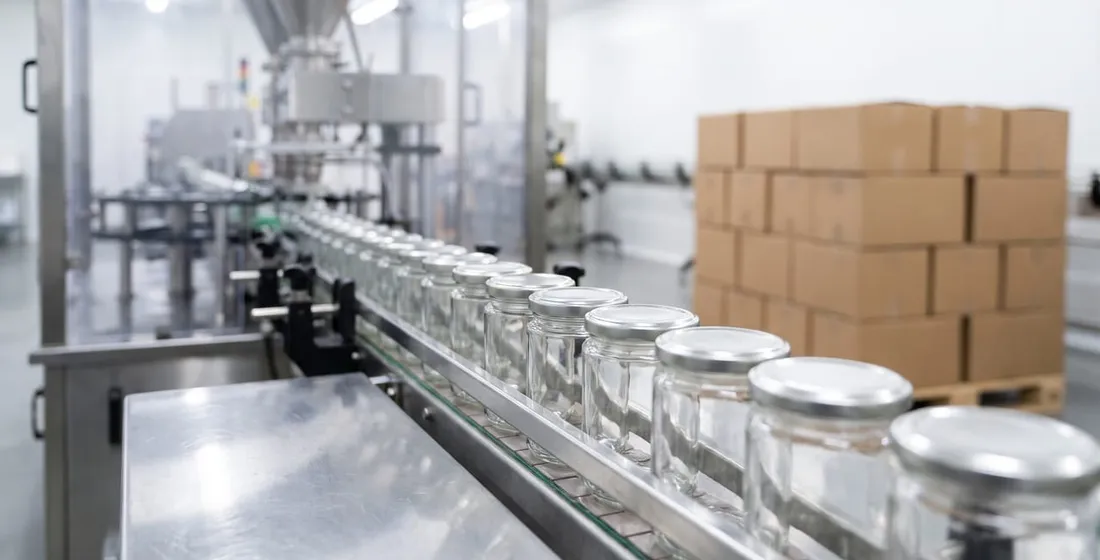
A single file of identical blank glass jars with plain metal lids moves along a stainless-steel conveyor toward a filling station, with stacked cardboard cartons behind.
Buyer’s snapshot
- Sri Lanka’s manufacturing PMI read 53.0 in September 2026, with food and beverages named among the drivers of new orders (Central Bank of Sri Lanka, October 2026). Production slots are in demand, so a clean brief matters.
- Four levers move a quote without touching the recipe, the audit or the testing: first-run size, pack choice, SKU count and brief quality.
- Silk Foods Ceylon (SFC) welcomes small first runs and quotes them on request. R&D takes 3 to 4 weeks at most.
- The table below shows which cost each lever reduces, and the checklist near the end turns them into a brief.
A founder opens a first quote, sees a per-unit price higher than the kitchen cost, and asks the obvious question: where can it come down? The tempting answers are the wrong ones. Thinner testing, a cheaper ingredient swapped in silently or a skipped label check all lower a price and all raise the risk of a recall or a rejected listing.
Four honest levers exist instead. None of them touches food safety. Each one removes a cost that a manufacturer would otherwise spread across fewer units, and each is a decision the brand owner makes before the quote is written. This post covers them in order of how much they usually move the number. For how the quote is built, the guide to reading a contract manufacturing quote covers the line items.
Why does the same recipe cost more per unit on a small first run?
A first run costs more per unit because fixed costs are shared across fewer units. Setup, line cleaning, first-article checks and changeover happen once per run whatever its size. Divide them by a small quantity and each unit carries a heavy share. Divide them by a larger one and the share falls.
This is the economics behind economic batch quantity, the standard lot-sizing idea that balances setup cost against the cost of holding stock (Racklify, 2026). It also explains why portfolio breadth matters: the number of changeovers depends on the number of orders, which depends on batch size and on how many items sit in the portfolio (OpEx Society, 2026). The levers below act on exactly those variables.
The maths is simpler than a quote sometimes makes it look. If setup is the same for a run twice the size, its per-unit share is halved. Ingredients and packaging scale with volume and do not shrink. So the lever works on the fixed share only, and the saving is largest when fixed costs are a big part of the price.
Lever one: how large should the first run be?
A larger first run lowers the per-unit price by spreading setup across more units. The trade is stock: the brand holds inventory longer, ties up cash and risks expiry on a short-shelf-life product. The right size is the largest one the brand can sell inside the product’s shelf life with margin to spare.
SFC welcomes small first runs and quotes them on request, so a small run is never refused. The honest advice is to ask for two quotes in one request: the run the brand wants and the next run up. The gap between the two prices shows what the extra volume buys. Some brands find the larger run costs little more in cash and clearly less per unit. Others find it does not, and stay small.
A brand that is still testing its market should lean small. A brand with confirmed retail demand, or a distributor order behind it, should price the larger run. The kitchen-to-contract-manufacturing guide walks through that first-run decision.
Lever two: does a standard pack change the quote?
A standard pack lowers the quote because a stock container and closure remove tooling, shorten supplier lead times and shorten line trials. A custom shape, colour or closure adds a one-off cost and a wait before the first run. Pack choice also fixes the label area, which sets how much artwork work sits behind each SKU.
Standard does not mean plain. A stock jar with a well-designed label looks as good on a shelf as a custom one, and the label is where a retail buyer’s eye goes first. Custom containers earn their cost when shape is itself the brand, such as a signature bottle. For most first launches, shape is not the brand yet.
Standard packs also help later. When a second flavour uses the same jar, the same lid and the same case, the line changes over faster. The post on standardised packaging and cost per unit covers that effect for retail ranges.
Lever three: how many SKUs should a brand launch with?
Fewer SKUs lower the quote because each SKU is its own changeover, its own artwork and its own approval. Three flavours at three sizes is nine SKUs, and the brand pays nine setups for volume that one well-chosen SKU might have carried. Concentrating volume in one or two SKUs makes each run larger without the brand selling more.
A practical launch order is one hero SKU first and variants after it sells. This is also the cheapest way to learn which flavour the market wants. Portfolio breadth is where complexity cost hides, because standard costing tends to understate the changeover and sanitation burden of long-tail items (Wiss, 2026).
The stick-pack changeover post shows the same logic for single-serve formats.
Lever four: what does a cleaner brief save?
A cleaner brief lowers the quote by removing rework, repeat quoting and padding for unknowns. When the quoting desk cannot tell the pack, the claim or the volume, it either asks (days of delay) or prices a margin for the risk. A complete brief gets a sharper number and a faster one.
The quote-ready pack lists the five inputs. Claims deserve a special mention: under the Food (Labelling and Advertising) Regulations 2026, a health or nutrient-function claim needs prior approval from the Chief Food Authority (Ministry of Health, 2026), so a claim planned late becomes a re-quote. A locked recipe also counts as a clean input. If the recipe is not locked, R&D comes first and takes 3 to 4 weeks at most, then the production quote follows.
Here is a pattern the quoting desk sees often. A brief arrives saying “coconut spread, jar, supermarkets, sugar-free version maybe later.” Every word after the first comma is an open question. Settling the jar, the channel and the sugar-free decision before the quote does more for the price than any negotiation after it.
How do the four levers compare?
| Lever | Cost it reduces | What the brand gives up | Best suited to |
|---|---|---|---|
| Larger first run | Setup and first-article cost per unit | Cash tied up in stock, shelf-life risk | Brands with confirmed demand |
| Standard pack | Tooling, supplier lead time, line trial | A custom container shape | Most first launches |
| Fewer SKUs at launch | Changeovers, artwork, approvals | A wider range on day one | Brands still learning which flavour sells |
| Cleaner brief | Re-quotes, delay, risk padding | Nothing, only preparation time | Every brand |
Service snapshot: Contract Manufacturing at Silk Foods Ceylon
First runs: small runs welcome, quote on request.
R&D: 3 to 4 weeks at most from signed brief to approved formulation.
Certification: BRCGS certified and FSSC 22000 V6 certified, plus SLSI clearance and Sri Lanka Food Act compliance on retail SKUs.
Location: Silk AgTech Park, Hapugasyaya, Matale; samples can be approved in person.
Where does SFC walk away from a request to cut the price?
Some savings are not on offer. SFC does not shorten testing, skip a label-clearance check, swap an ingredient without telling the buyer or drop a certification step to meet a price. Those lower a quote only by moving the cost to a recall, a rejected listing or a delisted SKU, and the buyer pays it later at a much higher price.
The test for any proposed saving is simple: does it remove a cost the run does not need, or does it remove a control the product does? The four levers above remove the first kind. A request that removes the second kind gets a plain no, with the reason.
A one-page checklist before you ask for a quote
- Name the run size you want and the next size up, and ask for both prices.
- Choose a stock container and closure, and say if a custom shape is non-negotiable.
- Launch with one or two SKUs, and list the variants for later.
- State the sales channel, because it decides label and pack checks.
- List every claim planned for the front of pack, or write “none”.
- Say whether the recipe is locked, or whether R&D is needed first.
Frequently asked questions
Can a Sri Lankan brand lower a co-manufacturing quote without lowering quality?
Yes. Four levers change the price without touching the recipe, the audit or the testing: a larger first run, a standard pack, fewer SKUs and a complete brief. Each one cuts setup, changeover or rework cost that would otherwise be spread over fewer units.
Does Silk Foods Ceylon welcome small first runs?
Yes. Silk Foods Ceylon welcomes small first runs and quotes them on request. A run that is small today can still be priced sensibly if the pack is standard and the brief is complete, and the quote shows which lever would move the number most.
Why does a custom pack raise a quote?
A custom container or closure adds tooling, longer supplier lead times and a line trial before the first run. A stock container removes those lines. Pack choice also fixes the label area, which decides how much artwork and approval work sits behind each SKU.
How long does R&D take if my recipe is not locked?
R&D at Silk Foods Ceylon takes 3 to 4 weeks at most from signed brief to approved formulation. A locked recipe skips that step, which is itself a lever, because quoting a fixed formulation is faster and carries fewer unknowns for both sides.
How Silk Foods Ceylon can help
For founders and mid-size brands pricing a first run, Silk Foods Ceylon (SFC) offers Contract Manufacturing at its Matale facility, with in-house R&D ahead of it when the recipe is not locked. R&D takes 3 to 4 weeks at most from signed brief to approved formulation, and small first runs are welcome, quoted on request. The site is BRCGS certified and FSSC 22000 V6 certified, with SLSI clearance and Sri Lanka Food Act compliance on retail SKUs. Send the brief with the checklist above and ask for two run sizes in one quote.
To brief a project, email b2b@esilkroute.com.lk or call +94 77 157 7294.
Sources
- Central Bank of Sri Lanka (2026), “Purchasing Managers’ Index, September 2026”, press release of 15 October 2026. cbsl.gov.lk (retrieved 31 October 2026).
- OpEx Society (2026), “The Cost of Complexity”, on changeovers scaling with batch size and portfolio breadth. opexsociety.org (retrieved 31 October 2026).
- Racklify (2026), “How to Plan Batch Production Runs: Scheduling, Sizing and Cost Control”, on economic batch quantity. racklify.com (retrieved 31 October 2026).
- Wiss (2026), “Flavor Profitability Analysis: Rationalizing Your Portfolio”, on hidden changeover and sanitation cost of long-tail SKUs. wiss.com (retrieved 31 October 2026).
- Ministry of Health, Sri Lanka (2026), Food (Labelling and Advertising) Regulations 2026, Gazette Extraordinary No. 2494/47 of 26 June 2026. eohfs.health.gov.lk (retrieved 31 October 2026).
Written by the Silk Foods Ceylon Team. Silk Foods Ceylon (Pvt) Ltd. is a BRCGS- and FSSC 22000 V6-audited contract manufacturer in Matale, Sri Lanka, offering contract manufacturing, private labelling, co-packing, and in-house R&D for local Sri Lankan brand owners, FMCG companies, hotel and restaurant groups, and distributors. To brief a project: b2b@esilkroute.com.lk or +94 77 157 7294.