Co-Packing for Retail: How Standardised Packaging Cuts Cost per Unit
By the Silk Foods Ceylon Editorial Team
Buyer’s snapshot
- Modern trade revenue growth in Sri Lanka rose from about 5% in 2024 to about 7% in 2025 (Daily Mirror, March 2026), so more of a brand’s volume now meets a retail buyer’s packing and label checks.
- Cost per unit falls with fewer set-ups, not with a cheaper pouch: one pack size, one film, one label template and one carton count cut the number of changeovers per range.
- Each changeover brings a documented label-clearance check (BRCGS Food Safety, clause 6.2.2), so every extra variant adds a fixed cost that no volume discount removes.
- The decision table and the six-line pack specification below can go straight into a brief.
Ask a brand owner what a retail pack costs and the answer is usually a film price and a label price. Ask what it costs when the second run of the same SKU comes back with the date code in a different corner, and the answer is longer. Rework, relabelling and held pallets sit outside the quote, yet they are the part of unit cost that moves most between one packing partner and another.
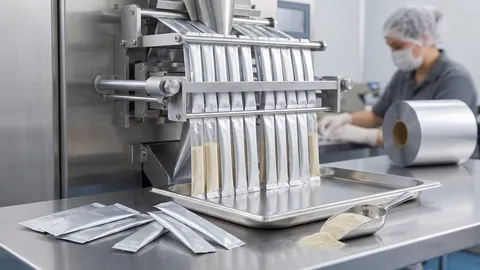
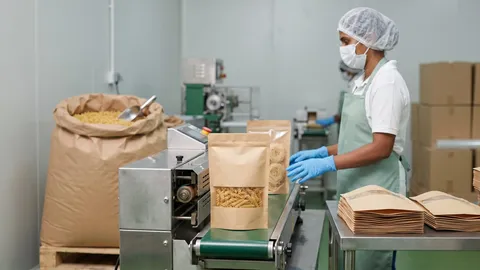
Silk Foods Ceylon (SFC) co-packs buyer-supplied goods into retail-ready formats at its Matale facility. This post looks at the cost side of that service for an established brand: which packaging choices lower the cost per unit across a range, and which only look cheaper on the quote. It is a different question from preparing one SKU for an online marketplace, which is about meeting a channel’s rules. This one is about holding a range to a single spec so the factory can run it cleanly.
What actually makes up the cost per unit in co-packing?
Cost per unit in co-packing is packaging material plus line time plus the cost of getting a run wrong, divided by good units out. Material is visible on the quote. Line time depends on how many set-ups the range needs. The third term, rework and rejected units, is where an inconsistent pack specification does its damage.
Think of the three terms separately, because standardising pack format acts on each one differently. Material cost falls modestly, since one film and one pouch size can be bought in larger reels and carton quantities. Line time falls more, since a range sharing a pack size needs one set-up where a mixed range needs several. The third term falls most, and it is the one nobody budgets: a label that sits in the same place on every SKU is checked the same way every time.
The unit cost is a fraction, and the denominator matters as much as the numerator. A run of 5,000 pouches with 200 held back for a seal or date-code fault delivers 4,800 good units, so the cost of every unit rises by about 4%, whatever the film cost. Held units are a quiet tax on the price you were quoted.
Which packaging decisions lower the cost per unit across a range?
Four decisions do most of the work: one pack size across as many SKUs as the channel allows, one barrier film, one label template with only the content changing, and one outer-carton count. Each reduces the number of times the line is stopped, cleaned, reset and checked.
| Decision | What changes on the line | Effect on unit cost |
|---|---|---|
| One pack size across the range | One forming and filling set-up; one weigh-fill setting | Fewer changeovers per range; the saving is fixed set-up time, shared across more units |
| One barrier film and print format | One reel type held in goods-in; one sealing temperature profile | Larger material orders; fewer seal faults from film-to-film settings |
| One label template, content-only changes | Same label position, size and date-code field on every SKU | Same check each run; lower chance of a misplaced or missing mandatory element |
| One outer-carton count and orientation | Same case-packing pattern and pallet layout | Simpler despatch; fewer damaged or miscounted cartons |
None of this requires the pack to be plain. Colour, flavour band and front-of-pack artwork can differ by SKU. What stays fixed is the physical specification the machine and the inspector work to.
Why do label errors cost more than material?
A packing run that uses the wrong label, or a correct label in the wrong place, is the most expensive kind of fault because it can mean holding or relabelling finished stock. Guidance summarised by ASC Food Safety treats wrong or misprinted packaging as one of the main causes of recalls and withdrawals, which is why it asks for checks at every product change.
Under clause 6.2.2 of BRCGS Food Safety Issue 9, documented checks at a product change confirm that the previous run’s printed packaging and labels have been cleared from the line before the next run starts. Clause 6.2.3 asks for checks during the run at set intervals and when new printed packaging arrives (ASC Food Safety summary of Issue 9, retrieved 2026). The checks are the same whether the range has two variants or twelve. What grows is how many times they are done.
That is the arithmetic of a mixed range. Every additional pack variant adds one more changeover, one more clearance check and one more chance that a roll of the previous SKU’s label stays near the line. A range of six SKUs in one pack size runs as one block with six label swaps, and the pack set-up is done once. The same six SKUs in three pack sizes need at least three pack set-ups on top of the six label swaps.
Illustrative scenario (hypothetical, not a client case): an established brand owner has six spice SKUs sold in 50 g, 100 g and 250 g pouches, each in a slightly different film and with the date code in a different position. After moving the range to two pouch sizes, one film and one label template, the line sets up for two formats instead of three, one film reel is held instead of three, and the date code is checked in the same place on every SKU. The saving is the set-ups removed and the faults not made, not a lower price per metre of film.
How does the 2026 labelling regulation interact with pack standardisation?
The Food (Labelling and Advertising) Regulations 2026 set minimum letter heights by main-panel area, so packs that share a panel size share the same rule. Net contents must be at least 1.5 mm where the main panel is 120 sq cm or less and 3 mm above that (regulation 6(d), Schedule III), and the regulations came into operation on 1 July 2026 (Gazette Extraordinary No. 2494/47, SFC labelling checklist, 2026).
The consequence for a range is practical. Two pack sizes that straddle 120 sq cm give two letter-height rules, two artwork checks and two sets of proofs. Keeping the main panel on one side of that threshold across the range gives one. The regulations do not apply to food manufactured before 1 July 2026, so the exposure is new artwork rather than existing stock, and a new artwork round is the cheapest moment to fix the template. The full labelling checklist sets out the mandatory elements, and the artwork print lead-time post covers how long the proofing round takes.
Which formats suit which retail channel?
The channel decides the pack size more than the brand does. The general trade, which carries about 75% of grocery sales, buys larger pouches and reorders often, while modern trade and online fulfilment lean to smaller formats with scannable barcodes (see the kraft pouch economics post). Euromonitor notes that cost-saving motives are shaping pack-size choices in Sri Lankan cooking ingredients, and private label is part of that shift (Euromonitor, Cooking Ingredients and Meals in Sri Lanka, retrieved 2026).
| Channel | Typical format direction | Standardisation lever |
|---|---|---|
| General trade and wholesale | Larger pouches or sacks, weekly reorder | One size and one film for the whole line; a simple carton count |
| Modern trade (supermarkets) | Retail pouches with barcode, tri-lingual label | One label template and one panel size across the range |
| Online fulfilment | Small pouches, order-level packing | Same small format as the retail line, to share one run |
A brand selling into all three does not need one format. It needs as few as the channels will accept, and a deliberate choice of which two to keep. The 50 g and 100 g pouch post and the 500 g and 1 kg sack post cover the two ends.
Service snapshot: co-packing at Silk Foods Ceylon
- Service: the buyer supplies finished or bulk goods; SFC packs, seals, labels and cartons them
- Pack formats: kraft pouches from 50 g to 1 kg, glass jars from 50 ml to 1 L, and 60-count capsule bottles
- Production block: a consolidated multi-SKU run typically fits a one-day block; buyer-supplied capsules run one to two weeks once goods arrive
- Cert coverage: BRCGS- and FSSC 22000 V6-audited, plus SLSI submission support and Sri Lanka Food Act labelling support on retail SKUs
What goes into a pack specification that keeps the range uniform?
Write the pack specification as a short document that the buyer, the packaging supplier and the co-packer all hold, and put these six lines in it:
- Pack format and fill weight, with the permitted tolerance.
- Film or container, with a supplier part number so the same material is reordered.
- Label template: panel size, position of the batch, manufacture and expiry fields, and which elements change per SKU.
- Outer carton: units per case, case orientation and pallet layout.
- Reference sample per SKU: one sealed, dated retained pack held by both parties.
- Acceptance check: which faults hold a run (seal fault, missing or misplaced date code, wrong label) and who signs the release.
Item six is the one most briefs omit. Without it, a seal or date-code fault found at goods-in becomes an argument about whose standard applied. With it, the fault is a line in a document, and the correction is the one already agreed.
Silk Foods Ceylon is not the right fit for a brand that wants a different pack size for every SKU on principle, or that has not yet settled the label artwork. The first has chosen a cost that standardisation would remove. The second needs the artwork approved before a run can be booked, since a label that changes mid-run is a held pallet. The co-packer switching post explains what to hand over if a spec has to move to a new partner.
Frequently asked questions
Does standardising pack size really lower the cost per unit in co-packing?
Yes, mainly through fewer set-ups and fewer faults rather than a cheaper film. A range sharing one pack size needs one forming and filling set-up instead of several. BRCGS Food Safety Issue 9 clause 6.2.2 requires a documented label-clearance check at every product change, so fewer variants also mean fewer checks (ASC Food Safety summary, retrieved 2026).
Which label rules affect how a retail pack range is standardised in Sri Lanka?
The Food (Labelling and Advertising) Regulations 2026, in operation since 1 July 2026, set net-contents letter height by main-panel area: 1.5 mm at 120 sq cm or less and 3 mm above (regulation 6(d), Schedule III). Keeping the range on one side of that threshold gives one artwork rule for every SKU.
What retail pack formats does Silk Foods Ceylon co-pack?
Silk Foods Ceylon co-packs buyer-supplied goods into kraft pouches from 50 g to 1 kg, glass jars from 50 ml to 1 L and 60-count capsule bottles (SFC product and service catalogue). A consolidated multi-SKU run typically fits a one-day production block at the BRCGS- and FSSC 22000 V6-audited Matale facility.
How do I brief Silk Foods Ceylon for a retail co-packing run?
Send a one-page pack specification: fill weight, film part number, label template with panel size and date-code position, carton count, one reference sample per SKU and the fault list that holds a run. SLSI submission support and Sri Lanka Food Act labelling support sit inside a standard co-packing engagement at SFC.
How Silk Foods Ceylon can help
For established brands standardising a retail range, Silk Foods Ceylon (SFC) runs co-packing at its Matale facility into kraft pouches from 50 g to 1 kg, glass jars from 50 ml to 1 L and 60-count capsule bottles, with a consolidated multi-SKU run typically fitting a one-day block. The line is BRCGS- and FSSC 22000 V6-audited, with SLSI submission support inside a standard engagement. Where a range also needs new formulation, R&D / NPD (Co-Development on the SFC brochure) takes 3 to 4 weeks at most, from signed brief to approved formulation.
To brief a project, email b2b@esilkroute.com.lk or call +94 76 441 0389 / +94 76 918 5744.
Sources
- Daily Mirror (2026), “Consumer goods in modern trade record strong growth momentum over 3 years”, March 2026. https://www.dailymirror.lk/print/business/Consumer-goods-in-modern-trade-record-strong-growth-momentum-over-3-years/215-335839 (retrieved 2026-10-15).
- ASC Food Safety (2026), “BRCGS for Food Safety Issue 9 Changes, Part 6: Process Control (R6)”, on clauses 6.2.2 and 6.2.3. https://ascfoodsafety.com/brcgs-for-food-safety-changes-process-control/ (retrieved 2026-10-15).
- Euromonitor International (retrieved 2026), “Cooking Ingredients and Meals in Sri Lanka” (report summary). https://www.euromonitor.com/cooking-ingredients-and-meals-in-sri-lanka/report (retrieved 2026-10-15).
- Government of Sri Lanka (2026), Food (Labelling and Advertising) Regulations 2026, Gazette Extraordinary No. 2494/47, 26 June 2026. https://documents.gov.lk/view/egz/2026/6/2494-47_E.pdf (retrieved 2026-10-15; regulation detail taken from SFC’s own labelling checklist).
- Silk Foods Ceylon (2026), Capabilities Flyer, Food and Beverage Contract Manufacturing brochure and product and service catalogue (first-party format, block-time and certification data).
- Further reading: co-packing in Sri Lanka and minimum order quantity by format.
Written by the Silk Foods Ceylon Team. Silk Foods Ceylon (Pvt) Ltd. is a BRCGS- and FSSC 22000 V6-audited contract manufacturer in Matale, Sri Lanka, offering contract manufacturing, private labelling, co-packing, and in-house R&D for local Sri Lankan brand owners, FMCG companies, hotel and restaurant groups, and distributors. To brief a project: b2b@esilkroute.com.lk, +94 76 441 0389, or +94 76 918 5744.