Spice and herb co-packing in Sri Lanka: a capability one-pager
Buyer’s snapshot
- Sri Lanka shipped US$449.9 million of spices and essential oils in 2025 across 40,302 metric tonnes, according to the Sri Lanka Export Development Board.
- Under the Food (Labelling and Advertising) Regulations 2022, the packer’s name and address goes on the pack. Choosing a co-packer is a compliance decision before it is a cost one.
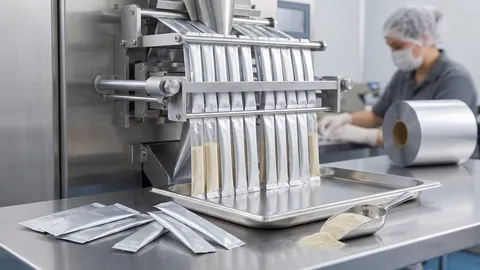
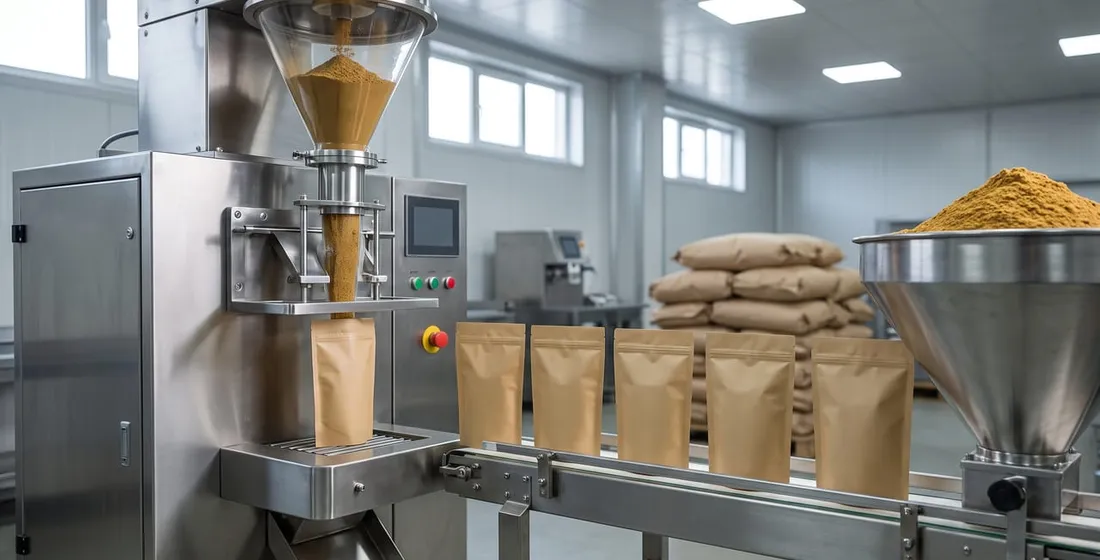
- The Silk Foods Ceylon (SFC) spice and herb line runs at 100 to 200 kg per hour, into kraft pouches from 50 g to 1 kg plus 25 kg and 50 kg brown sacks.
- Co-packing lead time runs one to two weeks from the arrival of finished goods. Scope table, format ladder and standards table follow.
A brand owner with a curry powder listing and a distributor with forty tonnes of imported bulk have the same problem on different days of the week. Product exists. Retail-ready packs do not. Somebody has to fill, seal, code and label it inside a hall that will survive a procurement audit, and somebody has to put a name and address on the back of that pouch.
This page is the capability sheet for that job at the Matale facility: what the spice and herb co-packing line covers, which formats it runs, how long a run takes, which standards the pack is built against, and how the quote is put together in rupees. Numbers here are the documented ones. Where a figure is not documented, this page says so rather than inventing a range.
What co-packing covers, and what it does not
Co-packing and private labelling get used interchangeably in local conversation, and the difference decides who carries the raw material risk. In a co-packing engagement the buyer owns and supplies the finished goods, and the facility supplies the hall, the line, the packing labour and the compliance work. In private labelling the facility sources and processes the product too, and the buyer’s brand goes on the front.
| Element | Co-packing (buyer supplies goods) | Private labelling (facility supplies product) |
| Raw material | Buyer’s own finished goods delivered to Matale | Sourced and processed from the SFC catalogue |
| Grinding and sieving | Only where goods arrive whole and a grind is agreed | In scope on the crusher, pulverizer, grading and sieve line |
| Filling, sealing, coding | In scope | In scope |
| Packaging material | Buyer’s own, or sourced on request | Sourced by the facility |
| Artwork review | Checked against the Food Act declarations | Checked against the Food Act declarations |
| SLSI submission support | Inside the standard engagement | Inside the standard engagement |
| Documented minimum | Quoted per production block | 50 kg per SKU, tiers at 500 kg, 1,000 kg and 2,500 kg |
What co-packing does not cover is formulation. A blend that has never been made before is an R&D and new product development brief, not a packing brief, and it runs on a different clock. The two often arrive together, and separating them early stops a packing slot being booked against a recipe that is still moving.
The handover mechanics of moving an existing SKU between packers are set out in switching co-packers in Sri Lanka and the audit chain handover.
Which pouch and sack formats does the spice line run?
Format decides the line configuration, the changeover time and most of the pack cost. The spice and herb line at Matale runs a kraft pouch ladder for retail and a paper sack format for bulk, with a clear gusseted inner where the product needs a moisture barrier behind the kraft.
| Format | Sizes run | Typical use |
| Kraft stand-up pouch, brown | 50 g, 100 g, 250 g, 500 g, 1 kg | Retail shelf listings for modern trade |
| Kraft stand-up pouch, white | 50 g, 100 g, 250 g, 500 g, 1 kg | Brands printing four-colour artwork |
| Kraft pouch with window | 50 g, 100 g, 250 g, 500 g, 1 kg | Whole spice and coarse grinds sold on appearance |
| LDPE clear gusseted inner bag | Matched to the pouch or sack above | Moisture barrier inside kraft, and bulk liners |
| Brown paper sack | 25 kg, 50 kg | Bulk supply to processors, hotel kitchens and re-packers |
| Glass jar | 40 g spice format, wider range 50 ml to 1 L | Table-top and gifting SKUs |
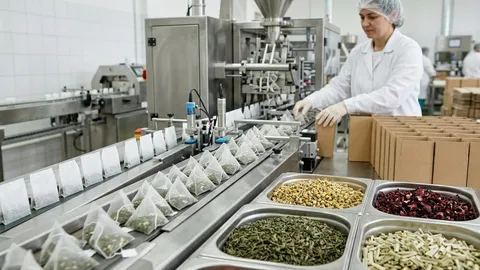
The grinding and sieving equipment behind the packing hall is a universal crusher, a coarse crusher, a pulverizer, a screw feeder, a destoner, a grading machine, a sieve line, a drying machine and a clean-in-place unit. That matters to a co-packing buyer for one reason: goods arriving whole can be brought to a grind and a particle size before they hit the filler, without a second site and a second transport leg.
Line rate on spice and herb work is 100 to 200 kg per hour depending on grind, bulk density and format. A 250 g retail pouch on a fine powder sits at the slower end of that band. A 25 kg sack fill sits at the faster end.
For how the same grind and sieve discipline shows up in a blend specification, see specifying coriander, cumin and fennel for an export-ready curry powder spec.
How fast is a co-packing run?
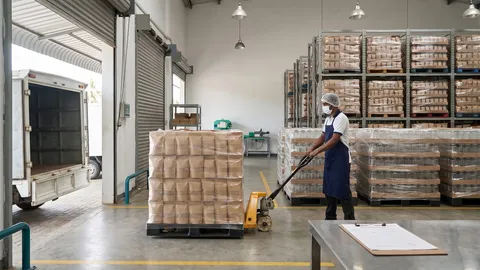
Documented co-packing lead time is one to two weeks from the arrival of finished goods at the facility, on a production block that is typically a single day. The block length moves with the SKU mix rather than the tonnage. Four SKUs in one pouch size on one product is a short block. Four products across three pouch sizes is a long one, because every changeover carries a line clean and a first-article check.
The two weeks are rarely spent packing. They are spent on artwork sign-off, packaging material arriving, and the coding format being agreed. A distributor who lands a container of bulk almonds and dates in the third week of a quarter, and wants 250 g retail packs on shelf before the season, usually discovers the constraint is the printed pouch supplier rather than the packing slot. Booking the block and releasing the artwork on the same day is what compresses that timeline.
There is a second date on that job that catches people. Goods imported in bulk and repacked locally have to carry both the date of manufacture and the date of repacking on the pack. A distributor working from a supplier certificate that gives only a production month has to go back and get the day before the coder can be set.
The SLSI side of a new packaged food listing is walked through in the SLSI packaged food submission, step by step.
What the label law puts on a co-packed spice pouch
The Food (Labelling and Advertising) Regulations 2022 were gazetted on 14 February 2023 under the Food Act No. 26 of 1980, and they treat packing as a regulated act in its own right. Three clauses decide most co-packing conversations.
First, the pack carries the name and address of the packer where there is one. The co-packer is on the buyer’s label, visible to any procurement team that turns the pouch over. Second, for tea, spices, edible oils, edible salt, cereals, legumes and edible oilseeds, the date of packing is taken as the date of manufacture, provided the packer ensures the product is wholesome and safe at the time of packaging. That duty sits with the packer. Third, bulk goods repacked locally carry both the date of manufacture and the date of repacking.
The artwork rules are equally literal. The common name is printed in bold in all three languages. Its letters run at no less than one third of the size of the brand name letters, subject to a minimum height of 3 millimetres. Other declarations print at no less than 1.5 millimetres in bold. Date of expiry appears in at least two of Sinhala, Tamil and English, and a batch or lot code has to be readable or decipherable. Packs at or below 25 g, and liquids at or below 30 ml, sit under a separate exemption threshold, which is what makes sachet and sample formats behave differently from the 100 g retail pouch beside them.
The failure the packaging desk at Matale sees most often is an artwork file arriving print-ready with the brand name set large and the common name set as a thin subtitle below it. Under the 2022 regulations that subtitle has to reach a third of the brand name letter size and clear 3 millimetres. Re-plating a printed pouch run costs considerably more than the artwork review that would have caught it before plates were cut.
Which SLS standards does the spice line pack to?
A purchase order that names a standard settles arguments that a purchase order describing quality in adjectives never will. The Sri Lanka Standards Institution publishes both product standards for individual spices and process standards for the hall they are packed in.
| Standard | Covers | Why it matters on a co-packed pouch |
| SLS 134:2017 | Curry powder | The blend spec most local retail curry powder SKUs are written against |
| SLS 1563:2017 | Chillie, whole and ground | Grade and grind for the highest-volume local powder |
| SLS 613:2017 | Turmeric, whole and ground | Colour and purity parameters procurement teams quote |
| SLS 1372:2009 | Black and white pepper, ground | Grind specification for pepper SKUs |
| SLS 1327:2008 | Code of hygienic practice for spices and dried aromatic plants | The process standard behind a clean packing hall |
| SLS 186 Part 12:2016 | Degree of fineness of grinding | The test that settles a grind dispute between buyer and packer |
Standards get revised. Confirm the current revision with the Sri Lanka Standards Institution before a number is written into a purchase order or a supplier agreement, because a superseded revision in a contract is a dispute waiting for a bad month.
Condiment and blend specification work of the same kind is covered in specifying garlic, mustard and fenugreek condiment SKUs.
Where the certification stack earns its keep
A co-packer’s certificates are the buyer’s certificates for the length of the audit chain. The Matale facility holds BRCGS and FSSC 22000 V6 on the food safety side, with USDA Organic and EU Organic available per SKU where the raw material qualifies. On the local side, SLSI product certification is the gate for a packaged food listing, the Sri Lanka Food Act 1980 sets the labelling floor, and Department of Ayurveda registration applies to any herbal SKU that carries a traditional claim.
The order matters in a procurement pack. BRCGS and FSSC 22000 V6 set the higher floor and travel internationally, which is why they lead. SLSI is what a local retail buyer actually asks for first. A brand that expects to export a version of the same SKU within two years is better served by a packer holding both, because retro-fitting a food safety certificate to an existing supply chain is slower than starting on one.
Herbal powders sit on a second track. The Department of Ayurveda operates the Ayurveda Medicine and Production Regulatory Council, with separate registration routes for manufacturing premises, including an annual renewal, and for the products themselves. A moringa or triphala powder making a traditional claim needs that registration in parallel with the SLSI work, not instead of it.
The herbal-side registration and naming detail is worked through in private label triphala and gurmar capsules in Sri Lanka.
How the rupee quote is built
Co-packing is quoted in Sri Lankan rupees, per pack or per kilogram depending on format, and a USD equivalent is added only where the buyer is comparing against an overseas packer. Five variables move the number, and a buyer who arrives with all five settled gets a firm quote instead of a range.
| Variable | What moves the price |
| Format | Pouch size and construction. Small retail formats carry more packs per tonne and more labour per kilogram than a 25 kg sack |
| Run length | Tonnage per block against the fixed cost of set-up, line clean and first-article checks |
| Changeovers | Number of SKUs and pouch sizes in one block. Each changeover is line time that produces nothing |
| Material supply | Buyer-supplied packaging against facility-sourced, and buyer-supplied goods against facility-sourced raw material |
| Compliance scope | Artwork review, coding set-up and SLSI submission support, which sit inside the standard engagement |
Where the facility sources the raw material, the engagement becomes private labelling and the documented minimum applies: 50 kg per SKU, with volume tiers at 500 kg, 1,000 kg and 2,500 kg. There is no separate published pouch or sack minimum for buyer-supplied co-packing work, because the block, rather than the tonnage, is the unit being booked.
Why the facility sits in Matale rather than an industrial zone closer to the port is explained in why cellular manufacturing sits in a Matale factory and not Colombo.
Frequently asked questions
What is the minimum order for spice co-packing in Sri Lanka?
Co-packing runs on buyer-supplied finished goods, so the unit booked is a production block, typically a single day, rather than a tonnage minimum. Where Silk Foods Ceylon supplies the raw material the engagement becomes private labelling, with a documented minimum of 50 kg per SKU and volume tiers at 500 kg, 1,000 kg and 2,500 kg.
Does the co-packer’s name have to appear on my label?
Yes. The Food (Labelling and Advertising) Regulations 2022, gazetted on 14 February 2023 under the Food Act No. 26 of 1980, require the name and address of the packer on the pack where there is one. The co-packer appears on the brand owner’s label, which makes packer selection a compliance decision.
Is the date of packing the same as the date of manufacture for spices?
For spices, tea, edible oils, edible salt, cereals, legumes and edible oilseeds, the 2022 labelling regulations treat the date of packing as the date of manufacture, provided the packer ensures the product is wholesome and safe at the time of packaging. Bulk goods repacked locally carry both the manufacture and repacking dates.
How long does a spice co-packing run take at Silk Foods Ceylon?
Documented lead time is one to two weeks from the arrival of finished goods at the Matale facility, on a production block that is typically a single day. Most of that window is artwork sign-off, packaging material delivery and coding set-up rather than line time, so releasing artwork early compresses it.
Do herbal powders need Department of Ayurveda registration?
Any herbal SKU carrying a traditional or Ayurvedic claim needs Department of Ayurveda registration. The department runs the Ayurveda Medicine and Production Regulatory Council, with separate routes for manufacturing premises, including annual renewal, and for products. That track runs in parallel with SLSI product certification, not instead of it.
How Silk Foods Ceylon can help
For local FMCG brand owners and distributors converting bulk into retail-ready SKUs, Silk Foods Ceylon operates a dedicated spice and herb co-packing capability at the 10,000 sq ft cellular manufacturing facility in Matale. The buyer supplies finished goods, and the SFC team handles grinding where agreed, filling, sealing, coding, labelling and SLSI submission support under the Sri Lanka Food Act labelling framework. Line rate runs 100 to 200 kg per hour. Formats span 50 g to 1 kg kraft pouches, 25 kg and 50 kg brown sacks, and 40 g glass jars. The BRCGS and FSSC 22000 V6 certificate stack on the packer side is what a modern trade procurement team asks for when it audits the chain behind a private label listing.
To brief a co-packing or consolidation plan, email brands@esilkroute.com.lk or call +94 76 441 0389 / +94 76 918 5744.
Sources
Sri Lanka Export Development Board, Spices, Essential Oils and Oleoresins in Sri Lanka. 2025 sector figures: US$449.91 million export revenue across 40,302.14 metric tonnes. Retrieved 13 August 2026. https://www.srilankabusiness.com/spices/
Sri Lanka Export Development Board, Policy and Strategic Planning Division, Sri Lanka’s export performance exceeded US$17.2 billion in 2025, published 26 January 2026. Spices and essential oils US$449.9 million, down 2.59 percent year on year. Retrieved 13 August 2026. https://www.srilankabusiness.com/news/sri-lankas-export-performance-exceeded-us-17.2-billion-in-2025.html
Ministry of Health, Food (Labelling and Advertising) Regulations 2022, Gazette Extraordinary No. 2319/40 of 14 February 2023, made under the Food Act No. 26 of 1980. Retrieved 13 August 2026. https://www.eohfs.health.gov.lk/food/images/2319-40_E.pdf
Sri Lanka Standards Institution, published standards for spices and dried aromatic plants, including SLS 134, SLS 1563, SLS 613, SLS 1372, SLS 1327 and SLS 186. Confirm current revisions with SLSI. Retrieved 13 August 2026. http://srilankanspices.com/wp-content/uploads/2012/06/SLSI-Standards.pdf
Department of Ayurveda, Sri Lanka, Ayurveda Medicine and Production Regulatory Council. Retrieved 13 August 2026. https://ayurveda.gov.lk/ayurveda-medicine-and-production-regulatory-council/
Silk Foods Ceylon, Matale, Sri Lanka. brands@esilkroute.com.lk, +94 76 441 0389 / +94 76 918 5744.