Why we built a cellular-manufacturing factory in Matale, not Colombo
Buyer's snapshot
|
In 2019 SFC first drew the factory as a single beverage line in Colombo. One product, one city, a short run to the port. It made sense on a page. We were wrong, and it took a spreadsheet and a cinnamon smallholder to show us why. What the team had underestimated was not demand for Sri Lankan food brands. It was how many different products a small brand actually needs made, and how fast it needs to change them.
That lesson is why Silk Foods Ceylon (SFC) exists as it does: a cellular-manufacturing food factory at Silk AgTech Park in Hapugasyaya, Matale, built to make many products for many brands on one BRCGS- and FSSC 22000 V6-audited line, rather than one product at high volume. This is the reasoning behind that choice, including the parts we got wrong first.
What is cellular manufacturing, and why does it matter for a small brand?
Cellular manufacturing arranges machines into flexible cells so one facility makes many products in small batches, not one product at volume. As of 2024, the US Environmental Protection Agency describes it as sequencing work stations for smooth material flow with minimal transport or delay. For a small Sri Lankan brand, that flexibility decides whether a factory fits its range or fights it.
Most local brand owners the SFC team meets do not have one product. They have a coconut spread, a spice blend they want next, and a capsule idea their retail buyer keeps asking about. A single-line plant forces three separate orders at three separate factories, each with its own audit, its own minimum, and usually the broker layer in Sri Lankan FMCG sitting in between.
A single-line factory is built for one product; most local brands are not
A single-line factory reaches its lowest cost per unit at high volume of one format. A cellular layout accepts a cost premium per changeover in exchange for running 50-plus SKUs on shared certification and shared overhead. For a brand launching 1,500 jars of one product and planning two more within a year, the cellular maths wins on total cost, not unit cost.
The two models are not better or worse in the abstract. They fit different brands. The table below sets the choice out the way the team set it out in 2019, when we still thought the answer was obvious.
| Dimension | Single-line plant (Colombo model) | Cellular factory (Matale model) |
| Product range | One format at high volume | 50-plus SKUs across formats on one audit |
| First-run MOQ | Tuned for large single runs | 1,500 jars / 1,250 bottles / 180 capsule bottles |
| Changeover | Slow and disruptive; built to avoid it | Designed for it; equipment moves between configurations |
| Certification | One audit for one line | One BRCGS + FSSC 22000 V6 audit covers every SKU |
| Raw-material proximity | Trucked in from growing regions | Spice belt and adjoining plantation on site |
| Best fit | High-volume commodity producer | Local brand with a growing, mixed range |
Read the bottom row first. A high-volume commodity producer with one hero SKU should build a single-line plant and beat everyone on unit cost. A local brand with a growing, mixed range needs the certification stack a Sri Lankan FMCG launch needs to cover every SKU at once, and that is what the cellular layout gives it.
Why Matale instead of Colombo?
Matale sits in Sri Lanka’s spice-growing and research belt. The Department of Export Agriculture runs national spice research and the National Spice Garden in the district, and Sri Lanka supplies close to 27 percent of world cinnamon demand as of 2025, per the Sri Lanka Export Development Board. For an R&D-led factory, that proximity turns raw-material sourcing from a logistics line item into a walk.
We hold the geography lightly, because local buyers already know where Matale is. The point is operational, not romantic. When a raw material grows a short drive away, a pilot batch does not wait on a truck.
A cinnamon smallholder farms a short drive from the facility. When our R&D bench needs a fresh batch to test a new spice blend, the raw material can be on the line the same week it is cut, not three weeks later off a lorry from another district. A Colombo plant would have paid for that distance on every pilot batch, and R&D speed is where a small brand keeps momentum or loses it. The same proximity helps when reformulating a home-kitchen recipe for a 1,500-jar batch before a first commercial run.
One audit, many SKUs: the certification argument for cellular
Certification is the hidden cost of a multi-product range. Each factory a brand uses needs its own audit trail before a retail buyer will list the SKU. A cellular factory carries one BRCGS- and FSSC 22000 V6-audited cert stack across every SKU it makes, plus SLSI clearance and Sri Lanka Food Act compliance on each retail line. One audit, not three, is the quiet economy of the layout.
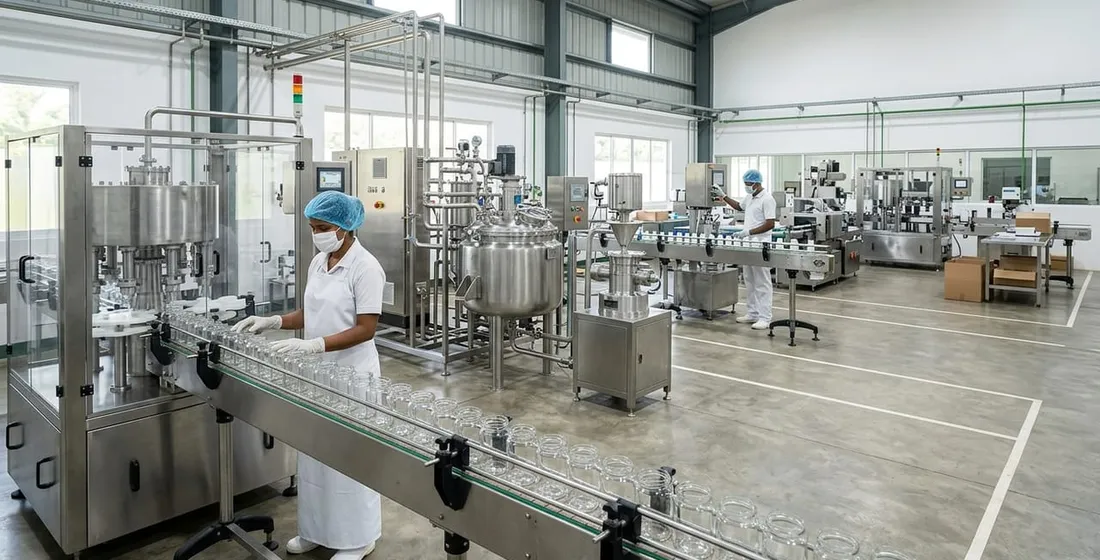
On a typical changeover at the Matale facility, the team moves the colloid mill, the forming machine, and the filling head between configurations rather than keeping one line frozen in place. That is what 50-plus ready-to-go SKUs on a single audit looks like in practice: the same certified hall, reconfigured, instead of five certified halls standing idle between runs.
Service snapshot: Contract Manufacturing at Silk Foods Ceylon Service: SFC manufactures the buyer's recipe at the Matale facility First-run MOQs: 1,500 jars (spreads, 300 g glass); 1,250 bottles (beverages, 200 ml); 180 bottles (capsules) Timelines: 2 to 3 weeks from PO to dispatch for a locked recipe; R&D, if needed first, takes 3 to 4 weeks maximum from signed brief to approved formulation Cert coverage: BRCGS- and FSSC 22000 V6-audited, plus SLSI clearance and Sri Lanka Food Act compliance on every retail SKU Local R&D: in-house team at Matale; samples approvable in person on the same property |
The certification point is the one founders underprice most. A first-time brand budgets for the recipe and the packaging, then discovers that the SLSI submission timeline and the manufacturer audit chain are the real gate to a shelf. When the second SKU can ride the same audit, even a 180-bottle capsule run stops being a fresh compliance project each time.
What did we get wrong, and what did the layout finally solve?
The mistake SFC made in 2019 was optimising for one product’s unit cost before the brand had one product. Most first-time local FMCG founders do the same. The cellular layout solved a problem we had framed backwards: the constraint was never making one thing cheaply, it was making the second and third thing without starting the audit, the sourcing, and the supplier hunt over again.
The SFC R&D lead put it plainly during a review. The brands that scale are rarely the ones with the single best recipe. They are the ones that can put their second and third SKU on a shelf before a competitor copies the first. A cellular factory is built for that sequence, whether the next SKU is a capsule, a spread, or a first plant-based patty run. A single-line plant quietly punishes it.
The team is not fully settled on where the line sits. Cellular flexibility has a real cost: a dedicated single-format plant will always beat us on the unit economics of one very-high-volume SKU. If a brand grows into that kind of volume on a single product, the honest answer is that a single-line plant may serve it better than we do. The question we still turn over is where that crossover point falls, and how early a founder can see it coming. For most local brands it is further away than they fear. For a few it arrives faster than we would like to admit.
Frequently asked questions
Does Silk Foods Ceylon offer contract manufacturing for multiple product types?
Yes. The Matale facility runs a cellular-manufacturing layout that produces 50-plus ready-to-go SKUs across spreads, beverages, capsules, spice blends, and plant-based formats on one BRCGS- and FSSC 22000 V6-audited cert stack. First-run MOQs sit at 1,500 jars, 1,250 bottles, or 180 capsule bottles depending on format.
What is cellular manufacturing in a food factory?
Cellular manufacturing arranges equipment into flexible cells so one plant makes many products in small batches. As of 2024, the US Environmental Protection Agency describes it as sequencing work stations for smooth flow with minimal transport or delay. For a small brand, it means many SKUs on shared certification rather than one product at volume.
Why is Silk Foods Ceylon in Matale and not Colombo?
Matale sits in Sri Lanka’s spice-growing and research belt, where the Department of Export Agriculture runs national spice research. The adjoining plantation and nearby smallholders put fresh raw material within a same-week reach of the R&D bench, which shortens pilot-batch turnaround compared with trucking material into a Colombo plant.
What is the first-run MOQ at Silk Foods Ceylon?
First commercial runs start at 1,500 jars for spreads in 300 g glass, 1,250 bottles for beverages in 200 ml, and 180 bottles for capsules. Lead times run 2 to 3 weeks from PO to dispatch once a recipe is locked. If in-house R&D is needed before the first batch, it takes 3 to 4 weeks maximum from signed brief to approved formulation.
How Silk Foods Ceylon can help
For local FMCG brands planning more than one SKU, Silk Foods Ceylon (SFC) operates a cellular-manufacturing facility in Matale that runs 50-plus ready-to-go formats on a single BRCGS- and FSSC 22000 V6-audited cert stack, with SLSI clearance and Sri Lanka Food Act compliance on every retail line. First commercial runs start at 1,500 jars, 1,250 bottles, or 180 capsule bottles, and the in-house R&D team can take a brief and return a sample before the line books a slot. One audit covers the second and third SKU as well as the first, which is the whole point of the layout.
To brief a project, email brands@esilkroute.com.lk or call +94 76 441 0389 / +94 76 918 5744.
Sources
- US Environmental Protection Agency (2024), “Lean Thinking and Methods: Cellular Manufacturing”, https://www.epa.gov/sustainability/lean-thinking-and-methods-cellular-manufacturing (retrieved 2026-07-12).
- Daily Mirror Business (2025), “Consumer goods in modern trade record strong growth momentum over 3 years”, https://www.dailymirror.lk/business/Consumer-goods-in-modern-trade-record-strong-growth-momentum-over-3-years/215-335839 (retrieved 2026-07-12).
- Sri Lanka Export Development Board (2025), “Ceylon Spice Industry Capability”, https://www.srilankabusiness.com/spices/about/industry-capability.html (retrieved 2026-07-12).
- Department of Export Agriculture, Sri Lanka, “National Spice Garden”, https://dea.gov.lk/national-spice-garden/ (retrieved 2026-07-12).
Written by the Silk Foods Ceylon Team. Silk Foods Ceylon (Pvt) Ltd. is a BRCGS- and FSSC 22000 V6-audited contract manufacturer in Matale, Sri Lanka, offering contract manufacturing, private labelling, co-packing, and in-house R&D for local Sri Lankan brand owners, FMCG companies, hotel and restaurant groups, and distributors. To brief a project: brands@esilkroute.com.lk, +94 76 441 0389, or +94 76 918 5744.