Private-Label Triphala and Gurmar Capsules for Local Ayurvedic Retail
Buyer’s snapshot
- Sri Lanka’s demand for vitamins, dietary supplements and herbal-traditional remedies grew through 2025, with pharmacies holding the leading retail distribution channel (Euromonitor, 2025).
- Triphala and gurmar (Gymnema sylvestre) are both traditional Ayurvedic formulations: a capsule SKU carrying either claim needs Department of Ayurveda registration alongside SLSI clearance, not one or the other.
- Silk Foods Ceylon (SFC) runs its capsule line at up to 200,000 capsules a day, with a 180-bottle private-label MOQ per SKU.
- The table below sets out where a triphala programme and a gurmar programme diverge on sourcing, claim language and first-run fit.
Triphala and gurmar are two of the most recognisable names on a Sri Lankan Ayurvedic shelf, and for a brand owner planning a private-label capsule programme, that recognition is the easy part. Sri Lanka’s consumer health category grew through 2025 on rising demand for vitamins, dietary supplements and herbal-traditional remedies, with pharmacies as the leading distribution channel ahead of general retail (Euromonitor, 2025). Both formulations already sit inside that growth. What most brand owners underestimate is not the herb sourcing. It is the registration paperwork that has to sit behind the capsule before a single bottle reaches a shelf.
What a triphala or gurmar capsule programme needs before the first 180-bottle run
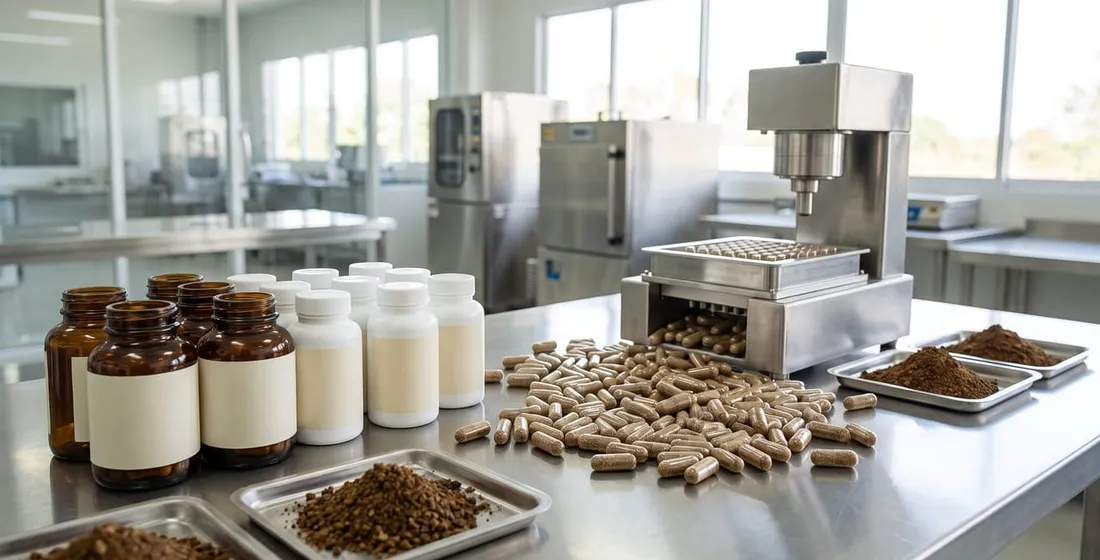
A private-label capsule SKU at Silk Foods Ceylon (SFC) starts at a 180-bottle minimum order per formulation, a figure set deliberately low for a first commercial run rather than export-scale volume. The Matale capsule line runs at roughly 100,000 capsules per single shift, scaling to 200,000 a day across shifts, which means a 180-bottle first order shares the line with other SKUs rather than requiring its own dedicated production block.
Timing depends on whether the formulation is already locked. Where a brand brings a stable triphala or gurmar recipe with defined herb ratios and an existing supplier, sample dispatch typically runs one to two weeks and PO-to-dispatch runs two to three weeks. Where the formulation needs adjustment, specifying active content for a private-label capsule becomes the first task, and the timeline stretches to six to ten weeks while sample iterations settle the ratio and the grind. Herb sourcing and traceability documentation has to be locked before that clock starts, since both the Department of Ayurveda and SLSI ask for a documented raw-material chain, not a verbal supplier assurance.
A first private-label capsule programme needs three things settled before the 180-bottle order goes in: a locked formulation with a defined herb ratio, a documented raw-material source for each herb, and a claim-language draft that a regulator can review. Skipping any of the three usually shows up later as a submission delay, not a manufacturing one.
Does a triphala or gurmar SKU need Department of Ayurveda registration?
Yes, and the requirement applies to both formulations, not just one. Triphala is the classical three-fruit combination (Amalaki, Bibhitaki and Haritaki) with a centuries-old digestive and general-wellness association. Gurmar, the Sinhala and Hindi common name for Gymnema sylvestre, carries a narrower traditional association tied to sweet-taste perception and blood-sugar balance support. Both are formulated under recognised Ayurvedic monographs, which is exactly the trigger for Department of Ayurveda registration under the Ministry of Health.
Registration sits parallel to SLSI clearance, not instead of it. The Department’s process covers first-time registration and renewal through a documented standard operating procedure, and it asks for the formulation, the source of the active herbs, and the exact claim language the brand intends to print on the label (Department of Ayurveda, Ministry of Health, 2026). That last point matters more for gurmar than for triphala: any wording that edges toward a glucose or diabetes-adjacent claim needs sign-off on the specific phrase, not just the ingredient. Triphala’s broader wellness framing gives a brand more available label language before it brushes against a regulated claim.
The full stack for an Ayurvedic-claim capsule SKU, in the order it should appear in any brand-facing document, is BRCGS, FSSC 22000 V6, SLSI, and Department of Ayurveda registration. The Matale facility carries the BRCGS and FSSC 22000 V6 audit on the manufacturing side; SLSI and Ayurveda Dept registration are formulation-specific and sit with the individual SKU. A brand that has cleared a private-label Ayurvedic capsule submission once can usually reuse most of the documentation for a second herb under the same manufacturer.
Both triphala and gurmar need Department of Ayurveda registration alongside SLSI clearance before retail sale, since both carry traditional Ayurvedic claims under recognised monographs. The Department’s process (ayurveda.gov.lk, 2026) reviews the formulation, the herb source, and the specific claim wording, which is the step that most often sets the real project timeline.
Triphala vs gurmar: which fits a first private-label programme?
The two formulations pull on different parts of a brand’s operation. Triphala’s three-fruit blend means three separate dried-fruit inputs, each with its own moisture and grinding spec, but a wellness claim that stays largely inside familiar, low-scrutiny language. Gurmar is a single-herb leaf powder, which simplifies the raw-material file, but its most marketable claim sits closest to the line a regulator watches hardest.
| Attribute | Triphala programme | Gurmar (Gymnema sylvestre) programme |
|---|---|---|
| Formulation | Three-fruit blend (Amalaki, Bibhitaki, Haritaki) at an established ratio | Single-herb leaf powder or extract |
| Traditional positioning | Digestive and general wellness association | Sweet-taste perception and blood-sugar balance association |
| Claim-language sensitivity | Moderate; broader wellness wording available | Higher; glucose-adjacent wording needs specific Ayurveda Dept sign-off |
| Raw-material sourcing | Three dried-fruit inputs, separate moisture and grind spec each | One leaf-powder input, narrower QC matrix |
| Best first-run fit | A brand wanting a recognisable, low-explanation SKU | A brand building a tighter functional-wellness story |
| First-run MOQ | 180 bottles | 180 bottles |
A brand unsure which to launch first often does better starting with triphala, since the claim review moves faster and the formulation is more forgiving of small supplier variation. Gurmar rewards a brand that already has its label copy drafted and is ready to sit through a longer claim-language review. Some programmes run both from the outset; a comparable wellness capsule programme took that route, sequencing the lower-scrutiny herb first and the second SKU once the manufacturer relationship and documentation pattern were established.
Scheduling the first commercial run: sample to shelf
One local wellness brand at Silk Foods Ceylon began with a 180-bottle pilot of a triphala capsule in 2024 and had a gurmar SKU in the same product line on shelf within a year, sold through a hotel group’s spa and gift-shop retail programme. The unlock was not a faster factory. It was that the SLSI submission and the Ayurveda Dept registration for the second herb reused most of the documentation structure the first SKU had already built, so the second review moved faster than the first.
The realistic buffer to plan against: SLSI clearance for a packaged-food SKU with a stable formulation typically runs four to eight weeks, and the operational habit is to build a six-to-ten-week gap between manufacturer QA sign-off and a target shelf date. Department of Ayurveda registration runs on its own schedule alongside that window rather than after it, so the two submissions should start close together, not sequentially. A brand that treats Ayurveda Dept registration as an afterthought after SLSI clears is usually the one that misses its shelf date.
The R&D iteration budget for a capsule SKU is smaller than for a retort or fresh-format product, typically two to four sample iterations to settle a herb ratio or a grind, since capsules skip the process variables that affect jars or bottles. That makes the registration timeline, not the manufacturing timeline, the longer pole in most triphala or gurmar launches.
A triphala or gurmar capsule launch is usually gated by the registration calendar, not the production line. SLSI clearance runs four to eight weeks; Department of Ayurveda registration runs in parallel on its own schedule. Starting both applications together, rather than one after the other, is the single change that shortens most first-run timelines.
How Silk Foods Ceylon can help
For hotel and wellness retail groups running gift-shop, spa or in-room amenity capsule programmes, Silk Foods Ceylon (SFC) offers a private-label catalogue that already includes triphala, gurmar, ashwagandha, moringa and turmeric capsule formulations, ready for custom branding without a new formulation cycle. First-run MOQs sit at 180 bottles per SKU, which keeps a multi-herb wellness programme inside a single production block rather than separate manufacturing runs. The Matale facility is BRCGS- and FSSC 22000 V6-audited, with SLSI clearance and Department of Ayurveda registration support built into the private-labelling engagement for every Ayurvedic-claim SKU.
To brief a private-label capsule programme, email b2b@esilkroute.com.lk or call +94 76 441 0389 / +94 76 918 5744.
Frequently asked questions
Does Silk Foods Ceylon offer private-label triphala and gurmar capsules?
Yes. Both are part of the existing SFC herbal-capsule portfolio, available for private-label branding without new formulation work. The MOQ is 180 bottles per SKU, with capsule-line capacity of up to 200,000 units a day at the Matale facility, so a first order shares the line rather than needing its own production slot.
Do triphala and gurmar capsules need Department of Ayurveda registration?
Yes, both do. Each is formulated under a recognised Ayurvedic monograph, which triggers registration under the Department of Ayurveda, Ministry of Health, alongside SLSI clearance. The Department’s process reviews the formulation, the herb source, and the specific claim language before a capsule SKU can carry an Ayurvedic claim at retail.
How long does SLSI clearance take for a private-label capsule SKU?
Typically four to eight weeks for a packaged-food SKU with a stable formulation. Most brands plan a six-to-ten-week buffer between manufacturer QA sign-off and a target shelf date, since Department of Ayurveda registration for the same SKU runs on a parallel, separate schedule rather than after SLSI clears.
What is the difference between a triphala and a gurmar capsule programme?
Triphala is a three-fruit blend with a broad wellness claim and more forgiving raw-material sourcing. Gurmar is a single-herb leaf powder with a narrower, more claim-sensitive positioning tied to blood-sugar balance. Both carry a 180-bottle first-run MOQ; triphala’s claim review usually moves faster.
Can Silk Foods Ceylon develop a new Ayurvedic capsule formulation from a brief?
Yes. SFC’s R&D and NPD route takes a brand’s concept or existing herb combination and settles the ratio, grind and encapsulation spec before a first commercial batch. Capsule formulations typically need two to four sample iterations, fewer than a retort or fresh-format product line.
Sources
- Euromonitor International, Consumer Health in Sri Lanka market research report, 2025. https://www.euromonitor.com/consumer-health-in-sri-lanka/report (retrieved 2026-07-27)
- Department of Ayurveda, Ministry of Health, Regulation of Local Ayurveda Drugs/Products Registration, 2026. https://ayurveda.gov.lk/docs/regulation-of-local-ayurveda-drugs-products-registration/ (retrieved 2026-07-27)
- Sri Lanka Export Development Board, Ayurvedic and Herbal Products sector overview, 2025. https://www.srilankabusiness.com/ayurvedic-and-herbal/ (retrieved 2026-07-27)
- Sri Lanka Standards Institution, national standards body overview. https://slsi.lk/en/ (retrieved 2026-07-27)
- Spherical Insights, Global Triphala Formulations Market Size and Forecast 2026-2035, 2025. https://www.sphericalinsights.com/blogs/top-20-companies-in-the-global-triphala-formulations-market-2026-2035-spherical-insights-analysis (retrieved 2026-07-27)
- Verified Market Reports, Global Gymnema Sylvestre Extract Market Size and Forecast, 2025. https://www.verifiedmarketreports.com/product/gymnema-sylvestre-extract-market/ (retrieved 2026-07-27)