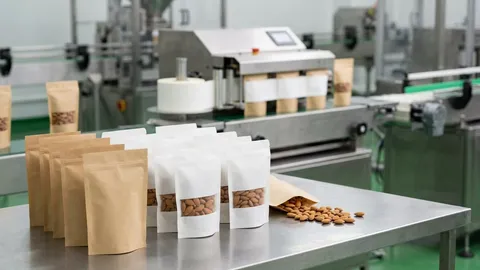
Sachet and Stick-Pack Co-Packing for Powdered Drinks in Sri Lanka
By the Silk Foods Ceylon Editorial Team
Buyer’s snapshot
- Sri Lanka exported 257.44 million kg of tea in 2025, worth Rs. 453.28 billion, according to Daily Mirror Business (January 2026). A drink-powder brand in this market is choosing a format as much as a flavour.
- For packs of 5 g to 50 g, OIML R 87 allows a tolerable deficiency of 9 per cent of the labelled weight: 0.45 g on a 5 g stick.
- Silk Foods Ceylon (SFC) co-packs buyer-supplied powder in one to two weeks from arrival. Printed laminate, at 8 to 13 working weeks, is the long item.
- The format table and the quote-inputs table are the two to take into a planning meeting.
A brand owner with a tested ginger and lemongrass drink mix usually arrives with the flavour settled and the format open. Jar, sachet or stick? Each answers a different buyer and moves the cost of a gram by a different amount. A distributor holding imported premix in 25 kg sacks has the same question with less time.
This is the capability one-pager for that job at the Matale facility: fill weight and tolerance, laminate and moisture barrier, format, line speed, label rules, minimum run and lead time. Where SFC has not documented a number, the page says so instead of guessing.
What does powdered-drink co-packing cover, and what does it leave out?
Co-packing means the buyer supplies finished goods and Silk Foods Ceylon (SFC) fills, seals, codes and labels them. For powdered drinks that covers dosing powder into sachets or stick packs, checking net weight, coding batch and dates, and reading artwork against the labelling rules. It does not cover formulation, which is a separate R&D brief.
The boundary matters because two different jobs hide inside “we need drink sachets”. If the powder already exists, the job is co-packing, and the buyer owns the goods and the recipe. If the powder has to be made first, for example a fruit or plant milk powder from a liquid, the job starts on the spray-drying line as contract manufacturing and co-packing follows. The spray-drying side is set out in spray-dried fruit powder contract manufacturing in Sri Lanka, and a worked powder spec is in coconut water powder co-packing and its spec limits.
| Element | Co-packing (buyer supplies powder) | Contract manufacturing (SFC makes powder) |
|---|---|---|
| Powder | Buyer’s finished goods delivered to Matale | Made on the SFC spray-drying line |
| Documented minimum | Quoted per production block | 50 kg for spray-dried plant milk powder, a single-day batch |
| Filling, sealing, coding | In scope | In scope |
| Laminate | Buyer’s own, or sourced on request | Sourced with the buyer |
| Artwork review | Checked against the Food Act labelling rules | Checked against the Food Act labelling rules |
Sachet, stick pack or jar: which format fits a powdered drink?
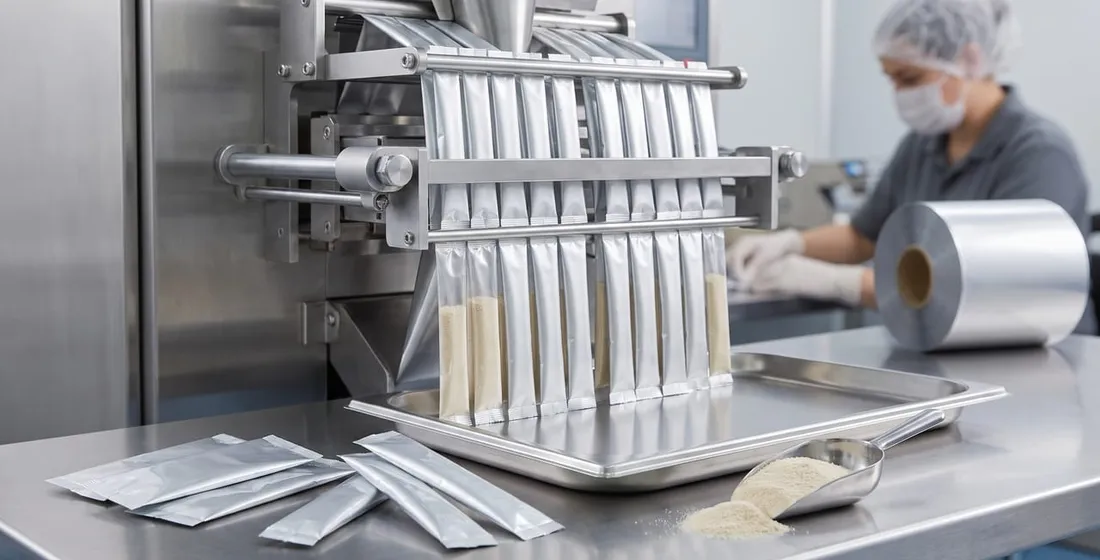
A flat sachet suits wide, shallow single servings and sampling. A stick pack, a narrow tube seal, suits a pour-into-a-glass serving. A jar suits a multi-serve tub. Format sets the line configuration, the pack count per kilogram and how much laminate an order consumes, so it is the first decision rather than the last.
| Format | What it suits | Planning consequence |
|---|---|---|
| Flat sachet | Sampling, hotel in-room trays, multipacks | Wider face, so fewer lanes fit on the same film web |
| Stick pack | Single-serve retail, slim cartons | Narrow face, often 38 mm or less on published machine ranges, which limits label space |
| Glass jar, 50 ml to 1 L | Multi-serve home and café use | Scoop dosing; the jar range already runs at SFC |
| Kraft pouch, 50 g to 1 kg | Bulk-value retail | Documented SFC format; weaker moisture barrier than foil unless lined |
The arithmetic that surprises first-time buyers is pack count. One kilogram of powder is 200 sticks at 5 g, 333 at 3 g and 100 at 10 g. Laminate, printing and sealing are paid per pack, so the cost of a kilogram rises as the serving shrinks, even when the powder is identical.
Service snapshot: Co-Packing at Silk Foods Ceylon
Service: buyer supplies finished powder; SFC fills, seals, codes and labels at the Matale facility
Unit booked: a production block, typically a single day, varying with SKU mix
Lead time: one to two weeks from arrival of finished goods; printed laminate is planned separately
Documented formats: sachet and portion-pack sizes, 50 g to 1 kg kraft pouches, glass jars from 50 ml to 1 L
Cert coverage: BRCGS- and FSSC 22000 V6-audited, plus SLSI submission support and Sri Lanka Food Act labelling review
How accurate does the fill weight have to be?
The Measurement Units, Standards and Services Department (MUSSD) describes its pre-packed goods inspections as following OIML practice. Under OIML R 87, a pack of 5 g to 50 g may fall short of its labelled weight by 9 per cent before it counts as defective, and the batch average must still reach the labelled weight.
Three rules apply together. The average content of the sample must not fall below the labelled quantity. No more than 2.5 per cent of packs may fall below the labelled quantity minus the tolerable deficiency. No pack may fall below the labelled quantity minus twice that deficiency.
| Labelled weight | Tolerable deficiency (9%) | Floor for 97.5% of packs | Hard floor for any pack |
|---|---|---|---|
| 5 g | 0.45 g | 4.55 g | 4.10 g |
| 10 g | 0.90 g | 9.10 g | 8.20 g |
| 20 g | 1.80 g | 18.20 g | 16.40 g |
The first rule is the expensive one. Because the average cannot sit below the label, a filler is set slightly above it. A 2 per cent overfill on a 5 g stick is 0.1 g, which is 10 kg of powder across 100,000 sticks. That is product the buyer pays for and nobody drinks, which is why dosing accuracy belongs in the quote conversation and not only the quality plan.
Confirm the schedule MUSSD applies to your SKU before writing a tolerance into a purchase order, because the rule of record is the department’s, not a reference table’s.
Which laminate protects a hygroscopic drink powder?
Drink powders with sugar, milk solids or fruit solids absorb moisture from humid air and cake. In a stick pack the barrier is the laminate. Foil structures such as PET, aluminium foil and PE are generally far tighter than metallised film, and the buyer should ask the converter for water vapour transmission data before artwork is released.
Three checks decide whether a laminate suits the powder. First, the water vapour transmission rate at the test condition the converter quotes, usually near 38 degrees Celsius and high relative humidity, since a figure without its condition cannot be compared. Second, the seal layer: fine powder dusting into the seal area is the usual cause of a weak seal, so the sealing film has to tolerate contamination. Third, the film has to run on the machine, which means roll width, core size and slip are agreed with the converter before the first roll is ordered.
The same humidity discipline for a dry herbal product is covered in private-label herbal tea shelf life in Sri Lanka’s humidity. SFC’s documented packing equipment includes a form-fill packing machine, a band sealer and a vacuum sealer. Lane count, stick-pack capability and film specification are confirmed per SKU at brief.
How fast does a stick-pack line run?
Published stick-pack machine ranges run from 300 packs a minute on six lanes to 800 on sixteen, at up to 50 cycles a minute. That is a machine-class reference, not an SFC rate. SFC quotes line speed per SKU at brief, because powder flow, fill weight and film decide the real figure.
| Lanes | Nameplate packs per minute | Packs per hour | Powder at a 5 g fill |
|---|---|---|---|
| 6 | 300 | 18,000 | 90 kg per hour |
| 9 | 400 | 24,000 | 120 kg per hour |
| 16 | 800 | 48,000 | 240 kg per hour |
Consider a distributor holding 400 kg of imported ginger drink premix who wants 5 g sticks. That is 80,000 sticks. At the six-lane nameplate rate, filling takes about 4.4 hours. The real block is longer, because the changeover, the line clean and the first-article weight check are all line time that produces nothing, and nameplate speed is a ceiling that real output sits below.
The consequence is a planning one. A single SKU in one pack size is a short block. Four flavours in the same size is four changeovers, and the fourth flavour costs clean-down time, not fill time. Consolidating flavours into one booking is how a multi-SKU launch stays cheap, a point developed in festival-season co-packing slots and when to book them.
What does a small drink pack have to carry on its label?
The Food (Labelling and Advertising) Regulations 2026, Gazette Extraordinary No. 2494/47, disapply the main label particulars under regulation 5(3) for packs of 25 g or less, if a labelled dispenser or container is available at the point of sale. A retail stick sold singly rarely has one, so brands usually label the carton fully.
The stick itself still earns its print. The regulations set a trilingual declaration and a 1.5 millimetre print floor, and a stick face is narrow. Fitting a common name in three languages, ingredients, net weight, batch, dates and the packer onto a 38 mm face is arithmetic, not design. Brands that print the full set end up on fewer lanes and a wider film, which lowers packs per minute.
Artwork is also the longest item on the calendar. SFC’s working plan for a first printed private-label pack runs 8 to 13 working weeks from dieline to material in the plant, against a filling block of one to three days. The schedule logic is laid out in artwork and print lead time for private label in Sri Lanka.
What is the minimum run and the lead time?
SFC publishes no per-sachet minimum for buyer-supplied powder. The unit booked is a production block, typically a single day. Lead time is one to two weeks from the arrival of finished goods at Matale. Printed laminate is planned separately and is the item that usually sets the calendar.
There is no published rupee list price either. Co-packing is quoted in LKR per 1,000 packs or per kilogram, with a USD figure added only where a buyer is comparing an overseas packer. Five variables move the number, and a buyer who arrives with all five settled gets a firm quote instead of a range.
| Variable | What moves the LKR quote |
|---|---|
| Format and fill weight | Pack count per kilogram: 200 sticks per kg at 5 g, 100 at 10 g |
| Run length | Packs per block against the fixed cost of set-up and first-article checks |
| Changeovers | Number of flavours and sizes in one block |
| Laminate | Buyer-supplied or sourced on request, and its width and seal layer |
| Compliance scope | Artwork review, coding set-up and SLSI submission support |
Where SFC walks away
A formulation that is still moving: that is an R&D and new product development brief, 3 to 4 weeks at most from signed brief to approved formulation, and it comes before a packing slot.
A pack with no laminate decision: a block booked before the film is chosen is released and rebooked.
A run too small to justify a block: for a founder still testing flavour at home scale, more bench rounds come first.
The handover mechanics for moving an existing SKU between packers are covered in switching co-packers in Sri Lanka and the audit chain handover.
Frequently asked questions
What is the minimum order for sachet co-packing at Silk Foods Ceylon?
Silk Foods Ceylon publishes no per-sachet minimum for buyer-supplied powder. The unit booked is a production block, typically a single day, which varies with the number of flavours and pack sizes. Lead time is one to two weeks from the arrival of finished goods. Printed laminate is planned separately and is usually the longer item.
How accurate must the fill weight of a 5 g stick pack be?
Under OIML R 87, which MUSSD cites for pre-pack inspection, a 5 g pack has a tolerable deficiency of 9 per cent, or 0.45 g. No more than 2.5 per cent of packs may fall below 4.55 g, none below 4.10 g, and the batch average must reach 5 g.
Does a 5 g stick pack need a full food label in Sri Lanka?
Regulation 5(3) of the Food (Labelling and Advertising) Regulations 2026 disapplies the main particulars for packs of 25 g or less, if a labelled dispenser is available at the point of sale. A single retail stick usually has none, so brands label the carton fully and print key particulars on the stick.
Can Silk Foods Ceylon make the drink powder as well as pack it?
Yes. SFC runs a spray-drying line that makes powders from liquids, such as plant milk powder with a documented minimum of 50 kg in a single-day batch. The powder is contract manufacturing and the packing is co-packing. A new formulation needs R&D first, 3 to 4 weeks at most, before either starts.
How Silk Foods Ceylon can help
For distributors and drink brands converting a powder into retail-ready sachets or sticks, Silk Foods Ceylon (SFC) runs a co-packing capability at its 10,000 sq ft cellular-manufacturing facility in Matale. The buyer supplies the powder; the SFC team handles filling, sealing, coding, labelling and artwork review against the Sri Lanka Food Act framework, with SLSI submission support. Lead time is one to two weeks from arrival of finished goods, quoted per production block. Where the powder has to be made first, the spray-drying line and the in-house R&D team sit on the same BRCGS- and FSSC 22000 V6-audited site.
To brief a sachet or stick-pack run, email b2b@esilkroute.com.lk or call +94 76 441 0389 / +94 76 918 5744.
Sources
Daily Mirror Business, Sri Lanka tea exports 2025: 257.44 million kg and Rs. 453.28 billion, published 26 January 2026, as reproduced by the History of Ceylon Tea. Retrieved 2 October 2026. https://www.historyofceylontea.com/ceylon-publications/ceylon-tea-articles/tea-industry-overview-january-december-2025.html
International Organization of Legal Metrology, OIML R 87, Quantity of product in prepackages, with erratum of 16 June 2008: tolerable deficiency of 9 per cent for 5 g to 50 g and the three-rule average and tolerance test. Retrieved 2 October 2026. https://www.oiml.org/en/files/pdf_r/r087-e04.pdf
Parliament of Sri Lanka, Measurement Units, Standards and Services Department, Performance Report and Annual Accounts 2018, on pre-packed commodity inspection by net content sampling to OIML practice. Retrieved 2 October 2026. https://www.parliament.lk/uploads/documents/paperspresented/performance-report-measurement-units-standards-services-department-2018.pdf
Unified Flex, Stick Pack Machines: six-lane 300 packs per minute, nine-lane 400, sixteen-lane 800, up to 50 cycles per minute, stick width up to 1.5 inches. A machine-class reference, not an SFC rate. Retrieved 2 October 2026. https://unifiedflex.com/stick-pack-machines/
Ministry of Health, Sri Lanka, Food (Labelling and Advertising) Regulations 2026, Gazette Extraordinary No. 2494/47 of 26 June 2026, regulation 5(3), made under the Food Act No. 26 of 1980. Retrieved 23 August 2026. https://www.eohfs.health.gov.lk/food/images/2494-47_E.pdf
Silk Foods Ceylon, internal capability data for the Matale facility: co-packing lead time one to two weeks from arrival of finished goods; production block typically a single day; spray-dried plant milk powder 50 kg single-day minimum; R&D 3 to 4 weeks maximum; first printed pack plan 8 to 13 working weeks.
Written by the Silk Foods Ceylon Team. Silk Foods Ceylon (Pvt) Ltd. is a BRCGS- and FSSC 22000 V6-audited contract manufacturer in Matale, Sri Lanka, offering contract manufacturing, private labelling, co-packing, and in-house R&D for local Sri Lankan brand owners, FMCG companies, hotel and restaurant groups, and distributors. To brief a project: b2b@esilkroute.com.lk, +94 76 441 0389, or +94 76 918 5744.