Herbal Tea Shelf Life in Sri Lanka: Moisture Barrier Specs
Buyer’s snapshot
- Colombo averaged 75.4% relative humidity by day and 86.7% by night in 2024, and wet-zone stations ran to between 92% and 95% at night (Department of Census and Statistics, Statistical Pocket Book 2025, from Department of Meteorology observations).
- There is no moisture ceiling for tea to hit. ISO 3720:2011 specifies no limit for moisture content, and Sri Lanka’s own tea standards adopt it as written. The binding numbers are microbiological, with yeasts and moulds capped at 1,000 cfu per gram (Sri Lanka Tea Board, 2021).
- In a 2024 packaging trial on a dried tropical leaf, an aluminium foil laminate returned an estimated 275 days of shelf life at 90% relative humidity. A nylon and LLDPE pouch returned 12 (Heliyon, 2024).
- Silk Foods Ceylon (SFC) private-labels herbal tea SKUs from a catalogue of more than 50 ready-to-go products at its Matale facility, on a BRCGS- and FSSC 22000 V6-audited site with SLSI clearance on every retail SKU.
- The three tables below cover the microbiological limits that set a date, the barrier materials that hold it, and the seasonal reorder cadence that keeps stock from sitting through a monsoon.
Sri Lanka closed 2025 with 18,308 rooms across 170 classified tourist hotels, inside a national stock of 59,578 rooms that had grown 11.6% in twelve months (Sri Lanka Tourism Development Authority, Year in Review 2025). A large share of those rooms carry a tea sachet, and every one of those sachets has a date printed on it.
That date is usually the last decision in a private-label tea programme and the most expensive one to get wrong. It is also the only decision on the spec sheet that a hotel group cannot fix after the run.
Is there a legal moisture limit for herbal tea in Sri Lanka?
No. ISO 3720:2011, the international standard for black tea, states in clause 4.2.2 that no limit is specified for the moisture content of tea as received. Loss in mass at 103 degrees Celsius may be measured and recorded, but it is optional. Sri Lanka’s tea standards adopt ISO 3720:2011 alongside SLS 135:2009, and carry no moisture parameter either (Sri Lanka Tea Board, 2021).
This surprises most buyers, because a maximum moisture figure circulates widely in trade material. It is not in the current standard. What is in the standard is a set of microbiological ceilings, and those are what a shelf-life date has to hold.
| Parameter | Limit | Why it matters for a hotel sachet |
| Total plate count | Maximum 10,000 cfu per gram | General hygiene indicator across the blend |
| Yeasts and moulds | Maximum 1,000 cfu per gram | The parameter that moisture ingress moves first |
| Total coliforms | Maximum 10 MPN per gram | Handling and packing hygiene |
| Escherichia coli | Absent per gram | Pass or fail, no tolerance |
| Salmonella | Absent per 25 grams | Pass or fail, no tolerance |
Read the second row. Yeasts and moulds are the parameter that water activity drives, and the one that decides whether a blend is still inside spec on the date printed on the sachet. The Tea Board’s own testing protocol switches method when a tea sits in a damp condition above a water activity of 0.95, which is the regulator naming moisture as a microbiological problem rather than a compositional one.
So the question a hotel group should put to a manufacturer is not what moisture percentage the blend leaves the line at. It is what mould count the blend will show at month nine, in a storeroom that is not air conditioned. That reframes the whole in-room tea bag programme as a packaging decision rather than a blending one.
One caveat worth stating plainly. ISO 3720 covers black tea from Camellia sinensis and excludes scented and decaffeinated teas, so it does not directly govern a caffeine-free tisane. It is the closest published benchmark a Sri Lankan buyer has, and the Tea Board microbiological limits are applied far more broadly than the chemical ones.
What the barrier material actually buys you
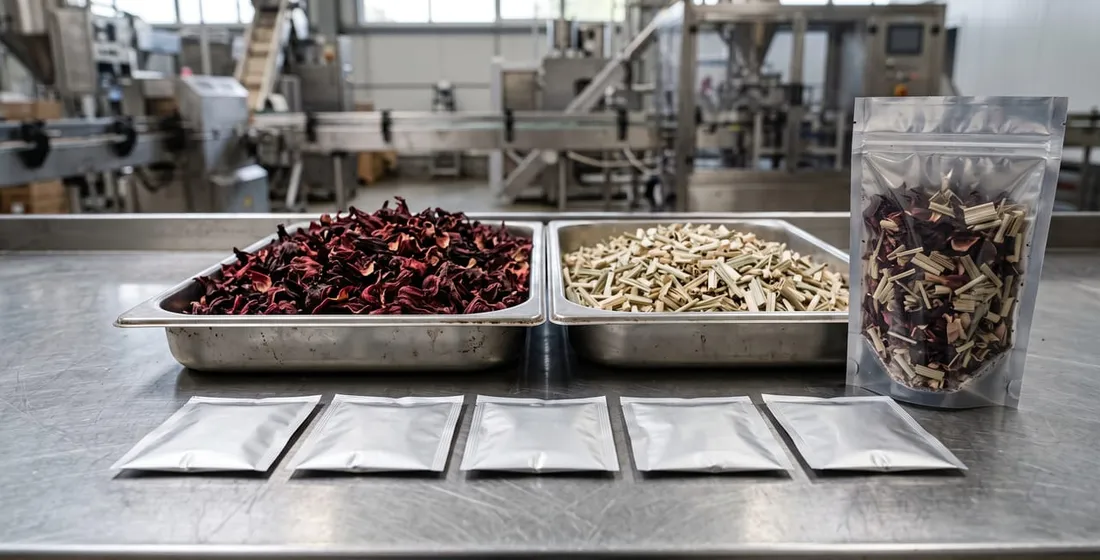
Barrier choice is the single largest lever on herbal tea shelf life in a tropical climate, and it is measurable. A 2024 study published in Heliyon stored a dried tropical leaf seasoning at 30 degrees Celsius in two pack formats, at 60% and at 90% relative humidity, and estimated shelf life from measured water vapour transmission rates.
| Pack format | Water vapour transmission rate, grams per day per square centimetre | Estimated shelf life at 60% relative humidity | Estimated shelf life at 90% relative humidity |
| Laminated aluminium foil, 93.0 microns | 3.22 x 10 to the minus 6 | 684 days | 275 days |
| Nylon and LLDPE, 77.6 microns | 7.39 x 10 to the minus 5 | 30 days | 12 days |
The foil laminate transmits water vapour at roughly one twenty-third the rate of the nylon structure. At week twelve in the foil pack at 60% relative humidity, the product still measured 3.45% to 3.58% moisture and a water activity of 0.277 to 0.278, which is well below the range where moulds grow.
The substrate in that study was a dried leaf seasoning, not a tisane, so treat the day counts as an analogue rather than a specification. The ratio is the transferable part. Two packs that look identical on a procurement line item can differ by an order of magnitude on the only property that matters here.
Format and barrier are separate decisions that buyers routinely merge. The four tea bag formats govern how the leaf is presented in the cup. The outer wrap governs how long the leaf stays inside spec. A pyramid sachet in a paper envelope is a good cup with a short date.
The R&D team at the Matale facility sees the same gap in hotel tea briefs. A brief will specify the blend ratio, the cup colour, the steep time, and the artwork tone, then leave the outer wrap as a line reading foil pouch or similar. Similar is where the shelf life goes. Two structures both described as foil in a quotation can sit a full order of magnitude apart on water vapour transmission, and the buyer finds out at month four.
What the sachet has to carry, and the 25 gram exemption
Sri Lanka’s Food (Labelling and Advertising) Regulations 2022, gazetted under the Food Act No. 26 of 1980, require a batch or code marking, a date of manufacture, and a date of expiry on prepackaged food, printed indelibly and legibly. Where a food is imported in bulk and repackaged locally, both the date of manufacture and the date of repackaging are required.
Prepackaged food of 25 grams or less is exempt from those declarations. A 2 gram tea sachet sits comfortably inside the exemption, which is why the in-room sachet itself often carries almost nothing.
This is the trap. The exemption removes a printing obligation. It does not remove the shelf life. The date still exists in the batch record, the outer carton still carries it, and the housekeeping team restocking a floor cupboard has no way of reading it off the sachet. A hotel group running an exempt sachet needs a stock rotation rule at property level, because the pack has stopped telling anyone when it expires.
For gift-shop retail the exemption usually falls away, because a retail carton of 20 sachets clears 25 grams comfortably and carries the full tri-lingual declaration set. A programme that runs both formats is running two label specs from one blend, which is the recurring complexity in a gift-shop herbal tea SKU sitting alongside an amenity sachet.
One further number is worth holding if any part of the blend is imported. Under the Food (Shelf Life of Imported Food Items) Regulations 2011, imported food must possess a minimum of 60% of its unexpired shelf life at the point of entry. A botanical landing in Colombo with half its life gone is not usable, whatever the price was.
That rule shapes any programme built on imported botanicals rather than locally grown ones, and it is one of the reasons the co-packing route for imported tea runs on tighter inbound scheduling than a locally blended SKU does.
Service snapshot: Private Labelling for hotel tea programmes Service: SFC-formulated herbal tea SKUs carrying the hotel group's brand, from a catalogue of more than 50 ready-to-go products First-run MOQ: from 1,500 units per SKU, which keeps a multi-SKU amenity and gift-shop programme inside a single production block Lead time: 2 to 3 weeks from PO to dispatch on a locked recipe, 6 to 10 weeks when formulation work comes first Regulatory window: SLSI clearance typically runs 4 to 8 weeks, so plan a 6 to 10 week buffer before a target shelf date Cert coverage: BRCGS- and FSSC 22000 V6-audited, with SLSI clearance and Sri Lanka Food Act 1980 compliance on every retail SKU Location: Matale, with an adjoining plantation supplying herbs for pilot batches |
How should a hotel group phase reorders against occupancy?
Sri Lanka received 2,362,521 tourists in 2025, up 15.1% on 2024, and the arrival curve is steep (Sri Lanka Tourism Development Authority, Year in Review 2025). December brought 258,928 arrivals. May brought 132,919. The peak month runs at roughly 1.95 times the trough.
| Month, 2025 | Tourist arrivals | Index against the monthly average of 196,877 | Reorder posture |
| December | 258,928 | 1.32 | Peak draw, order ahead of the season |
| January | 252,761 | 1.28 | Peak draw |
| February | 240,217 | 1.22 | Peak draw |
| March | 229,298 | 1.16 | Peak tapering |
| September | 158,971 | 0.81 | Below average |
| June | 138,241 | 0.70 | Trough, southwest monsoon |
| May | 132,919 | 0.68 | Trough, southwest monsoon |
A flat twelve-month reorder schedule fails at both ends of that curve. It runs short in December and it over-stocks in May, and the May over-stock is the damaging one. Surplus sachets sit in a property storeroom through the southwest monsoon, in exactly the months when wet-zone night humidity runs to between 92% and 95%. The two halves of this post meet there. The packaging decision and the ordering decision are the same decision, made six months apart.
The practical shape is a seasonal cadence rather than a flat one. Order the peak-season volume in October and November, order a deliberately small block in April, and hold the difference as production capacity rather than as inventory in a hot storeroom. Cellular manufacturing makes that workable, because a line that reconfigures between SKUs can take a short second run without a full changeover penalty.
Blend composition interacts with this too. A caffeine-free botanical blend behaves differently in storage from a black tea base, and the wellness tea blend brief covers the formulation side of that. This post covers what happens to it afterwards.
Whichever cadence a group settles on, the regulatory calendar sits underneath it. Build the SLSI submission into the schedule six to ten weeks before the first shelf date, not after the artwork is signed off.
Frequently asked questions
Does Silk Foods Ceylon private-label herbal tea for Sri Lankan hotel groups?
Yes. Private Labelling covers SFC-formulated herbal tea SKUs carrying the hotel group’s brand, drawn from a catalogue of more than 50 ready-to-go products. First-run MOQs start at 1,500 units per SKU, produced at a BRCGS- and FSSC 22000 V6-audited facility in Matale.
Is there a maximum moisture content for tea under Sri Lankan standards?
No. ISO 3720:2011 states that no limit is specified for moisture content, and Sri Lanka’s tea standards adopt it unchanged (Sri Lanka Tea Board, 2021). The binding limits are microbiological, with yeasts and moulds capped at 1,000 cfu per gram and Salmonella absent in 25 grams.
What shelf life can a private-label herbal tea sachet carry in Sri Lanka?
It follows the barrier, not the blend. A 2024 Heliyon trial on a dried tropical leaf estimated 275 days at 90% relative humidity in an aluminium foil laminate against 12 days in a nylon and LLDPE pouch. Specify the structure and the transmission rate, not the word foil.
Does a 2 gram tea sachet need a full label under the 2022 labelling regulations?
No. Prepackaged food of 25 grams or less is exempt from the declaration set in the Food (Labelling and Advertising) Regulations 2022. The outer carton still carries the dates, so a hotel group running exempt sachets needs a stock rotation rule at property level.
How often should a hotel group reorder a private-label tea SKU?
Seasonally rather than evenly. Sri Lanka’s December arrivals ran at roughly 1.95 times May’s in 2025 (Sri Lanka Tourism Development Authority, 2026). A flat schedule over-stocks the monsoon months, leaving sachets in storerooms through the highest humidity of the year.
How Silk Foods Ceylon can help
For hotel and restaurant groups running in-room amenity, gift-shop, or minibar SKU programmes, Silk Foods Ceylon offers a private-label catalogue of more than 50 ready-to-go products across herbal teas, spice blends, coconut SKUs, capsules, jams, and vegan formats. Custom branding is applied to existing SFC formulations, and first-run MOQs from 1,500 units per SKU keep a multi-SKU hotel programme inside a single production block. The Matale facility is BRCGS- and FSSC 22000 V6-audited, with SLSI clearance on every retail SKU, and barrier structure is specified on the production sheet rather than left to a quotation line. The adjoining plantation supports brand storytelling for sustainability-positioned hotel groups.
To brief an in-room or gift-shop programme, email b2b@esilkroute.com.lk or call +94 76 441 0389 or +94 76 918 5744.
Sources
- International Organization for Standardization, ISO 3720:2011, “Black tea. Definition and basic requirements”, clause 4.2.2 and Table 1 (2011). https://cdn.standards.iteh.ai/samples/51541/b956593025ba44539b133668d43d242c/ISO-3720-2011.pdf (retrieved 2026-08-03)
- Sri Lanka Tea Board, “Minimum Quality Standards for Sri Lankan Origin Tea”, Circular AL/MQS-02/2021, Issue No. 02 (January 2021). https://srilankateaboard.lk/wp-content/uploads/2024/11/02_Sri-Lanka-Tea-Board-Standads-for-Sri-Lankan-Origin-Teas_compressed.pdf (retrieved 2026-08-03)
- Department of Census and Statistics Sri Lanka, Statistical Pocket Book 2025, Table 1.3 “Meteorological Observation, 2024”, sourced from the Department of Meteorology (2025). https://www.statistics.gov.lk/Publication/PocketBook2025 (retrieved 2026-08-03)
- Usawakesmanee, W. et al., “Packaging impact on quality changes of dried Liang leaf seasoning”, Heliyon (2024), DOI 10.1016/j.heliyon.2024.e40462. https://pmc.ncbi.nlm.nih.gov/articles/PMC11615486/ (retrieved 2026-08-03)
- Food (Labelling and Advertising) Regulations 2022, Gazette Extraordinary No. 2319/40 of 14 February 2023, made under the Food Act No. 26 of 1980, as reproduced in USDA Foreign Agricultural Service GAIN report CE2023-0011 (23 August 2023). https://agriexchange.apeda.gov.in/ImportRegulations/Sri%20Lanka%20Enacts%20New%20Legislation%20for%20Food%20Labeling%20and%20AdvertisingColomboSri%20LankaCE20230011.pdf (retrieved 2026-08-03)
- Food (Shelf Life of Imported Food Items) Regulations 2011, Gazette Extraordinary No. 1694/5 of 23 February 2011, regulation 2. https://faolex.fao.org/docs/pdf/srl134168.pdf (retrieved 2026-08-03)
- Sri Lanka Tourism Development Authority, “Year in Review 2025”, Table 01 monthly arrivals and Table 10 accommodation capacity (published 2 April 2026). https://www.sltda.gov.lk/storage/common_media/Year_in_Review_2025_Final_updated_Report_2026_04_02-1.pdf (retrieved 2026-08-03)
Written by the Silk Foods Ceylon Team. Silk Foods Ceylon (Pvt) Ltd. is a BRCGS- and FSSC 22000 V6-audited contract manufacturer in Matale, Sri Lanka, offering contract manufacturing, private labelling, co-packing, and in-house R&D for local Sri Lankan brand owners, FMCG companies, hotel and restaurant groups, and distributors. To brief a project: b2b@esilkroute.com.lk, +94 76 441 0389, or +94 76 918 5744.