Plant-Based Beverage Formats in Sri Lanka: Glass, Can or Powder
By the Silk Foods Ceylon Editorial Team
Buyer’s snapshot
- Sri Lanka spends USD 300 to 400 million a year importing milk powder, the Minister of Health said in March 2024 (EconomyNext). A locally made plant-based drink competes with that imported tin, whichever format it picks.
- An oat, soy or rice drink is a low-acid food under Codex (pH above 4.6, water activity above 0.85), so every shelf-stable liquid needs in-container retort or aseptic processing.
- Silk Foods Ceylon (SFC) runs two of the four formats in Matale: a retorted 200 ml glass bottle at a 1,250-bottle first run, and a spray-dried powder at a 50 kg single-day batch. It does not run aluminium cans or aseptic cartons.
- The table below sets out each format’s thermal route, minimum run and lead time from approved artwork.
The brief for a plant-based drink usually arrives with the base chosen and the brand name ready. What it rarely settles is the container, and the container fixes the sterilisation route, the line the product can run on, the smallest batch anyone will quote, and the calendar between approved artwork and a pallet at the door.
The research side of that choice is covered in the earlier post on plant-based milk R&D and the spray-dry versus UHT decision. This post is the production side: what each of four formats commits a brand to.
Which plant-based beverage formats can a Sri Lankan brand actually run?
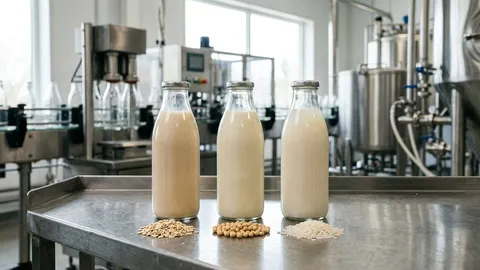
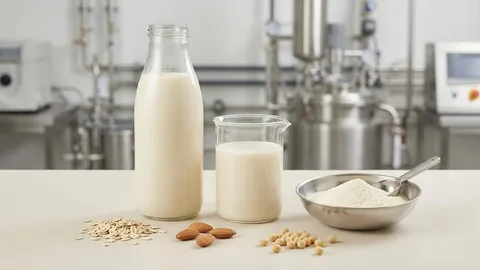
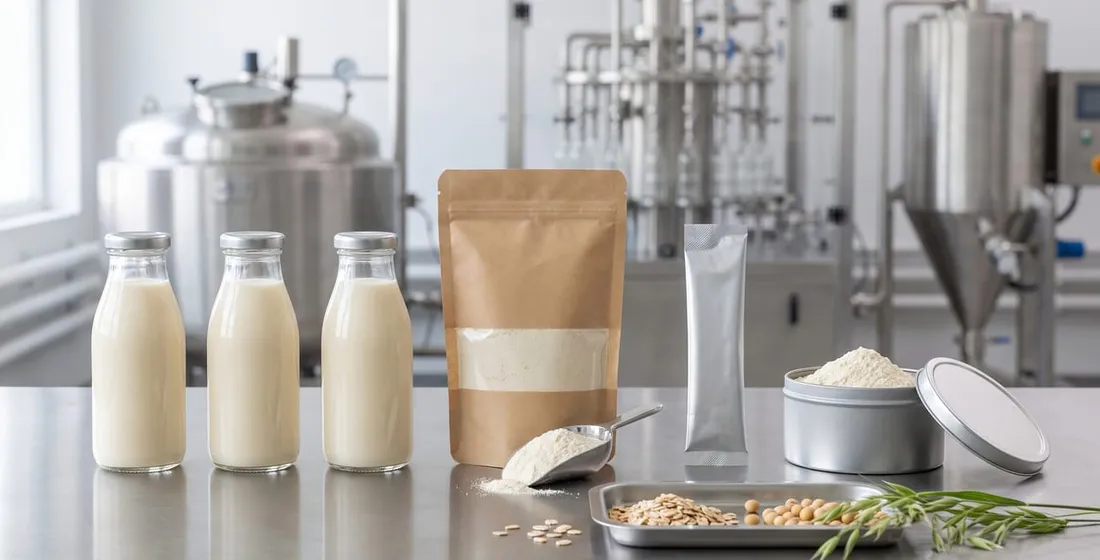
A shelf-stable plant-based drink reaches a Sri Lankan shelf in one of four formats: a retorted glass bottle, an aluminium can, an aseptic carton, or a powder the consumer reconstitutes. Two of them, glass and powder, run at Silk Foods Ceylon in Matale; cans and cartons mean a different factory for the fill.
| Format | Thermal route | Runs at SFC? | First-run minimum | Lead time once artwork is approved and in the plant |
|---|---|---|---|---|
| Glass bottle, 200 ml, retorted | In-container retort after capping | Yes, Non-Dairy Milk line | 1,250 bottles (half a shift at 2,500 bottles a day) | 2 to 3 weeks from PO to dispatch on a locked recipe |
| Spray-dried powder, packed to sachet, stick, pouch or tin | Spray-drying; no retort on the finished pack | Yes, spray-drying line plus packing block | 50 kg powder, a single-day batch; packing booked as a block | 2 to 3 weeks for the powder; 1 to 2 weeks for packing once powder and laminate are on site |
| Aluminium can | Retort after seaming, or hot-fill where the drink is acidified | No | Set by the canner; one large can co-packer publishes 180,000 cans per SKU | About 6 weeks from approved spec and materials, at that co-packer |
| Aseptic carton (UHT) | Product and pack sterilised separately, filled sterile | No | Set by the carton filler and the carton material supplier | Set by the filler; ask for it in writing before artwork starts |
A 1,250-bottle run or a 50 kg batch is a test a first-time brand can absorb. A can or carton minimum is a commitment to a year of sales before the first pallet exists.
The thermal route is the first commitment, not the label
The Codex Code of Hygienic Practice for Low-Acid and Acidified Low-Acid Canned Foods (CXC 23-1979) defines a low-acid food as one where any component has a pH above 4.6 and a water activity above 0.85. An oat, soy, rice or coconut drink sits on the wrong side of both lines, so the product must reach commercial sterility, which the same code defines as being free of microorganisms able to grow at normal non-refrigerated conditions during distribution and storage.
Two routes get there. In-container retort fills and seals first, then heats the sealed pack. The Codex code for aseptically processed foods (CXC 40-1993) describes the other route as packaging a commercially sterile product into sterilised containers with a sterilised closure, and states that it differs from canning, where the food is placed in the can, sealed and heat processed in that order.
The temperatures are not interchangeable. The Tetra Pak Dairy Processing Handbook gives UHT at 135 to 150°C for 1 to 10 seconds, and batch in-container sterilisation at 110 to 125°C for 3 to 40 minutes. A recipe tuned for seconds at 140°C behaves differently after 20 minutes at 121°C: more cooked note, more colour movement, a stabiliser system that has to hold through a longer heat. The recipe is developed for the route, so the format decision comes before the first sample.
Spray-drying sidesteps the question by removing the water. Research published in Scientific Reports in 2024 confirmed that plant beverages can be spray-dried without a carrier into a stable, reconstitutable powder. The commitment shifts from heat to moisture: the laminate, the seal and the storage humidity decide the shelf life.
What does a retorted glass bottle commit a brand to?
A glass bottle on the SFC Non-Dairy Milk line commits a brand to a 200 ml single-serve, a first run of 1,250 bottles, and a recipe that holds through retort. The line wet-grinds the base, heats and homogenises it, hot-fills and caps the glass, then retorts the sealed bottle. At 2,500 bottles a day, 1,250 bottles is half a shift, with the second half reserved for clean-down and the next SKU. Lead time is 2 to 3 weeks from purchase order to dispatch once the recipe is locked and printed labels are on site.
The brand also commits to glass logistics: water weight travels with the product, crates and dividers are part of the cost, and breakage is a line item a powder never carries. In return, a retorted glass bottle drinks closest to dairy, needs no cold chain, and sits in the ready-to-drink space where cartons and cans live.
Service snapshot: Contract Manufacturing at Silk Foods Ceylon
Service: SFC manufactures the buyer’s plant-based drink or powder at the Matale facility
Formats run: retorted 200 ml glass bottle; spray-dried powder packed to sachet, stick pack, 50 g to 1 kg kraft pouch or 400 ml round tin
First-run minimums: 1,250 bottles; 50 kg powder in a single-day batch
Lead time: 2 to 3 weeks from PO to dispatch on a locked recipe; R&D, where a recipe is not yet retort- or dryer-ready, is 3 to 4 weeks at most
Cert coverage: BRCGS- and FSSC 22000 V6-audited site, with SLSI submission support and Sri Lanka Food Act labelling review inside the engagement
The Food (Labelling and Advertising) Regulations 2026 allow a bottled food product to carry its date of expiry, batch number and date of manufacture stamped on the bottle neck at a letter size of at least 1.5 mm, so the artwork stays fixed across batches. The regulations are read in full in Sri Lanka’s 2026 food labelling rules as a first-run checklist.
What does a powder commit a brand to?
A spray-dried powder commits a brand to two production steps instead of one. The first is the powder: SFC’s documented minimum is 50 kg in a single-day batch, which at a 25 g to 30 g serving is in the region of 1,700 to 2,000 servings. The second is packing it into a retail format, booked as a production block and quoted at 1 to 2 weeks once powder and printed laminate are on site. Fill tolerance, laminate barrier and line speed are covered in sachet and stick-pack co-packing for powdered drinks.
The pattern the SFC R&D team sees most often is a brief that treats powder as the easy format. It is the light one, not the easy one. A plant-milk powder with oat or rice solids pulls moisture from humid air, and in Sri Lanka the air is humid most of the year. A metallised film will cake the powder inside a season; a foil laminate costs more per pack and is usually the right answer. The formulation also has to rehydrate cleanly in cold tap water, a sensory target the bottle never meets.
The label commitments move too. Reconstitution instructions become mandatory copy in at least two of the three languages. A small stick pack gets a concession: Schedule II of the 2026 regulations exempts a package with a total printable area of 100 cm² or less from nutrition labelling. The tin or pouch the sticks ship in does not.
Where Silk Foods Ceylon walks away: cans and cartons
SFC does not run an aluminium can or an aseptic carton, and a brief for either gets that answer at the first meeting rather than after a sample round. The 400 ml round tin on the SFC packaging list is a powder tin with a press-on lid, not a seamed beverage can. There is no can seamer and no aseptic filler at Matale.
What a can commits a brand to is rarely in the brief. One large beverage can co-packer publishes a minimum of 180,000 cans per SKU and a lead time of about 6 weeks from approved spec and materials to first pallets. That is one international operator’s published rate, not a Sri Lankan or SFC figure, but it shows the scale a canning line is built around. Under the 2026 regulations the expiry date, batch number and date of manufacture on a metal can must sit on the top or bottom of the can.
A carton commits a brand to the aseptic regime in Codex CXC 40-1993: sterile product, sterile pack material, sterile filling environment, and a HACCP plan built around keeping them that way. The minimum run is set by the carton filler and the material supplier; ask for it in writing before a designer draws a carton. For most first-time Sri Lankan plant-based brands the honest sequence is glass first, powder beside it for the pantry and online shelf, and a can or carton once the volume exists to fill one.
Buyer’s checklist: settle these before artwork starts
- The thermal route the recipe is developed for: retort, aseptic or spray-dry. It cannot be swapped after sampling without re-solving the recipe.
- The container, size and closure, in writing, so the minimum run and the coding method are known.
- Whether the pack is under or over 100 cm² of printable area, which decides the nutrition panel.
- The print lead for labels or laminate, booked before the production slot, not after it.
Lead time from approved artwork, format by format
Counted from the day the artwork is approved, the print is the long item on both formats. SFC’s working plan for a first printed label or laminate runs 8 to 13 working weeks from dieline to material in the plant.
| Step | Glass bottle | Powder to sachet, pouch or tin |
|---|---|---|
| R&D where the recipe is not yet process-ready | 3 to 4 weeks at most, before artwork | 3 to 4 weeks at most, before artwork |
| Print of labels or laminate (working plan) | 8 to 13 working weeks from dieline | 8 to 13 working weeks from dieline |
| Production, PO to dispatch, materials on site | 2 to 3 weeks | 2 to 3 weeks for the 50 kg batch, then 1 to 2 weeks for packing |
| Variable-data coding | On the bottle neck, 1.5 mm or larger | On the laminate or tin, within the artwork plan |
| SLSI | Confirm the current window directly with SLSI | Confirm the current window directly with SLSI |
Two things are deliberately missing. The Sri Lanka Standards Institution (SLSI) publishes no fixed processing window, so the schedule should carry a date confirmed with SLSI at submission. And there is no rupee price per bottle or sachet: the LKR figure depends on the base, the serving size and the run length, and is quoted on the brief. The print window is explained in artwork and print lead time for private label in Sri Lanka; the shelf-life figure for either format comes from the file described in shelf-life and accelerated stability testing for a Sri Lankan SKU.
Frequently asked questions
Does Silk Foods Ceylon manufacture canned or carton plant-based drinks?
No. Silk Foods Ceylon runs two plant-based beverage formats at its Matale facility: a retorted 200 ml glass bottle at a 1,250-bottle first run, and a spray-dried powder at a 50 kg single-day batch, packed to sachet, pouch or tin. Aluminium cans and aseptic cartons need a seamer or aseptic filler that SFC does not operate.
What is the minimum run for a plant-based drink in glass at Silk Foods Ceylon?
The first-run minimum is 1,250 bottles at 200 ml, half a shift on a line that fills 2,500 bottles a day. Lead time is 2 to 3 weeks from purchase order to dispatch once the recipe is locked and printed labels are on site. Where the recipe still needs retort work, in-house R&D takes 3 to 4 weeks at most before that.
Is a plant-based milk a low-acid food that needs retort or UHT?
Yes. Codex CXC 23-1979 defines a low-acid food as one with a pH above 4.6 and a water activity above 0.85, and oat, soy, rice and coconut drinks meet both. A shelf-stable liquid therefore needs in-container retort or aseptic processing to reach commercial sterility. A spray-dried powder avoids the sterile fill by taking the water out instead.
How long from approved artwork to a finished plant-based beverage run?
Count the print first. Silk Foods Ceylon’s working plan for a first printed label or laminate is 8 to 13 working weeks from dieline to material in the plant. Once labels are on site, a glass run ships 2 to 3 weeks after the purchase order; a powder takes 2 to 3 weeks for the 50 kg batch and 1 to 2 weeks more for packing.
How Silk Foods Ceylon can help
For local FMCG brands and founders choosing a plant-based beverage format, Silk Foods Ceylon (SFC) runs the two formats a first commercial run can carry: a retorted 200 ml glass bottle on the Non-Dairy Milk line, at 1,250 bottles per first run and 2,500 bottles a day, and a spray-dried powder at a 50 kg single-day batch, packed on the same site into sachets, stick packs, kraft pouches or 400 ml tins. Where the recipe is not yet retort- or dryer-ready, the in-house R&D team takes it there in 3 to 4 weeks at most. The Matale facility is BRCGS- and FSSC 22000 V6-audited, with SLSI submission support and Sri Lanka Food Act labelling review inside the standard contract manufacturing engagement.
To brief a plant-based beverage project, email b2b@esilkroute.com.lk or call +94 76 441 0389 / +94 76 918 5744.
Sources
EconomyNext, Sri Lanka’s sugar, milk powder consumption hurting people, economy: Minister, 14 March 2024, reporting the Minister of Health’s statement that Sri Lanka spends USD 300 to 400 million on powdered milk imports. Retrieved 5 October 2026. https://economynext.com/sri-lankas-sugar-milk-powder-consumption-hurting-people-economy-minister-154620/
FAO/WHO Codex Alimentarius, Code of Hygienic Practice for Low and Acidified Low Acid Canned Foods, CXC 23-1979, revised 1989 and 1993: definitions 2.9 (commercial sterility of thermally processed food) and 2.19 (low-acid food). Retrieved 5 October 2026. https://www.fao.org/input/download/standards/24/CXP_023e.pdf
FAO/WHO Codex Alimentarius, Code of Hygienic Practice for Aseptically Processed and Packaged Low-Acid Foods, CXC 40-1993: scope and definition 2.2 (aseptic processing and packaging), including the distinction from canning. Retrieved 5 October 2026. https://www.nicd.ac.za/wp-content/uploads/2018/05/Code_of_Hygienic_Practice_for_Aseptically_Processed_and_Packaged_Low-Acid_Foods_CAC_RCP_40-1993.pdf
Government of Sri Lanka, Food (Labelling and Advertising) Regulations 2026, Gazette Extraordinary No. 2494/47 of 26 June 2026, under section 32 of the Food Act No. 26 of 1980: regulation 6 provisos on bottled products and metal cans, and Schedule II section 1.2.16 on packages of 100 cm² or less. Retrieved 5 October 2026. https://eohfs.health.gov.lk/food/images/2494-47_E.pdf
Tetra Pak, Dairy Processing Handbook, chapter Long-life dairy products: UHT at 135 to 150°C for 1 to 10 seconds; batch in-container sterilisation at 110 to 125°C for 3 to 40 minutes. A process-engineering reference, not an SFC parameter. Retrieved 5 October 2026. https://dairyprocessinghandbook.tetrapak.com/chapter/long-life-dairy-products
BEV, Beverage co-packing in cans: minimum order quantity 180,000 cans per SKU; standard lead time about 6 weeks from approved spec and materials to first pallets. The published rate of one international can co-packer, cited as a scale reference, not a Sri Lankan or SFC figure. Retrieved 5 October 2026. https://bev.inc/cans-copacking
Scientific Reports (2024), Powdered plant beverages obtained by spray-drying without carrier addition: physicochemical and chemometric studies. Retrieved 5 October 2026. https://www.nature.com/articles/s41598-024-54978-x
Silk Foods Ceylon, internal capability data for the Matale facility: retorted 200 ml glass bottle at 1,250 bottles first run and 2,500 bottles a day; spray-dried plant milk powder 50 kg single-day batch; co-packing 1 to 2 weeks from arrival of powder and laminate; 2 to 3 weeks PO to dispatch; R&D 3 to 4 weeks maximum; first printed pack plan 8 to 13 working weeks; packaging list including the 400 ml round tin.
Written by the Silk Foods Ceylon Team. Silk Foods Ceylon (Pvt) Ltd. is a BRCGS- and FSSC 22000 V6-audited contract manufacturer in Matale, Sri Lanka, offering contract manufacturing, private labelling, co-packing, and in-house R&D for local Sri Lankan brand owners, FMCG companies, hotel and restaurant groups, and distributors. To brief a project: b2b@esilkroute.com.lk, +94 76 441 0389, or +94 76 918 5744.