Artwork and print lead time: the private-label gate in Sri Lanka
By the Silk Foods Ceylon Editorial Team
Buyer’s snapshot
- Print minimum order quantity, not filling capacity, usually sets the size of a first private-label run. Printed laminate pouches on rotogravure start around 10,000 units. Digital self-adhesive labels start around 250.
- The Food (Labelling and Advertising) Regulations 2026 fix a 1.5 millimetre floor on the date of expiry, the batch number and the date of manufacture, and require the mandatory particulars in Sinhala, Tamil and English. That is panel space decided before any design work starts.
- A GS1 Lanka barcode has to exist before artwork is signed off, because supermarket point-of-sale scanners will not read a SKU without one.
- Backward-planned from a shelf date, dieline to printed material lands at roughly 8 to 13 working weeks. Silk Foods Ceylon (SFC) fills in 1 to 3 days once the material is in the plant.
A brand owner scaling a private-label range in Sri Lanka usually arrives with the product settled and the packaging treated as the last step. The formulation is locked, the price point is modelled, the retail conversation has started. Artwork gets handed to a designer late, and the printer gets it later still.
The schedule then breaks in a predictable place. Filling a 300 gram jar or a 100 gram pouch is a one to three day block at the plant. Getting printed material into the plant is an eight to thirteen week exercise that nobody costed. Print is not a finishing task. It is the longest lead item in a private-label launch, and it sets the minimum size of the first run.
Start with the dieline, not the design
A dieline is the flat, dimensioned drawing of the pack: the cut outline, the fold and seal lines, the gusset geometry, the bleed allowance, and the areas that will be obscured by a seal or a fitment once the pack is formed. It comes from the converter, not from the designer, and it is specific to the machine that will run the job. Artwork built without one is artwork that has to be rebuilt.
The reason the order matters is that the dieline decides how much panel is genuinely usable, and the usable area is always smaller than the flat area. On a stand-up pouch the bottom gusset folds under and carries no readable content. The side seals take 8 to 10 millimetres each. The top 15 to 20 millimetres is lost to the seal and any zipper. On a 100 gram pouch the front panel that a shopper actually sees can be a third smaller than the sheet the designer was working on.
Codex Alimentarius CXS 1-1985 adds a constraint that a dieline has to satisfy rather than a designer. The standard requires that the name of the food and the net contents appear in a prominent position and in the same field of vision, and that where a container is covered by a wrapper, the wrapper carries the necessary information or the label beneath it stays readily legible through the wrapper. Both are geometry problems, and both are cheaper to solve on a dieline than on a press proof.
The same discipline applies to rigid formats, where the label wrap and the jar shoulder decide the readable area. That trade-off is worked through in white versus black capsule bottles and what the label costs.
What Sri Lankan law puts on the panel before the brand does
The Food (Labelling and Advertising) Regulations 2026, gazetted under the Food Act, No. 26 of 1980 and in operation from 1 July 2026, are the first claim on panel space. They set out the mandatory particulars for a packaged food sold in Sri Lanka, require them in Sinhala, Tamil and English, and put a floor on how small they can be printed. The date of expiry has to be declared in numerical form and printed at not less than 1.5 millimetres in height. The batch number, the date of manufacture and the nutrition declaration carry the same 1.5 millimetre floor.
Three languages at a legislated minimum height is a large block of type. On a 50 gram or 100 gram pack it is frequently the single largest content element, larger than the brand mark. Established local brands solve it by designing the compliance block first, at final size, and treating the remaining area as the creative canvas. Brands that design first and paste compliance in afterwards end up reducing the ingredient list below the floor, which is the most common reason artwork fails a compliance read.
Bulk material moving business to business is exempt from most of the labelling requirements but not from all of them. Ten items remain mandatory, including the date of manufacture, the date of expiry and the batch number, and the words Not for retail sale have to be printed in bold at not less than 3 millimetres. A distributor buying 25 kilogram sacks for repacking inherits that marking rather than resetting it.
The barcode is the other item that has to exist before sign-off. GS1 Lanka allocates the numbers, and a product has to carry a GS1 number to be sold through the point-of-sale scanners used by the supermarket multiples and the departmental stores. Allocation needs a certified business registration certificate, certified director details and a proof of address, so it is a company-level task with its own turnaround, not something a designer can generate.
| Element on the pack | What the 2026 regulations require | Panel consequence |
| Name of the food | Declared in Sinhala, Tamil and English | Three language variants of the same line, front panel |
| Date of expiry | Numerical form, not less than 1.5 millimetres | Fixed-height field, often coded at filling rather than printed |
| Batch number and date of manufacture | Not less than 1.5 millimetres | Reserved clear area for the coder, kept free of artwork |
| Nutrition declaration | Not less than 1.5 millimetres | Tabular block, usually back panel, sized before layout |
| Bulk business-to-business packs | Not for retail sale in bold, not less than 3 millimetres | Separate artwork version for bulk, not a scaled retail file |
| Barcode | GS1 Lanka allocation required for retail point of sale | Quiet zone and minimum magnification protected on the dieline |
Compliance artwork and the clearance file are separate exercises that run in parallel. The clearance side is set out in SLSI step-by-step for a first packaged-food submission in Sri Lanka.
Laminate versus wrap-around label: where the money actually sits
Two print routes cover most private-label work in Sri Lanka. Printed laminate, where the design is printed into the film that becomes the pouch, and a wrap-around or self-adhesive label applied to a jar, bottle or plain pouch. They fail in opposite directions.
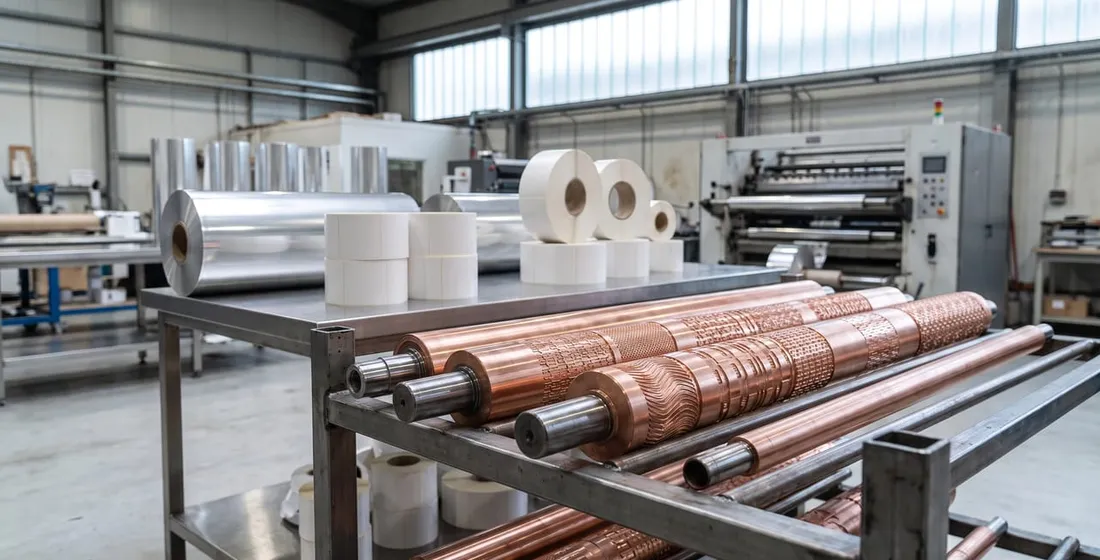
Rotogravure, the standard route for printed laminate, engraves one copper cylinder per colour. Industry pricing puts a cylinder at roughly USD 120 to 200, so a six-colour design is a one-time tooling cost of about USD 720 to 1,200 before a single metre of film runs. Converters set a minimum around 10,000 pouches for the route, because below that the tooling has nowhere to amortise. The cylinders are then reused on repeats, which is exactly why the second order looks so much cheaper than the first.
Labels invert this. Digital label presses have no plates and no tooling charge, and minimums start near 250 units. Flexographic labels sit between the two, with a plate set of roughly USD 50 to 200 per colour and a minimum near 500. Published break-even comparisons put digital ahead below about 2,000 to 3,000 labels and flexo ahead above roughly 5,000.
The arithmetic below converts those figures at LKR 300 to the US dollar, stated here as an illustrative rate rather than a quoted one, and divides the tooling across the minimum run. It is the number that decides the route, and it is almost never in the designer’s brief.
| Print route | Typical first-run minimum | One-time tooling | Tooling per unit at the minimum | Where it fits |
| Rotogravure printed laminate | 10,000 pouches | One engraved cylinder per colour, about LKR 36,000 to 60,000 each | About LKR 22 to 36 per pouch at six colours | A proven SKU with repeat volume |
| Rotogravure on a 50,000 repeat | 50,000 pouches | Cylinders already engraved and held | About LKR 4 to 7 per pouch | The second and subsequent orders |
| Flexographic self-adhesive label | 500 labels | Plate set, about LKR 15,000 to 60,000 per colour | About LKR 3 to 7 per label at 5,000 units | Mid-volume jars and bottles |
| Digital self-adhesive label | 250 labels | None | Zero | First runs, flavour variants, seasonal packs |
| Digital short-run pouch | Low hundreds | None | Zero | Sampling, trade shows, buyer presentations |
Tooling converted at LKR 300 to the US dollar from published converter pricing, then divided across the stated minimum run. Film, ink, conversion, delivery and wastage are additional. Method given so the figures can be rebuilt against a live quotation.
The practical consequence for a brand owner scaling a range is that print, not production, sets the floor. A capsule SKU can be made at 180 bottles and a spice or fruit powder at 50 kilograms, but a printed laminate pouch cannot be made at those numbers economically. The route out is to run the first year on digital labels applied to a plain pouch or a stock jar, prove the sell-through, and move to printed laminate once the annual volume clears the amortisation point. Several local ranges carry a mixed portfolio permanently, with printed laminate on the two or three lines that move and labels on the long tail.
The same volume logic drives format choice at the shelf, worked through for a supermarket listing in private-label curry powder for the Sri Lankan supermarket shelf and for glass formats in private-label vegan mayonnaise in a glass jar.
Proofing rounds are a schedule item, not a formality
Colour approval has a standard behind it. ISO 12647-7 sets the criteria for proofing systems working directly from digital data, and the certification schemes built on it, including the Fogra contract proof creation programme, define what a contract proof has to demonstrate before it can be used to approve colour. The controls are a calibrated output device, a substrate-specific profile, defined measurement conditions, and a stated Delta E tolerance, now generally expressed against the CIEDE2000 formula rather than the 1976 definition.
What that means commercially is simple. A contract proof is the reference the printer is held to. Approving colour from a desktop print, a screen or a phone photograph removes the reference, and any argument about the delivered print then has no measurable basis. Brand owners who have been through one dispute over a shade of green tend to insist on a contract proof from then on.
Two rounds is the working assumption. Round one carries the mark-up: type below the legislated floor, a barcode with an inadequate quiet zone, a language variant missing, a claim that has to come off. Round two confirms the corrections and is signed. A third round happens when the brief changed mid-flight, and it costs three to five working days plus the cost of the proof. On a printed laminate job a third round can also mean re-engraving a cylinder, which pushes the cost from an inconvenience into a real number.
A useful discipline for a scaling brand is to have the manufacturer read the artwork against the regulations before round one goes to the printer, rather than after. A compliance read costs two to three days and catches the failures that would otherwise be found by a proof round costing five.
How print lead time gates the production slot
Backward planning from a shelf date is the only way this schedule holds. The table below is the SFC working plan for a first printed private-label pack, in working days, from dieline request to a filled and packed SKU. It assumes one product, two proof rounds, and no repeat of a completed step.
| Step | Working days | Who holds it |
| Dieline issued against the chosen pack format | 2 to 3 | Converter |
| Artwork built to the dieline | 5 to 10 | Brand owner or the design agency |
| Compliance read against the 2026 regulations | 2 to 3 | Manufacturer |
| GS1 Lanka number allocation and barcode verification | 3 to 5 | Brand owner with GS1 Lanka |
| Contract proof round one and mark-up | 3 to 5 | Converter and brand owner |
| Contract proof round two and sign-off | 3 to 5 | Brand owner |
| Cylinder engraving or plate making | 5 to 10 | Converter |
| Print run and conversion into pouches or labels | 10 to 15 | Converter |
| Delivery of printed material into the plant | 2 to 3 | Converter |
| Filling, sealing, coding and packing | 1 to 3 | Silk Foods Ceylon |
SFC working plan for a first printed private-label pack, in working days. Totals 36 to 62 working days, roughly 8 to 13 working weeks. Steps that can genuinely overlap, such as barcode allocation running alongside artwork, are held separate here so the plan stays conservative.
Two things follow from the total. First, the filling block is the smallest item on the list. A brand owner who books a production slot and then starts artwork has inverted the dependency, and the slot will be released and rebooked. Second, an SLSI clearance window of four to eight weeks runs on its own track and does not absorb the print time, so the two have to be planned side by side rather than in sequence.
Seasonal work compounds it. A festival range with a dated design cannot be pushed, and converter capacity tightens in the same weeks that every other local brand is printing.
The seasonal booking pattern is set out in festival-season co-packing slots and when to book them, and the compliance overhead on gifting formats in the diaspora gifting channel, seasonal volumes and label compliance.
What to lock before briefing a printer
A printer quotes accurately against a fixed set of decisions. Handing over a design file without them produces a quotation that changes twice, and a schedule that moves with it.
Buyer's checklist
|
For a brand running several SKUs, one further decision saves more time than any of the above. Standardise the compliance block across the range at a single size and position, so that a new variant reuses an approved layout and only the variable content changes. Ranges built that way clear a new flavour in one proof round rather than two.
Frequently asked questions
What is the minimum print run for a private-label laminate pouch in Sri Lanka?
Converters generally set the rotogravure minimum at about 10,000 pouches, because engraving costs roughly USD 120 to 200 per colour and needs volume to amortise. Below that, a digital or flexographic self-adhesive label applied to a plain pouch or stock jar is the economic route, with minimums near 250 and 500 respectively.
Can a first private-label run use labels instead of printed laminate?
Yes, and for a first run it is usually the right call. Digital labels carry no tooling charge and start near 250 units, which matches a first-run production MOQ such as 180 capsule bottles or a 50 kilogram powder batch. Printed laminate becomes cheaper once annual volume clears roughly 10,000 units per design.
How many proofing rounds should be budgeted for food artwork?
Two contract proof rounds is the working assumption: one carrying corrections, one confirming them. Each round runs three to five working days. A third round costs the same again and, on rotogravure, can require re-engraving a cylinder. A compliance read before round one removes most of the causes of a third.
Does Silk Foods Ceylon manage artwork and print for a private-label run?
Silk Foods Ceylon works to the brand owner’s artwork and coordinates with the converter on dieline, substrate and coding area, and reads artwork against the Food (Labelling and Advertising) Regulations 2026 before it goes to proof. Print is contracted by the brand owner, with SFC holding the filling slot against the delivery date.
How Silk Foods Ceylon can help
Silk Foods Ceylon (SFC) is a BRCGS- and FSSC 22000 V6-audited manufacturer in Matale producing private-label, contract-manufactured and co-packed food and wellness SKUs for Sri Lankan brand owners, FMCG companies, hotel groups and distributors. For a brand scaling a range, the useful contribution is upstream of the press: confirming the pack format and fill weight that the dieline follows, reading artwork against the 2026 labelling regulations before a proof is paid for, specifying the coding area so the batch and expiry marking has somewhere to land, and holding the filling slot against a realistic print delivery date rather than an optimistic one.
First-run minimums are set at the production end rather than the print end: 180 bottles for a private-label capsule SKU, 50 kilograms for a spice, herb or fruit powder, 1,500 jars for a 300 gram spread or sauce, and 1,250 bottles for a 200 millilitre liquid. Sample dispatch on an existing recipe is one to two weeks, and purchase order to dispatch is two to three weeks, so the packaging path is the one that needs the early start.
To brief a private-label range: brands@esilkroute.com.lk, +94 76 441 0389, or +94 76 918 5744. The MOQ and lead-time position across formats is set out in the private-label buyer guide to MOQ and lead time.
Sources
Food (Labelling and Advertising) Regulations 2026, Gazette Extraordinary No. 2494/47 of 26 June 2026, made under the Food Act, No. 26 of 1980, Ministry of Health, on mandatory particulars, trilingual declaration and the 1.5 millimetre print floor. eohfs.health.gov.lk (retrieved 23 August 2026).
Food Act, No. 26 of 1980, Ministry of Health, Sri Lanka, the enabling statute for the labelling regulations. eohfs.health.gov.lk (retrieved 23 August 2026).
GS1 Lanka, Get a Barcode, on the requirement for a GS1 number to sell through supermarket point-of-sale scanners and the documents needed for allocation. gs1lanka.org (retrieved 23 August 2026).
Codex Alimentarius Commission, General Standard for the Labelling of Prepackaged Foods, CXS 1-1985, adopted 1985 and amended through 2010, section 8 on legibility, prominence and the same field of vision. fao.org (retrieved 23 August 2026).
International Organization for Standardization, ISO 12647-7:2013, Graphic technology, process control for the production of half-tone colour separations, proof and production prints, part 7 on proofing processes working directly from digital data. iso.org (retrieved 23 August 2026).
Fogra Research Institute for Media Technologies, Contract Proof Creation certification, 2016 revision, on contract-proof tolerances and the CIEDE2000 colour-difference formula. fogra.org (retrieved 23 August 2026).
Grounded Packaging, Minimum Order Quantities for Custom Packaging, 2025, industry source for the 10,000-unit rotogravure laminate minimum and per-cylinder engraving cost. groundedpackaging.co (retrieved 23 August 2026).
Custom Printing Company, Digital versus Flexographic Label Printing Cost Comparison, 2026, industry source for label minimums, plate costs and the digital-to-flexo break-even band. customprintingco.com (retrieved 23 August 2026).
Written by the Silk Foods Ceylon Editorial Team. Silk Foods Ceylon (Pvt) Ltd. is a BRCGS- and FSSC 22000 V6-audited contract manufacturer in Matale, Sri Lanka, offering contract manufacturing, private labelling, co-packing, and in-house R&D for Sri Lankan brand owners, FMCG companies, hotel and restaurant groups, and distributors. To brief a project: brands@esilkroute.com.lk, +94 76 441 0389, or +94 76 918 5744.