Private-Label Unit Cost in LKR: Working Back from the Shelf Price
By the Silk Foods Ceylon Team
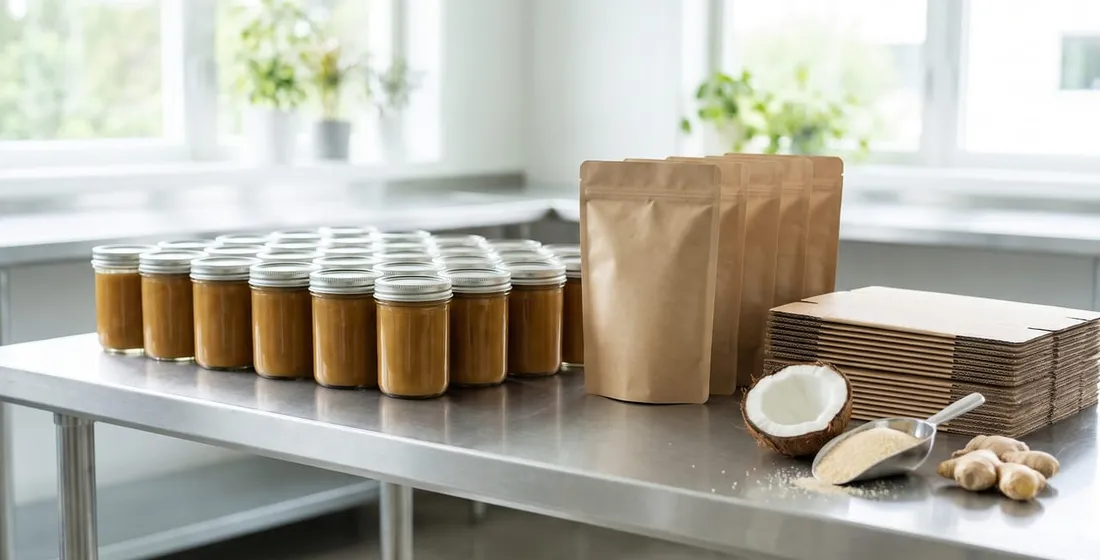
A row of identical blank glass jars with silver lids filled with golden-brown spread on a stainless steel packing table, beside blank kraft pouches, flat-packed cartons and a halved coconut.
Buyer’s snapshot
- Standard VAT in Sri Lanka has been 18 percent since 1 January 2024 (Inland Revenue Department), so about 15 percent of any shelf price including VAT is never yours to spend.
- In the worked example below, a LKR 1,200 shelf price leaves a LKR 610 ceiling at the factory gate once VAT, retailer margin and your own margin are taken out.
- A quote is only useful if it can be tested line by line against that ceiling: ingredient, pack, line time and QA.
- Written for a local brand owner pricing a first private-label SKU.
Most first private-label briefs start with a recipe and end with a price. The brands that reach a shelf with a margin intact usually work the other way round: they fix the shelf price first, strip out everything that is not the manufacturer’s, and treat what is left as a ceiling for the unit cost. Food inflation stood at 8.8 percent in October 2026 (Central Bank of Sri Lanka, 30 October 2026), so a unit cost built in the order recipe, quote, price is a number that has already moved by the time the label is printed.
Silk Foods Ceylon (SFC) quotes private-label and contract runs from its Matale facility, and this post sets out the method a brand owner can run before asking anyone for a quote. A note on the numbers: every rupee figure below is a round planning figure for a 300 g glass-jar spread, built to show the method. None of it is an SFC price or a quotation, so replace each line with your own. It sits beside the post on where the cost in a quote comes from, which covers the manufacturer’s side of the same sheet.
Why price from the shelf instead of from the recipe?
A shelf price is the one number the market has already decided. A supermarket buyer will list a 300 g spread at a price that sits against the brands around it, and an own-label range from one major supermarket chain was reported in November 2025 as priced at least 10 percent below comparable brands on most of its lines (Daily Mirror, 18 November 2025). A private-label brand does not get to choose its price freely, so cost has to be the variable.
How does a LKR 1,200 shelf price become a factory-gate ceiling?
The walk has four steps, and each one takes a share that belongs to someone other than the manufacturer. Tax comes out first, then the retailer, then the brand owner’s own margin and distribution, and the remainder is the most a manufacturer’s delivered price can be.
| Step | Working | LKR per jar |
|---|---|---|
| Shelf price including VAT | The price on the shelf tag | 1,200 |
| Less VAT at 18 percent | 1,200 minus (1,200 divided by 1.18) | 183 |
| Shelf price before VAT | 1,017 | |
| Less retailer margin, 25 percent | Assumption, replace with the agreed account terms | 254 |
| Price the brand owner receives | 763 | |
| Less brand owner margin and distribution, 20 percent | Assumption, covers sales, delivery and marketing | 153 |
| Ceiling for the delivered unit cost | About 51 percent of the shelf price | 610 |
Two of those lines are assumptions that only you can replace. The retailer margin is negotiated account by account and no public rate exists. A 2015 report quoted a Treasury official saying supermarket charges on locally supplied goods should not exceed 25 percent of the maximum retail price, while an unnamed manufacturer in the same article described 30 to 50 percent plus credit terms (The Sunday Times, 4 January 2015). That is an old, anecdotal range, so use it only as a prompt to ask your own buyer. The VAT line also deserves a check: treat a processed packaged food as standard-rated at 18 percent unless your accountant confirms the item sits on the exempt schedule (Inland Revenue Department).
Where SFC walks away
A brief with no target shelf price cannot be costed backward, and the walk above cannot be run for it. If the brand owner has not spoken to a single retail buyer, the better first step is that conversation, not a quote.
What goes into the five-line unit cost build?
With a LKR 610 ceiling in hand, the next question is whether a manufacturer’s quote fits under it. A useful quote can be split into five lines. The allocation below is the one used in this example to test a quote against, again with round figures and no claim to represent any manufacturer’s price.
| Line | What it covers | LKR per jar | Share of ceiling |
|---|---|---|---|
| Ingredients, including yield loss | Recipe weight divided by good output, at current input prices | 245 | About 40 percent |
| Pack | Jar, lid, label, shipper carton, any insert | 150 | About 25 percent |
| Line time and conversion | Cooking, filling, sealing, changeover share | 110 | About 18 percent |
| QA and compliance | Batch testing, retained samples, label check, documentation | 30 | About 5 percent |
| Manufacturer margin and site overhead | What keeps the line running | 75 | About 12 percent |
| Total delivered | 610 | 100 percent |
Two of those lines behave differently from the rest, and the brand owner controls more of them than most expect. Pack is the largest line the buyer can change without touching the recipe, and the logic of cutting pack variants is set out in the post on standardised packaging and cost per unit. Line time is the line that falls as a run grows, because the changeover is spread over more jars. SFC states no run size for that, as small runs are welcome and quoted on request, but the shape of the curve is the reason a first run and a repeat run are never priced the same.
Where does yield loss hide in the ingredient line?
Yield loss hides in the gap between recipe weight and good output. A recipe that calls for 300 g of product per jar does not consume 300 g of input, because some is lost to evaporation, trim, line residue and failed fills. Costing that loss correctly means dividing the batch cost by the good output, not by the input weight.
The standard worked example comes from costing teaching: a normal loss of 5 percent on a 4,000 kg batch is 200 kg, and the cost is spread over the 3,800 kg that survives (ACCA, process costing). Applied to a 300 g jar, a 5 percent loss means 0.316 kg of input per good jar, about 5.3 percent more than the recipe weight. On the LKR 245 ingredient line above, a sheet built from recipe weight alone would understate the cost by about LKR 12. The 5 percent is an illustration, so ask the manufacturer what normal loss its quote assumes and whether it is capped.
How much does a price rise eat into the margin?
A price rise eats margin in proportion to the line it hits, and the delivered price is fixed once the shelf price is. Food inflation was 8.8 percent in October 2026, against 8.7 percent in September (Central Bank of Sri Lanka, 30 October 2026).
Apply an 8.8 percent rise to the LKR 245 ingredient line and the cost rises by about LKR 22. The shelf price does not move for months, because a supermarket listing is negotiated, so that LKR 22 comes off the brand owner’s LKR 153 margin and cuts it by about 14 percent. A spread with a thinner margin assumption, or a recipe led by one volatile input, has less cushion still. Ask for a quote validity period in writing.
What does a quote need to show so it can be tested?
A quote that arrives as one number per jar cannot be tested against anything. The brand owner should ask for it in the five lines above, or at least in three: ingredients, pack and conversion. The checklist below is the minimum worth asking for before a purchase order.
Buyer’s checklist before accepting a unit cost
- The shelf price, VAT and retailer margin assumptions written down and dated
- The ingredient line shown with its normal-loss allowance
- The pack line itemised, with who supplies the jar, lid and carton
- Line time and changeover shown as a separate conversion charge
- QA, retained samples and label checking named as a line, not hidden in overhead
- The validity period of the quote and the rule if input prices move
- The label checked against the Food (Labelling and Advertising) Regulations 2026 before print
The last item is a cost as well as a compliance step. Label compliance sits under the Food (Labelling and Advertising) Regulations 2026 (Gazette Extraordinary No. 2494/47 of 26 June 2026), and a label reprint is a pack-line cost that no quote absorbs for free. Product certification is a separate question: the SLS mark is compulsory for 46 products under the Consumer Affairs Authority, but SLSI does not say that covers every packaged food, so confirm your SKU’s status directly with SLSI. The fee side is worked through in the post on what SLSI certification costs a first-time brand.
What does a ceiling look like when the brief is already moving?
The method earns its keep when a brief changes mid-way. The case below is a composite built from the pattern of brand-owner briefs, not one client’s file, and the figures are round.
A brand owner brought a 300 g spread and a target shelf price of LKR 1,350. Walked back with the same assumptions, that left a ceiling of about LKR 686. The first costing came in above it, and the gap was not in the recipe: it sat in the pack line, where a printed carton per jar had been specified for a product that would sit on a shelf in a shipper. Dropping the individual carton closed most of the gap without a single extra sample round. The recipe the brand owner had been worried about never changed.
A ceiling shows which line is out of proportion before samples are spent on the wrong one. The same logic scales across a range, which is the subject of the post on sequencing a three-SKU private-label launch.
Service snapshot: Private Labelling at Silk Foods Ceylon
Service: SFC formulates or adopts a recipe and supplies finished product under the buyer’s label
First runs: small runs welcome, quote on request
Lead times: samples typically dispatch in 1 to 2 weeks for an existing recipe; a locked recipe goes from purchase order to dispatch in 2 to 3 weeks; R&D, where needed, takes 3 to 4 weeks at most from signed brief to approved formulation
Cert coverage: BRCGS- and FSSC 22000 V6-audited, with Sri Lanka Food Act labelling compliance on every retail SKU
Frequently asked questions
How do I work out the most a manufacturer can charge for a private-label SKU?
Start at the shelf price and take out VAT at 18 percent, the retailer margin and your own margin. In the worked example, a LKR 1,200 shelf price leaves about LKR 610 at the factory gate, roughly 51 percent. The retailer and brand margins are assumptions to replace (Inland Revenue Department, 2026).
What share of a shelf price reaches the manufacturer in Sri Lanka?
It depends on the retailer’s agreed margin, which is not published. A 2015 report quoted a Treasury official saying supermarket charges should not exceed 25 percent of retail price, though one manufacturer described 30 to 50 percent plus credit terms (The Sunday Times, 2015). Ask your own buyer for the current terms.
How much yield loss should a unit cost allow?
It depends on the product and line, so ask for the figure in writing. A standard costing example uses a 5 percent normal loss, which means dividing batch cost by 95 percent of the input weight (ACCA, process costing). That adds about 5.3 percent to input per good unit.
Does Silk Foods Ceylon quote a unit cost for private-label SKUs?
Yes. Silk Foods Ceylon (SFC) quotes Private Labelling and Contract Manufacturing per SKU, with small runs welcome and quote on request. Samples for an existing recipe typically dispatch in 1 to 2 weeks, and a locked recipe goes from purchase order to dispatch in 2 to 3 weeks (SFC, 2026).
How Silk Foods Ceylon can help
For brand owners pricing a first private-label SKU, Silk Foods Ceylon (SFC) runs Private Labelling and Contract Manufacturing at its Matale facility, with in-house R&D of 3 to 4 weeks at most from signed brief to approved formulation. Quotes can be shown in the ingredient, pack, conversion and QA lines used above, so they can be tested against a ceiling like the one in this post. Small runs are welcome, quote on request, and a locked recipe goes from purchase order to dispatch in 2 to 3 weeks. The facility is BRCGS- and FSSC 22000 V6-audited, with SLSI submission support and Sri Lanka Food Act labelling compliance inside a standard engagement.
To brief a project, email b2b@esilkroute.com.lk or call +94 77 157 7294.
Sources
- Inland Revenue Department of Sri Lanka, Value Added Tax (VAT), rate history: 15 percent from 1 September 2022 to 31 December 2023, and 18 percent from 1 January 2024. ird.gov.lk (retrieved 8 November 2026).
- Central Bank of Sri Lanka (30 October 2026), “CCPI-based headline inflation accelerated in October 2026”, on food inflation of 8.8 percent in October 2026 against 8.7 percent in September. cbsl.gov.lk (retrieved 8 November 2026).
- Daily Mirror (18 November 2025), own-brands feature on a major supermarket chain, on most of the range being priced at least 10 percent lower than comparable branded products. dailymirror.lk (retrieved 8 November 2026).
- The Sunday Times, Business Times (4 January 2015), “Government to take stern action against supermarkets squeezing manufacturers”, on unnamed-source supermarket margin claims of 25 percent and of 30 to 50 percent. sundaytimes.lk (retrieved 8 November 2026).
- ACCA Global, “Process costing”, on normal loss and spreading cost over good output. accaglobal.com (retrieved 8 November 2026).
- Sri Lanka Standards Institution, SLS Mark Product Certification, on the mark being voluntary in principle and compulsory for 46 products under the Consumer Affairs Authority. slsi.lk (retrieved 8 November 2026).
- Government of Sri Lanka (2026), Food (Labelling and Advertising) Regulations 2026, Gazette Extraordinary No. 2494/47 of 26 June 2026. eohfs.health.gov.lk (retrieved 8 November 2026).
- Silk Foods Ceylon (2026), Capabilities Flyer, Food and Beverage Contract Manufacturing brochure and product and service catalogue (first-party lead-time data).
Written by the Silk Foods Ceylon Team. Silk Foods Ceylon (Pvt) Ltd. is a BRCGS- and FSSC 22000 V6-audited contract manufacturer in Matale, Sri Lanka, offering contract manufacturing, private labelling, co-packing, and in-house R&D for local Sri Lankan brand owners, FMCG companies, hotel and restaurant groups, and distributors. To brief a project: b2b@esilkroute.com.lk or +94 77 157 7294.