Private Label Vegan Cashew Cheese in Sri Lanka: A Chilled Jar Scenario
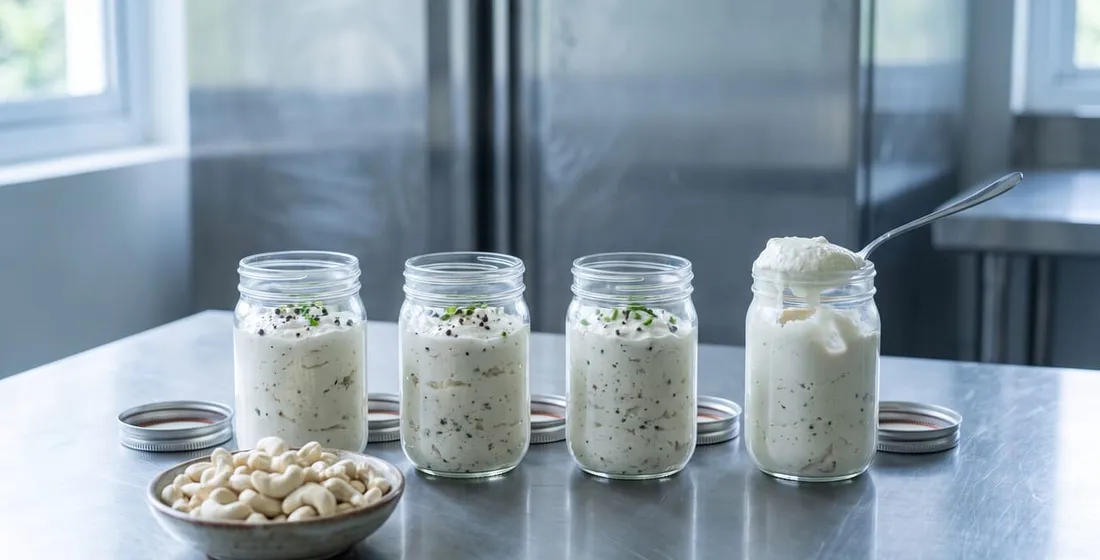
Four plain glass jars of creamy cashew cheese flecked with black pepper and chives on a stainless steel table, with a bowl of raw cashew kernels, loose metal lids and a spoon lifting cheese from one jar.
Buyer’s snapshot
- A cultured cashew cheese at pH 4.4 or below falls in the EU’s “unable to support growth” class for Listeria monocytogenes (Regulation (EC) No 2073/2005), and it still has to stay under 100 cfu/g for its whole shelf life.
- On a private-label SKU, the recipe is already done. The critical path is the real-time chilled shelf-life study, not R&D.
- In this scenario, a 200 g glass jar reaches a released first run of 1,500 jars at Silk Foods Ceylon (SFC) in 12 weeks from brief.
- A 42-day chilled life has to clear 1,500 jars inside about two weeks of delivery. The channel table shows the outlet count that makes it work.
An emerging plant-based brand (Persona B) already sells oat drinks and a vegan pesto through its own online store and a few cafes. It wants a vegan cashew cheese under its own name, on the chilled shelf of the supermarket multiples, within one quarter. It has no recipe and does not want to fund one. What follows is how that brief would run as a Private Labelling project at the Matale facility: an SFC formulation, the buyer’s brand, and the four decisions that set the launch date. Those are the jar format, the cost of the half-day block, the chilled shelf life and the label window.
A note on method. This is a scenario, not a client file. The volumes, weeks and LKR figures are planning assumptions that reflect how chilled private-label briefs are scoped. The regulations and standards cited are real.
Why private label rather than contract manufacturing for a first cheese SKU?
Because the slowest part of a cashew cheese project is usually the recipe, and private labelling removes it. Under contract manufacturing, the brand brings its own formulation and pays for two to four sample rounds to move it onto a commercial starter culture and a controlled fermentation. That route, and the five-day batch cycle behind it, is covered in vegan cashew cheese contract manufacturing in Sri Lanka.
Under private labelling, the brand starts from an SFC formulation that already runs on the non-dairy cheese line. The line has a cheese vat, a cheese press and a colloid mill. In this scenario, the brand’s only formulation input is one flavour tweak: cracked black pepper and chive on the base. That takes one bench round instead of four. The trade is ownership. The brand owns the name, the artwork and the customer. The formulation stays with the manufacturer. For a first SKU that is testing whether a chilled shelf will sell at all, most brands accept that trade.
What does a half-day filling block cost per jar?
A half-day block is limited by jar count, not by kilograms. At SFC, the first-run minimum for a spread in glass is 1,500 jars, filled in a half-day block. Changeover, pre-run sanitation, sampling and release testing cost the same whether each jar holds 150 g or 300 g. So the jar size decides how that fixed cost falls on each gram of cheese.
The table uses an illustrative fixed block cost of LKR 450,000 (about USD 1,500). That figure is a planning assumption, not a quote. It covers changeover, sanitation, QC sampling and release testing.
| Jar size | Cheese per 1,500-jar block | Fixed cost per jar | Fixed cost per 100 g |
|---|---|---|---|
| 150 g | 225 kg | LKR 300 | LKR 200 |
| 200 g | 300 kg | LKR 300 | LKR 150 |
| 300 g | 450 kg | LKR 300 | LKR 100 |
The fixed cost per jar is the same in all three rows. What changes is how much cheese carries it. A 150 g jar looks cheaper on the shelf, but it doubles the overhead per gram compared with 300 g. The 300 g jar has the best per-gram cost, but it asks a household to finish a chilled, opened product before its opened life runs out. The scenario settles on 200 g. That is a shelf price a first-time buyer will try, and a jar a household can finish within seven days of opening.
Kernel is the other big input. Cashew supply in Sri Lanka depends partly on imports and partly on the weather, so the specification sets a kernel grade and a re-quote trigger instead of a fixed twelve-month price. The pricing window is real, though. The Central Bank of Sri Lanka reported on 31 August 2026 that food inflation reached 8.5% in August 2026, up from 6.3% in July. It named milk powder prices as the main driver of the monthly rise. A dairy alternative launched now is priced against a dairy category that is getting more expensive.
Which glass jar format suits a chilled cashew cheese?
A wide-mouth jar with a tamper band, filled cold, with the date coded rather than printed. Each part of that answers a specific problem.
| Format decision | Scenario choice | Why |
|---|---|---|
| Jar | 200 g wide-mouth glass, short profile | A spoon or knife reaches the bottom; it stands stable on a chilled multideck shelf |
| Closure | Lug cap with a heat-shrink tamper band | A cold-filled product pulls no vacuum, so a vacuum button cannot show tampering |
| Fill | Cold fill at chilled temperature, fixed headspace | Protects the culture and the texture; a controlled headspace limits condensation |
| Date marking | Use-by coded in a blank area at filling | The printed label does not depend on the shelf-life result |
| Case | 12 jars per case | Fits a shelf holding of 12 jars per outlet without an opened case left in back-of-store |
The closure is the choice brand owners most often get wrong. Hot-filled jam and sauce jars pull a vacuum as they cool, so the button on the lid shows whether the jar has been opened. A chilled cultured cheese is filled cold and never pulls that vacuum, so the button tells the shopper nothing. A shrink band gives visible tamper evidence that the retailer’s quality team can check at goods-in. The wider glass-jar build, including tooling lead time, is set out in private labelling a vegan condiment in glass jars.
How long can a chilled cashew cheese stay on the shelf?
As long as a real-time study at chilled temperature shows, and no longer. In this scenario the declared life is 42 days from filling, stored at or below 5°C. That target comes from the Chilled Food Association specification: chilled foods stored “at or below 8ºC, targeting 5ºC” for their whole life.
The microbiology reference is European Union Regulation (EC) No 2073/2005 on microbiological criteria. For ready-to-eat foods, it treats a product with a pH of 4.4 or below as unable to support the growth of Listeria monocytogenes (criterion 1.3). The limit is 100 cfu/g throughout the shelf life. A cultured cashew cheese that reaches pH 4.4 during fermentation and stays there is in that class. The study has to confirm that it stays there. If the pH drifts back up during storage, the product moves into criterion 1.2, where the rules are stricter.
This is also why an accelerated study does not settle a chilled claim. Accelerated testing at high temperature suits ambient products, where quality changes follow temperature in a predictable way. For a chilled cultured product, safety at 5°C is not predicted by what happens at 35°C. So the study runs in real time, with the same schedule at two temperatures:
- Pilot jars are filled in the chosen 200 g jar and closure, from a pilot batch on the production line.
- One set is held at 5°C, the storage target. A second set is held at 8°C, an abuse condition that represents a warm cabinet or a slow delivery.
- Jars are opened on days 0, 14, 28, 42 and 49 for pH, yeasts and moulds, Listeria monocytogenes and a sensory check. Day 49 gives a week of margin beyond the claim.
- The claim is set at the last checkpoint that passes at both temperatures. If day 42 fails at 8°C, the claim shortens.
In most chilled briefs, the R&D team at the Matale facility sees yeasts and moulds, not pathogens, end the life of a cultured nut product first. A jar can be safe on day 42 and still show surface growth under the lid at 8°C. The headspace and the cold fill in the format table are what hold that back. For ambient products, the method in accelerated stability testing for shelf life still applies. A frozen plant-based SKU is a different problem again, worked through in R&D for a frozen plant-based seitan SKU.
Can 1,500 jars clear inside a 42-day life?
Only with enough outlets. Modern-trade chilled listings typically ask for about 60% of product life remaining at delivery. On a 42-day life, that means at least 25 days left when the jars arrive, so delivery has to happen by day 17 after filling. Release testing takes the first few of those days. In practice, the whole run has to reach its channels in about two weeks.
| Channel (scenario assumptions) | Jars absorbed in the two-week delivery window |
|---|---|
| Chilled modern trade, 45 outlets: initial fill of 12 jars each | 540 |
| Replenishment at 5 jars per outlet per week, two weeks | 450 |
| Brand’s own online store, 100 jars per week | 200 |
| Cafes and food-service accounts, 150 jars per week | 300 |
| Total | 1,490 |
At 30 outlets, the same assumptions absorb about 1,160 jars, which leaves roughly 340 jars aging in a distributor’s cold room. The fix is more outlets, not a smaller batch, which is the same conclusion reached for frozen SKUs in chilled and frozen SKUs on a Sri Lankan modern-trade shelf. The formed-frozen comparison is different again, because the life runs to months rather than weeks, and the minimum sits at 5,000 to 10,000 units, as covered in contract manufacturing for plant-based patties.
Spec snapshot: scenario private-label cashew cheese
- Product: cultured cashew cheese, black pepper and chive, SFC base formulation under the buyer’s brand
- Pack: 200 g wide-mouth glass jar, lug cap, heat-shrink tamper band, 12 jars per case
- Storage: at or below 5°C; declared life 42 days from filling; use within 7 days of opening
- Safety target: pH 4.4 or below held through shelf life; Listeria monocytogenes under 100 cfu/g
- First run: 1,500 jars (300 kg), half-day filling block behind a five-day batch cycle
- Channels: 45 chilled outlets, the brand’s online store and food-service accounts
What does the label have to clear before a chilled listing?
Four things: the Sri Lankan labelling regulations, the allergen rule, the product name and a barcode. They need to be done by week 9, because the listing form asks for the declared life and case configuration in the same submission.
- The Food (Labelling and Advertising) Regulations 2026, Gazette Extraordinary No. 2494/47, apply to food manufactured from 1 July 2026. The common name goes in bold in Sinhala, Tamil and English. Storage instructions must appear in at least two of the three languages. The expiry date must be at least 1.5 mm high and preceded by wording such as “Use by”. For a chilled SKU, the storage line (“Keep refrigerated at or below 5°C. Once opened, use within 7 days.”) is what the retailer and the consumer will hold the product to.
- Cashew is a tree nut. The Codex General Standard for the Labelling of Prepackaged Foods (CXS 1-1985, section 4.2.1.4) lists tree nuts and nut products among the ingredients that must always be declared. Fermentation does not remove that requirement.
- A plant qualifier has to be prominent in the product name, because dairy terms are protected under Codex CXS 206-1999. That point is covered in the SFC cashew cheese post linked above.
- The barcode comes from GS1 Lanka, and allocation is a company-level task with its own turnaround.
Glass jars take a self-adhesive label, which is quicker to print than a laminate pouch. The proof discipline is the same, though. SFC reads the artwork against the 2026 regulations before round one, then allows two contract proof rounds of three to five working days each. The full schedule logic is in artwork and print lead time as the private-label gate. Because the use-by date is coded at filling, the label can go to print before the shelf-life study finishes. That overlap saves about four weeks.
The 12 weeks, stage by stage
| Weeks | Stage | Output |
|---|---|---|
| 0 | Brief; tasting of the SFC base; chilled route confirmed | Signed brief |
| 1 to 2 | One flavour round; jar, closure and case chosen | Locked specification |
| 2 to 3 | Pilot batch filled in the final jar and closure | Shelf-life study jars |
| 3 to 10 | Real-time study at 5°C and 8°C to day 49, plus lab turnaround | Declared life |
| 2 to 9 | Compliance read, two proof rounds, GS1 number, label print | Labels on site |
| 9 | Listing form submitted with case configuration and declared life | Listing slot |
| 11 | Five-day batch cycle, half-day filling block | 1,500 jars |
| 12 | Release testing, chilled dispatch with temperature record | Stock in channels |
The shelf-life study runs from week 3 to week 10, which makes it the longest single item in the plan. A contract manufacturing version of this SKU would add the recipe rounds on top. That is why private labelling is the shorter route to a first chilled listing.
Where SFC walks away
Silk Foods Ceylon does not code a longer use-by date than the real-time study supports. It also does not dispatch a chilled run to a channel partner who will not sign a temperature record at the handover.
Frequently asked questions
Can a vegan cashew cheese be sold chilled in Sri Lanka without a preservative?
Yes, if fermentation brings it to pH 4.4 or below and it stays there. EU Regulation (EC) No 2073/2005 treats ready-to-eat foods at that pH as unable to support Listeria monocytogenes growth, with a 100 cfu/g limit through shelf life. The Chilled Food Association specifies storage at or below 8°C, targeting 5°C.
How long is the shelf life of a chilled cashew cheese?
Only as long as a real-time study shows. In this Silk Foods Ceylon scenario, jars are held at 5°C and at an 8°C abuse condition and tested on days 0, 14, 28, 42 and 49 for pH, yeasts and moulds, Listeria and sensory quality. The claim is 42 days. Accelerated testing does not settle a chilled claim.
What is the MOQ for a private-label vegan cheese in a glass jar?
At Silk Foods Ceylon, the first-run minimum for a spread in glass is 1,500 jars, filled in a half-day block behind a five-day batch cycle. In a 200 g jar that is 300 kg of cheese. On a 42-day chilled life, clearing 1,500 jars in about two weeks needed roughly 45 outlets plus online and food-service accounts.
Does Silk Foods Ceylon offer private-label vegan cashew cheese?
Yes. SFC runs a cultured cashew cheese base on the non-dairy cheese line at its Matale facility, which has a cheese vat, a cheese press and a colloid mill. The buyer’s brand, artwork and flavour variant go on top. The facility is BRCGS- and FSSC 22000 V6-audited, with Sri Lanka Food Act labelling compliance on every retail SKU.
How Silk Foods Ceylon can help
For an emerging plant-based brand that wants a chilled dairy-alternative SKU without funding a formulation, Silk Foods Ceylon offers Private Labelling from its cellular-manufacturing facility at Silk AgTech Park in Hapugasyaya, Matale. The in-house team adapts the SFC cultured cashew base to one flavour variant, fixes the jar, closure and case specification, and runs the real-time chilled shelf-life study. It reads the artwork against the 2026 labelling regulations and fills a first run of 1,500 jars in a half-day block. The typical timeline is about 12 weeks from brief to released stock. Semi-liquid capacity runs to 3,000 jars a day once the SKU has a sales record. The facility is BRCGS- and FSSC 22000 V6-audited, with USDA Organic and EU Organic on relevant SKUs, and Sri Lanka Food Act compliance on every retail SKU.
To brief a private-label project, email b2b@esilkroute.com.lk or call +94 76 441 0389 / +94 76 918 5744.
Sources
- European Union, Commission Regulation (EC) No 2073/2005 on microbiological criteria for foodstuffs (consolidated text), Annex I criteria 1.2 and 1.3 for Listeria monocytogenes in ready-to-eat foods, including the pH 4.4 condition. eur-lex.europa.eu (retrieved 28 September 2026).
- Chilled Food Association, Temperature, on storing chilled foods at or below 8°C, targeting 5°C, throughout their life. chilledfood.org (retrieved 28 September 2026).
- Central Bank of Sri Lanka, “CCPI-based headline inflation accelerated in August 2026”, 31 August 2026, on food inflation of 8.5% and milk powder prices. cbsl.gov.lk (retrieved 28 September 2026).
- Government of Sri Lanka, Food (Labelling and Advertising) Regulations 2026, Gazette Extraordinary No. 2494/47, in operation from 1 July 2026. eohfs.health.gov.lk (retrieved 28 September 2026).
- Codex Alimentarius, General Standard for the Labelling of Prepackaged Foods, CXS 1-1985, section 4.2.1.4 on ingredients that must always be declared, including tree nuts. fao.org (retrieved 28 September 2026).
- Codex Alimentarius, General Standard for the Use of Dairy Terms, CXS 206-1999. fao.org (retrieved 28 September 2026).
Written by the Silk Foods Ceylon Team. Silk Foods Ceylon (Pvt) Ltd. is a BRCGS- and FSSC 22000 V6-audited contract manufacturer in Matale, Sri Lanka, offering contract manufacturing, private labelling, co-packing, and in-house R&D for local Sri Lankan brand owners, FMCG companies, hotel and restaurant groups, and distributors. To brief a project: b2b@esilkroute.com.lk, +94 76 441 0389, or +94 76 918 5744.